
Not sure whether to register as a Trust, Society, or Section 8 Company?
Get expert guidance on the right NGO structure, required documents, registration process, and compliance.
Who Can Start an NGO in India?
- Age: Founders, trustees, and directors must be at least 18 years old (the legal age of majority).
- Citizenship: Indian citizens can establish any of the three structures. Foreign nationals can join as members, but FCRA regulations prohibit foreign nationals from holding chief executive roles, and Section 8 Companies generally require at least one resident Indian director.
- Clean Record: Founders must not have been convicted of any offense involving moral turpitude.
Minimum Group Size:
- Trust: Minimum 2 trustees.
- Society: Minimum 7 members.
- Section 8 Company: Minimum 2 directors.
How to Start an NGO – Step-by-Step Guide
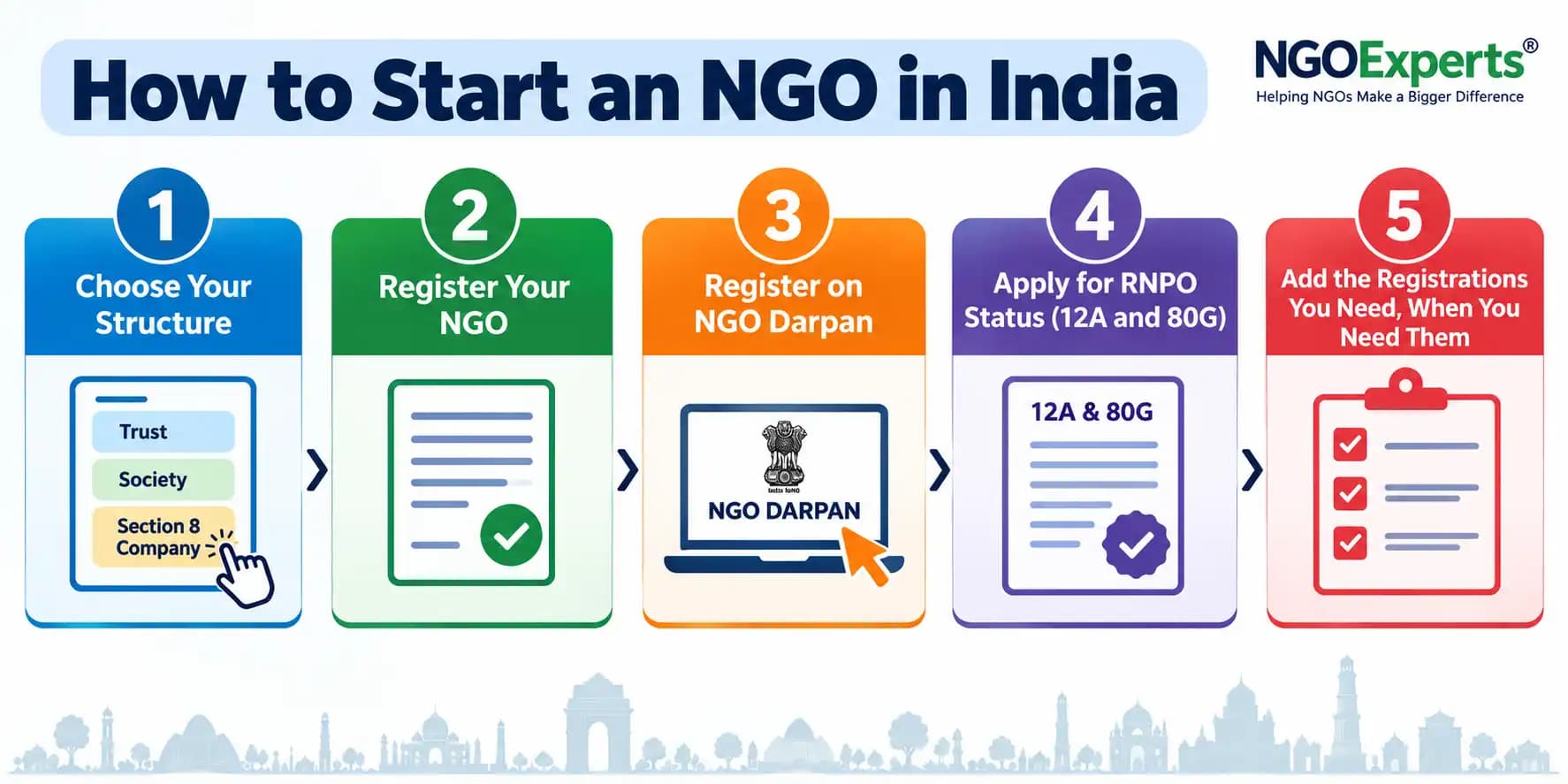
Step 1: Choose Your Structure
| Feature | Trust | Society | Section 8 Company |
| Governing law | Indian Trusts Act, 1882 / state Trust Acts | Societies Registration Act, 1860 | Companies Act, 2013 |
| Minimum members | 2 trustees | 7 members | 2 directors |
| Typical cost | ₹5,000–₹15,000 | ₹8,000–₹20,000 | ₹14,000–₹30,000 |
| Typical timeline | 1–2 weeks | 3–6 weeks | 3–5 weeks |
Step 2: Register Your NGO
File with Authorities
- Trust: File at the local Sub-Registrar's office.
- Society: File with the State Registrar of Societies.
- Section 8 Company: Submit via the Ministry of Corporate Affairs (MCA) SPICe+ web portal.
Step 3: Register on NGO Darpan
Step 4: Apply for RNPO Status (12A and 80G)
Step 5: Add the Registrations You Need, When You Need Them
| Registration | Needed for | When to apply |
| FCRA | Receiving foreign donations | Only after 3 years of active existence |
| CSR-1 | Receiving corporate CSR funds | Once RNPO (12A/80G) status is in place |
| GST registration | Selling goods/services above the threshold | If your NGO has taxable commercial activity |
| State-specific licences | Sector-specific work (schools, hospitals, shelters) | Before starting that specific activity |
Planning to Start an NGO in India?
Tell us your NGO's purpose, location, and proposed activities. Our experts can help you understand the registration route and next steps.
What Are Common Mistakes That Delay Founders
- Vague Object Clauses: Drafting overly broad mission statements that cause rejection during tax exemption or grant reviews.
- Skipping NGO Darpan: Realizing too late that missing a Darpan ID blocks access to government schemes and FCRA approvals.
- Premature FCRA Applications: Applying for FCRA before meeting the statutory 3-year track record requirement.
- Neglecting Post-Registration Approvals: Treating entity incorporation as the end goal rather than securing RNPO status, maintaining books, and filing yearly returns.
- Selecting Solely by Upfront Cost: Choosing a structure purely based on initial setup price while ignoring future CSR or funding goals.
What Compliance Looks Like After You Register
- ITR-7 — annual income tax return, due 31 October.
- Form 112 — the consolidated audit report under Section 348 of the Income-tax Act, 2025, due one month before ITR-7.
- AOC-4 and MGT-7A — for Section 8 Companies, filed with the MCA after every AGM.
- FC-4 — for FCRA-registered NGOs, due 31 December, NIL filing mandatory even with no foreign receipts.
Frequently Asked Questions
Can one person start an NGO in India?
How much money do I need to start an NGO?
Do I need 12A and 80G to start an NGO?
How long does it take to start an NGO from scratch?
Which structure is best for receiving CSR funds?
Can students or minors start an NGO?
Author
I am a Content Specialist holding a Master’s degree and with over 5 years of experience in the creative arena. I specialize in breaking down complex concepts into clear, understandable insights that help my viewers deeply engage and retain. Known for my approachable and engaging style, I am committed to providing accurate, trustworthy information that empowers individuals and organizations to make informed decisions and achieve their goals.
Written by Srijita Chatterjee. Last updated on September 17, 2026