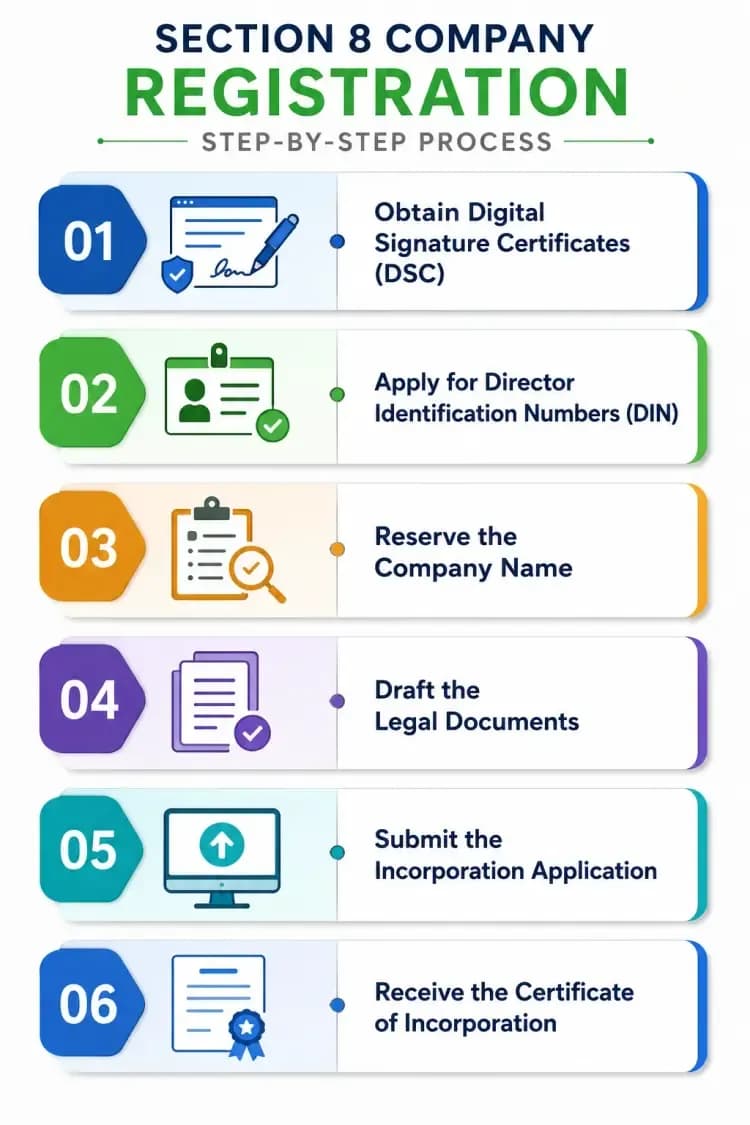
Section 8 Company Registration

Section 8 Company Registration promotes social welfare, sports, education, and aiding lower-income groups. Eligible for individuals, HUFs, & limited firms. Get benefits by fulfilling criteria.

  • At least one Indian resident director.
  • Eligible entities: Individuals, HUFs, & limited companies.
  • Social welfare objective: sports promotion, education support, or aiding lower income groups.

Contact Form

Your Section 8 Company Registration with NGOExperts

Cta Image

NGOExperts Premium – Our Services

For NGOs, trusts, societies, and businesses, we provide complete support in registrations, compliance, and funding. From NGO/Trust/Society setup to 12A, 80G, FCRA, NITI Aayog, and CSR project reports, our experts handle everything seamlessly to keep you compliant and fund-ready.

Features:

  • End-to-end documentation and application support.
  • Quick turnaround time for all filings.
  • Expert guidance on compliance and funding readiness.
  • Dedicated specialists for NGO and CSR processes.

Note:

  • First-year compliance support included.
Talk To NGOExperts

Quick Summary

Section 8 Company registration is the legal process of forming a non-profit organisation under the Companies Act, 2013, to promote education, social welfare, environment, arts, and other charitable causes. These companies operate without profit motives and offer tax benefits under Sections 12A & 80G, are exempt from stamp duty, have limited liability, and enjoy strong donor credibility. The process includes obtaining DSC and DIN, reserving a name, drafting the memorandum, and filing the SPICe+ form with the Ministry of Corporate Affairs. Approval typically takes 12–18 working days, and the registration remains permanently valid unless it is changed or revoked. NGOExperts handles the entire filing process—from documentation to incorporation—ensuring smooth and compliant registration.

Introduction

Section 8 Company allows NGOs and social enterprises to operate with limited liability, tax exemptions, and donor credibility. It is the most reliable structure for organizations engaged in education, healthcare, skill development, environmental protection, charity, and community welfare.

This structure is preferred because it provides CSR funding eligibility, tax benefits, and government approvals, helping NGOs build trust and scale their social impact effectively. Compared to trusts or societies, a Section 8 Company ensures stronger compliance and stability.

At NGOExperts, our experienced team has registered NGOs across India. We manage the entire process—from DSC & DIN to MOA/AOA drafting and ROC filing—to deliver a smooth and hassle-free registration, so you can focus on your mission while we handle the legal work.


Benefits of Section 8 Company

Choosing Section 8 Company Registration in India gives NGOs and social enterprises several benefits that enhance credibility, reduce costs, and unlock tax as well as funding opportunities:

  • Enjoys higher credibility than other charitable organizations, enhancing donor trust.
  • Zero stamp duty imposed on incorporation in India & further saves on registration costs. 
  • Allows partnership registrations to become members & obtain Directorship.
  • Effortless tax benefits under the Income Tax Act's Section 12AA & 80G, for greater financial efficiency.
  • Acquires a separate legal entity from its members & safeguards against legal liabilities.
  • Donors receive exemption under Section 80G if registered under the same section.
  • No obligation for minimum paid-up capital, which provides flexibility in operations.


Need Any Help?

Our experts team guide you to build your
dream through the registration process


Talk To Our Experts


Eligibility of Section 8 Company Registration

  • The Eligibility of Section 8 company registration in India is defined under the Companies Act, 2013, and ensures that only genuine non-profits and social enterprises qualify for this structure. Below are the key requirements:
  • One director should be a resident of India, or a firm may be a member of the registered company.
  • Individuals, HUFs, & limited companies are eligible to register.
  • The objective must be for social welfare, sports promotion, education support, or aiding lower-income groups.
  • A three-year project plan & vision must be defined for the company.
  • Two or more persons as shareholders or directors must comply with Section 8 Company requirements.
  • Profits can only be used towards the core objective of the company. Surplus can't be distributed to stakeholders.
  • Neither members nor directors can receive profits, either directly or indirectly. These earnings must serve the company’s purpose.
  • Founders, directors, & members are not permitted to receive remuneration, assuring that all profits go towards social causes.
  • The members or shareholders must not have any personal financial interest in the company.
  • A Section 8 company under NGO registration must prefix its name with "Foundation", "Association", "Society", "Council", "Club", "Charity", "Institute", "Organisation", or "Federation".Online Section 8 Company Registration Process

The Indian Companies Act, 2013, provides for online registration of Section 8 companies, which has made it easier & quicker for entrepreneurs to establish non-profit organizations for good causes. The step-by-step instructions for Section 8 Company Registration Online Process:

Step 1: Digital Signature Certificate (DSC) & Director Identification Number (DIN)

To initiate the registration process, the first thing required is to obtain a Digital Signature Certificate (DSC) & Director Identification Number (DIN) for all proposed directors of the Section 8 company.

Step 2: Name Reservation

The proposed name for the online registration of Section 8 company should be unique & not similar to any existing company. The applicant must apply to reserve the proposed name via the RUN (Reserve Unique Name) form. On approval of the name, the applicant gets a name reservation certificate, which is valid for 20 days from the date of approval.

Step 3: Requisite Documents

The following documents need to be prepared & filed with the Registrar of Companies (ROC) for Section 8 company registration online:

  • Memorandum of Association (MOA) & Articles of Association (AOA) of the company
  • Declaration of the applicant in Form INC - 14
  • Declaration of the proposed directors in Form INC - 9 & other forms
  • Residential proof of the proposed directors
  • Address proof of the registered office of the company
  • Other relevant documents (discussed below)

Step 4: Submit Application & Pay Fees

After obtaining the name reservation certificate & preparing the necessary documents, the application for company registration under Section 8 must be submitted online on the MCA (Ministry of Corporate Affairs) portal. Select the Spice+ form option under the Service section & complete the requirements. The requisite Section 8 company registration fees must be paid online.

Follow the official documentation link & get all the insights instantly. For any queries, NGOExperts is always here to help.

Step 5: Verification & Approval

As the documents are processed & approved, the ROC will issue a certificate of registration. Congratulations! You are now a registered Section 8 company in India.

The registration process for a Section 8 company can be quite challenging, especially if you are new to the legalities involved. This is why seeking professional assistance from NGOExperts is wise.

They are qualified in the field & can guide you through the registration process with ease, ensuring that all the documentation & legal requirements are taken care of. So, don't hesitate to seek guidance from them for a smooth & seamless registration process.

Compliance Requirements for a Section 8 Company

For Directors & Shareholders

A Section 8 Company can be incorporated as either a Private Limited Company or a Public Company. The basic eligibility in terms of directors and shareholders is shown below:

Type of Company

Minimum Requirement

Maximum Limit

Private Limited Company

2 Directors, 2 Shareholders

200 Shareholders

Public Company

3 Directors, 7 Shareholders

No upper cap

One person can hold both roles (director + shareholder), or different individuals can take up these positions.

For the Company

After incorporation, a Section 8 Company has to follow certain legal compliances every year to maintain its status:

  • Conduct an Annual General Meeting (AGM) and file details in Form MGT-15.
  • Appoint the first auditor within 30 days of incorporation.
  • File the company’s financial statements using Form AOC-4.
  • Submit annual returns through Form MGT-7 with the Registrar of Companies (ROC).
  • File Income Tax Returns under Form ITR-7.
  • Issue share certificates to all shareholders within 60 days of incorporation.
  • Update Director KYC details via Form DIR-3 KYC.
  • Directors must declare their financial interest using Form MBP-1.
  • Maintain a statutory register that includes details of members, loans, charges, and directors.

These are the key compliance steps, but depending on the nature of your NGO or business activities, there may be extra requirements to meet.

Documents Required for Section 8 Company Registration

Before you begin the section 8 company registration process, it is important to ensure that all the documents are ready & available. List of some essential documents include:

  • PAN Card of Directors & Shareholders: Every director & shareholder must have a PAN card for registration.
  • Aadhaar Card: Directors & shareholders must submit their Aadhaar card as proof of identification.
  • Latest Bank Statement: A recent bank statement is required as proof of address for all directors & shareholders.
  • Voter ID/Passport/Driving License: One of these documents is mandatory for the identification of directors & shareholders.
  • Passport Size Photograph: Each director & shareholder must submit a passport size photograph.
  • Rental Agreement: In case the registered office is on rent, a copy of the rental agreement must be provided.
  • DSC & DIN of Directors: All directors must obtain a Digital Signature Certificate (DSC) & Director Identification Number (DIN).
  • Objectives & Proposed Work: The Section 8 Company must provide a detailed plan of proposed activities & objectives of the business.
  • Financial Statements: The company must submit financial statements like assets & liabilities, & a five-year projection. This is to ensure adequate funding for the company's operations.

Checklist for Section 8 Company Registration

Registering a Section 8 Company involves a few mandatory steps that need to be completed before and after incorporation. To make the process easier, here’s a clear pre-registration and post-registration checklist you can follow:

Pre-Registration Checklist

  • Director Identification Number (DIN): Every proposed director must have a DIN. Apply for one if not already obtained.
  • Digital Signature Certificate (DSC): All directors and subscribers need a valid DSC for filing applications online.
  • Company Name Reservation: Select a unique name that reflects the company’s objectives, preferably ending with words like Foundation, Association, Council, or Society. File the RUN (Reserve Unique Name) form with the MCA for approval.
  • Registered Office Proof: Provide valid documents for the company’s registered office, such as a rent agreement/ownership proof along with a recent utility bill (not older than 2 months).
  • Statement of Objectives: Prepare a clear statement of the company’s charitable purpose and confirm that profits will be reinvested to further its objectives.

Post-Registration Checklist

  • Certificate of Incorporation with PAN & TAN: Secure the Certificate of Incorporation from RoC, along with the company’s PAN and TAN.
  • Bank Account Setup: Open a dedicated current account in the company’s name to handle all transactions.
  • 12A & 80G Registration: Apply for tax exemption registrations to enjoy benefits and attract CSR funding and donor support.
  • First Board Meeting & Records: Hold the first board meeting, issue share certificates, and maintain statutory records and registers.
  • GST Registration (If Required): If applicable, register the company under GST to ensure compliance with tax regulations.

Why Choose NGOExperts?

As a leading service provider in NGO registrations, NGOExperts brings a wealth of expertise & experience to the table. We offer Section 8 company registration services & a variety of other registration options to help organizations establish themselves & make a meaningful impact.

  • Expertise & Experience Our team of experienced professionals provides expert guidance on all aspects of running an NGO, from registration to compliance.
  • Tailored Solutions We are a people-focused organization & go the extra mile to understand your unique requirements & provide customized solutions.
  • Timely Delivery With our assistance, you can complete the registration process quickly & without any hassle, allowing you to focus on your NGO's cause.
  • End-to-end solutions: We offer end-to-end solutions, from legal registration to fundraising, so that you can focus on your mission without worrying about administrative hassles
  • Competitive Pricing: Our track record of success & high customer satisfaction make us a reliable partner for your NITI Aayog NGO registration needs.
  • Accountability Our mission is to empower non-profits to create a positive social impact, & we are driven by our passion for philanthropy.

With our all-inclusive section 8 company registration services, you can focus on your mission while we handle the paperwork. Trust us to help your organization thrive.

Need Any Help ? Feel Free To Connect


Our expert team guide you to build your dream throug the registration process

Talk To Our Experts
cta image

Popular FAQ's on
Section 8 Company Registration

Service Detail

The answer depends on whether you're incorporated as a private or public limited company. In the former case, you need at least two directors, while in the latter, you'll need a minimum of three. Directors are crucial to any company's success, as they are responsible for making important decisions, leading the company towards its goals, & ensuring that it complies with relevant laws & regulations.

  • A company registration under section 8 comes with numerous benefits, making it an optimal choice for charitable organizations.
  • Firstly, it earns higher credibility than other charities, which enhances donor trusts. This not only attracts more donors but also helps maintain long-standing relationships with existing ones.
  • Moreover, a Section 8 company enjoys zero stamp duty on incorporation in India & is further exempted from registration costs, allowing it to save valuable resources that can go towards its core mission.
  • Partnerships under this company can become members & obtain directorship, giving them a more active role in the organization.
  • Effortless tax benefits under Section 12AA & 80G of the Income Tax Act provide greater financial efficiency for the company. A Section 8 company acquires a separate legal entity from its members, thus safeguarding against legal liabilities.
  • Donors receive exemption under Section 80G if registered under the same section. Lastly, there is no obligation for minimum paid-up capital, providing flexibility in operations.


Section 8 companies are limited in their ability to raise funds by way of deposits. However, they are allowed to accept donations from the general public. These donations are typically used for the purpose of furthering the company's objectives, such as promoting social welfare or advancing education. It is important to note that Section 8 companies are subject to strict regulations & are required to maintain transparency & accountability in their financial practices. While they cannot accept deposits, these companies play an vital role in promoting social causes & making a positive impact on the world around us.

A foreign company cannot be registered under Section 8 of the Companies Act, 2013, as it does not fit within the definition of a foreign company as outlined in Section 2(42). It is essential that those looking to form a Section 8 company understand these limitations & eligibility requirements to avoid any potential legal issues down the line.

As far as taxation for Section 8 companies is concerned, they are treated like any other company. The profits generated by the company are taxed at a rate of 30%. However, if the section 8 company is registered under section 12AA of the Income Tax Act, then the profits are completely exempt from taxation. This means that if the company is following all the regulations & is registered under section 12AA along with being a Section 8 company, it can enjoy the perks of tax exemption.

For companies operating as Section 8 entities, the remuneration of directors can be a complex issue. When a company has only one managing director, whole-time director, or manager, their salary cannot exceed 5% of the net profits. However, if a company has multiple directors in these roles, the total remuneration cannot exceed 11% of the net profits. It's essential for companies to adhere to these guidelines, but it's equally important for directors to recognize their value & ensure they're being fairly compensated for their contributions.

There is no requirement for minimum paid-up capital in these cases. This is in contrast to other types of companies, where a minimum level of capital is necessary to get started. With a Section 8 company, the focus is on the social good the company can do, rather than just making a profit. Therefore, minimum capital requirements are not considered to be important for this type of entity.

Yes, as a separate legal entity, a Section 8 company has the right to acquire, own, & dispose of their properties in their own name. This means that the company can sell a property just like any other entity. It's always best to ensure that you're following all relevant laws & regulations when making these transactions.

While the Companies Act 2013 does prescribe a minimum of three members for public limited companies & two for private limited companies, there is no rule when it comes to Section 8 companies. In fact, there is no minimum or maximum number of members specified for these types of organizations. This can actually be a great advantage for those looking to establish a Section 8 company, as it provides ample flexibility in terms of membership & governance

Section 8 companies, in spite of their non-profit status, have the ability to make a profit. Rather than being focused solely on generating revenue, these organizations are formed to serve a public good, such as promoting the arts, science or charity. While some might believe that non-profit status restricts the potential for profit, Section 8 companies can & often do turn a profit while still fulfilling their intended purpose.

Subscribe Us For More Details
Email Address

I've had an outstanding experience with *NGO Experts* Their team is professional, responsive, and truly cares about delivering high-quality service. From start to finish, they exceeded my expectations with their attention to detail, clear communication, and commitment to customer satisfaction. I highly recommend *NGO Experts* to anyone looking for reliable and top-tier service. Definitely a company you can trust!!!

Vivek Anand Ji Shweta Chauhan

The team is incredibly quick, responsive, and truly supportive. They know exactly what they’re doing and guide you with clarity and confidence. Their professionalism, attention to detail, and ability to offer tailored solutions made the whole experience smooth and impactful. Highly recommended!

Vivek Anand Ji Akshit Goel

NGO Expert did an amazing job…well done ✔️ They finished our project on time with great transparency and fair pricing. Their knowledgeable team, especially SUDHA, was super cooperative and professional. Highly recommend them. Great work🫡

Vivek Anand Ji DURGESH KUMAR CHOUHAN

I had a great experience working with NGO Experts for registering my non-profit organization from outside India. From the beginning, they were approachable and professional. I explained my unique situation, and they guided me through the entire legal process with clarity and confidence.

Vivek Anand Ji Vishal Yadav

Extremely happy and satisfied by NGOexperts exceptional legal services for empowering NGOs in India. Highly recommend NGOexperts for seamless Section 8 certification and project report assistance.

Vivek Anand Ji Srijita Chatterjee

Professional and efficient team – made the entire NGO registration process seamless. Extremely knowledgeable and supportive throughout – highly recommended for NGO setup! Delivered more than expected – timely, reliable, and clear in communication

Vivek Anand Ji Parimala Narayanaswamy

Learnt through whatsapp; requested to support to get 12a. 80g, dharpan and CSR as well as Digital signature. Weldone NGO experts. Got all at reasonable cost that too not stepping out much from my city at far south in India. kUDOS to RITU and team.

Vivek Anand Ji Samrakshana Samaritan