12a and 80g Registration in Meghalaya: Complete Process(2026 Guide)
Read Article →


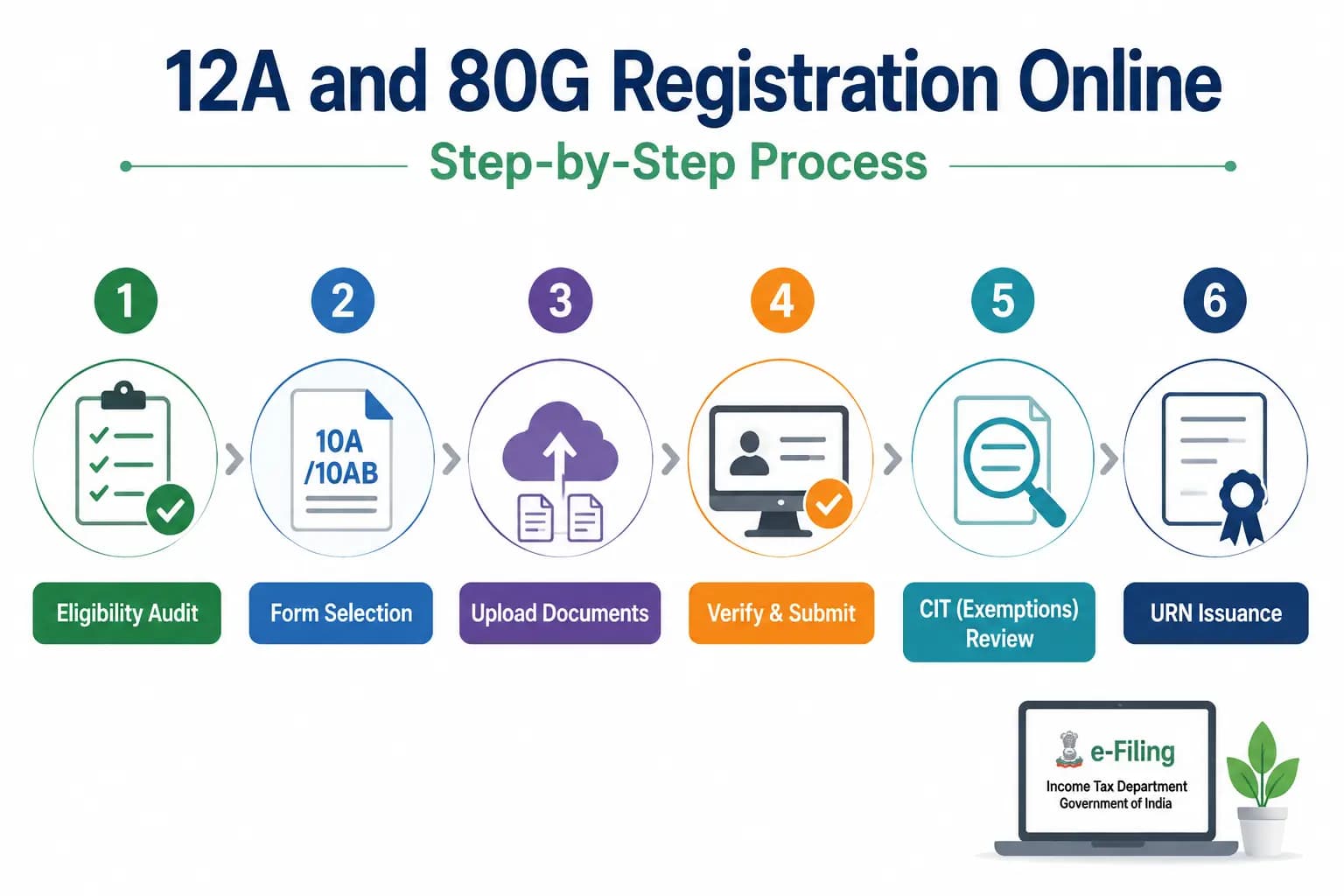
12A (now 12AB) exempts your NGO from income tax on income applied to charitable purposes. 80G lets your donors claim a deduction on what they give you. Both are filed online on the Income Tax portal using Form 10A for a new provisional registration or Form 10AB for final registration and renewal, and both can be filed together. Neither is permanent—provisional runs for 3 years, regular for 5.
By Aabha GargLast updated:
Claim Income Tax Exemption for Your NGO
Enable Donors to Get Tax Benefits
Increase NGO Credibility & Trust
Attract More CSR Funding & Donations
Claim Income Tax Exemption for Your NGO
Enable Donors to Get Tax Benefits
Increase NGO Credibility & Trust
Attract More CSR Funding & Donations

A Content Strategist at NGOExperts, who focuses on NGO registration, 12A and 80G registration, FCRA compliance, income tax filing for non-profits, and CSR funding guidelines in India. I research and write our compliance guides in collaboration with our in-house Chartered Accountants and Company Secretaries, so every article reflects current tax and regulatory requirements for the NGO and non-profit sector.
Written by Aabha Garg. Last updated on Oct 15, 2026, 11:35 AM
NGO Registration in Delhi provides unique strategic advantages, given its status as the national capital and a major corporate hub.
Get your NGO registered under Section 12A today to save funds, attract CSR grants, and focus on real impact.
Join the Social Stock Exchange and connect your NGO with ethical investors. Turn your mission into measurable impact and scale your social initiatives with transparency and trust.
Section 8 Company Registration in India refers to the legal formation of a non-profit company under Section 8 of the Companies Act, 2013, for charitable, social, educational, religious, environmental, research, or similar non-profit purposes.
Get the latest news delivered to your inbox
Live Update
Quick Answer
Get expert assistance with 12A and 80G registration to help your NGO claim income tax exemption and enable donors to receive tax benefits.
| Registration | Form | Validity | What happens next |
| Provisional 12AB | Form 10A | 3 years | Convert to regular registration by filing Form 10AB at least 6 months before it expires, or within 6 months of starting activities, whichever is earlier. |
| Regular 12AB | Form 10AB | 5 years | Renew by filing Form 10AB at least 6 months before expiry. The cycle repeats every 5 years. |
| Provisional 80G | Form 10A | 3 years | Same conversion route as 12AB, filed in parallel. |
| Regular 80G | Form 10AB | 5 years | Same 5-year renewal cycle as 12AB. |
| 12A / 12AB registration | 80G registration | |
| Main benefit | Income tax exemption on your NGO's income applied to charitable objects. | Tax deduction for your donors on what they contribute. |
| Who benefits | Your NGO. | Your donors. |
| Tax impact | An exemption on income applied to charitable purposes, subject to the 85% application rule. | Generally 50% of the donation, capped at 10% of the donor's adjusted gross total income. |
| Why you need it | Required for government grants, CSR funding, and FCRA. | Needed to attract retail donors, corporate CSR teams, and institutional funders. |
| Validity | Provisional for 3 years. Regular 5 years, then renewable. | Provisional for 3 years. Regular: 5 years, then renewable. |
| Forms | Form 10A (new/provisional) and Form 10AB (final/renewal). | Form 10A (new/provisional) and Form 10AB (final/renewal). |
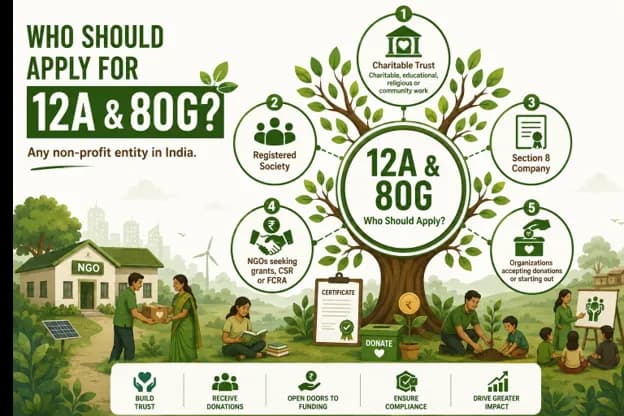
| Stage | Timing | What happens |
| Entity registration | Month 0 | Trust deed, society registration, or Section 8 incorporation completed. |
| Provisional filing | Month 1–3 | Form 10A filed for 12A and 80G in parallel. |
| Provisional approval | Month 2–5 | 30–90 days of processing. A unique registration number is issued for both. |
| Operating period | Years 1–3 | The NGO operates under provisional registration. CSR and grant eligible. |
| Regular registration | Before year 3 ends | Form 10AB filed at least 6 months before provisional expiry or within 6 months of commencing activities—whichever comes first. |
| Renewal cycle | Every 5 years | Form 10AB is filed again 6 months before each expiry. |
| Provisional registration | Regular registration | |
| Who gets it | NGOs that have not yet started charitable activities or are newly formed. | NGOs converting from provisional and NGOs already operating. |
| Validity | 3 years from the assessment year for which it is granted. | 5 years. Not permanent. |
| Form filed | Form 10A | Form 10AB |
| Next step | Convert before expiry, or 6 months after starting activities — whichever is earlier. | Renew via Form 10AB, 6 months before expiry. |
| CSR/grant eligible | Yes, accepted by most funders. | Yes. The stronger form of approval. |
Don't let incomplete paperwork delay your application. We help NGOs prepare and submit the correct documents for faster approval.
Complete your 12A & 80G registration with confidence. From documentation to application filing, we provide end-to-end support to help your NGO qualify for tax exemptions and attract more donors.
The first step is to ensure that your trust is registered & actively carrying out charitable activities. Once that requirement is met, you can submit an application to the Income Tax Department to seek approval to be eligible for 80G.It is important to note that not all trusts qualify for this status, & even those that do must comply with specific requirements to maintain it. Seeking the guidance of a tax expert like NGOExperts can help ensure your trust remains eligible for 80G & can continue to receive tax benefits.