
Want to start a non-profit in Nagaland? You have three options: a Trust, a Society, or a Section 8 Company. A Trust suits simple charitable causes, a Society fits community groups, and a Section 8 Company gives the strongest legal structure and easiest CSR access, whether you're in Kohima, Dimapur, or a smaller town. This guide covers all three, the latest 2026 updates, and one local rule most guides miss: how Article 371A affects your registered office.
What Is NGO Registration in Nagaland?
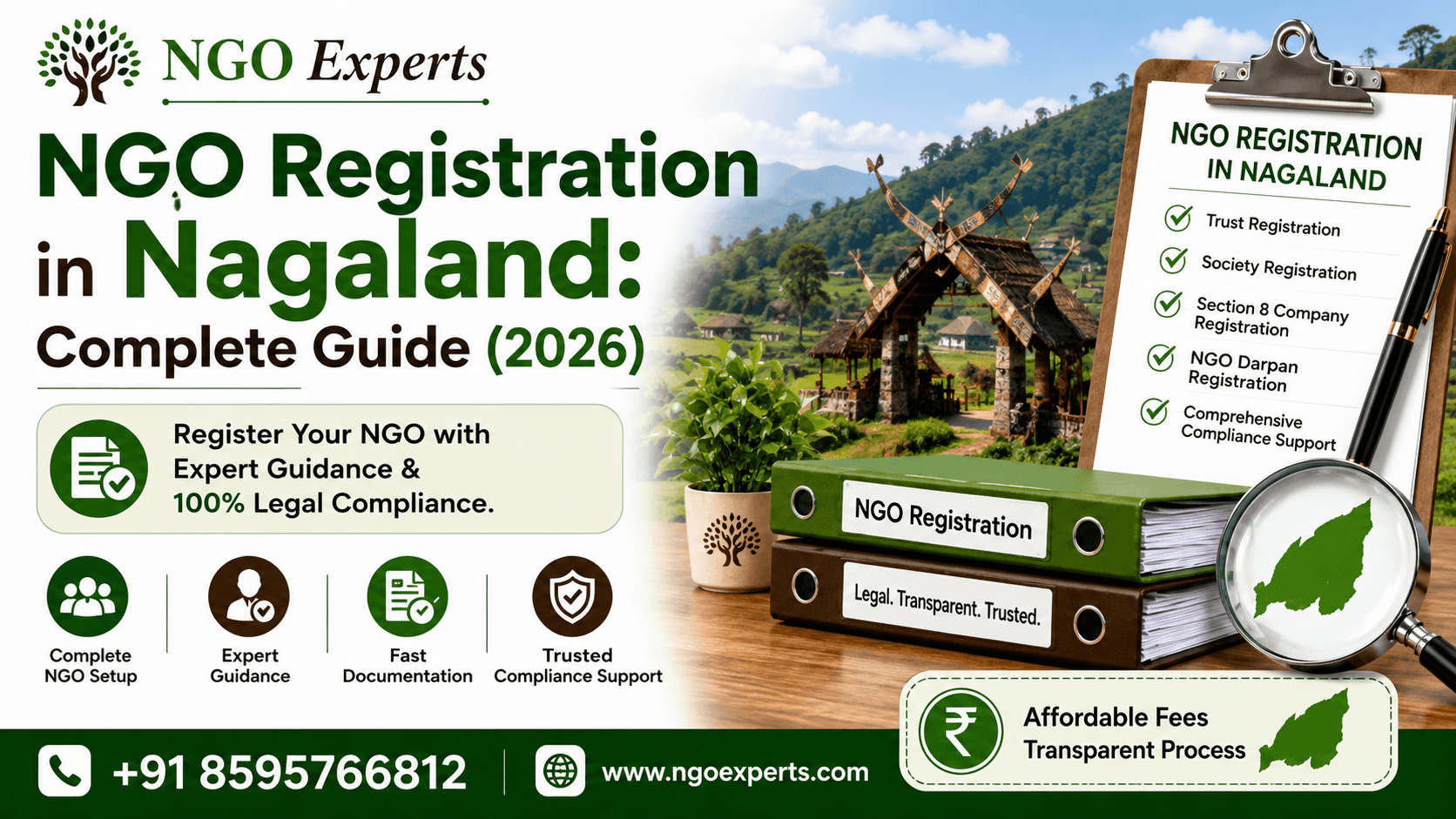
NGO Registration in Nagaland is the legal process of formally setting up a non-profit organisation under one of three structures: a Trust, a Society, or a Section 8 Company. Registering gives your organisation a recognised legal identity, lets it open a bank account, own property, sign contracts, and apply for tax exemptions under 12A and 80G, and makes it eligible for CSR funding, government grants, and NGO Darpan listing. Without formal registration, an informal group has no legal standing to receive donations, sign agreements, or claim tax benefits, which is why most social workers, community groups, and founders in Nagaland choose to register early.
Trust vs Society vs Section 8 Company: Which is the best structure for your NGO registration?
Here's a quick comparison table to help you decide the best structure for your NGO registration:
| Structure | Governing Law | Minimum Members | Best For |
| Trust | Indian Trusts Act, 1882 | 2 trustees | Small charitable or religious causes |
| Society | Societies Registration Act, 1860 | 7 members | Community or member-based groups |
| Section 8 Company | Companies Act, 2013 | 2 directors | Organisations planning to scale or seek CSR funding |
A Section 8 Company usually offers the most credibility and the smoothest path to 12A, 80G, and CSR-1, though it needs more ongoing paperwork than a Trust or Society. All three are available across Nagaland's districts, from Kohima and Dimapur to Mokokchung and Mon.
Latest Update on NGO Registration in Nagaland
Here's what's changed in 2026:
- MCA notified the draft Companies (Incorporation) Amendment Rules, 2026 on 8 April 2026, cutting 9 incorporation forms to 2 and, for the first time, allowing a Section 8 Company limited by guarantee to convert into one limited by shares.
- The Companies Compliance Facilitation Scheme, 2026 (Circular No. 01/2026) gives Section 8 Companies with pending ROC filings a window to catch up at a lower penalty.
- The Section 8 license now comes bundled with the Certificate of Incorporation via SPICe+ Part B, since the separate INC-12 filing was dropped in 2019.
- Nagaland's Society registration is slowly moving online via the state's eODB portal, though most filings still need an in-person visit to the Registrar of Societies.
- A registered society in Nagaland stays valid for 5 years and needs renewal after that.
Article 371A: What It Means for NGO Registered Offices in Nagaland?
One local rule shapes your registered office for all three structures, so you need to understand it.
Article 371A of the Constitution gives Nagaland control over land ownership and restricts non-tribal individuals from owning land across most of the state:
- Your registered office proof will usually be a rental or lease agreement with an NOC, not owned property, unless you're a non-tribal.
- Dimapur district has some non-tribal commercial zones, making it the most practical base for outside organisations. However, boundaries should be verified with the DC Dimapur office before signing a lease.
- Founders who are local Naga members generally face no such restriction.
- Founding members from outside Nagaland will also need an Inner Line Permit (ILP) to enter the state.
Trust Registration in Nagaland
Trust Registration is Best for a small team with a clear charitable purpose.
Eligibility: At least 2 trustees; a clear charitable purpose; a registered office (see land rules above).
Documents: Trust Deed on proper stamp paper; ID and address proof of settlor and trustees; photographs; registered office proof and NOC.
Process:
- Draft the Trust Deed with your purpose, trustees, and rules.
- Print it on non-judicial stamp paper of the right value.
- Register it at the local Sub-Registrar's office (Kohima, Dimapur, or your district HQ).
- Apply for PAN, then 12A/80G, once registered.
Cost: up to ₹10,000–₹15,000 for state- or national-level Trusts
Timeline: 7–10 working days.
Society Registration in Nagaland
Society registration is best for community-driven groups with several founding members, registered under the Societies Registration Act, 1860.
Eligibility: At least 7 members, aged 18+; a shared non-commercial purpose; no profit-sharing among members.
Documents: PAN cards of all members; MoA and Rules & Regulations; affidavit declarations and KYC of members; registered office proof and NOC.
Process:
- Pick a name not identical to any existing registered society.
- Draft the MoA and internal Rules & Regulations.
- Submit to the Registrar of Societies for your district, with signed documents and KYC.
- Receive your Certificate of Registration once approved.
Cost: Roughly ₹500 for basic filings, up to ₹18,000–₹25,000 for state- or national-level societies.
Timeline: 10–15 working days. Valid for 5 years, then needs renewal.
Section 8 Company Registration in Nagaland
A Section 8 company is best for organizations planning to grow, attract CSR partners, or seek larger funding. Registered under the Companies Act, 2013, it offers the strongest legal identity of the three.
Eligibility: At least 2 directors (3 for public), one Indian resident; a charitable/non-profit goal; no profit-sharing; no minimum paid-up capital (subscribed capital due within 60 days); a registered office in Nagaland; can't be registered as a One Person Company.
Documents: PAN, ID, and address proof of directors; photographs; registered office proof (lease + NOC); DSC for all subscribers; draft MoA/AoA; 3-year financial projections; DIR-2 consent letters.
Process:
- Reserve a unique name via SPICe+ Part A (RUN).
- Get DSCs for all subscribers, whether based in Kohima, Dimapur, or Mokokchung.
- Draft DIR-2 and supporting documents.
- File SPICe+ Part B with e-MoA, e-AoA, and AGILE-PRO.
- Pay Nagaland's applicable stamp duty on the MoA/AoA.
- Receive your Certificate of Incorporation, PAN, TAN, and CIN from the ROC.
- Apply for 12A/80G, NGO Darpan, and CSR-1.
Cost & Timeline
| Stage | Cost (₹) | Timeline |
| DSC (2 directors) | 800 – 1,200 | 1–2 days |
| Name Reservation | 1,000 | 2–3 days |
| MoA/AoA drafting + stamp duty | 1,500 – 2,500 | 3–4 days |
| SPICe+ Part B filing | 1,200 – 2,000 | 4–6 days |
| PAN & TAN | 200 – 300 | With incorporation |
| Professional fees | 3,300 – 8,000 | Throughout |
| Total | ₹8,000 – ₹15,000 | 15–20 working days |
Post-incorporation costs (12A/80G, NGO Darpan, CSR-1) are separate.
Funding & CSR Advantages of NGO Registration in Nagaland
Nagaland may have a smaller CSR ecosystem than major states, but registered NGOs can access CSR partnerships, government grants, and development funding when they meet the required eligibility and compliance conditions.
- Growing CSR interest: Recent CSR commitments in Nagaland show increasing corporate interest in healthcare, education, livelihoods, and rural development.
- CSR funding opportunities: Eligible NGOs can undertake CSR projects after completing applicable CSR-1 and other compliance requirements.
- Government grants: NGOs working in areas such as tribal welfare, education, healthcare, and rural development can explore relevant Central and state government schemes.
- Northeast-focused funding: National and international donors are increasingly exploring development projects across the Northeast, creating opportunities for Nagaland-based organisations.
- Stronger donor confidence: A legally registered NGO with proper governance and records can find it easier to meet donor due-diligence requirements.
- Funding-ready compliance: Maintaining 12AB, 80G, NGO Darpan, and CSR-1, where applicable, can improve your readiness when CSR or grant opportunities arise.
Registration is only the beginning. Keep your compliance, documentation, and impact records ready so your NGO can act when the right funding opportunity comes along.
Practical takeaway: register early, file CSR-1 promptly, and get your 12A, 80G, and NGO Darpan listing done, since corporates and grant-makers increasingly shortlist based on these credentials before committing funds.
Frequently Asked Questions
Which is better for NGO Registration in Nagaland: Trust, Society, or Section 8 Company?
It depends on your goals. Trust registration in Nagaland is quickest for a small charitable cause, Society registration in Nagaland suits community or member-based groups, and Section 8 Company registration in Nagaland offers the most credibility and the easiest access to CSR funding.
Can outsiders complete NGO Registration in Nagaland?
Yes, but your registered office will usually need to be leased, not owned, because of Article 371A's land-ownership restrictions, unless local Naga members found the NGO.
How long does Section 8 Company Registration in Nagaland take?
Section 8 Company registration typically takes 15–20 working days, depending on document readiness and ROC processing speed.
Is stamp duty payable on Section 8 Company Registration in Nagaland?
Yes. Nagaland charges state stamp duty on the MoA/AoA during Section 8 Company incorporation, similar to Tripura and Andhra Pradesh.
How long is Society Registration in Nagaland valid, and does it need renewal?
society registered under the Societies Registration Act, 1860 stays valid for 5 years in Nagaland, after which it must be renewed with the Registrar of Societies to keep its legal recognition.
Do I need 12A and 80G registration separately after NGO Registration in Nagaland?
Yes. Whether you complete Trust registration, Society registration, or Section 8 Company registration in Nagaland, 12A/12AB and 80G are separate Income Tax Act applications needed for tax exemption and donor tax deductions.
Which city in Nagaland is best for registering an NGO as an outsider?
Dimapur is generally the most practical choice, since it has some non-tribal commercial zones, though exact boundaries should be verified with the DC Dimapur office before signing a lease.
Author
Aabha Garg
A Content Strategist at NGOExperts, who focuses on NGO registration, 12A and 80G registration, FCRA compliance, income tax filing for non-profits, and CSR funding guidelines in India. I research and write our compliance guides in collaboration with our in-house Chartered Accountants and Company Secretaries, so every article reflects current tax and regulatory requirements for the NGO and non-profit sector.
Written by Aabha Garg. Last updated on October 6, 2026