Opening an NGO needs a lot of courage, and legal recognition and credibility always help get funds for organisations to make a lasting impact. Unlock opportunities for funding and compliance with a smooth and efficient process.
For NGOs, trusts, societies, and businesses, we provide complete support in registrations, compliance, and funding. From NGO/Trust/Society setup to 12A, 80G, FCRA, NITI Aayog, and CSR project reports, our experts handle everything seamlessly to keep you compliant and fund-ready.
NGO registration in India provides legal identity, tax exemptions, access to government and CSR funds, and global recognition. You can register as a Trust (for charitable work), Society (for member-led welfare), or a Section 8 Company (via MCA for nonprofit objectives). The process includes name finalization, documentation, and registration with relevant authorities—taking around 10–20 working days. Section 8 requires DSC, DIN, name approval, and filing SPICe+ forms. With expert support from NGOExperts, you get free consultation, complete drafting and filing, and guidance from registration to funding success.
In India, NGOs can be registered as a trust, society, or Section 8 company depending on their objectives. Societies are registered under the Societies Registration Act, 1860, with a minimum of seven members, and are usually set up to promote education, culture, art, or social welfare. Section 8 Companies, regulated by the Companies Act, 2013, work as not-for-profit companies and are preferred for their higher credibility, legal recognition, and ability to attract funding.
To gain legitimacy and access to government support, many NGOs register on the NGO-DARPAN portal of NITI Aayog, which allows them to apply for grants and even foreign contributions. Alongside this, NGOs often safeguard their brand through trademark registration and comply with tax requirements by obtaining GST registration when the turnover crosses the prescribed limit.
When considering NGO registration online, it can be difficult to know which type of organization is right for you. Depending on your goals, starting a Trust, a Society, or a Non-Profit Company (Section 8 Company) may be the best fit. Our team at NGOExperts can provide you with the knowledge & guidance you need to make an informed decision. Let us help you start your journey towards creating positive change for your community today.
Non-Governmental Organizations (NGOs) are vital players in India's social sector. However, before they can commence operations, NGOs must undergo a rigorous registration process with the government. There are three primary types of NGO registration in India, namely, Trust, Society & Section 8.
A trust is a legal arrangement where property or assets are held by a trustee for the benefit of others. In NGO registration, a public charitable trust is created where the trustees hold & administer assets for charitable purposes. It is the most preferred form of registration for NGOs that seek to work with philanthropic intentions. Trusts are governed by the Indian Trusts Act of 1882, which requires a minimum of two trustees & a trust deed that outlines the organization's objectives, mode of operation, & distribution of assets during dissolution.
A society is not formed for the sole purpose of making a profit. Societies are membership organizations that operate within a particular set of rules & regulations agreed upon by its members. They are registered under the Societies Registration Act of 1860 & regulated by state authorities. Societies are ideal for NGOs that aim to support civic & welfare projects, as they require seven or more members to register, & the governing body must contain a president, vice-president, secretary, & treasurer.
Also known as a non-profit company or a section 8 company, this registration is preferred by NGOs that intend to carry out social, charitable, or philanthropic activities but are also concerned with the organization's long-term sustainability. Section 8 companies are created under the Companies Act of 2013 & have to be registered with the Ministry of Corporate Affairs. Unlike other types of NGOs, they can operate across India & are allowed to receive contributions from foreign donors. However, they must satisfy strict compliance requirements under the Companies Act, such as having a board of directors with a minimum of two directors.
Choose NGOExperts for your successful NGO registration online & compliance needs & you can rest assured you're in good hands. Our team of legal experts will guide you through the NGO registration process with ease. Skip the paperwork & trust us.
Need Any Help?
Our experts team guide you to build your
dream through the registration process
| Talk To Our Experts |
Registering an NGO (Non-Governmental Organization) offers several benefits, including:
When it comes to establishing a Non-Governmental Organization (NGO), there are certain criteria that must be fulfilled to be considered eligible for ngo registration.
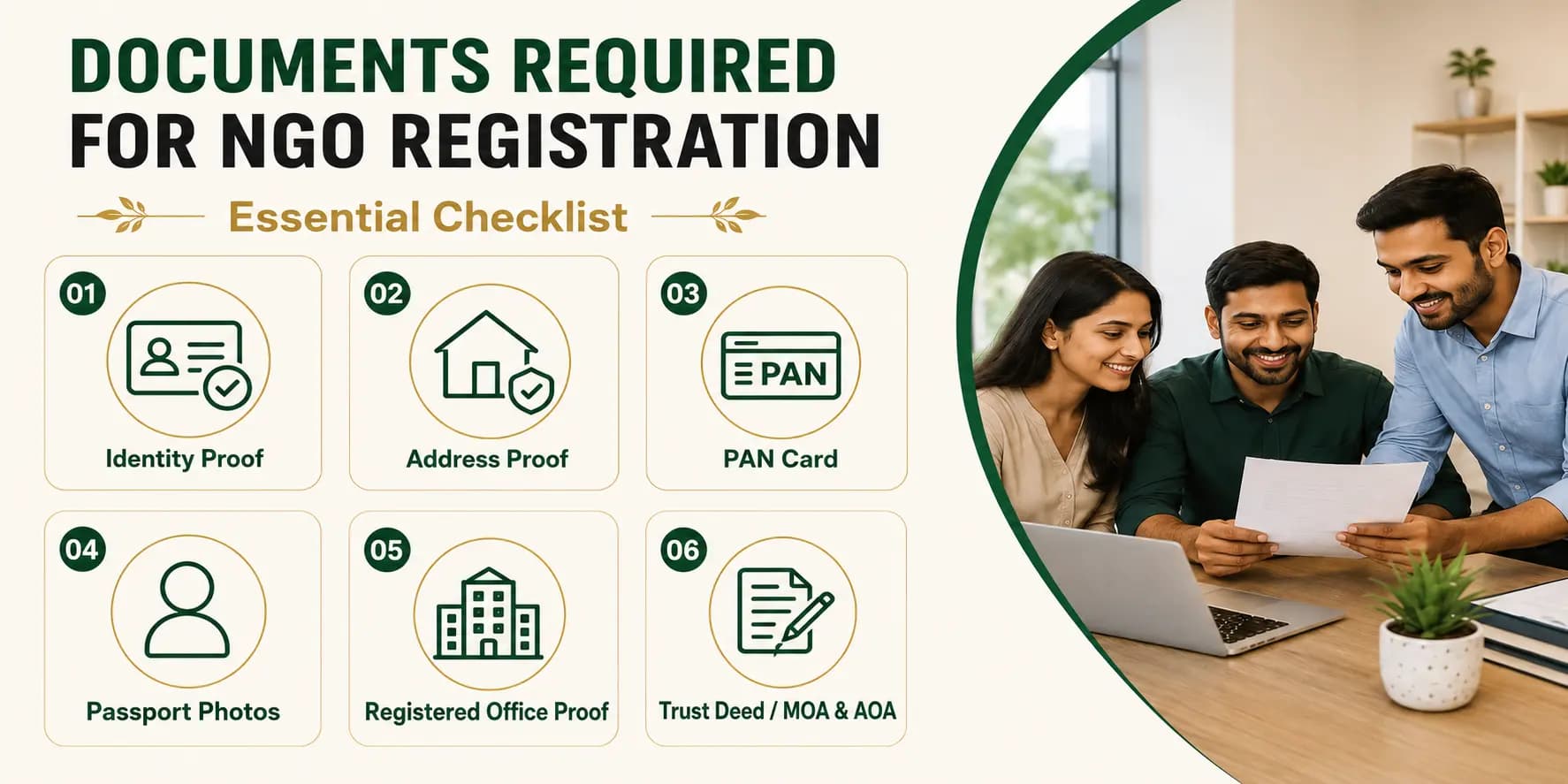
To build a successful and sustainable NGO, you will need to submit the following documents:
Each type of NGO registration process requires adhering to a specific set of laws & procedures prescribed in the applicable act (trusts, societies, & section 8 companies). Here, at NGOExperts, we will offer you a detailed step by step process of each & every type of ngo registration.

Step 1. Name of the Trust
The first step towards the registration of a Trust is deciding on a name for the Trust. The name should be unique & not identical or confusingly similar to the name of any other registered Trust or individual.
Step 2. Decide Settlers/Trustees of the Trust
According to the Indian Trusts Act, 1882, a Trust must have a minimum of two Trustees. The Settler should be a person who sets up the Trust, and the other Trustees should work for the goals & objectives of the Trust. Further, the Authors are individuals who prepare the Memorandum & Trust Deed of the Trust. The Settlers, Trustees, & Authors must be individuals of sound mind, over the age of 18, & must not be disqualified from entering into a contract.
Step 3. Form MOA for Trust
The Memorandum of Association (MOA) is a legal document containing the name of the Trust, its registered address, & the main objectives of the Trust. It must be drafted in duplicate.
Step 4. Draft the Trust Deed
When applying for trust registration certificate & drafting a trust deed registration, it is essential to include certain key elements:
Step 5. Submit the Trust Deed to Registrar
Once the MOA & Trust Deed have been drafted, they must be printed on non-judicial stamp paper of an adequate value, signed by the Settler & Trustees, & witnessed by two witnesses. The documents, along with the necessary affidavit, must be submitted to the Registrar of Trusts, along with the prescribed trust registration fees.
Step 6. Obtain Certificate of Trust Registration
Upon satisfactory scrutiny of the documents, the Registrar will register the Trust & issue a Trust Registration Certificate. The registration process usually takes around 7 working days but once completed, you can also look for the Trust Registration certificate download online.
Registering a society involves several steps:
Step 1: Filing of Application
The first step for society registration online is to file an application with the registrar of societies in the state where the society will be registered. The application must include an affidavit in a standard format along with relevant documents such as identity proof, address proof, account statements, etc.
Step 2: Drafting MOA & By-laws
The next step involves drafting a Memorandum of Association (MOA) & By-laws that need to be signed by three founding members of the society. The MOA outlines the objectives & goals of the society, whereas the by-laws provide the rules & regulations that govern the society.
Step 3: Board Resolution
A board resolution needs to be drafted, reflecting the consent of founding members for constituting the society. The board resolution should specify the office-bearers & their roles & responsibilities. This step is quite challenging so, you must seek professional assistance like NGOExperts & get it successfully drafted.
Step 4: Affidavit on Stamp Paper
An affidavit needs to be drafted on a stamp paper worth Rs 10, affirming the legitimacy of the society's name & address. The affidavit should be signed by the founding members of the society.
Step 5: Payment of Society Registration Fees
The final step of the society registration online process involves payment of the society NGO registration fees, which varies from state to state. Once the payment is made, the registrar issues a society registration certificate, indicating that the society is now a legal entity.
Step 1: Digital Signature Certificate (DSC) & Director Identification Number (DIN)
To initiate the registration process, the first thing required is to obtain a Digital Signature Certificate (DSC) & Director Identification Number (DIN) for all proposed directors of the Section 8 company.
Step 2: Name Reservation
The proposed name for the online registration of Section 8 company should be unique & not similar to any existing company. The applicant must apply to reserve the proposed name via the RUN (Reserve Unique Name) form. On approval of the name, the applicant gets a name reservation certificate, which is valid for 20 days from the date of approval.
Step 3: Requisite Documents
The following documents need to be prepared & filed with the Registrar of Companies (ROC) for Section 8 company registration online:
Step 4: Submit Application & Pay Fees
After obtaining the name reservation certificate & preparing the necessary documents, the application for company registration under Section 8 must be submitted online on the MCA (Ministry of Corporate Affairs) portal. Select the Spice+ form option under the Service section & complete the requirements. The requisite Section 8 company NGO registration fees must be paid online.
Step 5: Verification & Approval
As the documents are processed & approved, the ROC will issue a certificate of registration. Congratulations! You are now a registered Section 8 company in India.
NGOs are generally independent organizations. In India, NGOs can be classified based on their orientation and level of operation for NGO registration:
NGOExperts offers seamless NGO registration & provides comprehensive assistance in all aspects of running a non-profit organization. Our team of experts has a deep understanding of the legal & regulatory framework governing the sector & helps NGOs navigate the complexities involved.
But why choose NGOExperts for your philanthropic endeavors:
Our expert team guide you to build your dream throug the registration process
Talk To Our Experts
As you register your non-governmental organization (NGO), there are several types of registration available. The most common types include trust, society, & section 8 company registration
To register an NGO, a minimum of three members are required. These members must come together with a mutual goal & vision for their organization.
There are several top level & primary posts that are typically associated with NGOs. These include the board of directors, the executive director, program directors, fundraising & communications staff, & administrative support.
A trust is a legal arrangement in which the assets are mostly held by a trustee on behalf of the beneficiaries. On the other hand, a society is an association of individuals who come together with a common objective or interest. The decision ultimately depends on the purpose & goals of your organization.
To register a NGO in India, you have got a few options. One option is the Ministry of Corporate Affairs (MCA), which handles registration for all types of organizations, including NGOs. Another option is the Registrar of Societies, which registers the societies for various purposes, including charitable work. Also, some states may have their own registration processes for NGOs
First ensure your NGO is legally registered, maintain proper financials, identify relevant funding programs, and submit strong proposals that align with government schemes
No, having a physical office or landline is not mandatory, but you must provide a valid registered address and contact number for communication and legal purposes.
The ngo registration process generally takes 15–30 working days, depending on the state and type of NGO. Many states offer online registration via e-district or government portals.
Yes, but only after FCRA (Foreign Contribution Regulation Act) registration. To qualify, an NGO must be at least three years old, maintain clean records, and complete mandatory compliance for foreign funding.