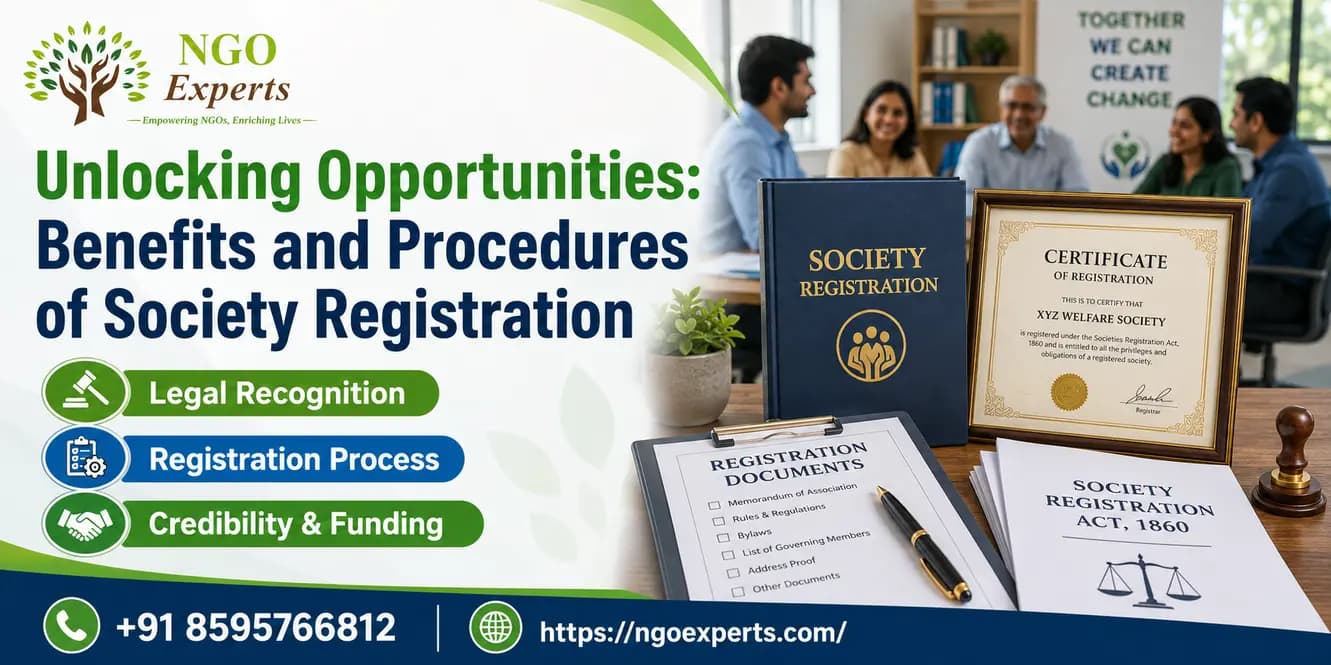
Society registration is mandatory for nonprofit organizations in India. It involves legal recognition, better credibility, and tax benefits. You can avail of these benefits by fulfilling the following criteria..
For NGOs, trusts, societies, and businesses, we provide complete support in registrations, compliance, and funding. From NGO/Trust/Society setup to 12A, 80G, FCRA, NITI Aayog, and CSR project reports, our experts handle everything seamlessly to keep you compliant and fund-ready.
Society registration in India is a structured legal process that gives groups working for social, cultural, educational, or charitable causes proper recognition, credibility, and protection. A registered society with a valid society registration certificate can raise funds legally, receive government support, gain donor trust, and operate transparently, making it easier to achieve goals like education, healthcare, poverty alleviation, or community development across India.
The society registration process is governed by the Societies Registration Act, 1860, which provides the framework for formation, management, and dissolution. To register, at least seven members must voluntarily come together for a common social objective. Once registered, the society becomes a recognized legal entity, capable of owning property, managing funds, entering contracts, and carrying out activities with full trust, accountability, and long-term sustainability.
With years of hands-on experience in society registration online and offline, our expert team assists NGOs, community groups, and social organizations in completing the process smoothly. From drafting and reviewing society registration documents to filing applications and ensuring compliance with the law, we provide end-to-end support, so you can focus entirely on creating genuine social impact while we handle every legal and regulatory requirement with precision.
The registration of a society under the Society Registration Act 1860 in India offers several significant benefits, which are crucial for the efficient and credible operation of non-profit organizations and other entities. Just like trust registration, society registration also ensures compliance and boosts credibility. Some of the key benefits of society registration in India include:
Need Any Help?
Our experts team guide you to build your
dream through the registration process
| Talk To Our Experts |
To obtain a valid society registration certificate under the Society Registration Act 1860 in India, certain eligibility criteria must be met:

The first step for society registration online is to file an application with the registrar of societies in the state where the society will be registered. The application must include an affidavit in a standard format along with relevant documents such as identity proof, address proof, account statements, etc.
The next step involves drafting a Memorandum of Association (MOA) & By-laws that need to be signed by three founding members of the society. The MOA outlines the objectives & goals of the society, whereas the by-laws provide the rules & regulations that govern the society.
A board resolution needs to be drafted, reflecting the consent of founding members for constituting the society. The board resolution should specify the office-bearers & their roles & responsibilities. This step is quite challenging so, you must seek professional assistance like NGOExperts & get it successfully drafted.
An affidavit needs to be drafted on a stamp paper worth Rs 10, affirming the legitimacy of the society's name & address. The affidavit should be signed by the founding members of the society.
The final step of the society registration online process involves payment of the society registration fees, which varies from state to state. Once the payment is made, the registrar issues a society registration certificate, indicating that the society is now a legal entity.
When registering a society, several Society Registration documents are required to ensure a successful registration. Keep a double check on all these documents & start your registration today.

1. Memorandum of Association (MOA): The Memorandum of Association is a crucial document that must include the name of the society, its objectives, the names, addresses, and occupations of the members of the governing body, and the address of the registered office of the society.
2. Rules and Regulations of Society: This document should detail the operational framework of the society, including membership details, meeting protocols, responsibilities of office bearers, financial management, amendment procedures, and dissolution procedures.
3. List of Governing Body Members: A list of the members of the governing body, along with their signatures, addresses, and occupations, must be submitted for transparency and accountability.
4. Covering Letter: A formal covering letter signed by all the founding members indicating their intention to form a society and requesting registration.
5. Proof of Address: Proof of the registered office address of the society, such as a rent agreement (if the property is rented), a No Objection Certificate (NOC) from the landlord, or utility bills (electricity, water, etc.).
6. Identity Proof of Governing Body Members: Copies of identity proof such as Aadhaar card, passport, or voter ID of all the members of the governing body.
7. Affidavit: An affidavit from the president or secretary of the society, stating the relationship between the subscribers (if any), and confirming the correctness of the details provided in the MOA and Rules and Regulations.
8. Minutes of the First Meeting: Minutes of the first meeting of the society, where the members adopted the Memorandum of Association and Rules and Regulations, and elected the office bearers.
9. Declaration by the President: A declaration by the president of the society stating his/her willingness to hold the said office.
10. Registration Fee: Payment of the prescribed registration fee, which varies from state to state. The fee is typically paid through a demand draft or challan.
After obtaining your society registration certificate, several essential legal compliances must be followed:
NGOExperts proves to be the unrivaled choice when it comes to society registration online and related services. Our expertise lies in in-depth knowledge of government policies & procedures, providing timely solutions to our clients - distinguishing us from others.
We provide complete assistance for society registration documents, drafting, filing, compliance, and guidance on society registration fees – so you get a hassle-free experience. Trust us to provide reliable & cost-effective services that exceed expectations.
Our expert team guide you to build your dream throug the registration process
Talk To Our Experts
In any organized society, there must be rules & regulations that govern its operations. These rules, commonly known as bye-laws, provide essential guidelines for how individuals within the community should conduct themselves. By-laws often cover various areas, including the management of finances, the conduct of meetings, & the election of officials. They exist to ensure that society operates efficiently, with every member fulfilling their responsibilities & acting in the best interest of the larger community.
As per the Societies Registration Act, the registration fee is Rs. 50 or less, as prescribed by the government when registering a society. This registration fee has to be paid to the Registrar along with the organization's memorandum. Keeping yourself updated on the latest fee structure is always advisable. With the necessary registration in place, your organization can function legally & transparently.
The first step in starting a society is to identify a common purpose & cause that drives your passion. This could be anything from supporting a local community project or even advocating for social justice on a larger scale. As you have a clear mission in your mind, you'll have to gather a group of like-minded individuals who share a similar vision.Remember, a minimum of 7 people is required to form a society under the 'Societies Act, 1860.' With dedication & hard work, you can bring together a group of passionate individuals who are committed to making a difference.
As Ownership in a registered society can be difficult at first. But ultimately, it all comes down to the members. These are the individuals who make up the society, & they have a say in the decisions that are made. While there might be certain individuals who hold positions of authority, they are still ultimately accountable to the members.Perhaps the most important thing to remember is that a registered society is not a business in the traditional sense. It exists to serve its members & the wider community, rather than to generate profit for any one individual or group. This means that the ownership of a registered society is ultimately in the hands of the members, who have the power to shape its direction & purpose.
Registering the society with the government grants it legal recognition, turning it into a separate legal entity. With that comes a number of perks, including the ability to own property & engage in transactions in its own name. When a society is registered, it is allowed to buy, rent, hold, lease, or even sell property. Also, compliance requirements tend to be less complicated when the society holds property in its own name.
There are several options available for those hoping to set up a cooperative society. In India, the Registrar of Cooperative Societies (RCS) is responsible for overseeing the registration process. You can register your society locally at the RCS office in your respective state.Alternatively, you can also register online through the e-Governance Portal for Cooperatives. Regardless of which option you choose, it's important to ensure that you have all the necessary documents & information in order to make the process as smooth as possible.
The necessary Society Registration documents are as follows.
Registering a society is an essential legal step for promoting the arts, science, literature, & other charitable causes. The Society Registration Act, 1860, enables societies to gain legal recognition, so they can undertake various activities to improve the lives of those in the community.By registering, societies can avail of the benefits granted by the government, like tax exemptions, grants, & subsidies. Furthermore, it gives credibility to the organization, making it easier to raise funds & build a good reputation.
When it comes to forming a society, it's important to have at least seven dedicated individuals joining together for a common purpose or cause. It's not just limited to Indian residents. Foreigners, companies, & even other registered societies can join the cause. Unlike other types of organizations though, societies have the option to register or remain unregistered. It's important to note that registering has its benefits, as it brings official legitimacy & recognition to your society.