
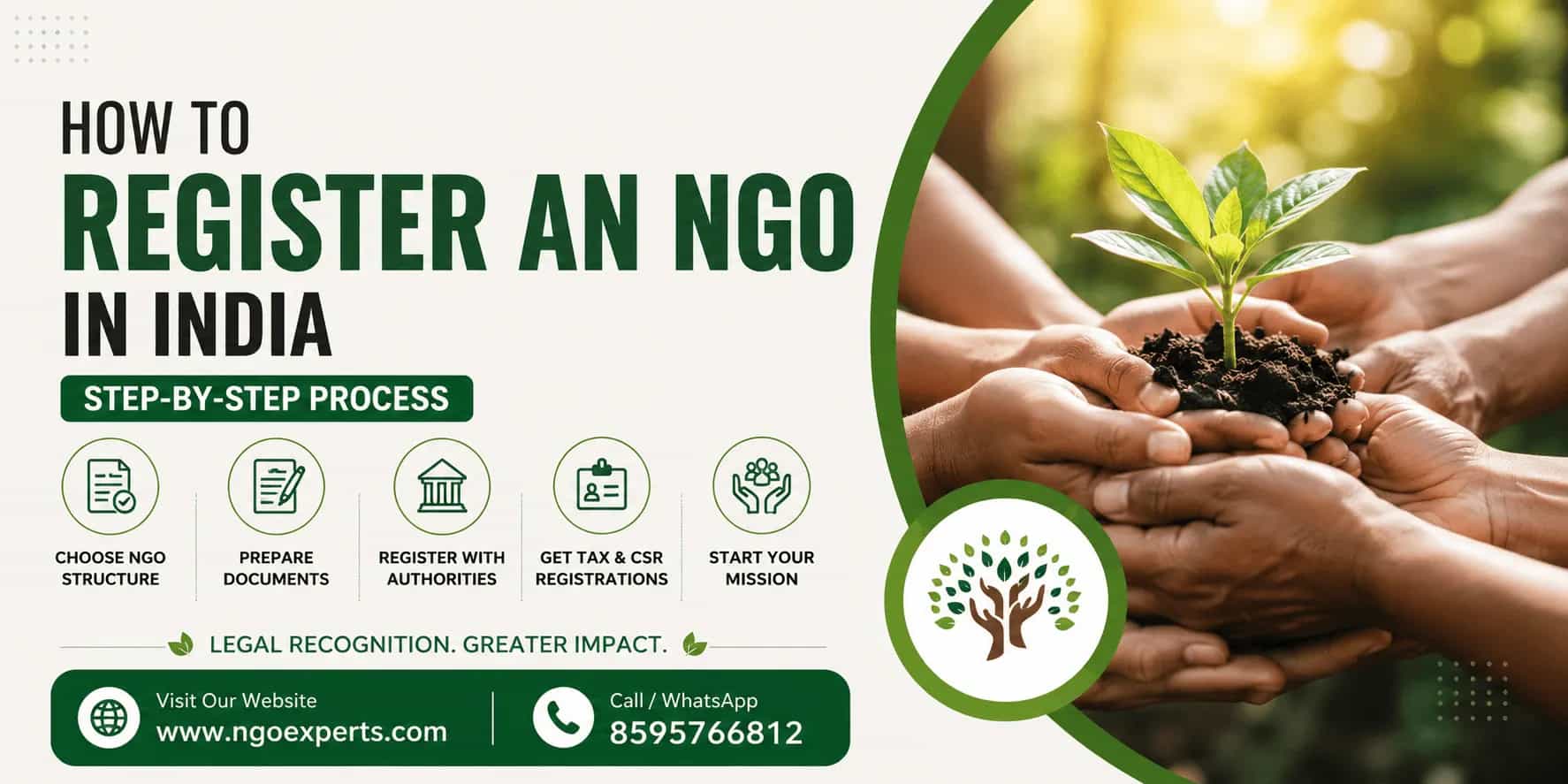
Here's how to register NGO in India: pick a structure — Trust, Society, or Section 8 Company — based on your team size and funding goals, draft the matching founding document, and file it with the right authority (the Sub-Registrar, your state Registrar of Societies, or the MCA portal). Registration alone won't get you tax exemption or CSR funding. Those need separate approvals afterward: income-tax registration, CSR-1, and FCRA for foreign funds.
Need Help With NGO Registration?
Get expert guidance on choosing and registering a Trust, Society, or Section 8 Company.
What Is an NGO in India?
An NGO is a non-profit formed to serve a social, charitable, educational, cultural, religious, or environmental cause. It can earn income or charge fees for its services, but that income must go back into its mission, never to founders or members.
NGO registration in India can be done as a Trust, Society, or Section 8 Company. The right option depends on five key factors: your objective, team size, state, funding plans, and the level of compliance you can handle.
As of NITI Aayog's last published count, close to 1.87 lakh NGOs were already registered on NGO Darpan, highlighting the scale of India's nonprofit sector. Keeping your registration and documentation accurate can help build credibility with donors, government bodies, and other stakeholders.
At NGOExperts, we help founders, trustees, and social workers register NGOs as a Trust, Society, or Section 8 Company with the right documentation, clear object drafting, and practical compliance guidance.
Which NGO Structure Is Best for Your Objective: Trust, Society, or Section 8?
Each structure operates under different laws and suits different kinds of work.
| Particulars | Trust | Society | Section 8 Company |
| Governing law | State trust laws | Societies Registration Act, 1860 | Companies Act, 2013 |
| Minimum people | 2 trustees | 7 members | 2 directors |
| Main document | Trust Deed | Memorandum & Rules | MOA & AOA |
| Registered with | Sub-Registrar / Charity Commissioner | State Registrar of Societies | MCA |
| Best for | Small, founder-led work | Membership-driven community groups | CSR funding, grants, multi-state growth |
| Compliance | Low | Moderate | Highe |
- Pick a Trust if a small group of trustees will run things and your work stays mostly charitable.
- Pick a Society if you have at least seven committed members who'll hold regular meetings.
- Pick a Section 8 Company if you want institutional partnerships and corporate CSR money, and professional operations.
Ready to Start Your NGO?
Let our experts help you with the NGO registration process, documents, and compliance requirements.
Why Does the Right Structure Matter?
Choosing the right NGO structure affects how your organisation operates, manages funds, meets compliance requirements, and grows over time.
| Factor | Why It Matters |
| Legal recognition | Registration gives the organisation a recognised legal identity to open bank accounts, receive donations, and enter into agreements. |
| Tax benefits | Eligible registered organisations can apply for applicable 12A and 80G registrations to access tax-related benefits. |
| Foreign funding | Organisations must meet FCRA requirements before receiving foreign contributions. |
| CSR funding | Companies can contribute CSR funds only to entities that meet the eligibility and compliance requirements under the CSR framework. |
| Liability | The level and nature of liability can differ between a Trust, Society, and Section 8 Company. |
| Governance | Each structure has its own rules for trustees, members, directors, meetings, records, and ongoing compliance. |
Who Is Eligible to Start an NGO in India?
To start an NGO, you need a genuine public-purpose objective, not a profit motive.
- A public-purpose objective. Social, charitable, educational, religious, or welfare-focused, never profit-driven.
- Adult founders. Every founder, trustee, member, or director must be 18 or older and have a valid PAN and Aadhaar. Minors can't hold any of these roles.
- A registered office. A valid address for registration and official communication.
- The right founding document. A Trust Deed, Society Rules, or MOA/AOA, depending on your structure.
- Compliance: You'll need to maintain accounts and records after registration; this isn't a one-time filing.
What Documents Do You Need to Start an NGO in India?
Keep these documents ready before you file:
- PAN and Aadhaar for every founder, trustee, or director
- Passport-size photos
- Registered office proof: a recent utility bill, plus an NOC if it's rented
- Your founding document: Trust Deed, Society Rules, or MOA/AOA, depending on structure
- DSC and DIN if you're going the Section 8 route
Your object clause matters most. In our experience, it's the top reason applications get sent back: founders copy another NGO's objectives instead of writing their own actual plans.
How to Register an NGO in India: Step-by-Step Process

Once you've chosen a structure and gathered your documents, the process follows the same steps, no matter which entity you choose.
Step 1: Define your objectives
Be specific about what you'll do, who you'll help, and where. Vague lines slow down every approval that follows.
Step 2: Pick your structure and founders
Match the structure to your team size and goals. Choose people you trust, not just enough to hit a headcount.
Step 3: Choose a name
Keep it unique, free of trademark clashes, and free of words that suggest a government link or profit motive.
Step 4: Set up your registered office
You'll need a utility bill, proof of ownership or rent, and an NOC if the property isn't yours.
Step 5: Draft your legal document
Cover objectives, management powers, voting, fund use, and dissolution terms clearly.
Step 6: File your application
Trusts go to the Sub-Registrar, Societies to the state Registrar, and Section 8 Companies online through MCA's SPICe+, which bundles incorporation with PAN and TAN into one filing, according to the Ministry of Corporate Affairs.
Step 7: Open a bank account
Open it in your NGO's name once you're registered. Never route donations through a founder's personal account; it can quickly erode donor trust.
Real-Life Examples of NGO Registration in India
Seeing how each structure plays out in practice makes the choice easier:
- Trust: Tata Trusts funds healthcare, education, and rural work through founder-led governance.
- Society: Bharat Scouts and Guides runs on elected bodies and a large membership base across states.
- Section 8 Company: Akshaya Patra Foundation feeds over 2 million children daily, backed by board-level compliance that lets it partner with government schools and corporate CSR donors.
How Much Does NGO Registration Cost?
| Structure | Estimated Total Cost | Timeline |
| Trust | ₹10,000–₹15,000 | 7–20 working days |
| Society | ₹10,000–₹25,000 | 20–45 working days |
| Section 8 Company | ₹8,000–₹15,000 | 10–25 working days |
Costs vary based on state stamp duty, registrar workload, and how clean your documents are. Verify current fees on the relevant state or MCA portal before filing.
What Comes After NGO Registration in India?
Registration gets you a legal identity, not funding. You still need the following post-registration compliance:
- NGO Darpan: a NITI Aayog ID many Central Government grants require
- Income-tax registration: Form 104 (provisional) or Form 105 (regular) under the Income-tax Act, 2025, effective 1 April 2026, still informally called "12A/80G"
- CSR-1: filed with MCA, required before you can run corporate CSR projects
- FCRA registration: mandatory before accepting any foreign contribution; never take foreign funds before approval
Registration is only the beginning. Securing the right 12A/80G approvals and completing FCRA compliance correctly from the outset strengthens credibility and access to funding opportunities.
The RNPO Revolution: What the Income-tax Act, 2025 Changed
The Income-tax Act, 2025, effective from 1 April 2026, reorganises the tax framework governing charitable and religious institutions in India. For NGOs, this brings greater focus on how registration, approval, validity, and tax-exemption requirements are handled under the new regime.
What Is an RNPO?
Under the new regime, all NGOs, charitable trusts, and societies have been automatically reclassified as Registered Non-Profit Organisations (RNPOs) under Chapter XVII-B (Sections 332–355), without requiring fresh registration.
| Change | Impact |
| Unified registration | All NPOs are now RNPOs under a single framework |
| Fixed registration period | Registration is generally granted for five tax years (extendable to ten years for small NPOs meeting specified income thresholds) |
| Form 105 | New application form for RNPO registration under Section 332 |
| Form 107 | Order for grant of registration or approval |
| Form 10AB | Renewal application for RNPOs (deadline: September 2027 for March 2028 expiry) |
What Do Existing NGOs Need to Do Under the Existing RNPO System?
| Action | Deadline |
| Automatic reclassification | Already effective from 1 April 2026 |
| Renewal under Section 332 | By September 2027 (6 months before March 2028 expiry) |
| FCRA Form FC-6F | By 21 June 2027 (for existing FCRA-registered organisations) |
Not Sure Which NGO Structure to Choose?
Discuss your objectives, funding plans, and compliance needs with an expert.
Frequently Asked Questions
Which NGO structure is best for my organisation?
The right structure depends on your goals. A Trust may suit founder-led charitable activities, a Society works well for membership-based organisations, and a Section 8 Company suits structured operations, CSR partnerships, and expansion across states.
Can one person register an NGO in India?
No. NGO registration generally requires more than one person. The number and role of trustees, members, or directors depend on whether you choose a Trust, Society, or Section 8 Company.
Is NGO registration completely online?
The Section 8 Company registration process is completed through the MCA portal. Trust and Society registration procedures vary by state and may involve online and offline submissions.
Does NGO registration provide automatic tax exemption?
No. NGO registration does not automatically provide income-tax exemption. Eligible organisations need to apply separately for the applicable income-tax registration, including the relevant Forms 104 or 105 under the current framework.
Can a newly registered NGO receive foreign donations?
Not immediately. An NGO generally needs FCRA registration or prior permission to legally receive foreign contributions under the Foreign Contribution (Regulation) Act
How long does NGO registration take in India?
The timeline depends on the legal structure and state. A Trust may take around 7–20 days, a Society around 20–45 days, and a Section 8 Company around 10–25 days, subject to document verification and government processing.
What documents are required for NGO registration?
Common documents include identity and address proofs of the founders or directors, registered office proof, photographs, constitutional documents, and details of the organisation's objectives. The exact documents required for NGO registration depend on the structure and state.
What should I do after registering an NGO?
After NGO registration, organisations should complete applicable tax registrations, maintain books and statutory records, meet annual compliance requirements, and consider NGO Darpan registration where relevant for government schemes and funding opportunities.
Author
Aabha Garg
A Content Strategist at NGOExperts, who focuses on NGO registration, 12A and 80G registration, FCRA compliance, income tax filing for non-profits, and CSR funding guidelines in India. I research and write our compliance guides in collaboration with our in-house Chartered Accountants and Company Secretaries, so every article reflects current tax and regulatory requirements for the NGO and non-profit sector.
Written by Aabha Garg. Last updated on September 30, 2026