NGO Experts Logo
12a and 80g

12A and 80G Registration in Maharashtra (2026): Complete Process, Benefits & Documents Guide

August 18, 20265 mins605 views
12A and 80G Registration in Maharashtra (2026): Complete Process, Benefits & Documents Guide
Share
Maharashtra is home to one of India's largest and most active non-profit ecosystems, from urban Mumbai and Pune, working on education, healthcare, and livelihoods, to rural and tribal-belt organizations in Vidarbha, Marathwada, and the Konkan, tackling agrarian distress, malnutrition, and disaster relief. With such a large nonprofit ecosystem, donor and CSR opportunities are significant. However, having 12AB registration for the NGO's tax exemption and 80G approval for eligible donor deductions is important for building funding confidence. Here's the complete, up-to-date process for obtaining 12A and 80G registrations under the new Income-tax Act, 2025 framework, which took effect this year.
From 1 April 2026, 12A/80G registration falls under the Income-tax Act, 2025. 12A is now Section 332; 80G approval is now Section 133(1)(b)(ii). Maharashtra NGOs, whether Public Trusts registered under the Maharashtra Public Trusts Act, 1950, with the Charity Commissioner, Societies, or Section 8 Companies, apply online via Form 104 (replacing old Form 10A) for provisional approval, then Form 105 (replacing Form 10AB) for final registration. Filing is free on the income tax portal; the full cycle typically takes 4 to 8 weeks, and final registration is now valid for 5 to 10 years depending on annual income.

What Is 12A and 80G Registration in Maharashtra?
12A registration, now granted under Section 332 of the Income-tax Act, 2025, exempts an NGO's own income from tax, provided at least 85% of that income is applied toward its charitable objects each year. 80G approval, now under Section 133(1)(b)(ii), lets donors deduct their contribution from their own taxable income, which is often the single biggest factor influencing whether a donor, individual or corporate, actually gives.
Both approvals are issued centrally by the Income Tax Department, not by any Maharashtra state authority. The state-level piece is registering your underlying entity, most commonly as a Public Trust with the Charity Commissioner under the Maharashtra Public Trusts Act, 1950 (also known historically as the Bombay Public Trusts Act), which must be in place before you can apply for 12A/80G.

Why 12A and 80G Registration Matters in Maharashtra

The Charity Commissioner's office in Maharashtra registers an enormous number of Public Trusts every year, but registration alone doesn't unlock funding. Without 12A, a Trust's surplus is taxed like any commercial entity's. Without 80G, donors in India's financial capital, where corporate CSR budgets and high-net-worth individual philanthropy are concentrated, have no tax incentive to give. For an NGO competing for attention in one of the country's most crowded non-profit sectors, 12A/80G is often the baseline credibility check that decides whether a proposal even gets read.

12A and 80G Registration Eligibility in Maharashtra

You must already hold valid registration as one of the following:
  1. Public Trust: Registered under the Maharashtra Public Trusts Act, 1950, with the office of the Charity Commissioner in the relevant region. Requires a Trust Deed and a minimum of two trustees. Under the new Income-tax Act, 2025, the trust deed must be irrevocable; a revocable deed is grounds for outright rejection of the 12A/80G application, so it's worth reviewing before filing.
  2. Society: Registered under the Societies Registration Act, 1860 (as applicable in Maharashtra), with a minimum of seven members, an MOA, and bye-laws. Many Maharashtra Societies also register in parallel as a Public Trust, since the state's Public Trusts Act applies broadly to charitable entities.
  3. Section 8 Company: Incorporated under the Companies Act, 2013, via the MCA portal, with a minimum of two directors.
A PAN in the organisation's name is mandatory before opening the 12A/80G application.

Documents Required for 12A/80G Registration in Maharashtra

Keep these ready before filing Form 104. For Maharashtra Public Trusts especially, mismatches between the Charity Commissioner's records and the Income Tax filing are a common cause of delay:
  • Constitutional document: Self-certified copy of the Trust Deed (registered with the Charity Commissioner) / Society MOA & bye-laws / Section 8 Company MOA-AOA
  • Registration certificate: Self-certified copy of the Charity Commissioner's registration certificate (Schedule I / Change Report extract, as applicable) or Society/Section 8 registration certificate
  • PAN card: PAN card of the organisation
  • Trustee/member details: Identity and address proof of trustees/governing body members
  • Financial statements: Annual accounts (balance sheet, income & expenditure statement) for the last 3 financial years, where the entity has existed that long
  • FCRA certificate: FCRA registration certificate, if applicable
  • Activity note: Note describing charitable activities carried out or proposed
  • Prior registration order: Self-certified copy of any earlier 12A/12AA/12AB order, for renewals
All documents should be self-certified by a trustee, secretary, or authorised signatory and uploaded as clearly named PDFs. Check that the listed objects exactly match your Charity Commissioner filing before submitting.

Step-by-Step 12A and 80G Registration Process in Maharashtra
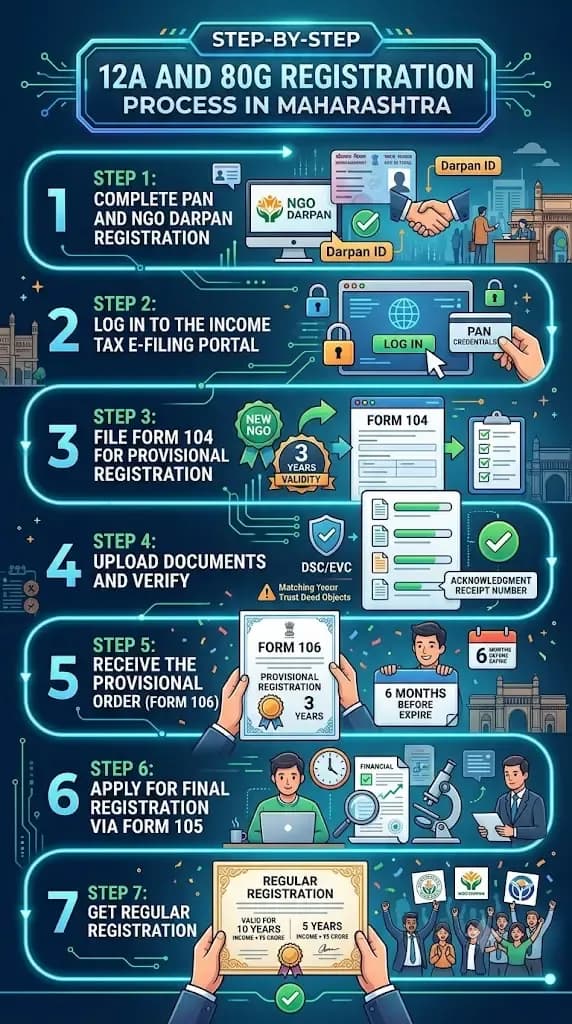
Getting 12AB and 80G registration in Maharashtra involves preparing the required documents and meeting applicable Charity Commissioner requirements. Here's a simple step-by-step overview of the process.
Step 1: Complete PAN and NGO Darpan Registration Apply for the organization's PAN if not already done, and register on the NGO Darpan portal for a Darpan ID, which is frequently referenced during the 12A/80G application and is required for most government and CSR grants downstream.
Step 2: Log In to the Income Tax e-Filing Portal Access the Income Tax e-filing portal using the organisation's PAN credentials.
Step 3: File Form 104 for Provisional Registration Go to e-File → Income Tax Forms → File Income Tax Forms and select Form 104 (the form that replaced Form 10A from 1 April 2026). This applies to new NGOs, or those that haven't yet commenced charitable activities. Provisional registration under Section 332 is valid for 3 years and is granted on the strength of the documents submitted, without a field inquiry. File separately for 12A (Section 332) and 80G (Section 133(1)(b)(ii)) if you want both.
Step 4: Upload Documents and Verify Attach the required documents (below), and ensure the objects listed match your Trust Deed exactly: a common and entirely avoidable reason for rejection. Submit using a Digital Signature Certificate (DSC) or Electronic Verification Code (EVC), and save the Acknowledgment Receipt Number.
Step 5: Receive the Provisional Order (Form 106) Upon approval, the Income Tax Department issues Form 106 (replacing the old Form 10AC), confirming a 3-year provisional registration.
Step 6: Apply for Final Registration via Form 105 At least six months before provisional registration expires, or once the Trust has demonstrably started charitable work, file Form 105 (replacing old Form 10AB) for final registration. The Principal Commissioner of Income Tax (PCIT) reviews actual activities, financial records, and compliance, and may raise queries before granting regular registration.
Step 7: Get Regular Registration Once satisfied, the PCIT grants regular registration, valid for 10 years if the NGO's income doesn't exceed ₹5 crore in either of the two preceding years, and 5 years otherwise, under the validity rules introduced with the 2026 changes.

Fees and Timeline for 12A and 80G Registration in Maharashtra

There is no government fee for filing Form 104 or Form 105 on the income tax portal: the application itself is free. Charity Commissioner filing fees and professional fees for handling the 12A/80G filing are the main costs most NGOs budget for.
StageFormValidityApprox. Timeline
Provisional registration (12A)Form 104 (was 10A)3 years15 to 30 working days from filing
Provisional approval (80G)Form 104 (was 10A)3 years15 to 30 working days from filing
Final/regular registrationForm 105 (was 10AB)5 years (10 years if income ≤ ₹5 crore)1 to 3 months, depending on PCIT review
RenewalForm 105 (was 10AB)Same as aboveFile 6 months before expiry

Post-Registration Compliance for 12A/80G Registration in Maharashtra

  • Apply 85% of income: toward charitable objects annually to retain full exemption under Section 332
  • File Form 113: the renumbered Form 10BD, the annual statement of donations received, without which donors cannot actually claim their 80G deduction
  • Issue Form 114: donation certificates to every donor
  • File ITR-7: annually, along with the applicable audit report (Form 112, the renumbered Form 10B/10BB)
  • Comply with Charity Commissioner filings: Maharashtra Public Trusts must separately file annual accounts and budgets with the Charity Commissioner under the state Act; this is in addition to, not a substitute for, Income Tax compliance
  • Renew on time: file Form 105 at least six months before expiry; a lapsed registration requires a fresh Form 104 application and makes interim income taxable

Funding and CSR Advantages of 12A and 80G Registration in Maharashtra

  • CSR funding: Maharashtra is the headquarters of a large share of India's CSR-spending corporates, and eligibility for their CSR budgets under the Companies Act, 2013, almost always requires active 12A/80G plus CSR-1 filing on the MCA portal
  • Donor tax deductions: 80G is frequently the deciding factor for individual and HNI donors deciding between competing appeals
  • Government and municipal grants: schemes run by Maharashtra state departments and urban local bodies frequently list 12A as a baseline eligibility requirement
  • International funding: while FCRA is a distinct, additional registration, most foreign foundations and multilateral agencies treat a well-established 12A/80G record as a marker of institutional maturity
  • Institutional credibility: in a state with thousands of registered Trusts, 12A/80G status, along with NGO Darpan and CSR-1, is what separates NGOs that get shortlisted from those that don't.

Frequently Asked Questions

Does the Charity Commissioner grant 12A/80G registration in Maharashtra?
No. The Charity Commissioner registers Public Trusts under the Maharashtra Public Trusts Act, 1950. 12A and 80G are separate, central Income Tax Department approvals filed on the national e-filing portal.
Can a Maharashtra Society apply for 12A/80G, or only Public Trusts?
Any eligible non-profit structure, Public Trust, Society, or Section 8 Company, can apply, as long as it holds a valid underlying registration and a PAN.
What replaced Form 10A and Form 10AB in 2026?
Form 104 replaced Form 10A (provisional registration/approval), and Form 105 replaced Form 10AB (final registration/approval and renewal), effective 1 April 2026 under the Income-tax Act, 2025.
How long does 12A/80G registration last now?
Provisional registration: 3 years. Regular/final registration: 5 years, extended to 10 years for NGOs with annual income up to ₹5 crore in each of the two preceding years.
Is there a fee for 12A/80G registration?
No government fee applies to filing Form 104 or Form 105 on the income tax portal; costs typically arise only from engaging a CA or consultant.
My Maharashtra Trust's old 12A registration hasn't expired yet. Do I need to do anything now?
No immediate action is required. Existing registrations under the old Sections 12A/12AA/12AB remain valid until their original expiry date; you'll need to file Form 105 for renewal at least six months before that date.

Author

Aabha Garg

A Content Strategist at NGOExperts, who focuses on NGO registration, 12A and 80G registration, FCRA compliance, income tax filing for non-profits, and CSR funding guidelines in India. I research and write our compliance guides in collaboration with our in-house Chartered Accountants and Company Secretaries, so every article reflects current tax and regulatory requirements for the NGO and non-profit sector.

Written by Aabha Garg. Last updated on August 18, 2026

📢Subscribe For Updates

Get the latest news delivered to your inbox