
Stay Compliant After Section 8 Company Registration
Keep up with ROC filings, annual returns, statutory audit, tax compliances, and other ongoing requirements. Get professional support to manage your Section 8 Company compliance.
What Is the Importance of Post Registration Compliance for Section 8 Company in India?
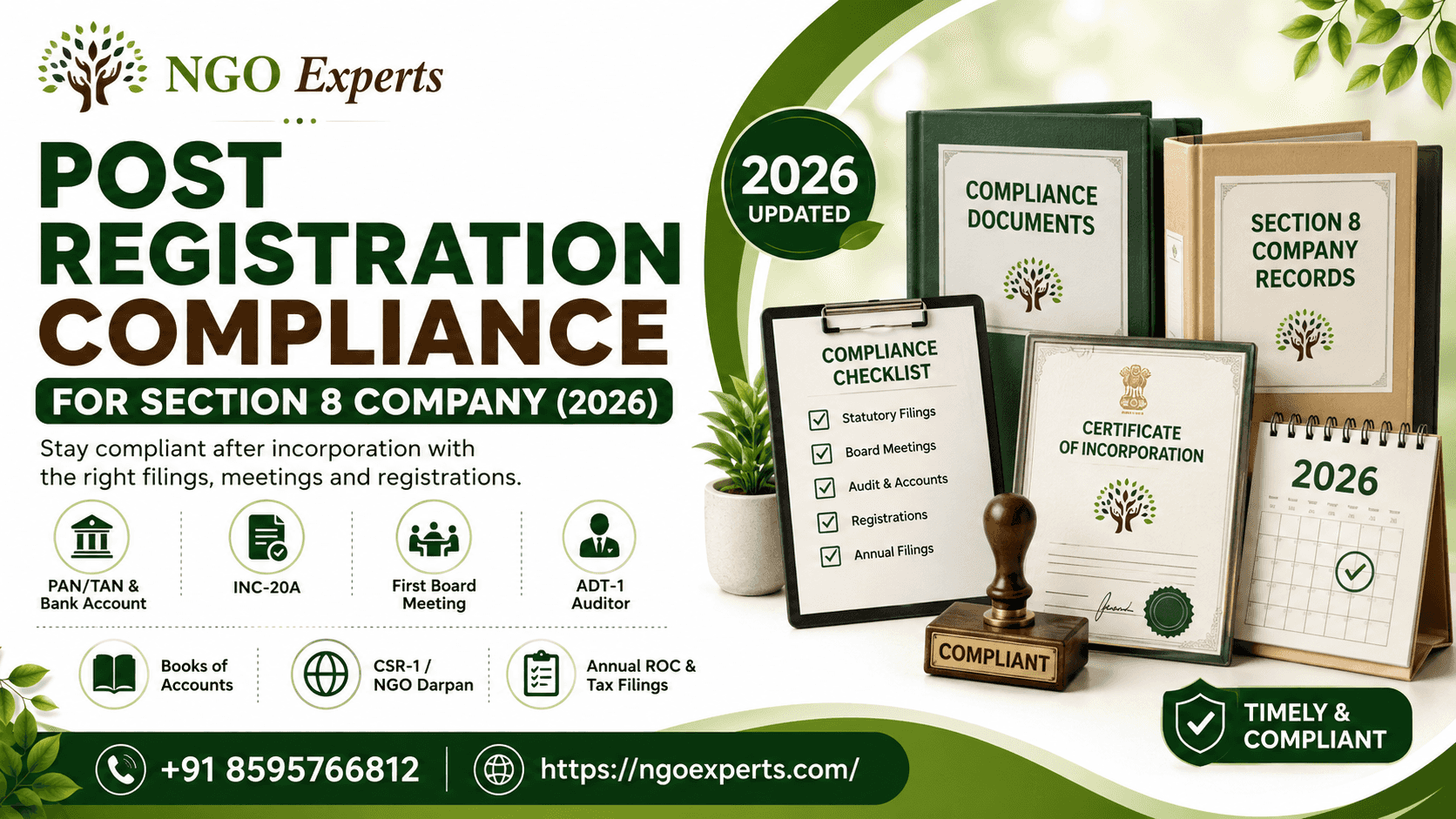
Post Registration Compliance for a Section 8 Company: First 30 Days
- Open a bank account in the company's legal name — never route donations through a founder's personal account
- Apply for PAN and TAN, usually issued alongside incorporation through the SPICe+ process
- File Form INC-20A (Declaration of Commencement of Business) within 180 days of incorporation, confirming that subscribers have paid their share capital
- Hold the first board meeting within 30 days of incorporation
- Appoint your first statutory auditor within 30 days, using Form ADT-1
Annual Statutory Compliance for Section 8 Companies in India
- AOC-4: Filing of financial statements with the Registrar of Companies, generally within 30 days of the AGM
- MGT-7: Annual return filing, within 60 days of the AGM. Note that a Section 8 Company cannot use the abridged MGT-7A form — Section 2(85) of the Companies Act, 2013 specifically excludes Section 8 Companies from the "small company" definition, so the full MGT-7 is mandatory regardless of size.
- Board meetings: Section 8 Companies get a specific relaxation under the MCA's exemption notification, a minimum of one board meeting every half calendar year, with a gap of not more than 90 days between the two, instead of the four-meetings-a-year rule that applies to regular companies
- Statutory registers: Maintaining registers of members, directors, and charges as applicable
- Income Tax Return (ITR-7): Filed annually, regardless of RNPO/tax-exemption status
Tax and Donor-Related Compliance for Section 8 Companies in India
- RNPO registration (Section 332, formerly 12A): Exempts the company's income from tax. See our guide on what 12A and 80G certificates actually do
- Donor-deduction approval (Section 354, formerly 80G): Lets donors claim a tax deduction on contributions
- NGO Darpan registration: Often required for Central Government grants and schemes
- CSR-1 filing: Required before it can legally receive corporate CSR funding
- FCRA registration: Required before accepting any foreign contribution
- Form 113 (formerly 10BD) and Form 114 (formerly 10BE): Annual donation statement and donor certificates, if the company has 80G/Section 354 approval
Post Registration Compliance Checklist: A Step-by-Step Guide
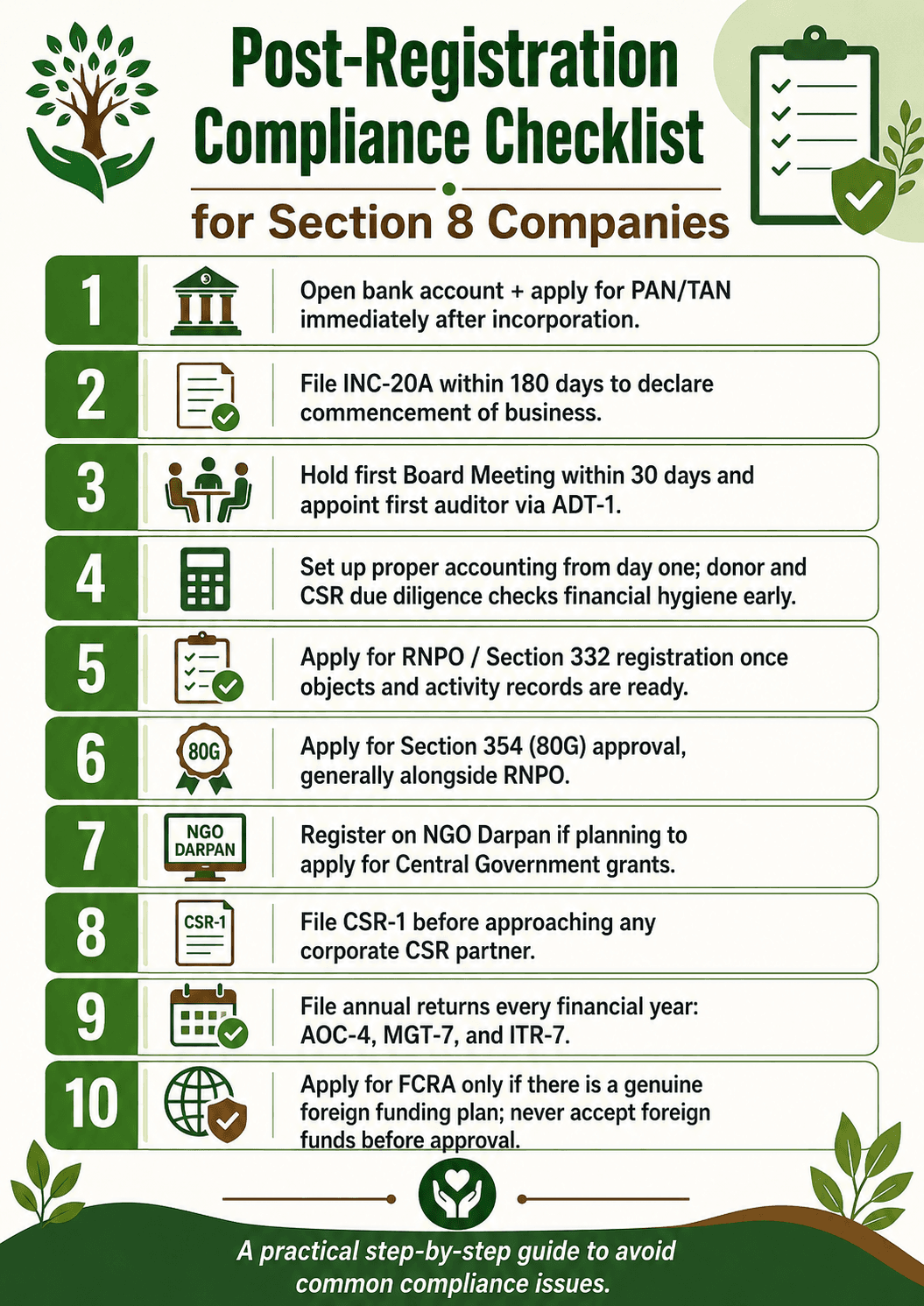
- Open your bank account and apply for PAN/TAN immediately after incorporation.
- File INC-20A within 180 days to declare commencement of business.
- Hold your first board meeting within 30 days and appoint your first auditor via ADT-1.
- Set up proper accounting from day one; donor and CSR due diligence increasingly checks financial hygiene early.
- Apply for RNPO/Section 332 registration as soon as your objects and activity records are ready.
- Apply for Section 354 (80G) approval, generally alongside your RNPO application.
- Register on NGO Darpan if you plan to apply for Central Government grants.
- File CSR-1 before approaching any corporate CSR partner.
- File your annual returns: AOC-4, MGT-7, and ITR-7, every financial year without exception.
- Apply for FCRA registration only if and when you have a genuine foreign funding plan; never accept foreign funds before approval.
Avoid missed filings and compliance issues. Get assistance with annual ROC filings, financial statements, statutory records, and other applicable compliances.
Avoid missed filings and compliance issues. Get assistance with annual ROC filings, financial statements, statutory records, and other applicable compliances.
Penalties for Non-Compliance for Section 8 Companies in India
- Late filing penalties for AOC-4, MGT-7, and INC-20A, calculated per day of delay
- Loss of RNPO/tax-exemption status if 12A and 80G renewal deadlines are missed
- Ineligibility for CSR funding without a valid CSR-1 filing
- Risk of company strike-off by the Registrar of Companies for prolonged non-filing
- Donor and CSR due-diligence failures, since most serious funders now check MCA filing status before committing
Post-Registration Compliance Calendar for a Section 8 Company
| Requirement | Typical Deadline |
| First board meeting | Within 30 days of incorporation |
| Auditor appointment (ADT-1) | Within 30 days of incorporation |
| Commencement of business (INC-20A) | Within 180 days of incorporation |
| Annual financial statements (AOC-4) | Within 30 days of AGM |
| Annual return (MGT-7) | Within 60 days of AGM |
| Income Tax Return (ITR-7) | Annually, per Income Tax Department deadline |
| RNPO/80G renewal | At least 6 months before expiry |
Not Sure If Your Section 8 Company Is Fully Compliant?
Get your current compliance status reviewed and identify pending filings, registrations, and regulatory requirements for 2026.
Frequently Asked Questions
What is the first compliance step after Section 8 Company registration?
Is INC-20A compulsory for a Section 8 Company?
Does a Section 8 Company need to file annual returns even with no income?
Is RNPO (12A) registration compulsory for a Section 8 Company?
Can a Section 8 Company receive CSR funding without CSR-1?
What happens if annual filings are missed for consecutive years?
How often does a Section 8 Company need to renew its 80G approval?
Author
A Content Strategist at NGOExperts, who focuses on NGO registration, 12A and 80G registration, FCRA compliance, income tax filing for non-profits, and CSR funding guidelines in India. I research and write our compliance guides in collaboration with our in-house Chartered Accountants and Company Secretaries, so every article reflects current tax and regulatory requirements for the NGO and non-profit sector.
Written by Aabha Garg. Last updated on September 9, 2026