

Quick Answer
Confused About the New Income Tax Act 2025?
Understand how the new NGO tax provisions, including Sections 332 and 354, affect your 12A/80G status, tax exemptions, and compliance requirements.
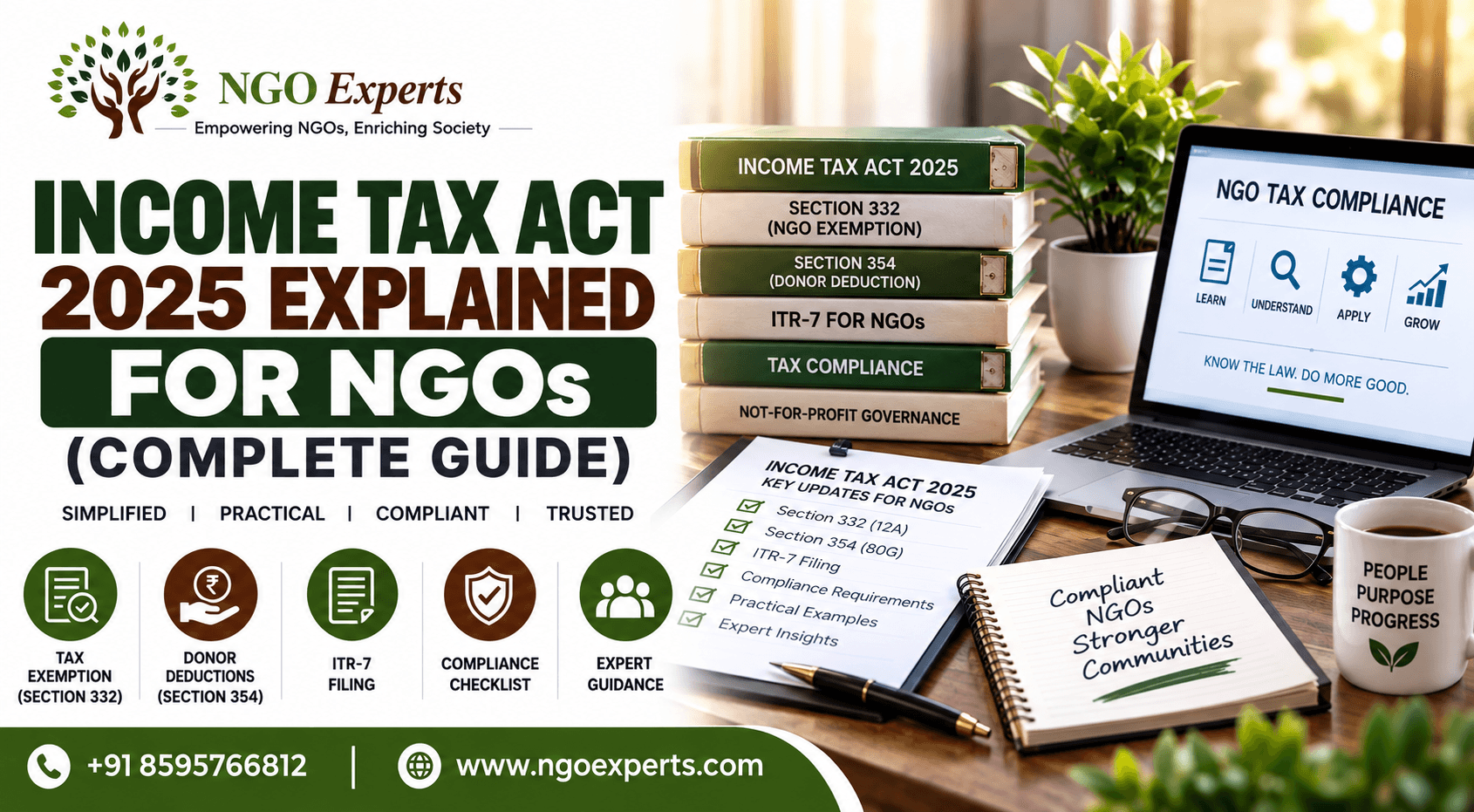
What Is the Income Tax Act 2025?
Why Did the Government Rename These NGO Tax Sections?
What Is an RNPO?
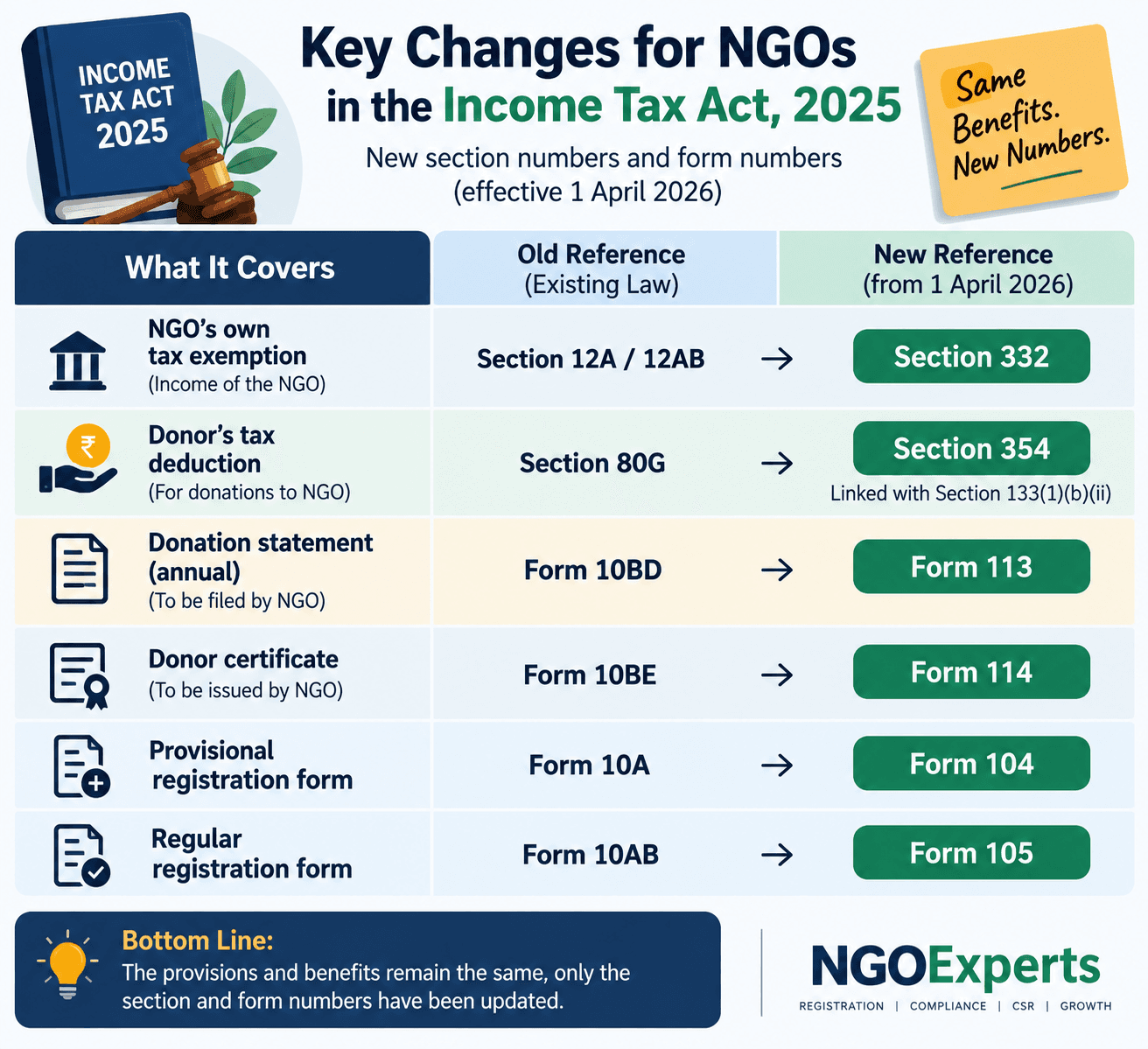
What Changed: Old Sections vs New Sections
| What It Covers | Old Reference | New Reference (from 1 April 2026) |
| NGO's own tax exemption | Section 12A / 12AB | Section 332 |
| Donor's tax deduction | Section 80G | Section 354, linked with Section 133(1)(b)(ii) |
| Donation statement (annual) | Form 10BD | Form 113 |
| Donor certificate | Form 10BE | Form 114 |
| Provisional registration form | Form 10A | Form 104 |
| Regular registration form | Form 10AB | Form 105 |
What Are the New Forms, and When Do You Use Them?
- Form 104 — for provisional registration or approval, used by NGOs that haven't started activities yet
- Form 105 — for regular registration, renewal, or converting from provisional to regular status
- Form 106 — used by the department for orders related to provisional registration or approval
- Form 107 — used by the department for regular grant, rejection, or cancellation orders
Is Your NGO Ready for the New Tax Rules?
Get help reviewing your NGO's registration, tax exemptions, forms, renewals, and annual compliance under the Income Tax Act 2025.
How Long Does Registration Last Now: Timeline
| Registration Type | Validity |
| Provisional (new NGOs) | 3 years |
| Regular, income above ₹5 crore a year | 5 years |
| Regular, income ₹5 crore or below | 10 years |
| Section 354 (80G) approval | 5 years, regardless of NGO size |
What Other Rules Should NGOs Know About?
- The 85% income-application rule. Under Section 11(1) of the earlier law, and carried forward under the new Act, a registered NGO must apply at least 85% of its income toward its charitable objects each year, or risk losing part of its exemption.
- Accreted income tax (exit tax). If an NGO's registration is canceled, rather than simply left to lapse, it can face a one-time tax on its accumulated net assets, a much bigger financial hit than a routine missed renewal.
- Annual donation reporting. Form 113 (the new name for Form 10BD) must be filed every year, even as a nil return if there were no qualifying donations, or a penalty of ₹200 per day can apply under Section 234G.
- One-time reapplication after rejection. Under Rule 181(12), an NGO whose Form 105 application is rejected via Form 107 may reapply within one month in specified cases, such as missing documents or a corrected trust deed issue.
What Should NGOs Do Right Now?
- Check your current registration's expiry date, since that date, not the new law's start date, determines when you need to act
- Update internal references gradually, from "12A" and "80G" to Section 332 and Section 354, especially on donor-facing documents
- Keep filing Form 113 annually, regardless of which section your registration technically falls under
- Plan renewals using Form 105, at least 6 months before your registration expires
- Don't refile early out of confusion, since a valid, unexpired registration continues without needing fresh action
Need Help With NGO Tax Registration or Compliance?
Our NGO compliance experts can help you with 12A, 80G, income-tax compliance, renewals, and related NGO registrations.
Frequently Asked Questions
Does the Income Tax Act 2025 cancel my NGO's existing registration?
What is Section 332 under the new Income Tax Act?
What is Section 354 under the new Income Tax Act?
What does RNPO stand for?
Which form replaced Form 10A and Form 10AB?
Do I need to refile if my registration is still valid?
What happens if I miss filing Form 113 in a year with no donations?
Author
A Content Strategist at NGOExperts, who focuses on NGO registration, 12A and 80G registration, FCRA compliance, income tax filing for non-profits, and CSR funding guidelines in India. I research and write our compliance guides in collaboration with our in-house Chartered Accountants and Company Secretaries, so every article reflects current tax and regulatory requirements for the NGO and non-profit sector.
Written by Aabha Garg. Last updated on October 13, 2026