

Ready to Register Your Section 8 Company in Delhi?
Get expert assistance with eligibility, documentation, name approval, MCA filing, and the complete Section 8 Company registration process.
What Is a Section 8 Company?
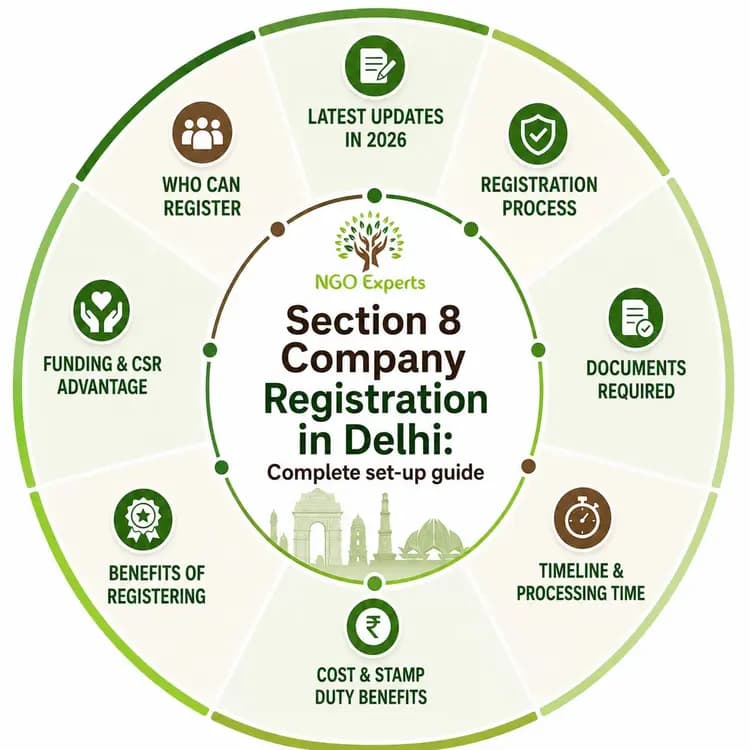
Latest Update on Section 8 Company Registration in Delhi
- MCA notified the draft Companies (Incorporation) Amendment Rules, 2026 on 8 April 2026 — the biggest incorporation change since SPICe+ was launched. It cuts 9 forms down to 2, and for the first time lets a Section 8 Company limited by guarantee convert into one limited by shares.
- Companies Compliance Facilitation Scheme, 2026 (Circular No. 01/2026, 24 Feb 2026) gives Section 8 Companies with pending ROC filings a limited window to catch up at a lower penalty.
- The Section 8 license now comes bundled with the Certificate of Incorporation through SPICe+ Part B. The older, separate INC-12 filing was dropped back in 2019, which keeps Delhi filings quick.
- Average incorporation time right now: 12–18 working days, since Delhi's ROC, which also handles Haryana filings, is known for relatively efficient processing.
- Delhi fully exempts Section 8 Companies from state stamp duty on the MoA/AoA, unlike states such as Tripura or Andhra Pradesh, which makes registering here noticeably cheaper.
- Scale of the sector: ~1.87 lakh NGOs are registered on NGO Darpan nationwide, and Delhi, home to major corporates, media houses, and e-commerce companies, is one of the biggest sources of CSR funding for non-profits in India.
Steps for Section 8 Company Registration in Delhi
- Reserve a name: Pick a unique name for the company using SPICe+ Part A (RUN), making sure it follows Section 8 naming rules, whether you're registering from New Delhi, Rohini, or Vasant Kunj.
- Get DSCs: Obtain Digital Signature Certificates (DSC) for all proposed subscribers so that they can sign forms electronically.
- Draft supporting documents: Prepare DIR-2 and supporting documents, including consent letters, your objects clause, and financial projections.
- File SPICe+ Part B: Submit along with e-MoA (INC-33), e-AoA (INC-34), and AGILE-PRO for PAN, TAN, and other registrations.
- Submit to the ROC, NCT of Delhi and Haryana: This single ROC office handles filings for both Delhi and Haryana, and is generally quicker than ROCs in less-active states. Since Delhi exempts stamp duty, this step is simpler and cheaper than in many other states.
- Get your Certificate of Incorporation, along with PAN, TAN, and CIN, once the ROC approves your filing.
- Complete post-incorporation registrations: Apply for 12A and 80G and NGO Darpan, plus CSR-1 on the MCA portal, to unlock tax benefits and CSR/government funding, especially useful given Delhi's dense concentration of CSR-active corporates.
Benefits of Registering a Section 8 Company in Delhi
- No stamp duty at all: Delhi fully exempts Section 8 Companies from MoA/AoA stamp duty, which is a real cost saving compared to many other states
- A legal identity of its own: the company can own property, sign contracts, and sue or be sued in its own name, whether your office is in Connaught Place, Nehru Place, or Dwarka
- Tax exemptions under Sections 12A/12AB and 80G of the Income Tax Act, once applied for
- No minimum capital needed to get started
- Limited liability for directors and members
- Access to India's biggest CSR pool: Delhi NCR's concentration of corporates, IT firms, and media houses in areas like Nehru Place, Karol Bagh, and Saket makes it easier to find CSR partners
- A strong professional ecosystem: Delhi has one of the highest concentrations of company secretaries, chartered accountants, and legal experts in India, useful whether you're in South Delhi, North Delhi, or East Delhi
- Higher credibility with donors, CSR-funding corporates, government bodies, and international grant agencies
- The company keeps running even if members or directors change
- Eligibility for government schemes, grants, and CSR funding, especially once you register on NGO Darpan and, where relevant, get FCRA approval
Funding & CSR Advantages of a Section 8 Company in Delhi
- Strong CSR ecosystem: Delhi NCR is home to many large companies, PSUs, and corporate offices, creating more opportunities for CSR partnerships
- CSR funding eligibility: Eligible Section 8 Companies can receive CSR funds for approved social development activities
- CSR-1 registration: Filing Form CSR-1 with the MCA is essential for eligible entities seeking to undertake CSR activities on behalf of companies
- High-demand sectors: Education, healthcare, skill development, women empowerment, and livelihoods offer significant opportunities for CSR projects
- Corporate networking: Being based in Delhi can make it easier to connect with CSR teams, foundations, and corporate decision-makers
- Other funding options: With registrations such as 12AB, 80G, and NGO Darpan, organisations can explore government schemes, grants, and other funding opportunities
Planning a Section 8 Company in Delhi?
Understand the registration fees, required documents, timeline, and MCA process before you begin.
Eligibility Criteria for Section 8 Company Registration in Delhi
- At least 2 directors for a private company (3 for a public company); at least one must live in India (182+ days in the past year)
- A charitable or non-profit goal: the main purpose must be things like education, healthcare, poverty relief, art, science, sports, social welfare, research, religion, or the environment
- No profit-sharing: the company can't distribute dividends or profits to its members or shareholders
- No minimum paid-up capital, though any subscribed capital must be deposited within 60 days of incorporation
- A registered office in Delhi (owned or rented, with valid proof and NOC)
- Not allowed as a One Person Company (OPC): under Companies (Incorporation) Rules, 2014, Rule 3, an OPC can't be registered as, or converted into, a Section 8 Company
- Section 8 license approval, now granted along with the Certificate of Incorporation via SPICe+ Part B, confirming eligibility under the Companies Act, 2013
Documents Required for Section 8 Company Registration in Delhi
- PAN card of all proposed directors/members
- Identity proof (Aadhaar, Voter ID, or Passport)
- Address proof (bank statement, electricity bill, not older than 2 months)
- Passport-size photographs
- Registered office proof: electricity bill, rent agreement or ownership document, and NOC from the property owner
- Digital Signature Certificate (DSC) for all subscribers
- Draft Memorandum of Association (MoA) and Articles of Association (AoA) stating charitable objectives
- Projected annual income and expenditure statement for the next 3 years
- DIR-2 consent to act as director, from each proposed director
Cost & Timeline for Section 8 Company Registration in Delhi
| Stage | Cost (₹) | Timeline |
| Digital Signature Certificate (DSC), 2 directors | 800 – 1,200 | 1–2 working days |
| Name Reservation (SPICe+ Part A / RUN), govt fee | 1,000 | 1–2 working days |
| DIR-2, MoA/AoA drafting (no stamp duty in Delhi) | 500 – 1,000 | 2–3 working days |
| SPICe+ Part B, e-MoA, e-AoA, AGILE-PRO filing, ROC/govt fees | 1,200 – 2,000 | 4–6 working days |
| PAN & TAN application | 200 – 300 | Issued with incorporation |
| Professional/consulting fees | 4,300 – 8,500 | Runs alongside all stages |
| Total | ₹8,000 – ₹15,000 | 12–18 working days |
Need Help Registering a Section 8 Company in Delhi?
Our experts can guide you from document preparation to MCA approval and post-registration compliance.
Frequently Asked Questions
How long does Section 8 Company registration take in Delhi?
Is stamp duty payable for Section 8 Company registration in Delhi?
Can a Section 8 Company in Delhi earn income?
Is minimum capital required for a Section 8 Company in Delhi?
Can a Section 8 Company in Delhi receive CSR funding?
Do I need 12A/12AB and 80G separately after incorporation?
Author
A Content Strategist at NGOExperts, who focuses on NGO registration, 12A and 80G registration, FCRA compliance, income tax filing for non-profits, and CSR funding guidelines in India. I research and write our compliance guides in collaboration with our in-house Chartered Accountants and Company Secretaries, so every article reflects current tax and regulatory requirements for the NGO and non-profit sector.
Written by Aabha Garg. Last updated on September 19, 2026