
Quick Answer
To register a Section 8 company in India, choose the company’s objectives and name, arrange the required directors and subscribers, prepare the documents, and apply through the Ministry of Corporate Affairs. The company must meet the Companies Act, 2013 requirements and use its income for its approved objectives. Fees and approval time depend on the application and any corrections needed.
A Section 8 Company can be registered by choosing a suitable name, obtaining DSC and DIN, preparing the required documents, filing the SPICe+ incorporation forms with the ROC, and obtaining the Certificate of Incorporation. After registration, the company must complete applicable post-registration and compliance requirements.
What Is a Section 8 Company?

Real-Life Example
What Are the Key Benefits of a Section 8 Company?
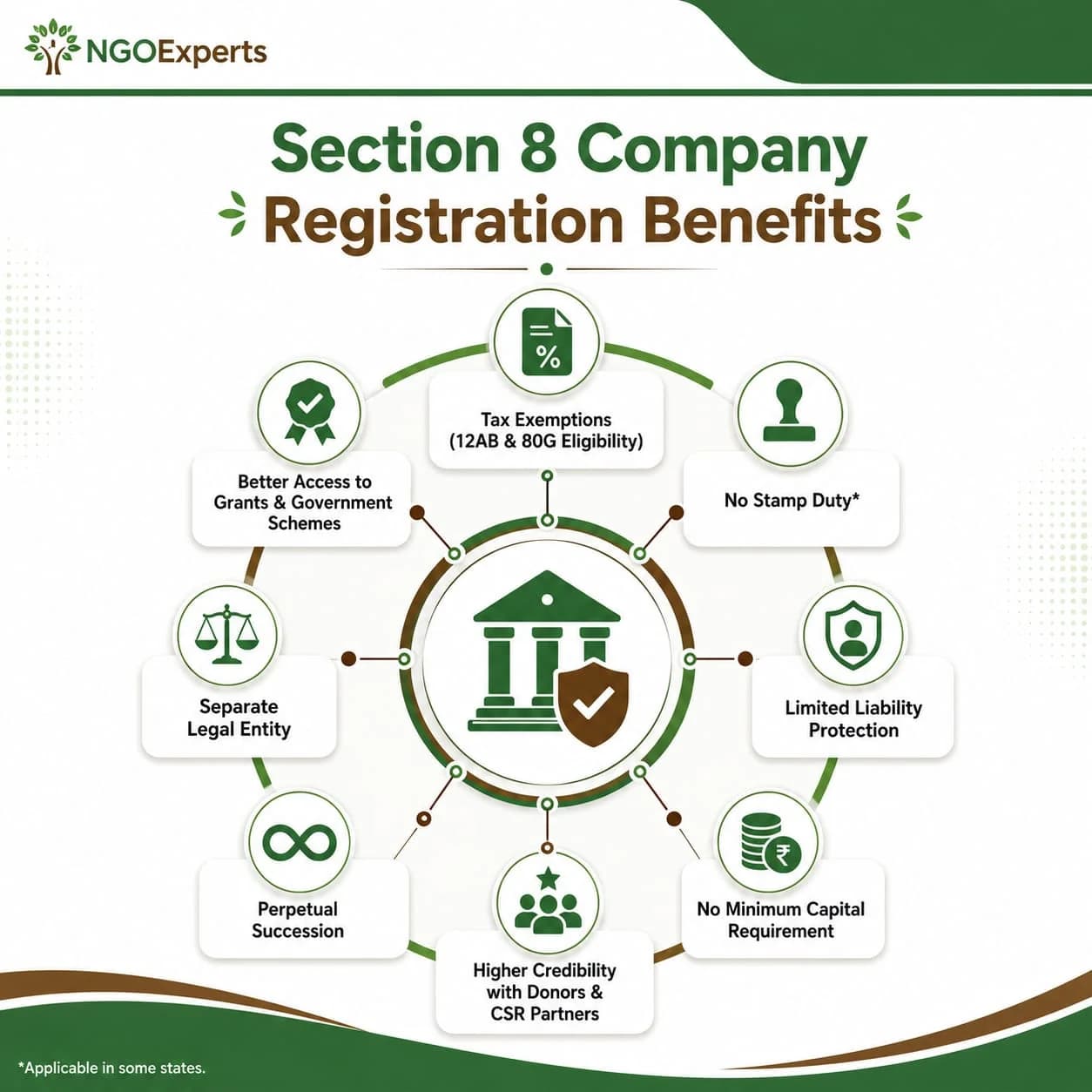
- Eligible to apply for tax exemptions like 12A and80G
- 80G
- No stamp duty on incorporation papers in some states
- Limited liability: Directors aren't personally responsible for company debts
- No minimum capital needed to start
- Higher credibility with companies, donors, and the government
- Perpetual succession: The company survives even if members change
What Activities Can a Section 8 Company Do?
- Education and skill development
- Healthcare and medical relief
- Social welfare and charity
- Religion, art, and culture
- Science, research, and sports
- Environment protection
- Women's and child welfare, rural development
What Laws Govern Section 8 Company Registration?
- Companies Act, 2013, Section 8: the core law allowing charitable companies
- Companies (Incorporation) Rules, 2014, Rules 19 & 20: what the Registrar checks before approval
- SPICe+: the single online MCA form for name approval, incorporation, PAN, and TAN
- CSR-1: must be filed online only via the MCA portal, needed to receive CSR funds (since July 2025)
- 12A and 80G: separate Income Tax Act approvals, applied for after incorporation
Who Is Eligible to Register a Section 8 Company?
- Purpose must be charitable or for social welfare, with no profit paid to members.
- At least 2 directors and 2 members for a private company
- At least 3 directors and 7 members for a public company
- Directors should usually be Indian residents (foreign nationals allowed with extra compliance)
- A license from the Registrar of Companies (RoC) confirming charitable status.
What Documents Are Needed for a Section 8 Company Registration?
- PAN, Aadhaar, and photograph of all directors and members
- Address proof and Digital Signature Certificate (DSC) for each director
- Consent to act as director, plus MCA declarations
- Utility bill and rent agreement (if rented) for the registered office
- NOC from the property owner
- Proposed company name and main objects (activities)
What Is the Registration Fee and Timeline for a Section 8 Company?
| Particulars | Indicative Cost | Timeline |
| DSCs for 2 directors | ₹3,000 | 1–2 days |
| Name reservation & MCA filing | ₹1,000 | 1–3 days |
| Drafting MOA, AOA & incorporation docs | ₹2,999 | 2–4 days |
| Government fee & state stamp duty | ₹1,000–₹2,000 | Varies by state |
| PAN, TAN & Certificate of Incorporation | Included | With RoC approval |
| Total estimated cost | ₹8,000–₹15,599 | 10–20 working days |
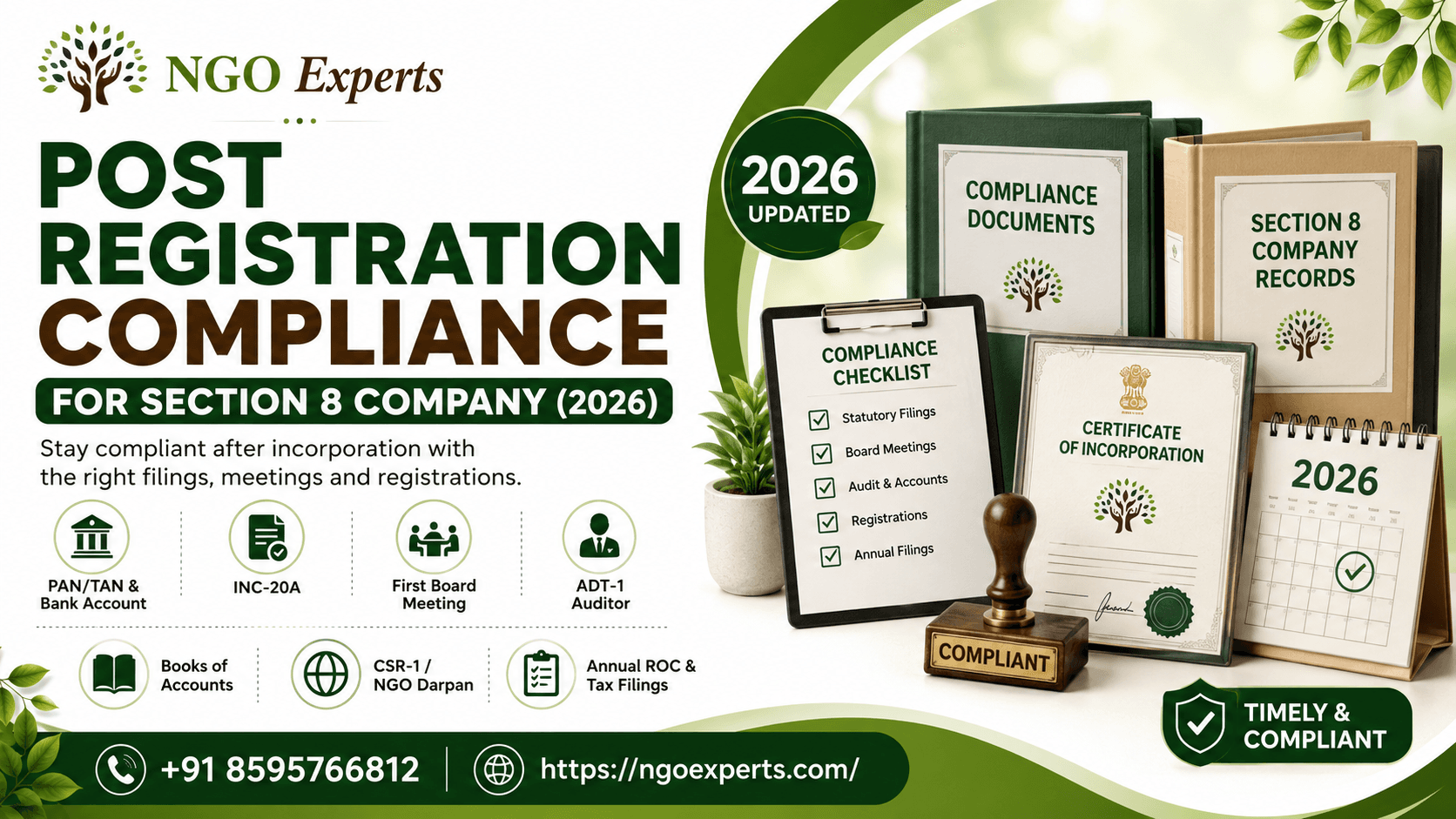
What Compliance Is Needed After Registration for a Section 8 Company?
- Open a bank account for donations and grants
- Set up proper accounting from day one
- Apply for 12A (tax exemption) and 80G (donor deduction)
- Register on NGO Darpan for government scheme recognition
- Complete CSR-1 registration to receive CSR funds
- File annual ROC returns and income tax returns
- Get yearly audits done for donor transparency
What Mistakes Should You Avoid for a Section 8 Company Registration?
- Picking a name that doesn't match your stated objects
- Copying generic NGO objects instead of writing your own
- Skipping early planning for 12A, 80G, and CSR-1
- Forgetting the NOC from the property owner
- Entering incorrect director or member details
- Ignoring compliance after getting the certificate
- Assuming the certificate alone brings in donations or CSR funds
Frequently Asked Questions
What is Section 8 Company Registration?
Is a Section 8 Company good for NGO registration?
How many people are needed to start one?
Can a Section 8 Company earn income?
Can it receive CSR funding?
Is a Section 8 Company better than a Trust?
Author
A Content Strategist at NGOExperts, who focuses on NGO registration, 12A and 80G registration, FCRA compliance, income tax filing for non-profits, and CSR funding guidelines in India. I research and write our compliance guides in collaboration with our in-house Chartered Accountants and Company Secretaries, so every article reflects current tax and regulatory requirements for the NGO and non-profit sector.
Written by Aabha Garg. Last updated on October 13, 2026