

Looking for CSR Funding for Your NGO?
Get expert guidance on CSR funding opportunities, documentation, and proposal preparation
What Is CSR Funding?
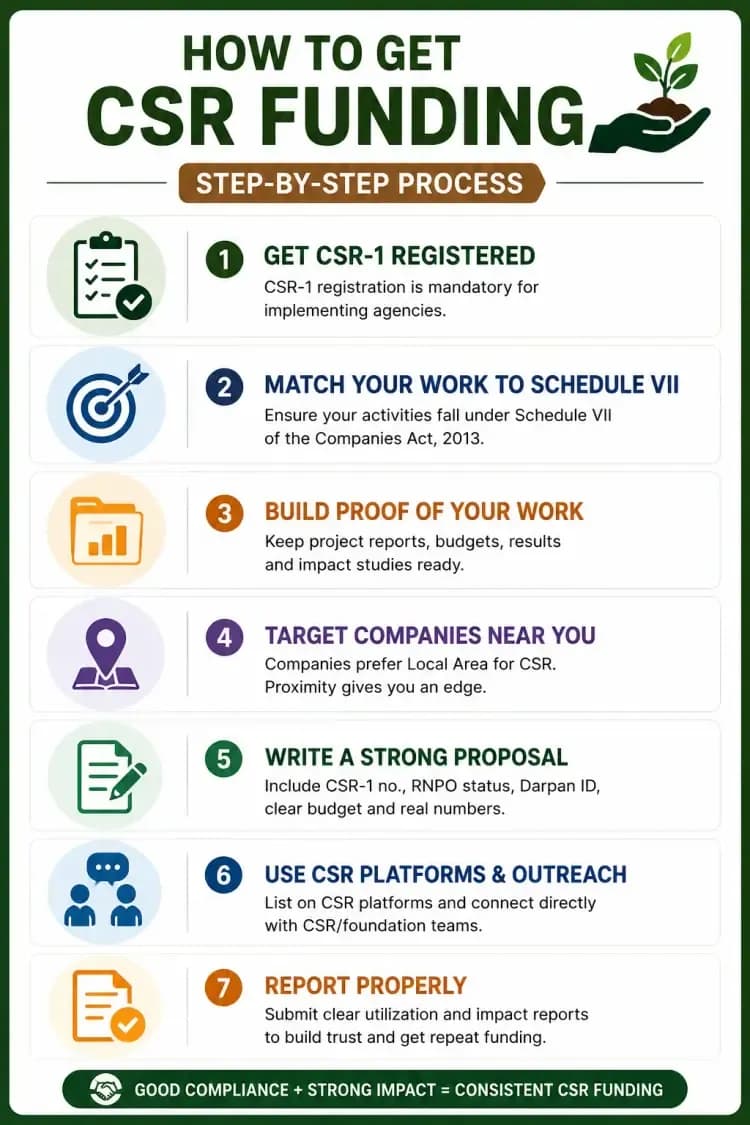
How to Get CSR Funding: Step-by-Step Process
Want to Attract CSR Funding?
We help NGOs prepare professional CSR proposals and improve their chances of connecting with suitable corporate donors.
Latest CSR Funding Updates in 2026
- New CSR Rules, 27 May 2026: The MCA now allows companies to allocate part of their CSR funds through special instruments called "zero coupon zero principal" bonds issued by NPOs listed on the Social Stock Exchange. This is capped at 10% of a company's total CSR spend and skips the usual impact study requirement — a new funding route for listed NPOs.
- CSR-1 Overhaul, July 2025: The old paper form is gone. CSR-1 is now fully online, with tighter rules; professional certification and a 3-year work history are now required before an NGO can legally get funds.
- Easier CSR-2 Filing, May 2025: Companies can now file Form CSR-2 on their own, instead of attaching it to another form. This eases the process for the company.
- Possible New Limits: A pending law, the Companies (Amendment) Bill, 2025, proposes lowering the CSR limits to a net worth of ₹100 crore, a turnover of ₹500 crore, or a net profit of ₹3 crore. If passed, many more mid-sized companies would have to give CSR funds.
- Stricter Checks: The MCA has been sending warning notices to companies that don't meet the 2% CSR spending rule, a sign that both sides of CSR funding are being watched more closely.
Which Companies Must Give CSR Funding?
| Criteria | Limit |
| Net worth | ₹500 crore or more |
| Turnover | ₹1,000 crore or more |
| Net profit | ₹5 crore or more |
| Compulsory CSR spend | At least 2% of average net profit (last 3 years) |
| Impact study needed | If CSR spend is ₹10 crore or more |
CSR Funding Scams NGOs Should Know About
- The ₹800 Crore Scam: Income Tax officers found fake trusts and shell companies across six states that pretended to use CSR funds for real work while diverting them.
- The ₹5,000 Crore Diversion Case: A 2025 probe found money meant for schools and hospitals was shown as "spent" through fake NGOs. Real villagers' and MNREGA workers' identities were misused to fake beneficiary lists.
- The Kerala CSR Scam: One of the biggest cases, over ₹1,000 crore allegedly collected by a group called "National NGO Confederation," which promised cheap scooters and laptops using fake CSR money. Over 34 cases were filed, and the top accused were arrested.
- Fake Hexaware CSR Offer: Scammers faked documents in the name of Hexaware Technologies, offering over ₹100 crore in fake CSR deals to unsuspecting NGOs.
- Tripura NGO Fraud: An NGO allegedly linked to a land mafia stole ₹40 crore by faking education and rubber-trade projects that never existed.
How NGOs Become Eligible for CSR Funding?
- Form CSR-1 registration: Compulsory with the Ministry of Corporate Affairs (MCA) to become a recognised "Implementing Agency." Since July 2025, this has moved fully online, with stricter checks, including sign-off by a practicing CA, CS, or Cost Accountant.
- 3-year track record: Under the new CSR-1 rules, your NGO usually needs 3 years of real, documented work, unless it was set up by the company or a government body itself.
- NGO Darpan ID: Register on the NGO Darpan portal. Companies now treat this as a basic trust check before sending funds.
- RNPO registration (earlier called 12A/80G): Needed for tax exemption. Apply on the Income Tax e-filing portal. Most CSR teams expect this before they'll even consider your NGO.
- Trust, Society, or Section 8 Company registration: Your NGO must already be legally registered as one of these before applying for anything else.
How to Avoid CSR Funding Fraud?
- Never pay any fee or "processing charge" to get CSR funding; real CSR money never asks the NGO to pay first.
- Check a company's CSR claims on its own official website, not through someone who contacts you first.
- Check an NGO's CSR-1 number, Darpan ID, and RNPO status on the official portals before working together.
- Be careful of anyone offering guaranteed funding in exchange for personal details, bank access, or advance payment.
Need Help Getting CSR Funding?
From identifying CSR opportunities to preparing funding documents, get end-to-end support for your NGO
Frequently Asked Questions
Which NGOs can get CSR funding in India?
Is CSR-1 registration compulsory?
How much CSR money do Indian companies give each year?
What's the biggest CSR change in 2026?
Are CSR funding scams common in India?
Can a brand-new NGO get CSR funding?
What kind of work qualifies for CSR funding?
Author
A Content Strategist at NGOExperts, who focuses on NGO registration, 12A and 80G registration, FCRA compliance, income tax filing for non-profits, and CSR funding guidelines in India. I research and write our compliance guides in collaboration with our in-house Chartered Accountants and Company Secretaries, so every article reflects current tax and regulatory requirements for the NGO and non-profit sector.
Written by Aabha Garg. Last updated on September 17, 2026