

Trusts, Societies, and Section 8 Companies claiming exemption under Sections 11, 12, 10(23C), 13A, or 35 must file ITR-7, even with zero tax due. CBDT revised the form for AY 2026-27 with more disclosures. Non-audit NGOs file by 31 July 2026; audited NGOs by 31 October 2026.
Ready to File Your NGO's ITR-7?
Avoid errors, missed deadlines, and compliance issues. Get professional assistance with ITR-7 filing and related NGO tax compliance.
What is an ITR for an NGO?

For an NGO, the Income Tax Return is the annual report of income, how it was spent on charitable work, and how well the organisation followed the conditions of its tax exemption under the Income Tax Act, 1961. It's proof — to the government and to donors — that your Trust, Society, or Section 8 Company is genuinely doing the charitable work that it claims to do.
What is ITR-7?
ITR-7 is the return form for entities filing under Sections 139(4A), 139(4B), 139(4C), and 139(4D) of the Income Tax Act. It checks:
- Your registration approvals (12A/12AB, 80G, 10(23C))
- How income was applied toward charitable purposes, including the well-known 85% application rule
- Details of corpus funds and donors
Why is ITR-7 filing mandatory?
Filing becomes mandatory the moment your NGO claims exemption under Sections 11, 12, 10(23C), 13A, or 35 — even if the final tax liability is nil. It's also how donors, CSR partners, and regulators verify your funds went where you said they would. Skipping it or filing incorrectly puts your 12A and 80G status, FCRA compliance, and CSR-1 eligibility at risk.
As of February 2026, India had roughly 5.25 lakh active NGO Darpan IDs — about half trusts, 42% societies, and 8% Section 8 companies. Nearly all of them fall into the ITR-7 net if they claim any exemption.
What is the latest ITR-7 update for 2026?
CBDT notified the Income-tax (Seventh Amendment) Rules, 2026 on 30 March 2026, revising ITR-7 for AY 2026-27 onward. Key changes:
- Unique Registration Numbers (URN) now required for each approval (12A/12AB, 80G, 10(23C))
- Detailed activity and project disclosure, including whether any activity involves trade or commerce
- Stakeholder/donor-level reporting — founders, trustees, and large contributors
- Mandatory FCRA/SEBI disclosure if the NGO holds either registration
- Sharper fund-application schedules under Section 11 — application, accumulation, and investments
Note: A new Income-tax Act, 2025 came into force on 1 April 2026 and renumbers most sections, but it only applies from Tax Year 2026-27 onward (returns filed in 2027). For the FY 2025-26/AY 2026-27 filing this guide covers, you still use the familiar 1961 Act section numbers.
Which ITR form applies to NGOs?
| Form | Who uses it | NGO relevance |
| ITR-1 to ITR-4 | Individuals, HUFs, presumptive taxpayers | Not for NGOs |
| ITR-5 | Firms, LLPs, AOPs not under 139(4A)–(4D) | Only if not claiming exemption |
| ITR-6 | Companies not claiming Section 11 exemption | Section 8 companies without exemption claims |
| ITR-7 | Trusts, societies, Section 8 companies, political parties | Primary form for tax-exempt NGOs |
Who is required to file ITR-7?
- Charitable/religious trusts and institutions claiming Sections 11 and 12 — filed under 139(4A). (Covers most public trusts, societies, and Section 8 companies.)
- Political parties under Section 13A — filed under 139(4B).
- Specified institutions under Section 10 (research bodies, hospitals, universities) — filed under 139(4C).
- Universities and research institutions under Section 35(1) — filed under 139(4D).
Who is eligible to file ITR-7?
- Registered as a trust, society, or Section 8 company under applicable Indian law.
- Claiming exemption under Sections 11/12, 10(23C), 13A, or a similar provision.
- Earning income from property held for charitable purposes, donations, or grants.
- Maintaining proper books of account and financial statements.
What documents are required for ITR-7?
- PAN and registration certificates: Trust deed, society registration, Section 8 license, 12A/12AB, 80G, 10(23C), FCRA.
- Audited financials: Balance Sheet, Income & Expenditure Account, Receipts & Payments, with audit report (Form 10B/10BB).
- Donation records, including donor-wise details for larger contributions.
- Bank statements, TDS certificates (Form 16A/26AS), AIS/TIS reconciliation.
- Project, activity, and fund-utilisation records (Form 10).
- Login credentials for the e-filing portal and authorized signatory details.
What is the due date for ITR-7 in AY 2026-27?
| Category | Due date |
| Audit report (Form 10B/10BB) | 30 September 2026 |
| Audited NGOs | 31 October 2026 |
| Non-audit NGOs | 31 July 2026 |
CBDT has extended these dates in past cycles, so check the e-filing portal closer to the deadline for any last-minute change.
How do you file ITR-7 online?
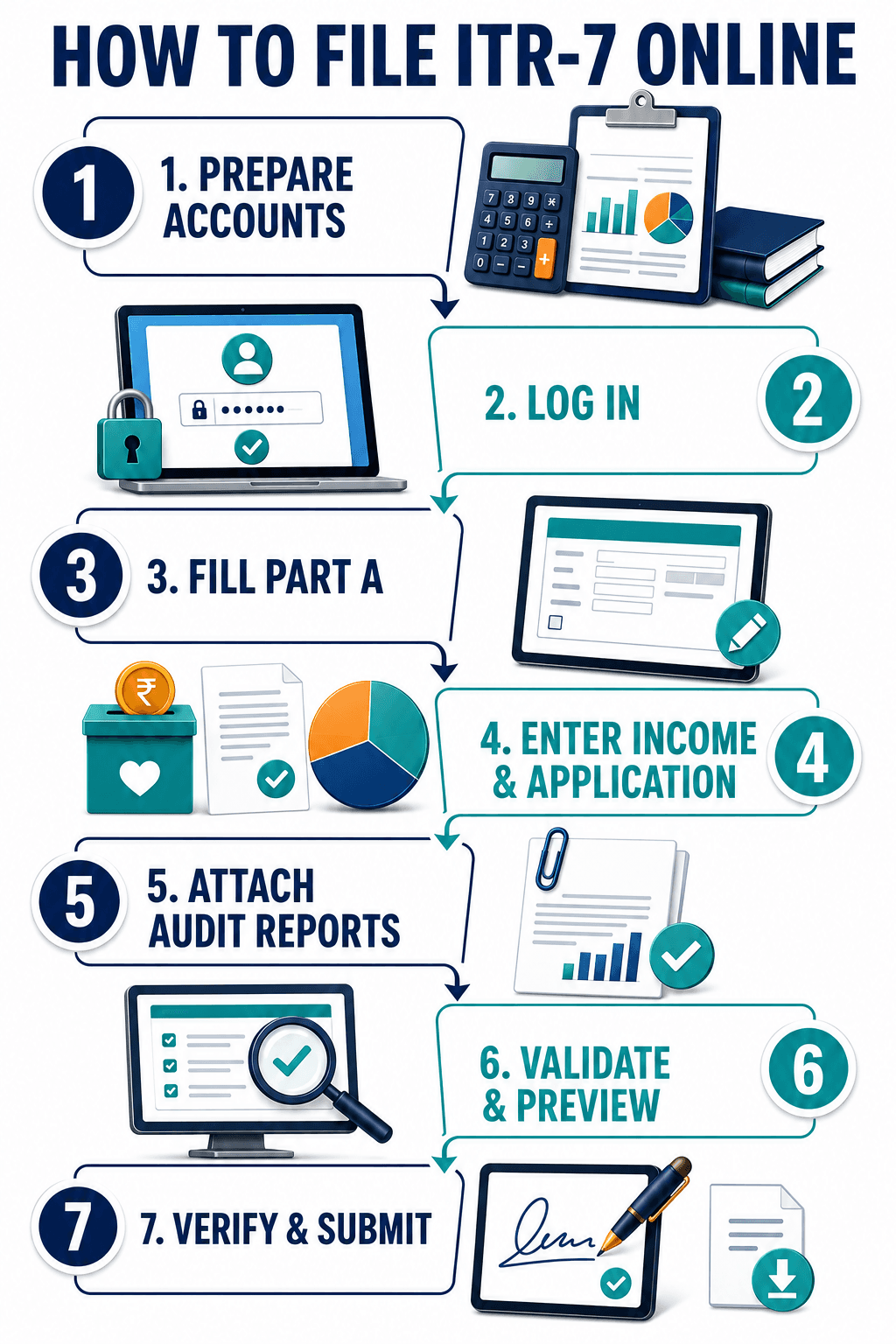
- Prepare: Finalize accounts, complete the audit, and confirm 12A/12AB, 80G, and 10(23C) registrations are current.
- Log in: Use your NGO's PAN on the e-filing portal, select the assessment year, and choose ITR-7.
- Fill Part A: Legal status, registration details, applicable exemption sections, and filing section (139(4A)–(4D)).
- Fill in income and application schedules: Donations, grants, property income, and the 85% application, accumulation, and corpus details.
- Attach audit reports: Link Form 10B/10BB (and Form 3CEB, if applicable) to your PAN for the year.
- Validate and preview: Check for missing fields and confirm the tax computation is correct.
- Verify and submit: Use DSC or EVC, then download the ITR-V acknowledgment for your records.
What common mistakes do NGOs make while filing ITR-7?
- Filing ITR-5 or ITR-6 instead of ITR-7 despite claiming exemption.
- Missing income streams like interest or capital gains, assuming they're automatically exempt.
- Incomplete reporting of the 85% application requirement.
- Late or unlinked audit report (Form 10B/10BB).
- Skipping donor-wise, corpus vs non-corpus, or foreign contribution details.
- Filing after the due date.
What is the penalty for late or non-filing of ITR-7?
Late filing can attract a fee under Section 234F, interest under Sections 234A/B/C if tax is payable, and — in serious cases — loss of exemption under Sections 11, 12, or 10(23C), making otherwise exempt income taxable. Repeated or serious misreporting can also invite penalties under Section 270A, along with real damage to donor and CSR confidence.
What is the ITR-7 filing checklist for NGOs?
- Registration certificates and 12A/12AB, 80G, 10(23C), FCRA approvals in place.
- Final accounts and audit report completed before due dates.
- Correct section mapping: 139(4A)–(4D) matched to 11/12, 10(23C), 13A, or 35.
- Every income source recorded and classified: corpus vs non-corpus, domestic vs foreign.
- Accurate 85% application, accumulation, and donor-wise details.
- Portal profile updated, DSC/EVC ready, return validated with zero errors.
Need Help Understanding Your NGO's ITR-7 Compliance?
Learn about ITR-7 filing, Form 10B/10BB, 12A/12AB compliance, and the documents required to complete your NGO's income tax filing correctly.
Frequently Asked Questions
Which ITR form applies to NGOs in India?
Most trusts, societies, and Section 8 companies claiming exemption under Sections 11, 12, or 10(23C) must file ITR-7.
Is ITR filing mandatory even with no taxable income?
Yes, entities claiming exemption must file ITR-7 even when tax liability is nil, to preserve their exemption status.
What's new in ITR-7 for AY 2026-27?
CBDT's 2026 amendment added URN details, activity-level reporting, stakeholder disclosure, FCRA/SEBI cross-checks, and sharper fund-application schedules
Can a Section 8 company file ITR-7?
Yes, if it claims exemption under Section 11 or similar. Otherwise, it may fall under ITR-6.
What happens if an NGO misses the deadline?
Late fees, interest, and possible loss of exemption for that year, plus reduced donor and CSR confidence.
Author
Aabha Garg
A Content Strategist at NGOExperts, who focuses on NGO registration, 12A and 80G registration, FCRA compliance, income tax filing for non-profits, and CSR funding guidelines in India. I research and write our compliance guides in collaboration with our in-house Chartered Accountants and Company Secretaries, so every article reflects current tax and regulatory requirements for the NGO and non-profit sector.
Written by Aabha Garg. Last updated on September 11, 2026