

Can Students Register an NGO in India?
Yes, students can be involved in starting an NGO, but the registration process depends on the legal structure and eligibility requirements. Learn how students can turn their social ideas into a registered organisation.
Can Students Register an NGO in India?
What is NGO Registration for Students?
Can Students Legally Register an NGO in India?
- Age: Generally 18+ to sign documents and hold a founder role.
- Purpose: Must be charitable — education, health, environment, and similar.
- Profit rule: No profit to founders; funds go back into the cause.
- Team size: Trust = 2 trustees, Society = 7 members, Section 8 = 2 directors.
- Documents: PAN, Aadhaar, address proof, office proof, photos.
What If a Student Is Under 18?
Which NGO Structure Should a Student Pick?
| Feature | Trust | Society | Section 8 Company |
| Best for | Small student charity | College group, 7+ members | CSR funding, credibility |
| Minimum people | 2 trustees | 7 members | 2 directors |
| Governing law | Indian Trusts Act, 1882 | Societies Registration Act, 1860 | Companies Act, 2013 |
| Main document | Trust Deed | MOA + Rules | MOA + AOA |
| Filing authority | Sub-Registrar | Registrar of Societies | MCA (SPICe+) |
| Compliance load | Low | High | Medium |
| Funding image | Basic | Good | Strongest |
Not Sure Which NGO Structure Is Right for You?
Students can explore options such as a Trust, Society, or Section 8 Company. Understand the differences, eligibility, documents, and registration process before choosing the right structure.
What Documents Does a Student Need?
- PAN and Aadhaar of every founder
- Passport-size photos
- Address proof
- Office proof (rent agreement/utility bill), an NOC from the property owner
- The main legal document (Trust Deed/MOA/AOA)
- For Section 8 only: Digital Signature Certificates for directors
How Does a Student Register an NGO?
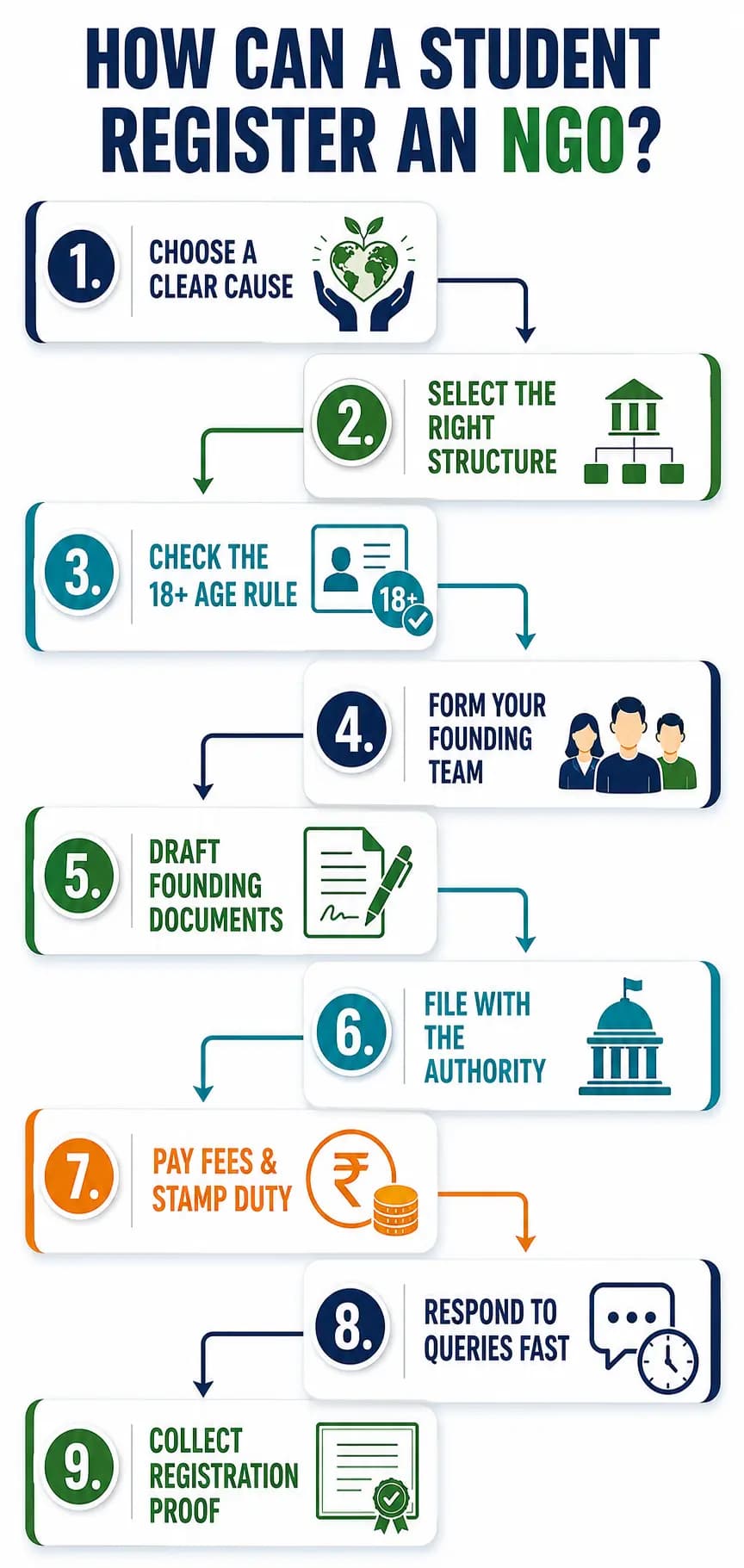
- Choose one clear cause: Free tuition, food support, or a clean-up drive, instead of a vague mission.
- Choose the right structure: Match Trust, Society, or Section 8 Company to your team size and funding goal.
- Check the age rule: Confirm every listed founder is 18+, or add an adult co-founder.
- Bring your co-founders on board: Line up the minimum trustees, members, or directors the structure needs.
- Draft the founding document: The Trust Deed, MOA, Rules, or AOA should state the objectives, management rules, and a no-profit clause.
- File with the right authority: Trusts go to the Sub-Registrar, Societies to the Registrar of Societies, and Section 8 Companies to the MCA via SPICe+.
- Pay the government fee and stamp duty: Amounts vary by state and structure.
- Respond quickly to any query: Most delays happen when founders sit on a clarification request.
- Collect your registration proof: This is the registered Trust Deed, Society Certificate, or Certificate of Incorporation.
Cost and Timeline
- Trust: ₹15,000–₹25,000, 1–3 weeks.
- Society: ₹10,000–₹25,000, 3–6 weeks.
- Section 8 Company: ₹8,000–₹15,000, 2–4 weeks via SPICe+.
What to Do After Registering
- Apply for RNPO status (formerly 12A/80G). Since 1 April 2026, the Income-tax Act, 2025 replaced 12A/80G with RNPO registration (Sections 332–355). Form 10A is now Form 104; Form 10AB is now Form 105. Valid for 5 years, or 10 if income stayed under ₹5 crore in each of the prior two years.
- Register on NGO Darpan for a unique ID most grants require.
- File CSR-1 with the MCA to receive CSR funds.
- Apply for FCRA later, once you have a compliance track record.
- File ITR-7 every year by 31 October, even if tax-exempt.
- File annual returns with your authority and keep Darpan/CSR-1 updated.
Real-Life Example
Bhumi & Make A Difference
Common Mistakes
- Vague objectives
- Ignoring the age rule
- Picking the wrong structure for future CSR plans
- Mixing personal and NGO money
- Skipping RNPO or NGO Darpan registration
- Applying for CSR too early
- Not keeping activity proof
- Treating registration as the finish line rather than year one
Ready to Turn Your Social Idea Into an NGO?
Get expert assistance with choosing the right structure, preparing documents, and completing your NGO registration process correctly.
Frequently Asked Questions
Can a college student under 18 start an NGO in India?
Is a Section 8 company better than trust for a student?
Can student run an NGO while being a full-time student?
How much money do I need to start an NGO?
Can student run an NGO from home in India?
Author
A Content Strategist at NGOExperts, who focuses on NGO registration, 12A and 80G registration, FCRA compliance, income tax filing for non-profits, and CSR funding guidelines in India. I research and write our compliance guides in collaboration with our in-house Chartered Accountants and Company Secretaries, so every article reflects current tax and regulatory requirements for the NGO and non-profit sector.
Written by Aabha Garg. Last updated on July 24, 2026