
NGO Experts Logo
NGO

NGO Registration in India: Process, Fees & Latest Rules(2026)

July 22, 20266 min read603 views
NGO Registration in India: Process, Fees & Latest Rules(2026)
Share
Starting an NGO in India in 2026 is a powerful way to work in education, health, women empowerment, or the environment. Still, registration decides whether you can open a bank account, get CSR funds, claim tax exemption, or accept foreign donations. This guide covers NGO types, differences, documents, process, real fees, and the latest 2026 FCRA updates in simple language.
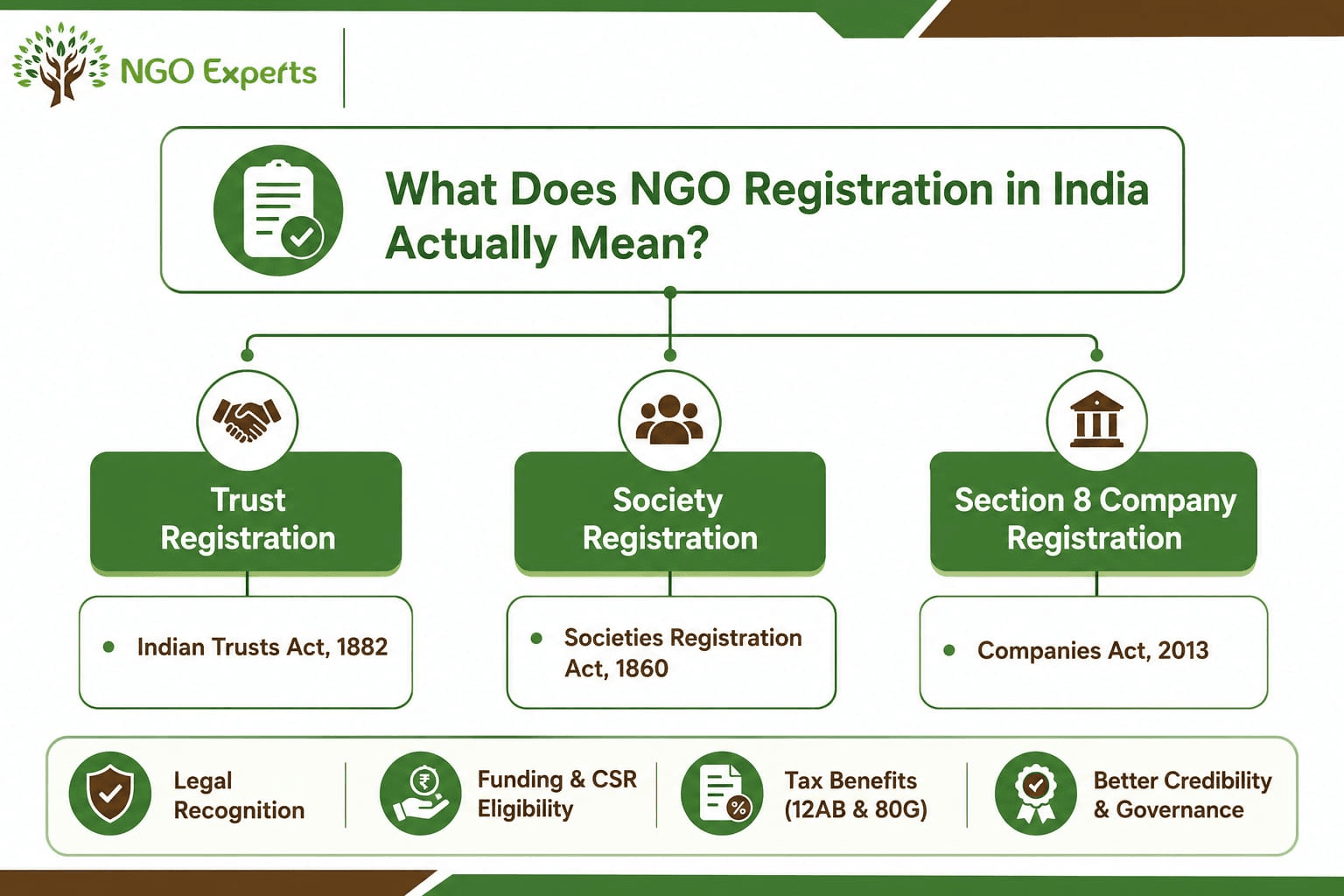
An NGO in India is commonly registered as a Trust, Society, or Section 8 Company. A Trust is often suitable for locally managed charitable work. A Society is useful for a member-based organisation. A Section 8 Company offers a more formal corporate structure. The documents, cost, and registration time depend on the structure, state, founders, and proposed activities.

Not Sure How to Register an NGO in India?

Learn the right registration process, documents, and legal structure before you begin.

What Is NGO Registration in India?

NGO registration is the legal process of setting up a non-profit organization in India as a Trust, Society, or Section 8 Company so that it can operate as a recognized legal entity instead of an informal group of people.
Once registered, your NGO can:
  • Open a bank account in its own name.
  • Apply for PAN and TAN, and claim tax exemption under 12A and 80G.
  • Receive CSR funds from companies and government grants.
  • Apply for FCRA to accept foreign donations legally.
  • Get an NGO Darpan ID for grants, CSR eligibility, and bank KYC.
  • Own property, sign contracts, and hire staff in the NGO's name.
Without registration, a group cannot legally raise public funds, sign agreements, or receive tax-exempt donations.

What Are the Types of NGO Registration in India?

There are three most commonly used NGO structures in India. You should pick one based on funding goals, not just budget.
  • Trust: Indian Trusts Act, 1882; minimum 2 trustees; ideal for small, family-led charitable work.
  • Society: Societies Registration Act, 1860; minimum 7 members; suited to education, culture, and membership groups.
  • Section 8 Company: Companies Act, 2013 via MCA; minimum 2 directors; best for CSR funding, foreign grants, and scale.

What Is the Difference Between Trust, Society and Section 8 Company Registration in India?

Founders often confuse these three structures, so here's the real comparison.
FeatureTrustSocietySection 8 Company
Governing LawIndian Trusts Act, 1882Societies Registration Act, 1860Companies Act, 2013
Minimum Members272
Registering AuthoritySub-RegistrarRegistrar of SocietiesMCA (SPICe+ portal)
Governing DocumentTrust DeedMOA & RulesMOA & AOA
Annual ComplianceLowModerateHigh (ROC filings)
Best ForLocal charity workEducation/cultural bodiesCSR, FCRA, large-scale NGOs
Credibility with DonorsModerateModerateHighest

Confused Between Trust, Society & Section 8 Company?

Get expert guidance to choose the right NGO structure based on your objectives, funding plans, and long-term goals.

What Are the Benefits of NGO Registration in India?

An unregistered group can never access funding, so here is the list of benefits of registering an NGO in India.
  • Legal identity to own property, open a bank account, and sign contracts.
  • 12A and 80G tax exemption for the NGO and its donors.
  • Access to CSR-1, government grants, and NGO Darpan-linked schemes.
  • Eligibility to apply for FCRA and receive foreign contributions.
  • Builds public and donor trust through audited operations.

Who Is Eligible for NGO Registration in India?

Basic founder and structure requirements before applying for NGO Registration:
  • Minimum 2 trustees (Trust), 7 members (Society), or 2 directors (Section 8 Company).
  • Founders must be 18+, of sound mind, and not convicted of financial fraud.
  • At least one founder/director should ideally be an Indian resident.
  • The objective must be strictly non-profit, charitable, religious, educational, or social welfare.
  • A valid registered office address (owned or rented, with NOC) is mandatory.

What Documents Are Required for NGO Registration in India?

Missing documents are the main cause of rejection or delay in NGO registration.
  • PAN and Aadhaar of all trustees/members/directors.
  • Passport-size photographs of founders.
  • Office address proof (electricity bill/rent agreement + NOC).
  • Trust Deed, or MOA & Rules, or MOA & AOA (as per structure).
  • DSC and DIN, for Section 8 company only.
  • Affidavits/declarations confirming no criminal background.

What Is the Process for NGO Registration in India?

NGO registration means picking a structure, drafting the deed or MOA, filing with the right authority, and finishing post-registration steps like PAN and Darpan.
Step 1: Select the Correct Structure. Choose between a Trust, Society, and Section 8 Company based on your management, funding, and compliance needs.
Step 2: Decide the Name. Select a clear and unique name. Avoid names that are already registered, trademarked, or misleading.
Step 3: Write the Charitable Objects. Clearly explain what the NGO will do, who it will help, and where it will operate. Vague, commercial, or conflicting objects may delay the registration or later tax applications.
Step 4: Prepare Founder Documents. Collect identity proof, address proof, photographs, and other required declarations.
Step 5: Arrange the Registered Office. Prepare the utility bill, rent agreement, and owner's NOC, where applicable.
Step 6: Draft the Governing Document. Prepare the:
  • Trust Deed for a Trust;
  • Memorandum and Rules or Bye-laws for a Society; or
  • MOA and AOA for a Section 8 Company.
Step 7: File the Registration Application. File the application with the relevant authority:
  • Sub-Registrar or state authority for a Trust;
  • Registrar of Societies for a Society; or
  • Registrar of Companies through the MCA system for a Section 8 Company.
Step 8: Obtain the Registration Certificate. After approval, the authority issues the registration certificate or Certificate of Incorporation.
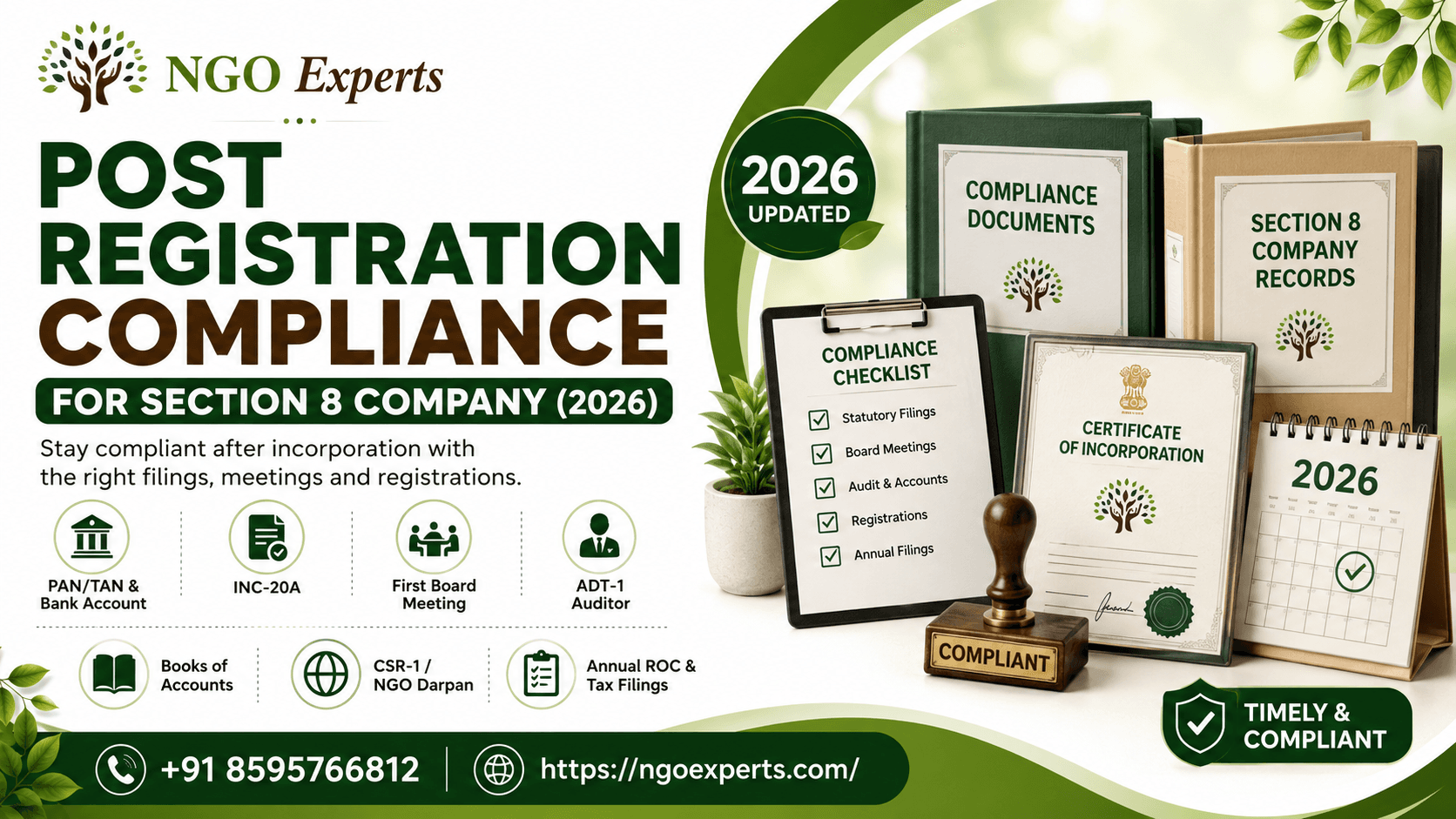
Step 9: Complete PAN, Bank and Accounting Setup. Obtain or confirm PAN and TAN, where applicable. Open the NGO's bank account and start maintaining proper accounting records.
Step 10: Apply for Additional Registrations. Depending on the NGO's activities, apply for:
  • Income-tax registration and donation-deduction approval;
  • NGO Darpan ID;
  • CSR-1;
  • FCRA registration or prior permission;
  • Professional Tax, Shops and Establishment, GST, or other activity-based registrations, where applicable.

What Changed for NGO Tax Registration in 2026?

In 2026, NGO tax registration rules changed with the introduction of new forms, section numbers, and compliance requirements.
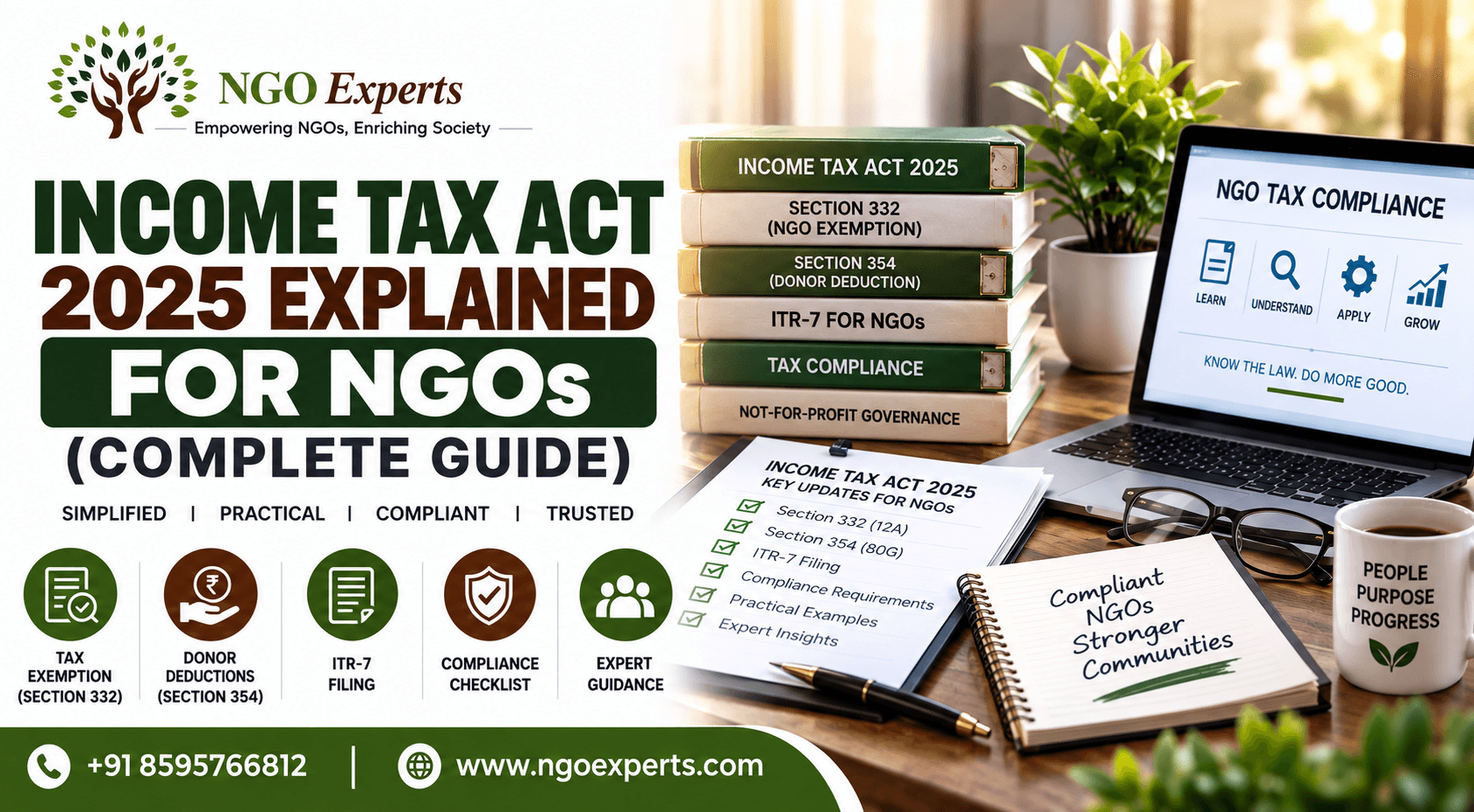
  • The Income-tax Act, 2025 and Income-tax Rules, 2026 became effective from 1 April 2026.
  • The Income Tax e-filing portal now refers to Form 105 for NGO and non-profit registration applications.
  • The current legal provisions for NGOs are mainly covered under Sections 332 and 354.
  • The terms "12A registration" and "80G registration" are still commonly used and searched online.
  • Basic NGO registration does not automatically provide income-tax exemption.
  • Tax registration and donor tax-deduction approval are separate applications.
  • To continue enjoying these benefits, the NGO must carry out genuine charitable activities, maintain proper accounts, complete audits where required, and file returns on time.

What Is the Timeline and Fee Structure for NGO Registration in India (2026)?

A realistic, all-inclusive breakdown so you can budget accurately; most sites quote only government fees and skip hidden costs.
StructureTimelineFees (incl. stamp/professional)Total Cost
Trust7–15 days₹5,000–₹10,000₹5,000–₹15,000
Society21–30 days₹15,000–₹25,000₹8,000–₹20,000
Section 8 Company30–45 days₹8,000–₹15,000₹10,000–₹30,000
12A & 80G (post-reg.)30–60 days₹5,000–₹10,000
FCRA Registration90–120 days₹5,000 govt. fee₹10,000–₹20,000
Note: FCRA now requires a valid NGO Darpan ID before applying.

Why Choose NGOExperts for NGO Registration in India?

Hundreds of founders trust NGOExperts to get registration right the first time.
  • End-to-end support for Trust, Society, and Section 8 Company registration across India.
  • In-house CA/CS team handling 12A, 80G, CSR-1, Darpan, and FCRA together.
  • Transparent, upfront pricing with zero hidden charges.
  • Fast document turnaround and a dedicated case manager per client.
  • Ongoing compliance support so your NGO never loses tax or FCRA status.
  • Clients should receive a written scope, document list, fee breakup, and expected timeline before work begins.


Ready to Register Your NGO in India?

Let NGOExperts handle your NGO registration process—from choosing the right structure and preparing documents to filing and registration support. Start your NGO with the right legal foundation.

Frequently Asked Questions

What is the latest FCRA update for NGOs in 2026?
On 23rd June 2026, the MHA notified amendments requiring NGOs to declare the exact purpose and state/UT-wise geography of foreign fund use, alongside a separate Bill in Lok Sabha proposing to cut the admin expense cap from 20% to 15%.
Is NGO Darpan registration mandatory now?
Officially voluntary for non-FCRA NGOs, but practically unavoidable, FCRA applications, CSR funding, and bank KYC under PMLA rules now all require a valid NGO Darpan ID.
Which NGO structure is best for CSR and foreign fundings?
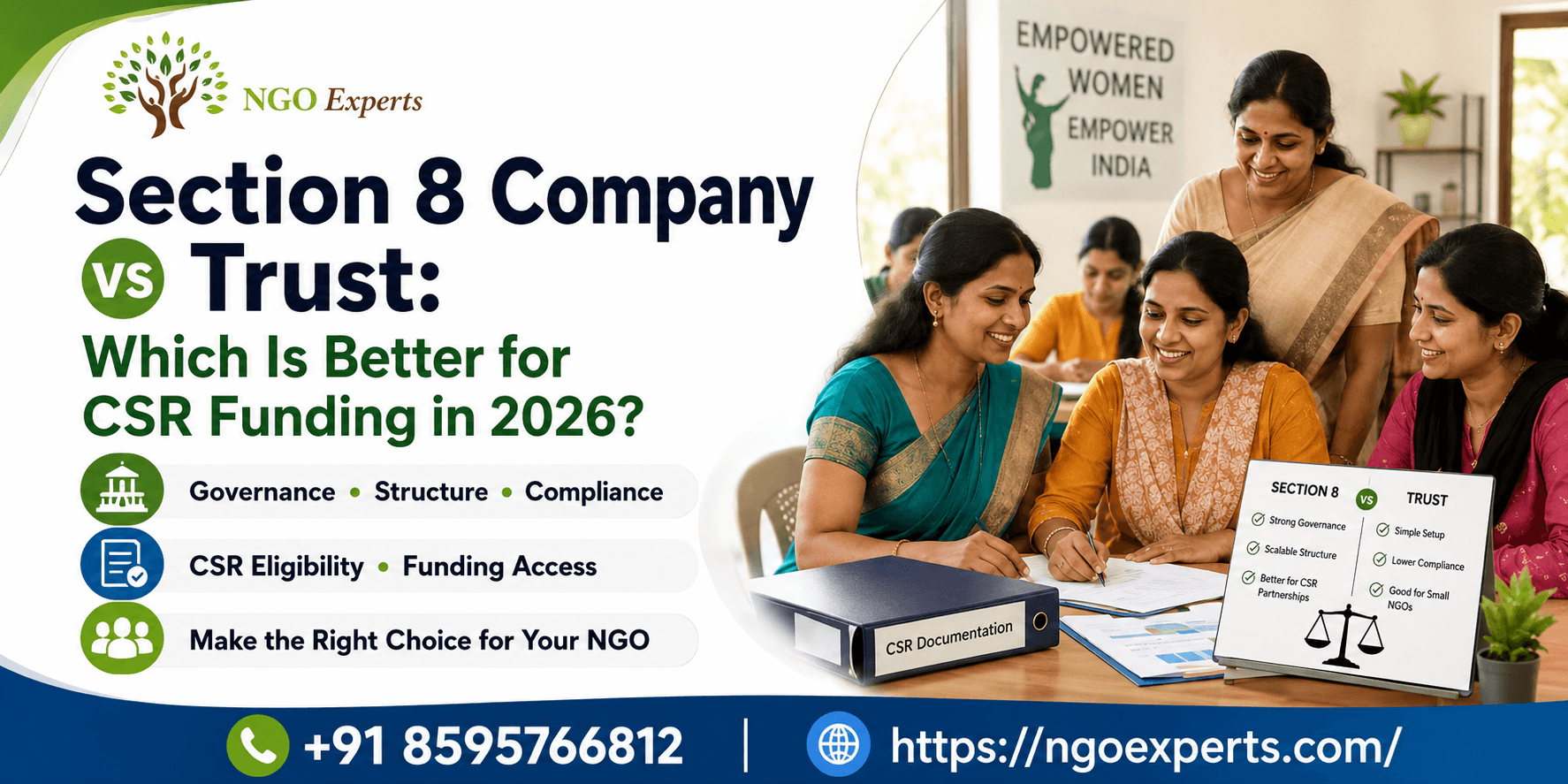
Section 8 Company offers the highest donor and CSR credibility, making it the preferred choice for organizations planning to scale or apply for FCRA.
Trusts take 7–15 days, Societies 21–30 days, and Section 8 Companies 30–45 days; FCRA adds another 90–120 days on top.
How long does NGO registration take in India?
How much does complete NGO registration cost in 2026?
Total costs (government + professional + stamp duty) range from ₹5,000 for a basic Trust to ₹15,000 for a Section 8 Company, with 12A/80G and FCRA as separate add-ons.
How many NGOs in India currently hold active FCRA registration?
As of 2026, only around 16,000 NGOs hold active FCRA registration, down sharply from over 40,000 before the 2020 amendment tightened compliance norms.

📢Subscribe For Updates

Get the latest news delivered to your inbox