
To check NGO registration status in India, first identify the legal type: Trust, Society, or Section 8 Company. Then verify it on the matching portal. Use the MCA portal for Section 8 Companies, the state Registrar of Societies for Societies, and the local Sub-Registrar or Charity Commissioner for Trusts. To check tax status, use the Income Tax e-filing portal to verify 12A (Section 332) and 80G (Section 354) registration by PAN. For government grant eligibility, check NGO Darpan. For foreign funding status, check the FCRA portal. Most checks take under five minutes and need only the NGO's name, registration number, or PAN.
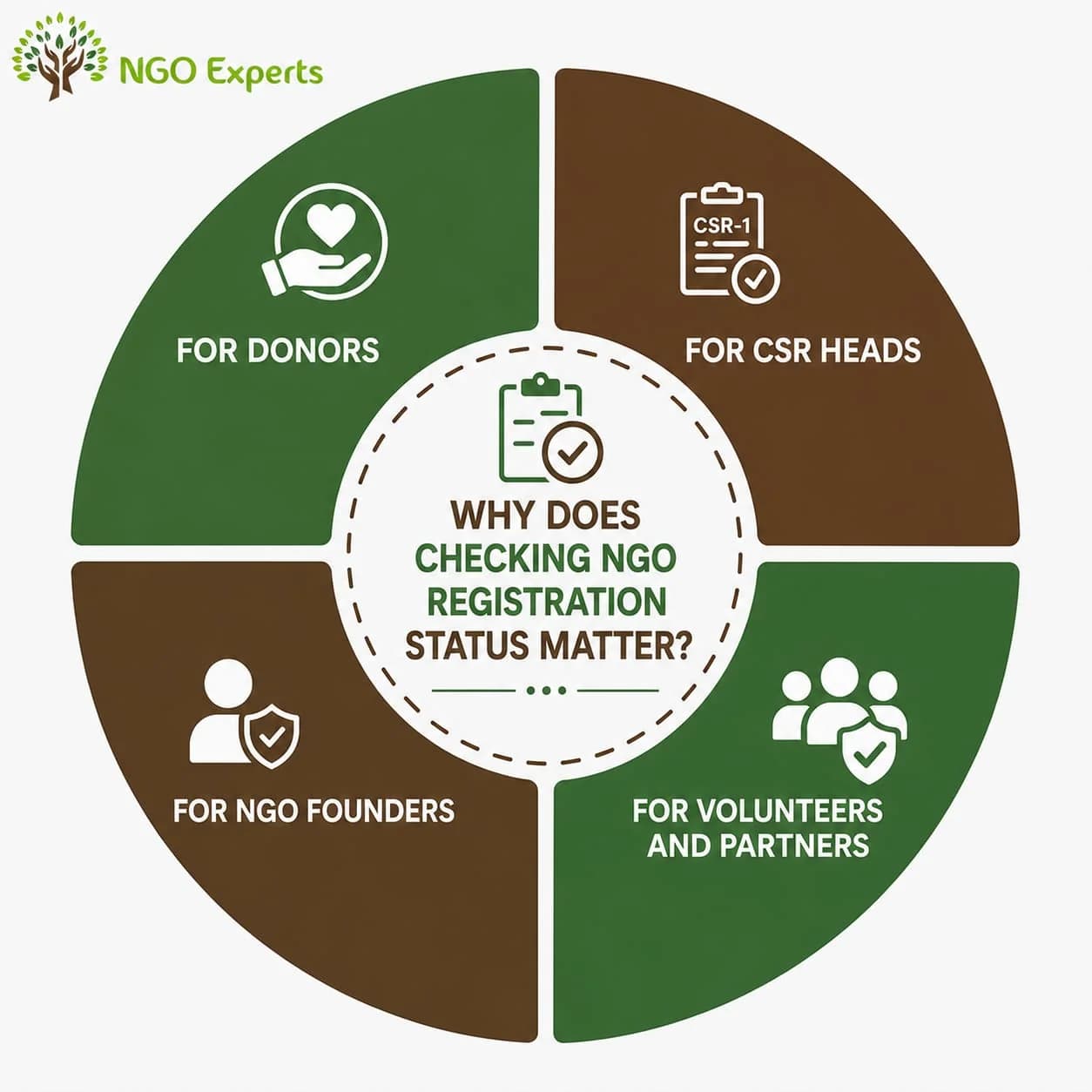
Why Does Checking NGO Registration Status Matter?
Checking NGO registration status protects your money, your CSR budget, or your own organisation's credibility before a problem shows up.
- For donors: confirms the organisation legally exists and isn't a personal bank account dressed up as a cause.
- For CSR heads: confirms CSR-1 eligibility before funds are released, avoiding compliance issues later.
- For NGO founders: confirms your own Darpan, RNPO, or FCRA status is current, active, and matches your other filings; worth revisiting our guide on how NGO registration works in India if anything looks off.
- For volunteers and partners: confirms you're associating your name with a legitimate, functioning entity.
What Type of NGO Are You Checking?
Before you check NGO registration status, you need to know which of India's three legal structures the organisation actually is, because each one is checked on a different portal.
| NGO Type | Where It's Registered | How to Spot It | Verification Portal |
| Section 8 Company | Ministry of Corporate Affairs | Has a CIN starting with "U" | MCA Company Master Data search |
| Society | State Registrar of Societies | State registration number, no CIN | State Registrar of Societies portal |
| Trust | State Sub-Registrar / Charity Commissioner | Trust Deed registration number | State Sub-Registrar / Charity Commissioner office |
If you're unsure which type an NGO is, ask for its registration certificate; it will name the exact Act it's registered under, which tells you exactly where to verify it. If you're checking your own NGO's status, this matches the same three structures covered in our guide on registering an NGO for social work.
How Do You Check NGO Registration Status in India?
Process to Check Section 8 Company Registration Status
- Visit the MCA portal and go to the Company Master Data search option.
- Enter the Section 8 Company's name or CIN in the search field.
- View the company details, including the incorporation date and directors.
- Check the company status to confirm whether it is Active or Struck Off.
Process to Check Society Registration Status
- Visit your state's Registrar of Societies website where the Society was registered.
- Select the registration status or Society search option available on the portal.
- Enter the Society's registration number or name in the search field.
- View the Society's registration details and confirm its current status.
Process to Check Trust Registration Status
- Identify the local Sub-Registrar or state Charity Commissioner's office where the Trust Deed was originally registered.
- Visit the concerned office or its online portal, if available.
- Provide the Trust's registration number or relevant details to locate the registration record.
- Check the registration record to confirm the Trust's registration status.
How Do You Check RNPO, 12A/80G, and FCRA Status?
These registrations must be verified separately through the respective government portals.
- RNPO / 12A and 80G-equivalent status: search the Exempted Institutions database by the NGO's name or PAN to confirm its tax exemption is currently valid, not expired.
- FCRA status: check the NGO's name on FCRA Online Services to confirm it's authorized to receive foreign donations, since a lapsed FCRA registration makes accepting foreign funds illegal.
- CSR-1 status: this isn't separately searchable, but a valid CSR-1 filing requires an active NGO Darpan Unique ID, so a confirmed Darpan listing is a strong indirect signal.
Real Case: What Happens When No One Checks NGO Registration Status?
In 2018, police in Noida busted an organisation called We Care Foundation, run by a man named Vikas Goswami, which had been collecting donations for treatment of poor patients, including children with AIDS and physical amputations. The "NGO" accepted money online and through mobile wallets but never issued donation receipts — a basic transparency step any properly registered NGO provides. By the time police intervened, the operation had collected ₹16.31 lakh in donations, with 13 people arrested in the raid. A quick registration check, matched against a receipt and a real registration number, would have raised the alarm long before the money was gone.What Should You Do If an NGO's Status Looks Wrong?What Should You Do If an NGO's Status Looks Wrong?
What Should You Do If an NGO's Status Looks Wrong?
Before donating or partnering with an NGO, watch for these common warning signs that may indicate its registration is invalid, inactive, or misrepresented
- The NGO refuses to share its registration certificate, registration number, or PAN when requested.
- It requests donations to a personal bank account instead of the NGO's official bank account.
- The organization does not issue donation receipts or provide proper financial records.
- It relies on high-pressure fundraising tactics but cannot produce verifiable information about its registration, activities, or past projects.
- A Section 8 Company appears as "Struck Off," "Under Liquidation," or "Inactive" on the MCA portal, yet continues to solicit donations or claim to be operational.
- The NGO's details cannot be verified on the relevant government portal, or the registration information does not match its name, address, or legal structure.
If you notice one or more of these red flags, verify the organization's registration through the appropriate government portal before donating or entering into any partnership.
What Are the Red Flags of a Fake or Non-Compliant NGO?
Before donating or partnering with an NGO, watch for these common warning signs that may indicate its registration is invalid, inactive, or misrepresented:
- The NGO refuses to share its registration certificate, registration number, or PAN when requested.
- Donations are requested in a personal bank account instead of the NGO's official bank account.
- The organisation does not issue donation receipts or provide proper financial records.
- It relies on high-pressure fundraising tactics but cannot produce verifiable information about its registration, activities, or past projects.
- A Section 8 Company appears as "Struck Off," "Under Liquidation," or "Inactive" on the MCA portal, yet continues to solicit donations or claim to be operational.
- The NGO's details cannot be verified on the relevant government portal, or the registration information does not match its name, address, or legal structure.
What Mistakes Do People Make While Verifying an NGO?
A few avoidable mistakes lead people to trust the wrong organisation.
- Checking only the NGO Darpan listing and assuming that alone proves legal registration
- Not checking MCA's Active/Struck-Off status for Section 8 Companies
- Confusing "TM" or "registered trademark" claims with actual legal NGO registration
- Trusting a printed certificate without cross-checking it on the actual government portal
If you're a new founder still setting up your own NGO, our guide on starting an NGO without money covers the registration basics that keep your own status easy to verify later.
Disclaimer
NGOExperts is a private consultancy and is not a government body, ministry, or regulatory authority; it is not affiliated with the Registrar of Societies, MCA, NITI Aayog, or the Income Tax Department. This article is for general information only and is not legal advice. Verification portals, processes, and requirements can change; always confirm directly on the official government portal before making a financial or legal decision.
Sources and References
Frequently Asked Questions
How can I check if an NGO is registered in India?
Identify its legal type first: Trust, Society, or Section 8 Company, then verify on the matching portal: MCA for Section 8, the state Registrar for Societies and Trusts, and NGO Darpan for its Unique ID.
Is NGO Darpan registration proof of legal registration?
No, Darpan confirms a listing used for grants and CSR, not the underlying legal registration itself, which sits with MCA, the Registrar of Societies, or the Sub-Registrar.
How do I check if an NGO can legally accept foreign donations?
Search the NGO's name on the FCRA Online Services portal to confirm its FCRA registration is active, not expired or canceled.
What does a "Struck Off" status mean for a Section 8 Company?
It means the company has been removed from the active register, usually for not filing annual returns; donations to a struck-off entity carry real legal risk.
. Can I check an NGO's 12A/80G tax exemption status online?
Yes, through the Exempted Institutions database, where you can search by name or PAN to see whether the RNPO approval is currently valid.
What should I do if I suspect an NGO is fraudulent?
Report it to cybercrime.gov.in, the National Cyber Crime Reporting Portal, in addition to your local police.
Author
Aabha Garg
A Content Strategist at NGOExperts, who focuses on NGO registration, 12A and 80G registration, FCRA compliance, income tax filing for non-profits, and CSR funding guidelines in India. I research and write our compliance guides in collaboration with our in-house Chartered Accountants and Company Secretaries, so every article reflects current tax and regulatory requirements for the NGO and non-profit sector.
Written by Aabha Garg. Last updated on September 26, 2026