


Quick Summary
Are you aiming to start a society for charitable, educational, or social purposes? Understanding this fundamental requirement is crucial before you begin the registration process under the Societies Registration Act, 1860, which varies slightly from state to state. One key eligibility criterion for society registration is the minimum number of members required. Knowing this is essential before starting the process. Let’s explore this in detail.
Overview
Unlike companies that focus on profits, societies channel their resources toward social welfare, community development, cultural promotion, or educational advancement. Society registration is a popular means of legally establishing a group or organisation for social, e
ducational, cultural, or charitable purposes in India. They enjoy legal recognition, can own property, enter into contracts, and receive tax benefits under sections 12A and 80G of the Income Tax Act.
This detailed guide walks you through the important factors of society registration, offering helpful tips, comprehensive checklists, and practical examples.
What is a Society, and why is it important to register?
A society in India is a group of individuals united by a common goal or purpose, often related to social work, education, culture, or community welfare. Societies are registered under the Societies Registration Act, 1860. Whether it is charitable, educational, literary, scientific, or social goals, societies operate as non-profit organisations aimed at promoting specific objectives for public benefit. Unlike trusts or companies, societies have a democratic membership and manage their affairs with elected representatives.
A registered society gains instant credibility with donors, government agencies, and the public. Not only that, registration provides your organization with a distinct legal identity, separating it from its members. This protects individual members from personal liability and enables the society to sue or be sued in its own name.
Furthermore, registered societies can:
- Open bank accounts in the society's name
- Receive domestic and foreign funding legally
- Apply for government grants and subsidies
- Claim tax exemptions under the relevant provisions
- Issue donation receipts with tax benefits to donors
Who Can Benefit from Society Registration?
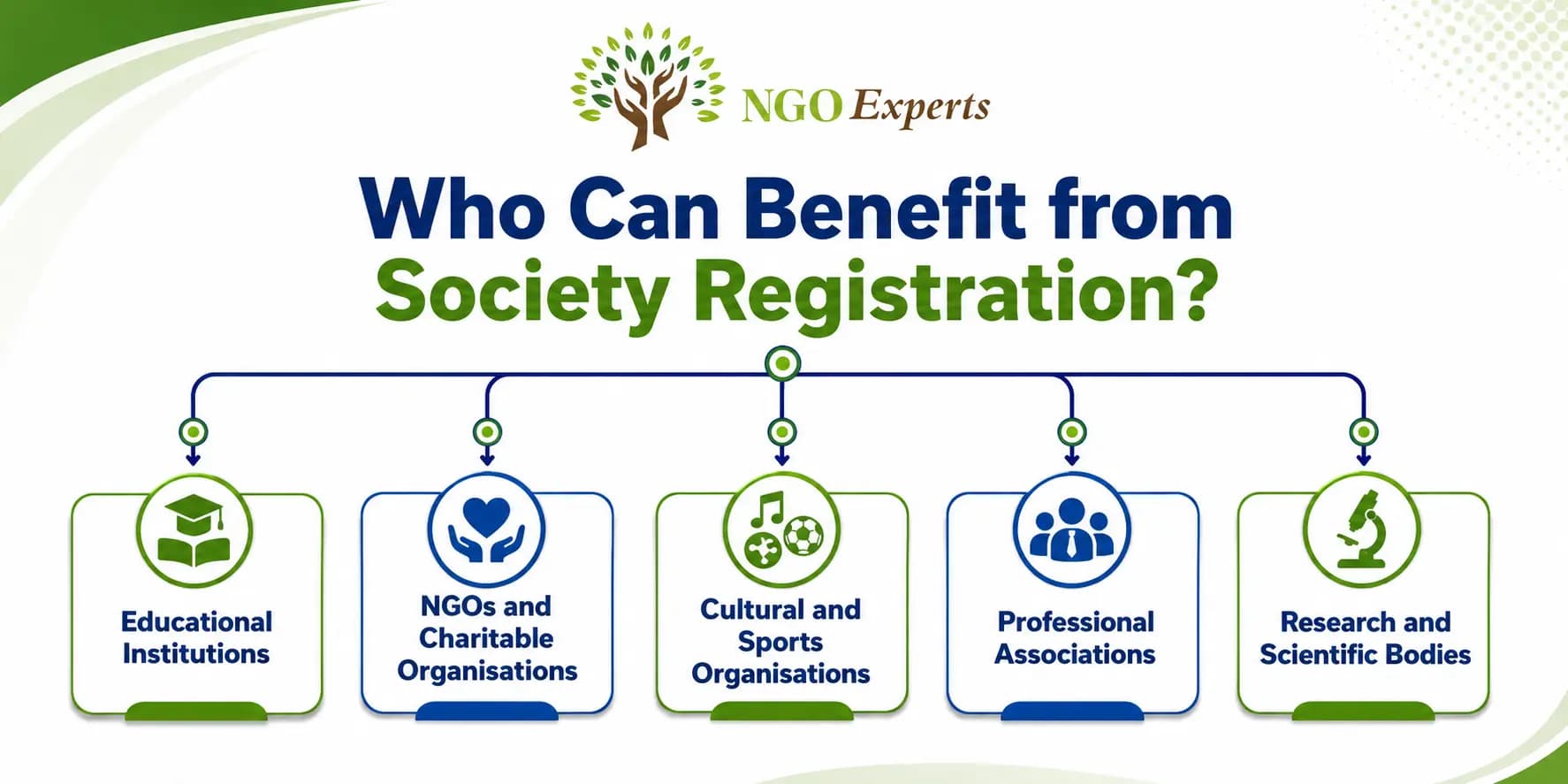
Educational Institutions
Schools, colleges, coaching centres, and educational trusts benefit from society registration to operate legally and access government schemes.
NGOs and Charitable Organisations
Organisations working in healthcare, poverty alleviation, women's empowerment, and child welfare require society registration for legitimacy and access to funding.
Cultural and Sports Organisations
Clubs promoting arts, culture, music, dance, sports, or recreational activities gain formal structure through registration.
Professional Associations
Groups of professionals, such as doctors, lawyers, or artists, can form societies for knowledge sharing, advocacy, and the welfare of their members.
Research and Scientific Bodies
Organisations conducting research, promoting innovation, or advancing scientific knowledge benefit from the legal framework societies provide.
How Many Members Are Required for Society Registration?
Minimum Member Requirement
To register a society under the Societies Registration Act, 1860, a minimum of 7 members is required. These members should be Indian citizens or foreign nationals who share the common goal of establishing the society. This requirement for seven members is consistent across most Indian states and remains the standard rule.
Who Can Become a Society Member?
Anyone who wants to become a member of a society should be at least 18 years old and mentally sound, meaning they understand their actions and decisions clearly. Usually, members are Indian citizens, although some societies may permit foreign nationals with certain restrictions.
In addition, the potential member should not be legally disqualified from joining under any laws, ensuring that all members are responsible and capable of actively participating in the society’s activities. This helps create a trustworthy and committed group that can effectively work towards common goals.
| Type of Society Registration | Minimum Members Required |
| General Society | 7 members |
| Charitable or NPO Society | 10 members |
| State Societies | 7 or more members |
Important Considerations for Members Before Registering a Society
- All founding members must sign the Memorandum of Association (MoA)
- At least 50% of members should typically be Indian citizens for most purposes
- Members need not contribute capital (unlike companies)
- Family members can be included as founding members
Documents Required for Society Registration
| Category | Documents Required | Details |
| For the Society | Memorandum of Association (MoA) | Includes society name, objectives, registered office address, and details of founding members |
| Rules and Regulations (Bye-laws) | Governance structure, membership criteria, meeting protocols, and election procedures | |
| List of Managing Committee / Governing Body | Names, addresses, and occupations of office bearers (President, Secretary, Treasurer) | |
| For Individual Members | Identity Proof | Aadhaar Card, PAN Card, Passport, or Voter ID |
| Address Proof | Aadhaar Card, utility bill (electricity/water), bank statement, rent agreement, or property papers | |
| Photographs | Recent passport-size photographs (2–3 copies) | |
| For Registered Office | Address Proof of Office Premises | Ownership documents or No Objection Certificate (NOC) if rented, rent agreement, utility bills |
Need Help? Our expert team has helped register 100+ societies across India. Download your FREE PDF to read ‘How a Small Group Built a Successful NGO within 1 year’
Conclusion
Registering a society is a great way to formalise your group’s efforts and gain legal recognition. Remember, the minimum number of members required is generally 7, but always confirm with local state laws. Proper member selection, clear objectives, and transparent rules build a strong foundation for success.
Frequently Asked Questions
What is the minimum number of members required for society registration in India?
A minimum of 7 members are needed to register a society under the Societies Registration Act, 1860.
Can a society be registered online in India?
Yes, some states now allow online registration of societies through their official portals, simplifying the process.
Can members of a society be from different states or countries?
Generally, members should be Indian residents; some state rules may allow non-resident Indians as members, but foreigners usually cannot be members.
What are the advantages of having more than the minimum members?
More members improve democratic governance, diversity, and credibility, helping with fundraising and compliance.
Author
Srijita Chatterjee
I am a Content Specialist holding a Master’s degree and with over 5 years of experience in the creative arena. I specialize in breaking down complex concepts into clear, understandable insights that help my viewers deeply engage and retain. Known for my approachable and engaging style, I am committed to providing accurate, trustworthy information that empowers individuals and organizations to make informed decisions and achieve their goals.
Written by Srijita Chatterjee. Last updated on June 3, 2026