
Quick Summary
If you are an NGO, trust, or Section 8 company searching for ways to keep your NGO’s hard-earned donations from being eaten up by taxes, we have a solution for you: 12AA, A registration that grants NGOs tax exemption on their income.
Section 12AA used to be the registration path for NGOs to claim tax exemption on charitable income, and now the fresh registration system operates under Section 12AB via Form 10A/10AB. Today, we’re breaking down everything you need to know about Section 12AA, the new 12AB, and how to stay compliant.
What is Section 12AA of the Income Tax Act?
Section 12AA (now 12AB) tells the Income Tax Department, "We are a non-profit. Please don't tax us!" Without this registration, your NGO is treated as a normal taxpayer, an Association of Persons (AOP), or a Body of Individuals (BOI), meaning you’d have to pay taxes on the donations you receive. With it, your surplus income becomes tax-exempt, allowing every rupee to go toward your cause.
The application is filed electronically in Form 10A or Form 10AB, depending on the category of registration, and the department checks documents, objects, and the genuineness before issuing approval.
2. Difference Between Section 12A and Section 12AA
Many people use these interchangeably, but there’s a technical nuance:
- Section 12A: The provision that allows for the exemption.
- Section 12AA: The process or the section under which the Commissioner used to grant the registration (until March 2021).
- Section 12AB: The current section for all new and renewal registrations since the 2021 amendment.
Comparison Section 12A ,Section 12AA and Section 12AB
| Aspect | Section 12A | Section 12AA | Section 12AB (Current) |
| Purpose | Basic exemption eligibility | Registration procedure | Fresh registration + renewal |
| Validity | Lifetime (pre-2021) | Lifetime (pre-2021) | 5 years (regular), 3 years (provisional) |
| Application Form | Form 10A (old) | Form 10A (old) | Form 10A/10AB |
| Renewal Required | No | No | Yes, every 5 years |
| Timeline for Order | No strict timeline | No strict timeline | 1-3 months prescribed |
In simple words, 12A is about eligibility for exemption, 12AA was the older approval process, and 12AB is the updated process used today.
Objectives of 12AA/12AB Registration for NGOs & Trusts
Why does the government give you this break? The main objectives of the government are:
- To ensure the money is used for Charitable Purposes (Education, Medical Relief, Relief of the Poor, etc.).
- Keep a digital trail of NGO activities to prevent money laundering.
- To encourage private participation in social welfare.
This matters because the Commissioner checks whether your trust deed and real work truly meet the charitable purpose test before granting registration.
4. Who Can Apply?
A trust, society, Section 8 company, or other eligible non-profit entity can apply if it is created for charitable or religious purposes and can show genuine activities or a credible plan to start them. The Form 10A instructions specifically allow trusts, societies, companies, and others, depending on the selected section code.So yes, a Society, Trust, and Section 8 Company can apply if they meet the relevant conditions and file the correct form with supporting documents.
5. Eligibility Criteria for 12AA Registration
To ensure your NGO Qualifies for 12AA registration, verify that it is a registered Public Charitable Trust, Society, or Section 8 Company, and confirm that it meets the eligibility criteria outlined in the law.
- Legal Structure: You must be a registered Public Charitable Trust, Society, or Section 8 Company.
- No Private Benefit: The NGO must not be created for the benefit of a particular religious community or caste (unless it's for the public at large).
- Charitable Objects: Your "Object Clause" in the Trust Deed or MoA must strictly define charitable activities.
Let's know what a charitable purpose is under the Income Tax Act.
Under Section 2(15), it includes relief of the poor, education, yoga, medical relief, environmental preservation, and advancement of any other object of general public utility.
6. Documents Required for 12AA Registration in India
Gather these before you log into the portal. Missing even one can lead to rejection!
- Self-certified copy of the Trust Deed or Registration Certificate.
- PAN Card of the NGO.
- Utility Bill (Electricity/Water) of the registered office.
- NOC from Landlord (if the office is rented).
- Detailed Report on activities conducted in the last 3 years (or since inception).
- Financial Statements (Balance Sheet/ITR) for the past 3 years.
- List of Donors with their PAN and addresses.
- ID Proofs (Aadhaar/PAN) of all Trustees/Directors.
7. Step-by-Step Process for 12AA Registration in India
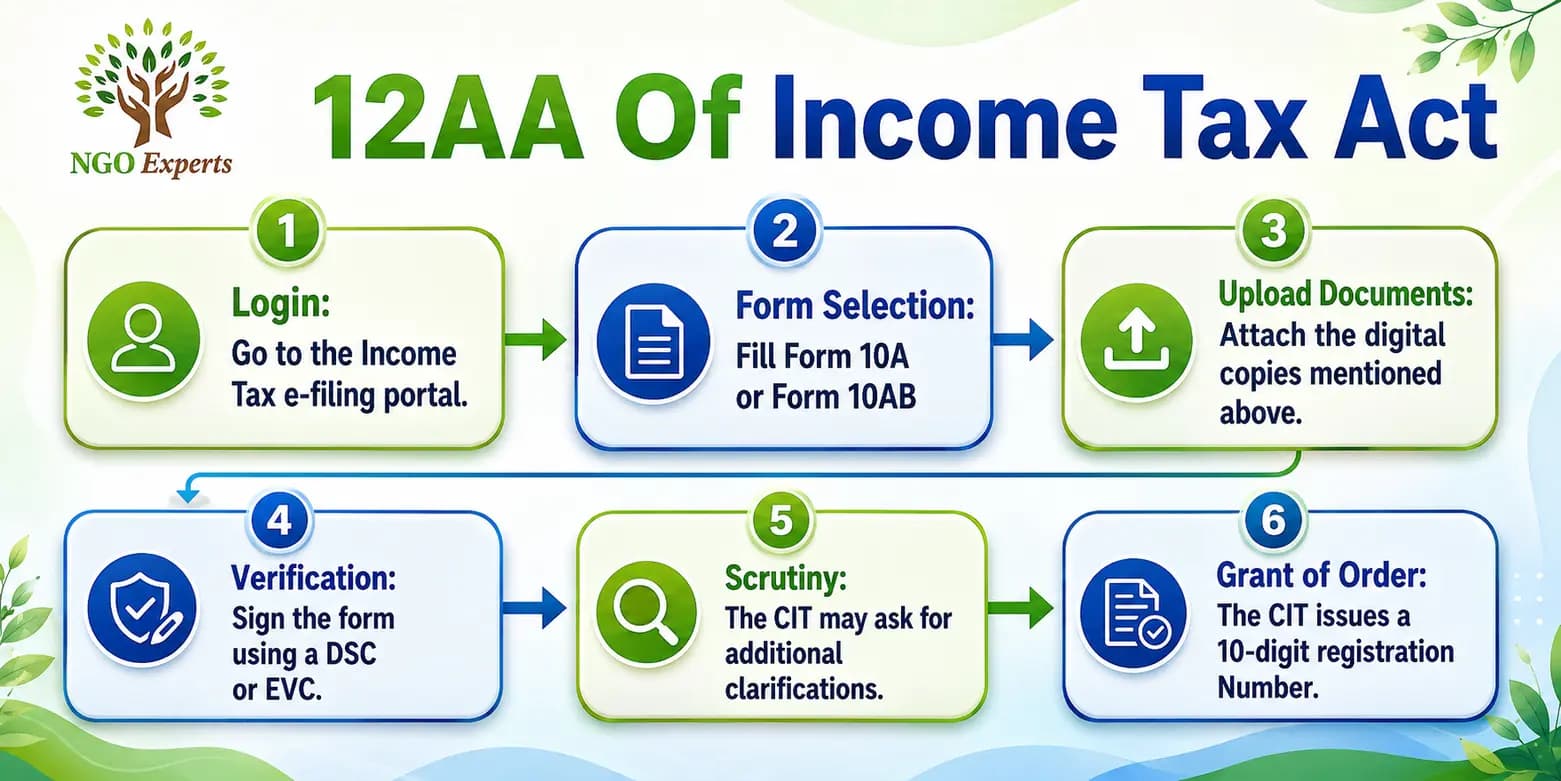
Gone are the days of physical filing. In 2026, everything is digital.
- Login: Go to the Income Tax e-filing portal.
- Form Selection: Fill Form 10A (for Provisional Registration) or Form 10AB (for converting Provisional to Permanent).
- Upload Documents: Attach the digital copies mentioned above.
- Verification: Sign the form using a Digital Signature Certificate (DSC) or EVC.
- Scrutiny: The Commissioner of Income Tax (CIT) may ask for additional clarifications.
- Grant of Order: If satisfied, the CIT issues a 10-digit Alphanumeric Registration Number.
The current law allows the Commissioner to grant regular registration for five years in many cases, or provisional registration for three years in specified new-entity cases.
8.Time Limit & Validity of 12AA Registration
It usually takes 1 to 3 months for the final order to be processed, so you can plan your registration timeline accordingly.
Validity:
- Provisional: Valid for 3 years
- Permanent: Valid for 5 years
- New: Smaller trusts (income < ₹5 crores) may now qualify for a 10-year validity period under recent amendments.
9. Common Reasons for Rejection of 12AA Application
Don't let your hard work go to waste, as applications are usually rejected due to:
- Incomplete Documents: Especially missing the activity report.
- Non-Charitable Objects: Having Profit-making clauses in the deed.
- Non-Response: Failing to answer the commissioner of income tax's (CIT) queries within the deadline.
- Personal Benefit: If the trustees are using the trust funds for personal gains.
10. Compliance Requirements After 12AA Registration
Getting the certificate is just the beginning. If you want to keep it, you should apply the following points:
- Apply 85% of your income toward charitable activities annually.
- File Form 10B or 10BB (Audit Report) by the due date.
- Submit ITR-7 every year.
- Keep a record of all donations of ₹5,000 or more.
Transition from 12AA to 12AB (The Latest Update)
As of the latest amendments, there is no longer a one-time registration.
- If you had a 12AA certificate, you should switch to 12AB.
- If your 5-year 12AB registration is expiring, you must apply for renewal 6 months before the expiry.
- Difference between provisional and permanent registration: Provisional is for new NGOs that haven't started work yet; Permanent (Final) is for those with active operations.
Real-Life Case Study
A small environmental NGO in Pune, "Green Earth Foundation," had been operating without a 12AA for 2 years. They received a ₹20 Lakh donation but had to pay nearly ₹6 Lakh in taxes as a regular association.
The Solution: Rectified their Trust Deed and applied for Section 12AB.
The Result: Not only did they save ₹6 Lakh in taxes the following year, but with the 12AB certificate, they secured a ₹50 Lakh CSR grant from a leading tech firm.
Conclusion
If you are launching an NGO, the smartest first step is to get your legal structure, objects clause, and income-tax registration strategy right from day one. A clean 12AB application, supported by strong documentation and genuine charitable intent, can save time, reduce the risk of rejection, and strengthen donor trust.
Frequently Asked Questions
What is the role of the Commissioner of Income Tax in 12AA?
The CIT (Exemption) is the authority that reviews your application and grants the registration. They have the power to call for your books and verify your activities.
How long is the 12AA registration valid?
Under the new 12AB regime, it is usually valid for 5 years, though smaller trusts may now get 10 years.
Can the Income Tax Department revoke 12AA?
Yes, if you stop doing charitable work or violate the 85% spending rule, the CIT can cancel your registration.
What is the 12AA registration fee?
The government does not charge a heavy fee on the portal, but professional consultancy fees range from ₹10,000 to ₹25,000, depending on the complexity.
Can I apply for 12AA and 80G together?
Yes, it is highly recommended to apply for both simultaneously to provide tax benefits to your donors as well.
Author
Sakshi Kashyap
I am a dedicated and detail-oriented Website Content Writer with over two years of experience in creating compelling, reader-friendly, and SEO-optimized content. My expertise lies in developing well-structured web pages, landing pages, blogs, and service descriptions that enhance user engagement and drive organic traffic.
Written by Sakshi Kashyap. Last updated on August 26, 2026