

Running a non-profit takes relentless commitment, and sometimes pausing or shutting down operations is the most responsible call a board can make. Whether your project funding ended, your objectives were fulfilled, or the entity never took off, leaving a dormant Section 8 company open exposes directors to recurring annual filing penalties and potential disqualification under the Companies Act, 2013.
Unlike a standard private limited company, you cannot simply file a fast-track closure form on the MCA Portal to exit a Section 8 entity. Because your organization holds special tax privileges and charitable status, the law requires a strict two-stage exit: first surrendering your charitable license and then dissolving the corporate shell.
Start Your Section 8 Company Closure
Ready to close your Section 8 Company? Get expert assistance with ROC filings, required documents, and legal closure procedures.
Why Is Closing a Section 8 Company Different from a Regular Company?
A Section 8 company cannot be closed directly because Section 8(4)(ii) and Section 8(9) of the Companies Act, 2013 prohibit it from converting or dissolving without prior approval from the Central Government (delegated to the Regional Director).
Furthermore, Rule 21 of the Companies (Incorporation) Rules, 2014, strictly bars a Section 8 company from directly filing Form STK-2 for fast-track strike-off. Even if your non-profit has zero bank balance and zero transactions since incorporation, the Registrar of Companies (ROC) will reject a direct strike-off application unless you first revoke your Section 8 status and surrender your 12A and 80G registrations with the Income Tax Department.
Strike-off vs. Winding Up: Which Closure Route Fits Your Non-Profit?
Choosing between strike-off and winding up depends entirely on your company’s balance sheet, asset ownership, and operational history.
| Comparison Factor | ROC Strike-off (Form STK-2) | Voluntary Winding Up (IBC / Tribunal) |
| Governing Law | Section 248 of the Companies Act, 2013 | Section 59 of the IBC, 2016 & Section 271 of the Companies Act, 2013 |
| Best Suited For | Defunct or inactive entities with nil assets and nil liabilities | Active or asset-heavy NGOs with property, grants, or creditors |
| Prerequisite Step | Surrender of Section 8 license via Form INC-18 | Surrender of Section 8 license via Form INC-18 (or direct Tribunal order) |
| Liquidator Required? | No | Yes (Registered Insolvency Professional) |
| Estimated Timeline | 6 to 9 months (including INC-18 approval) | 12 to 24+ months |
| Surplus Asset Rule | Must have zero assets before filing STK-2 | Transferred to another Section 8 company with similar objects or the Rehabilitation and Insolvency Fund |
| Government & Statutory Fees | ₹10,000 (STK-2) + ₹2,000 (INC-18) + newspaper ad costs | Based on asset valuation and insolvency professional fees |
Our Recommendation: If your non-profit never commenced operations or has settled all vendor dues, returned unspent grants, and holds zero fixed assets, ROC Strike-off is cleaner and far more economical. If you own land, have fixed deposits, have corpus funds, or have complex creditor claims, Winding Up is legally mandatory.
What Are the Mandatory Pre-Closure Steps Before Filing?
Before approaching the Regional Director or the ROC, your board must bring the company’s compliance record up to date. Regulators will reject closure applications if statutory filings are pending.
- Clear Pending Annual Filings: File all overdue AOC-4 (financial statements) and MGT-7 / MGT-7A (annual returns) up to the financial year in which the company ceased operations.
- Settle Liabilities and Close Bank Accounts: Pay off all creditors, employee dues, and statutory taxes. Obtain a formal bank account closure certificate once the balance reaches zero.
- Surrender Tax & Regulatory Registrations: Cancel your 12A and 80G registrations, CSR-1 registration, FCRA certificate (if applicable), and GST/PAN registrations to prevent future tax notices.
- Prepare a Zero-Asset Statement of Accounts: Have a practicing Chartered Accountant certify a Statement of Accounts showing nil assets and nil liabilities, dated not more than 30 days before filing your strike-off application.
Avoid ROC Rejections and Delays
Incorrect filings can lead to ROC objections and unnecessary delays. Let our experts handle your Section 8 Company closure accurately.
Step-by-Step Process to Close a Section 8 Company via Strike-off
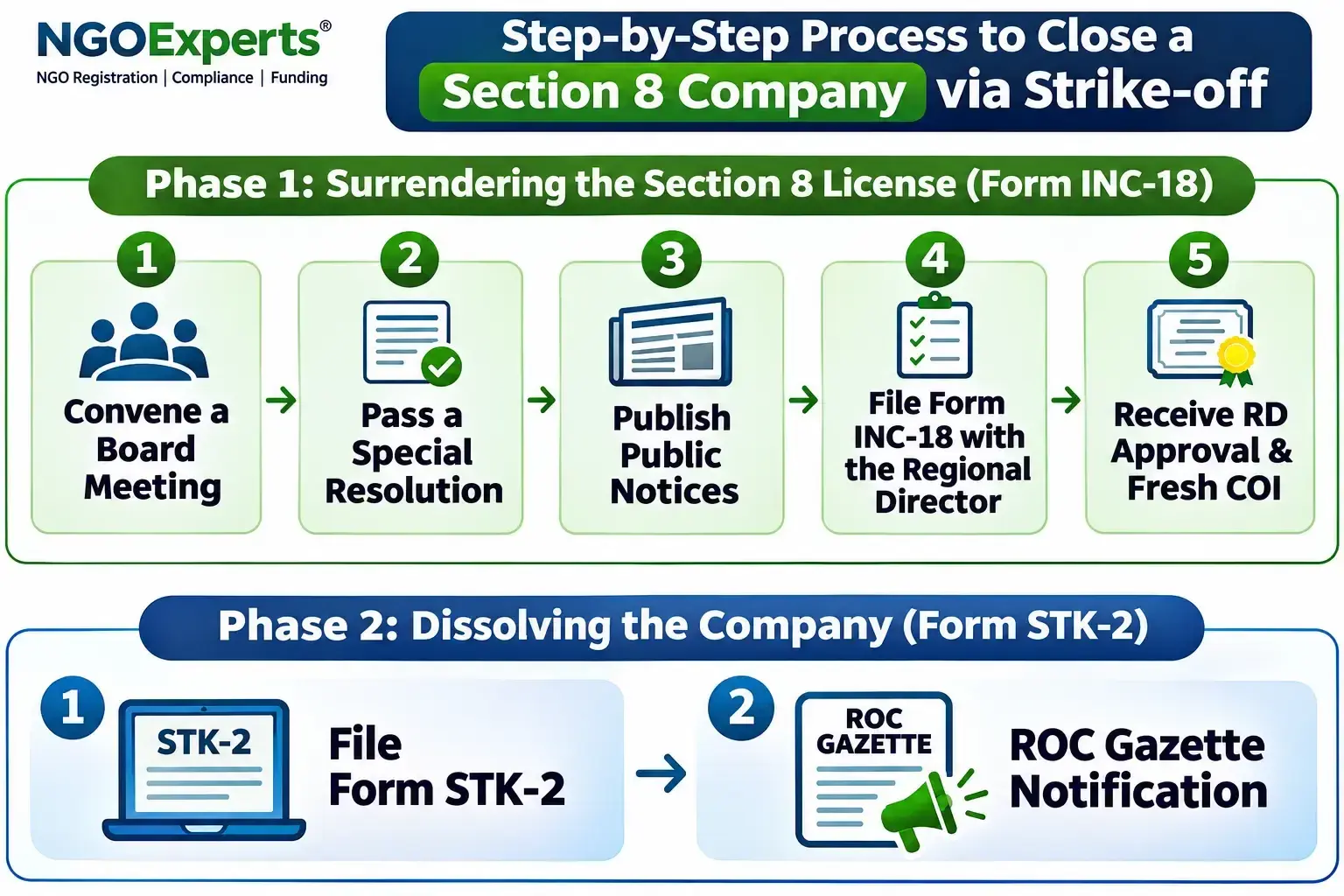
Closing a Section 8 company via strike-off is a two-phase legal workflow that moves from the Regional Director to the Registrar of Companies
Phase 1: Surrendering the Section 8 License (Form INC-18)
- Convene a Board Meeting: Pass a board resolution approving the surrender of the Section 8 license, conversion into a private/public company, and subsequent closure.
- Pass a Special Resolution: Call an Extraordinary General Meeting (EGM) and secure approval from at least 75% of members. File Form MGT-14 with the ROC within 30 days.
- Publish Public Notices: Within a week of filing with the RD, publish a notice in Form INC-19 in at least one vernacular newspaper and one English newspaper circulating in the district of your registered office.
- File Form INC-18 with the Regional Director: Submit the application along with the altered Memorandum and Articles of Association (MOA/AOA), NOCs from relevant regulatory authorities (such as the Income Tax Department or Charity Commissioner, if applicable), and board declarations.
- Receive RD Approval & Fresh COI: Once satisfied, the RD issues an order approving conversion. File Form INC-20 with the ROC to receive a fresh Certificate of Incorporation (COI) as a standard company.
Phase 2: Dissolving the Company (Form STK-2)
- File Form STK-2: Once the fresh COI is issued, file Form STK-2 (with a statutory fee of ₹10,000) accompanied by an indemnity bond (Form STK-3), affidavit (Form STK-4), and the CA-certified Statement of Accounts.
- ROC Gazette Notification: The ROC publishes a public notice inviting objections for 30 days. If no objections arise, the ROC strikes the company’s name off the register and publishes the final dissolution notice in the Official Gazette.
Practical Scenario: How a Delhi-Based Education NGO Exited Cleanly
Consider an education-focused Section 8 company incorporated in New Delhi in 2023. The founders raised ₹4 lakhs in initial seed donations, ran pilot workshops for eight months, and decided to pause operations permanently when the core team relocated abroad.
- The Mistake They Almost Made: They attempted to file Form STK-2 directly to save time.
- The Compliant Fix: Because the company had ₹65,000 left in its bank account and held 12A/80G status, they first transferred the remaining ₹65,000 to another registered Section 8 education trust (as mandated by Section 8(9)), surrendered their 12A/80G certificates, and closed their bank account. They then secured RD approval via Form INC-18 in 4.5 months and completed their STK-2 strike-off in 3 months—exiting cleanly with zero director penalties.
NGOExperts Professional Fee & Closure Package Breakdown
Navigating Regional Director hearings and ROC scrutiny requires accurate drafting of declarations, newspaper notices, and CA certifications. Over the last decade, NGOExperts has supported over 2,400 non-profit organizations across India, maintaining an average regulatory approval turnaround of 15 to 21 working days for incorporation and license filings, and 6 to 8 months for end-to-end Section 8 strike-offs.
| Closure Package | Ideal For | Key Inclusions | Government Fee | NGOExperts Professional Fee |
| License Surrender Only (INC-18) | NGOs converting to a commercial Pvt Ltd entity | Board/EGM drafting, MGT-14, INC-19 ad coordination, INC-18 & INC-20 filing | ₹2,000 + ad costs | ₹14,999 + GST |
| Complete Section 8 Strike-off | Defunct NGOs with nil assets & liabilities | End-to-end INC-18 surrender + STK-2 filing, CA Statement of Accounts, STK-3/STK-4 drafting | ₹12,000 + ad costs | ₹24,999 + GST |
| 12A / 80G & CSR-1 Surrender Add-on | Registered tax-exempt non-profits | Income tax cancellation filing & compliance closure | Nil | ₹4,999 + GST |
Close Your Section 8 Company Hassle-Free
From documentation to final ROC submissions, get professional support to complete your company's closure with confidence.
Frequently Asked Questions
Can I close a Section 8 company within 1 year of incorporation?
Yes, you can initiate closure within one year of incorporation provided the company never commenced business operations, holds zero assets and liabilities, and completes the mandatory Form INC-18 license surrender before filing Form STK-2.
What happens to surplus funds or property when closing a Section 8 company?
Under Section 8(9) of the Companies Act, 2013, directors and members cannot distribute surplus assets or profits among themselves. Any remaining funds or property after settling debts must be transferred to another registered Section 8 company with similar charitable objects, or credited to the Insolvency and Bankruptcy Fund.
Is it mandatory to file pending annual returns before closing a Section 8 company?
Yes. Under the Companies (Removal of Names of Companies from the Register of Companies) Rules, 2016, a company cannot apply for strike-off unless it has filed all overdue financial statements (Form AOC-4) and annual returns (Form MGT-7/7A) up to the end of the financial year in which it ceased operations.
How much does it cost to close a Section 8 company in India?
Statutory government fees start at ₹12,000 (₹2,000 for Form INC-18 and ₹10,000 for Form STK-2), excluding local newspaper publication charges (typically ₹3,000–₹6,000) and professional compliance fees. Voluntary winding up costs more due to mandatory Insolvency Professional fees.
What is the penalty for leaving an inactive Section 8 company open without filing?
Leaving a company non-compliant triggers an additional late fee of ₹100 per day per overdue form (AOC-4 and MGT-7) with no upper cap. Additionally, if a company fails to file annual returns for three consecutive financial years, its directors face disqualification under Section 164(2) for five years.