
Quick Answer
12A and 80G registration helps eligible NGOs in Meghalaya obtain applicable income tax benefits and offer donors tax deductions on qualifying donations. Charitable trusts, registered societies, and Section 8 companies can apply, subject to legal requirements. The cost depends on professional assistance, while the approval timeline varies according to document completeness and Income Tax Department processing.
NGOs in Meghalaya work in education, healthcare, tribal welfare, livelihoods, and environmental protection, from Shillong to smaller towns throughout the Khasi, Garo, and Jaintia Hills. To receive donations and grants with real tax benefits, getting 12A and 80G registration is important.
Get Expert Help for 12A and 80G Registration in Meghalaya
Register your NGO with the right documentation and compliance support
12A helps an eligible NGO claim income-tax exemption, while 80G allows eligible donors to claim deductions on their donations. This guide explains the 2026 registration process, documents, eligibility, fees, and key compliance requirements in simple language.
From 1 April 2026, 12A and 80G registrations are governed by the Income-tax Act, 2025, not the old 1961 Act. Section 12A is now Section 332, and Section 80G approval is now Section 133(1)(b)(ii). New NGOs in Meghalaya apply online via Form 104 (provisional, replacing old Form 10A) for a 3-year approval, then Form 105 (replacing Form 10AB) for final registration. There's no fee for filing on the income tax portal, and the whole cycle, from a Society/Trust already registered in the state to receiving 12A and 80G, typically takes 4 to 8 weeks.
What Is 12A and 80G Registration?
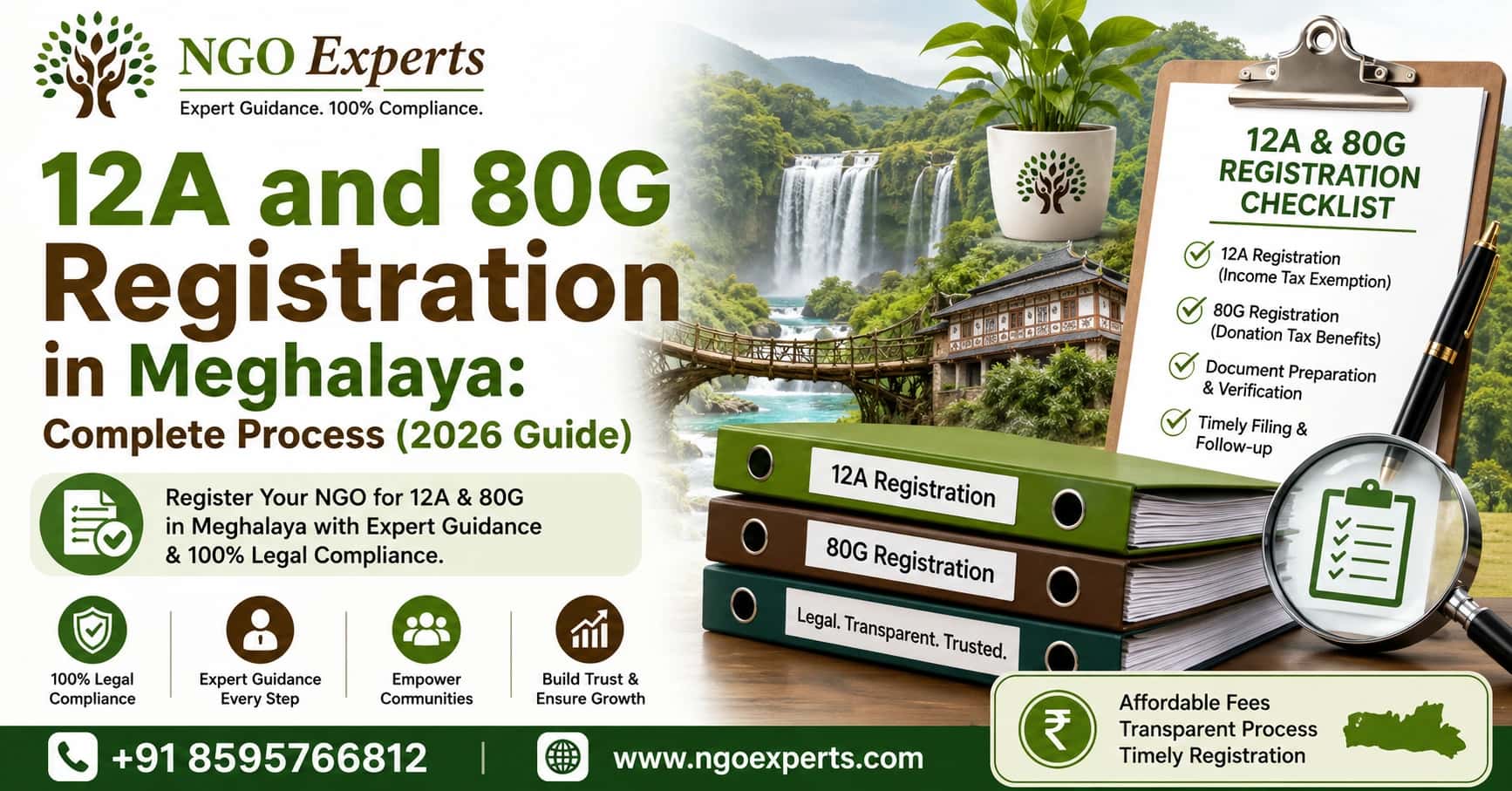
12A registration (now granted under Section 332 of the Income-tax Act, 2025) exempts an NGO's own income from tax, as long as at least 85% of that income is used for its charitable work. 80G approval (now under Section 133(1)(b)(ii)) lets donors claim a deduction on their taxable income for money given to the NGO. Both are issued centrally by the Income Tax Department; no Meghalaya state office handles them. What the state office does handle is the underlying registration of your Trust, Society, or Section 8 Company, most commonly under the Meghalaya Societies Registration Act, 1983, which you must have in place before you can apply for 12A and 80G.
Why Is 12A and 80G Registration Important for NGOs in Meghalaya?
Without 12A, an NGO's surplus income is taxed just like a business's, which is a real burden for organisations already working with limited resources. Without 80G, individual and corporate donors have no tax reason to give, which matters a lot in a state where local philanthropy is limited and most funding comes from outside: pan-India donors, CSR budgets, and government schemes that specifically prioritise the Northeast. Together, 12A and 80G are what make a legally registered NGO fundable.
What Are the Eligibility Conditions Before Applying for 12A and 80G Registration in Meghalaya?
Before filing for 12A and 80G, your organisation must already hold one of these:
- Trust: registered under the Indian Trusts Act, 1882, with an executed Trust Deed on proper stamp paper, registered with the local Sub-Registrar. Minimum two trustees. Under the new law, the trust deed must be irrevocable; a revocable deed gets your application rejected outright, so check this before you file.
- Society: registered under the Meghalaya Societies Registration Act, 1983, filed with the district Registrar of Societies (often the Additional Deputy Commissioner acting as Joint Registrar). Needs a minimum of seven members and a Memorandum of Association plus bye-laws.
- Section 8 Company: incorporated under the Companies Act, 2013, through the MCA portal, with a minimum of two directors.
A PAN in the organisation's name is mandatory before you can even open the 12A and 80G application on the income tax portal.
Documents Required for 12A and 80G Registration in Meghalaya
Keep these ready before you start the Form 104 application; incomplete or mismatched documents are the most common reason applications get stuck with the PCIT:
- Constitutional document: self-certified copy of the Trust Deed / Society MOA & bye-laws / Section 8 Company's MOA-AOA
- Registration certificate: self-certified copy of the registration certificate from the Registrar of Societies, Sub-Registrar, or Registrar of Companies
- PAN card: PAN card of the organisation
- Trustee/member details: details and address proof of trustees or governing body members
- Financial statements: copies of annual accounts for the last 3 years, if the NGO has been operational that long
- FCRA certificate: if applicable
- Activity note: a short note on the charitable activities carried out or planned
- Prior registration order: self-certified copy of any earlier 12A/12AA/12AB order, if you're renewing
All documents should be self-certified by a trustee, secretary, or authorised signatory, and uploaded as a single file.
Apply for 12A and 80G Registration in Meghalaya
Make your NGO eligible for tax exemptions and help donors claim tax benefits
Step-by-Step Process for 12A and 80G Registration in Meghalaya
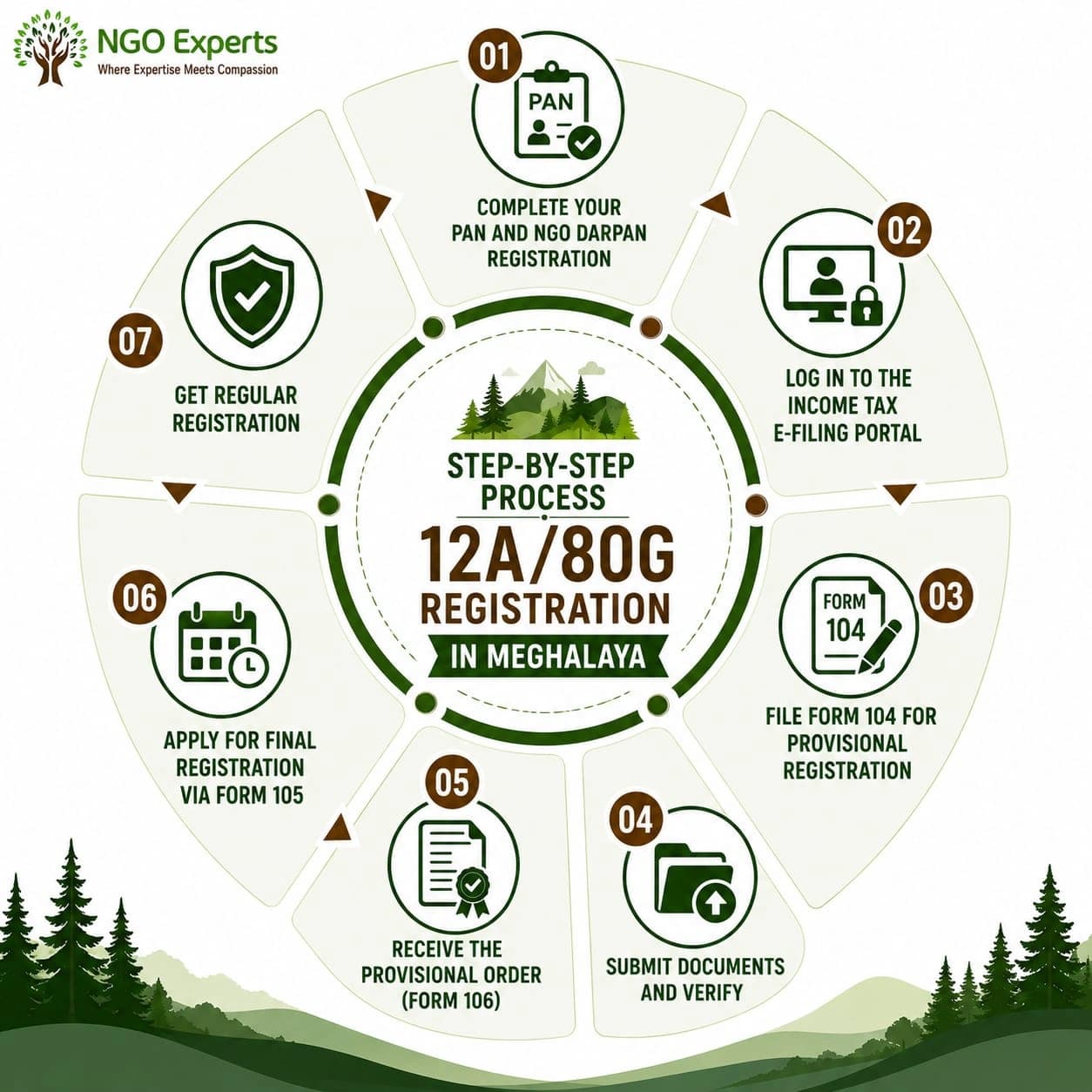
Before applying for 12A and 80G registration, your NGO should have its PAN and NGO Darpan registration in place. Here's how the full process works.
- Complete your PAN and NGO Darpan registration. Apply for the organization's PAN if you don't already have one, and register on the NGO Darpan portal to get a Darpan ID, which is increasingly requested in the 12A and 80G application and is almost always required for government grants later.
- Log in to the Income Tax e-filing portal. Go to the Income Tax e-filing portal and log in using the organisation's PAN.
- File Form 104 for provisional registration. Navigate to e-File → Income Tax Forms → File Income Tax Forms and select Form 104 (the form that replaced Form 10A from 1 April 2026). This is for organisations that haven't started charitable activities yet, or are applying for the first time. Provisional registration under Section 332 is granted for 3 years based purely on the documents submitted. File two applications if you want both approvals: one under Section 332 (for 12A) and one under Section 133(1)(b)(ii) (for 80G).
- Submit documents and verify. Upload the required documents, enter the NGO's objects exactly as they appear in your Trust Deed or MOA, and verify using a Digital Signature Certificate (DSC) or Electronic Verification Code (EVC). Any mismatch is a common reason for rejection. Save the Acknowledgment Receipt Number that's generated.
- Receive the provisional order (Form 106). If the application is in order, the Income Tax Department issues an order in Form 106 (which replaced the old Form 10AC), confirming provisional registration for 3 years.
- Apply for final registration via Form 105. At least six months before your provisional registration expires, or once your NGO has actually started charitable work and can show it, apply for final registration using Form 105 (replacing old Form 10AB). At this stage, the Principal Commissioner of Income Tax (PCIT) reviews your activities, accounts, and compliance before granting regular registration.
- Get regular registration. Once satisfied, the PCIT grants regular registration. Under the 2026 rules, this is valid for 10 years if the NGO's income doesn't exceed ₹5 crore in either of the two preceding years, and for 5 years otherwise, a real relief for smaller Meghalaya NGOs compared to the earlier flat 5-year term.
Fees and Timeline
There's no government fee for filing Form 104 or Form 105 on the income tax portal; it's a free, entirely online application. Professional fees for a CA or consultant handling the filing are the main cost, and these are set by the market rather than by statute.
| Stage | Form | Validity | Approx. Timeline |
| Provisional registration (12A) | Form 104 (was 10A) | 3 years | 15 to 30 working days |
| Provisional approval (80G) | Form 104 (was 10A) | 3 years | 15 to 30 working days |
| Final/regular registration | Form 105 (was 10AB) | 5 years (10 years if income ≤ ₹5 crore) | 1 to 3 months |
| Renewal | Form 105 (was 10AB) | Same as above | File 6 months before expiry |
Timelines are indicative and depend on how complete your documents are and how quickly the PCIT reviews them; always confirm current processing times on the income tax portal.
Post-Registration Compliance
Getting 12AB and 80G registration is not the end of the process. Your NGO must keep meeting these requirements every year to keep the benefits active:
- Apply 85% of income toward charitable objects each year to retain full tax exemption under Section 332.
- File Form 113 (the new number for Form 10BD), the annual statement of donations received, which is what lets your donors actually claim their 80G deduction.
- Issue Form 114 donation certificates to donors.
- File ITR-7 annually, along with an audit report where applicable.
- Renew on time: file Form 105 at least six months before your registration expires; a lapsed registration doesn't roll over automatically and forces a fresh Form 104 application, with income taxable in the meantime.
- Report changes in objects within 30 days, since this is assessed at the registration stage under the new law.
Latest 2026 Updates for 12A and 80G Registration in Meghalaya
- The Income-tax Act, 2025 took effect on 1 April 2026, replacing the old Sections 12A and 80G with Section 332 and Section 133(1)(b)(ii), approved via Section 354
- Forms 10A, 10AB, and 10AC have been renumbered to Form 104, Form 105, and Form 106
- 12A-equivalent final registration (Section 332) now extends to 10 years for NGOs with income under ₹5 crore in either of the two preceding years, up from a flat 5-year term earlier
- 80G approval (Section 354) still renews every 5 years, regardless of NGO size, so don't assume it automatically extends alongside a 10-year 12A registration
- Existing registrations under the old Sections 12A/12AA/12AB remain valid until their original expiry date; no immediate action is needed until then
Funding Advantages of 12A and 80G Registration in Meghalaya
- CSR eligibility: companies funding CSR projects under the Companies Act, 2013 overwhelmingly prefer NGOs with active 12A and 80G and a CSR-1 filing on the MCA portal, especially for Northeast-focused programs.
- Donor confidence: an 80G certificate is often the first thing individual donors check before giving, since it directly reduces their own tax liability.
- Government schemes: many central ministries funding tribal welfare, education, and rural livelihoods in Meghalaya require 12A as a baseline eligibility condition.
- Foreign funding readiness: while FCRA is a separate registration, most international donors expect 12A and 80G to already be in place as a sign of institutional maturity.
Need 12A & 80G for Your Meghalaya NGO?
Get end-to-end assistance with documentation, application filing, and registration.
Frequently Asked Questions
Is 12A and 80G registration handled by a state office in Meghalaya, or centrally?
Centrally. 12A and 80G are Income Tax Department approvals filed on the national e-filing portal; there's no separate state-level process. Only your underlying Trust/Society/Section 8 registration is handled by a state or district authority.
Do I need to be registered as a Society or Trust in Meghalaya before applying?
Yes. You must first hold valid registration as a Trust, Society (under the Meghalaya Societies Registration Act, 1983), or Section 8 Company before the 12A and 80G application can be filed.
What happened to Form 10A and Form 10AB in Meghalaya?
They were replaced by Form 104 and Form 105, effective 1 April 2026, under the Income-tax Act, 2025. Existing registrations made under the old forms remain valid until their original expiry date.
How long is 12A and 80G registration valid now in Meghalaya?
Provisional registration lasts 3 years. Final 12A registration (Section 332) then runs 5 or 10 years depending on income, but final 80G approval (Section 354) always renews every 5 years, so track the two separately.
Is there a government fee for 12A and 80G registration?
Filing Form 104 and Form 105 on the income tax e-filing portal is free; you only pay if you hire a CA or consultant to handle it for you.
What happens if I miss the renewal deadline?
If your registration lapses without renewal, it doesn't continue automatically. You'll need to file a new Form 104 application, and your NGO's income will be taxable in the interim.
Author
Aabha Garg
A Content Strategist at NGOExperts, who focuses on NGO registration, 12A and 80G registration, FCRA compliance, income tax filing for non-profits, and CSR funding guidelines in India. I research and write our compliance guides in collaboration with our in-house Chartered Accountants and Company Secretaries, so every article reflects current tax and regulatory requirements for the NGO and non-profit sector.
Written by Aabha Garg. Last updated on October 13, 2026