


Ready to Get Your NGO Tax Exemptions?
Apply for 12A and 80G Registration with NGOExperts and get professional guidance on eligibility, documents, application filing, and compliance.
Why Does 12A and 80G Registration Timing Matter?
When Should a Brand-New NGO Apply for 12A and 80G Registration?
- File Form 104 as soon as your organisation's PAN is in place — activities don't need to have started yet
- Provisional registration runs for 3 years, giving you time to build an activity track record
- This is the fastest route to donor-ready status, since regular registration typically expects some operating history
When Should an Already-Operating NGO Apply for 12A and 80G Registration?
- File Form 105 if you already have activity records, financials, and a track record to show
- Regular registration runs for 5 years (or 10 years if annual income is ₹5 crore or below, for filings after 31 March 2025)
- Don't wait for a "perfect" moment — every year unregistered is a year of avoidable tax liability and lost donor deductions
When Should You Convert Provisional Registration to Regular?
- Apply to convert to regular registration within 6 months of starting activities, or 6 months before the provisional period expires, whichever is earlier
- This "whichever is earlier" rule catches NGOs that started activities early but assumed they had the full 3 years to convert
- Start compiling activity reports and financials well before you file, since regular registration requires demonstrated charitable work
When Should You Renew Regular Registration?
- File your renewal (Form 105) at least 6 months before your current approval expires
- For full renewal mechanics and what happens if you miss the deadline, see our Renewal of 12A and 80G Registration guide
- Filing early, not just on time, leaves a buffer to fix documentation issues before your deadline
Which Timing Rule Applies to Your NGO?
| Your Situation | When to Apply | Form |
| Just incorporated, no activity yet | Immediately after incorporation | Form 104 (provisional) |
| Already operating, never applied | As soon as records are ready | Form 105 (regular) |
| Provisional, nearing expiry | 6 months of starting activity, or 6 months before expiry — whichever is earlier | Form 105 (convert) |
| Regular, nearing renewal | At least 6 months before expiry | Form 105 (renewal) |
| Already rejected via Form 107 | Within 1 month of the order (specified cases) | Form 105 (reapply) |
Just Registered Your NGO? Get 12A and 80G Next.
Don't wait to start your tax-exemption process. NGOExperts helps newly registered NGOs understand the right timing and complete the registration process correctly.
What Does Bad Timing Actually Cost an NGO?
- Tax exposure: Waiting too long to apply for tax-exemption registration can leave income potentially taxable if the NGO is not yet eligible to claim exemption.
- Missed donor benefits: Without 80G approval, donors generally cannot claim the associated tax deduction for eligible donations made during the unapproved period.
- Funding delays: Many CSR partners and institutional funders expect NGOs to have their key tax registrations and compliance documents in place before considering funding.
What Happens If You Apply Too Early or Too Late?
- Too early with a weak file: A regular registration application with vague objectives or no evidence of activity is a common cause of 12A or 80G rejection. Provisional registration helps avoid these issues by allowing eligible NGOs to secure registration before their activities are fully established.
- Too late: Delaying registration can affect your NGO's ability to claim applicable tax exemptions and prevent eligible donors from claiming deductions for donations made before 80G approval.
- Missed renewal: Failing to maintain valid registration can have serious tax consequences, including potential accreted income tax (exit tax) under the applicable provisions of the Income-tax Act, 2025.
- Donation reporting: Don't overlook the annual donation reporting requirement. Form 113 (formerly Form 10BD) must be filed where applicable; failure to furnish the statement can attract a ₹200-per-day fee, subject to the applicable statutory provisions.
When Should Your NGO Apply for 12A and 80G: Step-by-Step Process
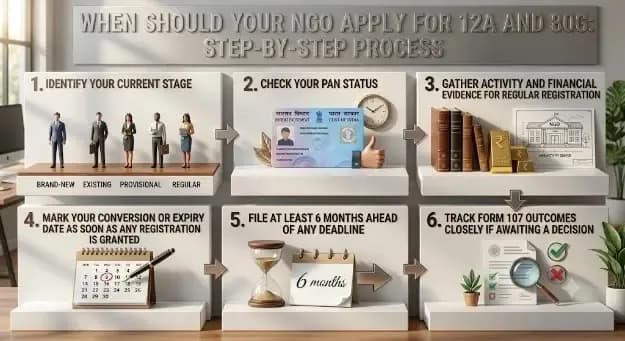
- Identify your current stage: brand-new, operating-but-unregistered, provisional-nearing-conversion, or regular-nearing-renewal.
- Check your PAN status: it must be in the NGO's own name before filing.
- Gather activity and financial evidence for regular registration — audited statements, bank records, an activity report.
- Mark your conversion or expiry date as soon as any registration is granted, using the earlier of the two applicable deadlines.
- File at least 6 months ahead of any deadline, leaving a buffer for departmental queries.
- Track Form 107 outcomes closely if awaiting a decision, since a rejection opens only a narrow reapply window.
Already Running an NGO? Check Your 12A and 80G Status
If your NGO is already operating, make sure your tax-exemption registrations are in place and up to date. Get professional assistance from NGOExperts.
Frequently Asked Questions
When should a brand-new NGO apply for 12A and 80G?
Can an NGO apply for regular registration without first getting provisional registration?
How long before expiry should I file a renewal?
What's the deadline to convert from provisional to regular registration?
Is there a "too early" for filing regular registration?
Does 80G always need to be filed alongside 12A?
Do I need to file anything annually even after 12A/80G is approved?
What's the risk of applying too close to my registration's expiry date?
Author
A Content Strategist at NGOExperts, who focuses on NGO registration, 12A and 80G registration, FCRA compliance, income tax filing for non-profits, and CSR funding guidelines in India. I research and write our compliance guides in collaboration with our in-house Chartered Accountants and Company Secretaries, so every article reflects current tax and regulatory requirements for the NGO and non-profit sector.
Written by Aabha Garg. Last updated on September 17, 2026