

Section 8 Company Registration in Andhra Pradesh
Registering a Section 8 Company in Andhra Pradesh provides a recognised legal structure for organisations pursuing charitable, educational, healthcare, environmental and other eligible non-profit objectives. The company is incorporated under the Companies Act, 2013, through the Ministry of Corporate Affairs (MCA). Organisations explore relevant Andhra Pradesh government schemes, CSR partnerships and other funding opportunities based on their objectives and eligibility. These opportunities are subject to the conditions of each scheme or funding programme.
By Aabha GargReviewed by CA Ashutosh Agarwal Last updated:
Andhra Pradesh provides significant relief on start-up costs through stamp duty incentives.
Access to State-Level Grants and Portals.
Specialized Andhra Pradesh MSME Incentives
Vizag-Chennai Industrial Corridor) create a high-density environment for Corporate Social Responsibility (CSR) partnerships
Quick Answer
Quick Summary
Meaning of Section 8 Company
- Better transparency
- Strong legal identity
- High donor credibility
- Easier CSR funding opportunities
- Improved chances of obtaining FCRA registration
Common Objectives of Section 8 Companies
- Promote charitable or social objectives
- Utilize profits only for organizational goals
- Prohibit dividend distribution to members
- Operate under a license issued by the Central Government through the MCA
Benefits of Sec 8 Company Registration in Andhra Pradesh
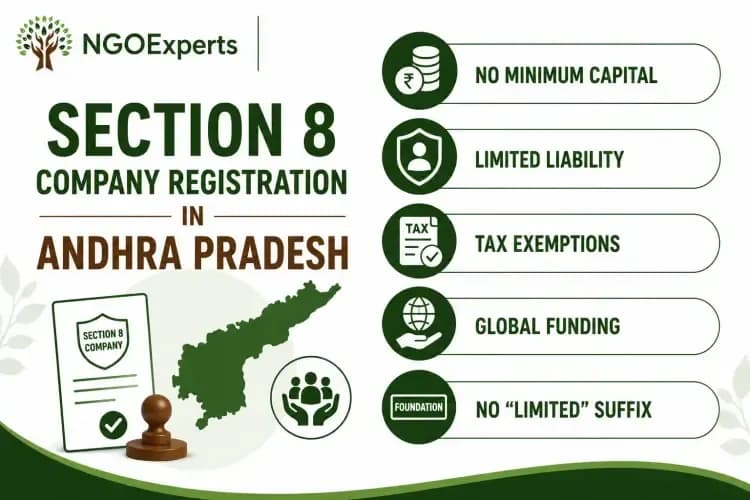
- Foundation
- Council
- Forum
- Association
- Federation
- Mission
Eligibility Criteria for Section 8 Company Registration
- Minimum Members: At least 2 shareholders (individuals or other companies).
- Minimum Directors: At least 2 directors. One director must be a resident of India (i.e., have stayed in India for 182+ days in the previous year).
- Charitable Intent: The primary motive must strictly be non-profit.
- Registered office: A registered office address in Andhra Pradesh is compulsory
- Digital Signature Certificate: DSC (Digital Signature Certificate) is mandatory for all directors
Documents Required for Section 8 Company Registration
| Document Category | Required Papers |
| For Directors | PAN Card, Aadhaar Card, Passport Size Photo, Bank Statement/Utility Bill (not older than 2 months) |
| For Office Address | Utility Bill (Electricity/Water), Rent Agreement, NOC from Landlord |
| Legal Drafts | MOA (INC-13) and AOA, Declaration by Professional (INC-14), Declaration by Directors (INC-15) |
| Financials | Estimated Income & Expenditure Statement for the next 3 years |
Process for Sec 8 Company Registration in Andhra Pradesh
- Company Incorporation
- Allotment of DIN
- PAN and TAN Applications
- EPFO/ESIC Registration
- Professional Tax Registration (Mandatory in AP)
Timeline and Cost of Section 8 Company Registration in Andhra Pradesh
| Expense Head | Estimated Cost |
| DSC | ₹1,000 – ₹2,000 |
| Professional Fees | ₹8,000 – ₹15,000 |
| Government Filing Fees | Depends on authorized capital |
Role of MCA in Section 8 Company Registration
- Incorporation approvals
- Annual filing compliance
- Governance monitoring
- Licensing and legal actions
Compliance Requirements After Registration for a Sec 8 Company Registration in Andhra Pradesh
- First Auditor: The Board of Directors must appoint the company's first auditor within 30 days of registration. If the Board fails to do so, the members must appoint the auditor within the statutory period.
- Board Meetings: Section 8 Companies are subject to the applicable Board meeting requirements and exemptions under the Companies Act and relevant rules. Verify the company's specific requirements before stating a fixed number of meetings.
- AOC-4: File the company's financial statements annually within the applicable statutory deadline.
- MGT-7 / MGT-7A: File the applicable annual return, depending on the company's eligibility and the prescribed form.
- Other Compliance: Maintain statutory registers, minutes, accounts, audit records and other required filings. Non-compliance may attract penalties and, in applicable circumstances, regulatory action affecting the company's licence.
Tax Benefits for a Sec 8 Company Registration in Andhra Pradesh
- Non-profit Tax Registration: Eligible organisations may apply for registration under Section 332 of the Income-tax Act, 2025, corresponding broadly to the earlier Section 12A/12AA/12AB framework, subject to the applicable conditions.
- Approval for Donor Deductions: Eligible organisations may apply for approval under Section 354 of the Income-tax Act, 2025, corresponding broadly to the earlier Section 80G framework. Donor deductions depend on the approval, the nature of the donation and the applicable statutory conditions.
- Update 2026: Check the current Income Tax Department portal and applicable rules for the prescribed application form and filing procedure. Form 105 is identified by the Department for specified applications for regular registration and approval under Sections 332 and 354; do not state that Forms 10A/10AB are the universal current route without checking the applicable transition provisions.
Why choose NGOExperts for Sec 8 company registration in Andhra Pradesh?
- Andhra‑specific experience: NGOExperts has handled registrations across 20+ states, including Andhra Pradesh, so they understand the local ROC and MCA dynamics.
- End‑to‑end online Registration: We manage the entire Section 8 process for you, DSC/DIN, name approval, INC‑12/INC‑13 drafting, and MCA filing.
- First-time approval focus: The firm highlights a strong track record of first‑time approvals for NGO registrations, thereby reducing delays.
- Affordable and transparent pricing: NGOExperts is a cost‑effective option for non‑profit entities.
About the Author

A Content Strategist at NGOExperts, who focuses on NGO registration, 12A and 80G registration, FCRA compliance, income tax filing for non-profits, and CSR funding guidelines in India. I research and write our compliance guides in collaboration with our in-house Chartered Accountants and Company Secretaries, so every article reflects current tax and regulatory requirements for the NGO and non-profit sector.
Written by Aabha Garg, reviewed by CA Ashutosh Agarwal . Last updated on Oct 13, 2026, 09:35 AM