

NGO Registration in Andhra Pradesh
A properly structured NGO can also apply for relevant tax registrations, NGO Darpan recognition, CSR-1 registration, and FCRA approval, subject to eligibility and applicable conditions. However, registration is only the
Last updated:
Overview
Meaings and Types
Structure
Eligibility
Ready to Register Your NGO in Andhra Pradesh?
Get expert assistance with Trust, Society or Section 8 Company registration.
What Is an NGO?
Types of NGO Registration in Andhra Pradesh
1. Trust Registration
- Managed by trustees.
- Suitable for charitable and religious activities.
- Generally simpler to establish.
- Often preferred for local charitable activities.
2. Society Registration
- Requires at least 7 members.
- Managed by an elected governing body.
- Suitable for community-based organisations.
- Governed by applicable society registration laws.
3. Section 8 Company Registration
- Has a separate legal identity.
- Requires at least 2 directors and 2 members.
- Suitable for large-scale operations and CSR projects.
- Offers a structured corporate governance framework.
- Can operate across multiple states.
What Changed in 2026: Latest Updates for NGO Registration in Andhra Pradesh
- New Income-tax Act, effective 1 April 2026. The Income-tax Act, 2025 replaced the 1961 Act. Charitable registration (old 12A/12AB) now sits under Section 332, and donor-deduction approval (old 80G) under Section 354. The applicant is now called a Registered Non-Profit Organization (RNPO).
- New forms. Form 104 replaces Form 10A for provisional registration, and Form 105 replaces Form 10AB for regular registration and renewals. Provisional registration runs for 3 years. Commentary on Section 332(5) says entities with income under ₹5 crore in each of the two preceding years can get 10-year regular registration instead of 5. Confirm this with your CA before relying on it.
- Existing registrations continue. Valid 12A/12AB/10(23C) registrations carry over as RNPO status until expiry. The 80G (Section 354) renewal must be filed separately.
- FCRA Amendment Rules, 2026 (22 June 2026). NGOs seeking foreign funds must select declared purposes from a fixed schedule, name their states of operation, disclose social media accounts, and pay ₹300 for each extra purpose or state. Existing holders have one year to update. As of 15 July 2026, there were 14,449 active FCRA registrations, 22,498 canceled, and 15,212 expired. The FCRA Amendment Bill, 2026 (introduced on 25 March 2026) was still pending in the sources we reviewed.
Which Structure Fits NGO Registration in Andhra Pradesh?
| Trust | Society | Section 8 Company | |
| Law | Indian Trusts Act, 1882; deed registered under the Registration Act, 1908 | Andhra Pradesh Societies Registration Act, 2001 | Companies Act, 2013 |
| Registered with | Sub-Registrar | District Registrar | Registrar of Companies (MCA) |
| Minimum people | 2 trustees | 7 members | Private: 2 directors and 2 members. Public: 3 directors and 7 members |
| Best for | Family-led, scholarship or endowment work | Member-run, district or community programs | Multi-state work, large CSR and institutional funding |
| Compliance | Lightest | Annual meeting and returns | Heaviest (MCA and tax filings) |
Confused About Which NGO Structure to Choose?
Let our experts help you select the right legal structure for your NGO.
Eligibility and Core Requirements for NGO Registration in Andhra Pradesh
- Members: Indian citizens aged 18 or above, meeting the minimums above.
- Registered office in Andhra Pradesh: with address proof (electricity or water bill) and a landlord NOC if rented.
- Unique name: it must not match or closely resemble another society in the same district, a trademark, or a name that misleads.
- Charitable objects: written for public benefit such as education, health, livelihoods, or environment, with no profit sharing among members.
Documents Required for NGO Registration in Andhra Pradesh
- Each member, trustee, or director: passport photo, PAN, Aadhaar or another ID, and address proof.
- Office: utility bill, rent agreement if applicable, and owner’s NOC.
- Trust: registered Trust Deed.
- Society: Memorandum of Association and bye-laws.
- Section 8 Company: MOA, AOA, declaration in the incorporation form, a Digital Signature Certificate for each director, and a three-year income and expense projection.
Step-by-Step Process for NGO Registration in Andhra Pradesh
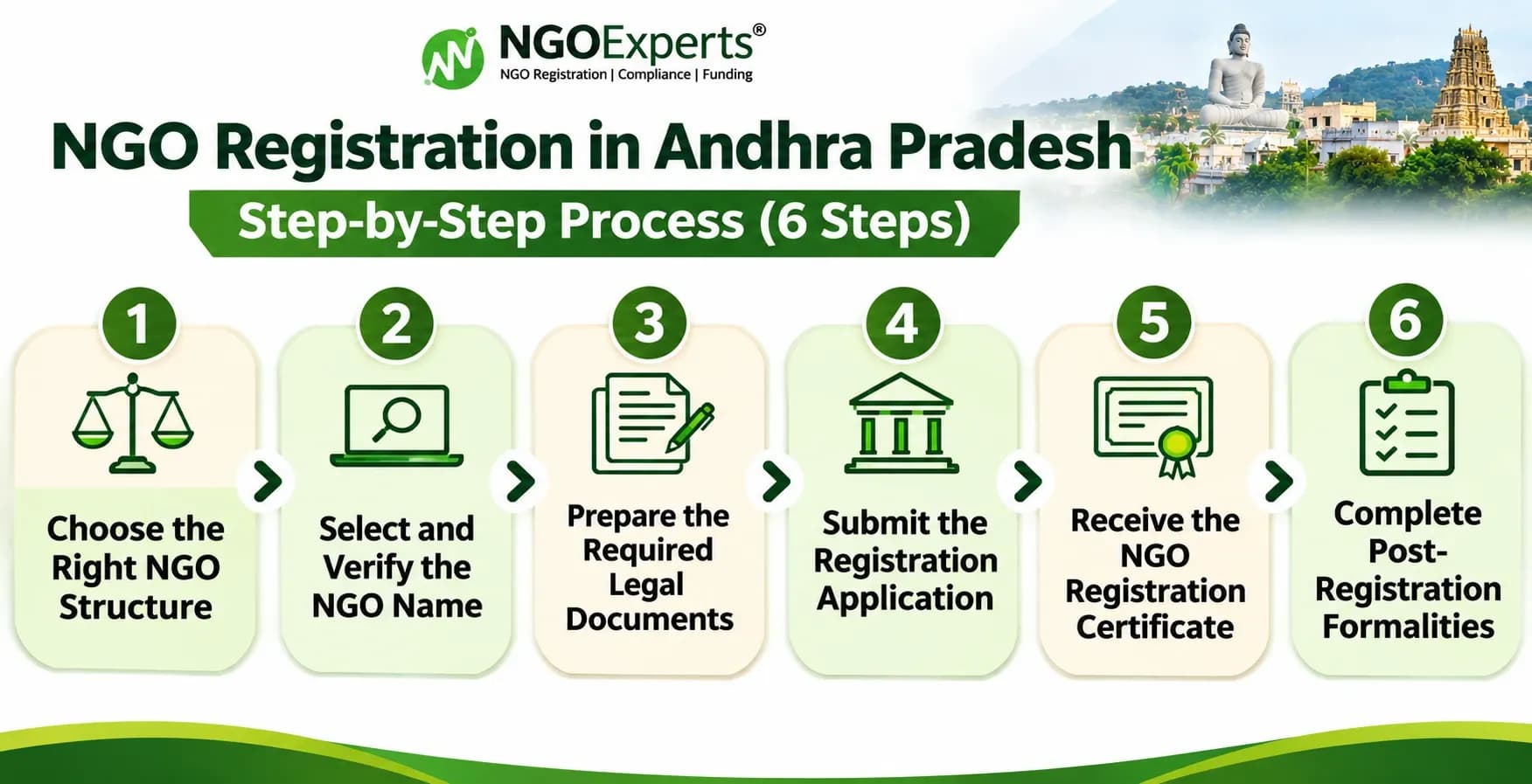
Step 1: Choose the Right NGO Structure
- Trust: Suitable for charitable and religious activities.
- Society: Suitable for community-based, educational and social welfare activities. Requires at least seven members.
- Section 8 Company: Suitable for professionally managed non-profit organisations and large-scale social projects.
Step 2: Select and Verify the NGO Name
- Check existing registered societies.
- Search company names through the MCA portal.
- Check existing trademarks to avoid name conflicts.
Step 3: Prepare the Required Legal Documents
- Trust: Trust Deed.
- Society: Memorandum of Association (MOA) and Rules & Regulations/Bye-laws.
- Section 8 Company: Memorandum of Association (MOA) and Articles of Association (AOA).
Step 4: Submit the Registration Application
- Trust: Execute and register the Trust Deed before the jurisdictional Sub-Registrar, as applicable.
- Society: Apply to the District Registrar under the Andhra Pradesh Societies Registration Act, 2001.
- Section 8 Company: Apply online through the MCA SPICe+ incorporation process.
Step 5: Receive the NGO Registration Certificate
- Trust: Receive the registered Trust Deed.
- Society: Receive the Society Registration Certificate.
- Section 8 Company: Receive the Certificate of Incorporation from MCA.
Step 6: Complete Post-Registration Formalities
- PAN Card: Obtain PAN in the NGO's name.
- TAN Registration: Apply for TAN if the organisation is required to deduct tax at source.
- Bank Account: Open a dedicated bank account for NGO transactions.
- Income-Tax Registration: Apply under Section 332 of the Income-tax Act, 2025, if eligible and seeking registration as a non-profit organisation.
- 80G Equivalent Approval: Apply under Section 354 of the Income-tax Act, 2025, to obtain approval for eligible donor deductions.
- NGO Darpan Registration: Register with NITI Aayog where required for government grants or other applicable purposes.
- CSR-1 Registration: File Form CSR-1 with MCA if the NGO qualifies and intends to act as a CSR implementing agency.
- FCRA Registration: Obtain FCRA registration or prior permission before accepting foreign contributions.
Cost of NGO Registration in Andhra Pradesh (2026)
| Structure | Total fees (approx.) | Timeline |
| Trust | ₹10,000 – ₹15,000 | 7 – 15 days |
| Society | ₹15,000 – ₹25,000 | 15 – 20 working days |
| Section 8 Company | ₹8,000 – ₹15,000 | 15 – 20 working days |
After NGO Registration in Andhra Pradesh: Tax, Darpan, CSR and FCRA
1. Apply for Income Tax Registration (12A/12AB and 80G)
- Section 332 registration (formerly 12A/12AB). File Form 104 for provisional registration, then Form 105 for regular registration. Income must be applied to charitable objects, and the framework keeps the 85% application rule.
- Section 354 approval (formerly 80G). This lets donors claim a deduction, which makes small-donor fundraising easier.
2. NGO Darpan ID
3. CSR-1 (MCA)
4. FCRA Registration
Annual Compliance After NGO Registration in Andhra Pradesh
- Trusts: maintain books, get accounts audited where required, and file the income tax return (ITR-7).
- Societies: hold an annual general meeting, adopt audited accounts, file the governing body list with the District Registrar, and file ITR-7.
- Section 8 Companies: file annual financial statements and returns with the Registrar of Companies, complete Form K, C, and file the income tax return.
- All: renew Section 332 and Section 354 before expiry, and, if you hold FCRA, file annual returns and update declarations within the one-year window.
- Structure advice before paperwork. We match Trust, Society, or Section 8 to your funding plan and compliance capacity, not to the cheapest package.
- Andhra Pradesh filing, done right. Societies are drafted for the AP Societies Registration Act, 2001 and filed with the District Registrar. Trust deeds go to the Sub-Registrar.
- 2026-ready tax filings. We apply under Section 332 and Section 354 using Forms 104 and 105, not the outdated 12A and 10A process still described on many sites.
- Funding readiness built in. NGO Darpan ID, CSR-1, and FCRA support follow the right registration order, so a CSR committee or ministry doesn’t turn you away.
- Written quote, timelines, and a compliance calendar. Government fees, stamp duty, and professional charges are listed separately, and renewal dates are tracked so exemptions never lapse.
Need Help with NGO Registration and Compliance?
Get end-to-end support for NGO registration, 12A, 80G, NGO Darpan and CSR-1.
Related NGO Services & Legal Solutions
12A Registration
12A Registration is a tax registration for NGOs, trusts, societies, and Section 8 companies involved in charitable activities. It helps eligible organisations get income tax exemption on their income, provided they use their funds for approved purposes and follow the rules of the Income Tax Act.
80G Registration
80G Registration is a tax approval for NGOs, trusts, societies, and Section 8 companies that allows eligible donors to claim tax deductions on qualifying donations. It is granted under Section 354 of the Income-tax Act, 2025, while Section 133 covers the donor's tax deduction, subject to applicable rules and conditions