
Quick Summary
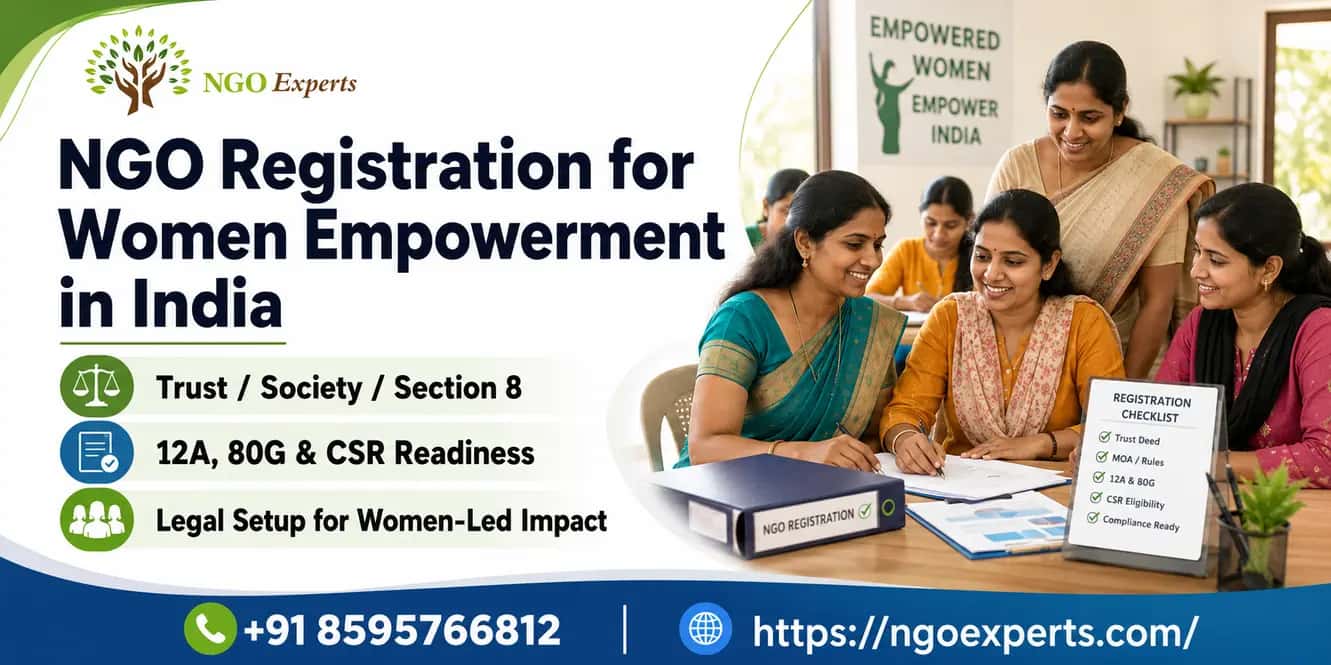
A huge round of applause for those who support and create platforms that empower women, as every empowered woman strengthens a family, a community, and a nation. With a strong cause like women's empowerment, the right legal structure and guidance, your NGO can become a powerful entity not for itself but for the nation as well. NGO registration for women's empowerment in India is a simple yet powerful step towards change. Register your women's empowerment NGO as a Society Trust, or a Section 8 company. Secure 12A & 80G certifications for a women's NGO to access tax benefits and funding.
Benefits of Registering an NGO for Women's Empowerment
Starting an NGO dedicated to women’s empowerment is not just a noble mission; it becomes even better if you are recognised and earn revenue. You can have the following benefits-
- A registered women's empowerment NGO can receive funding from government schemes, corporate CSR (Corporate Social Responsibility), and foreign donors.
- It builds trust, protects your work legally, and qualifies for 12A and 80G tax exemptions for a women's empowerment NGO.
- If you are not registered, your personal liability increases, and you can't issue tax receipts. NGO registration for women in India includes limited liability.
How to Start a Women's Empowerment NGO in India?
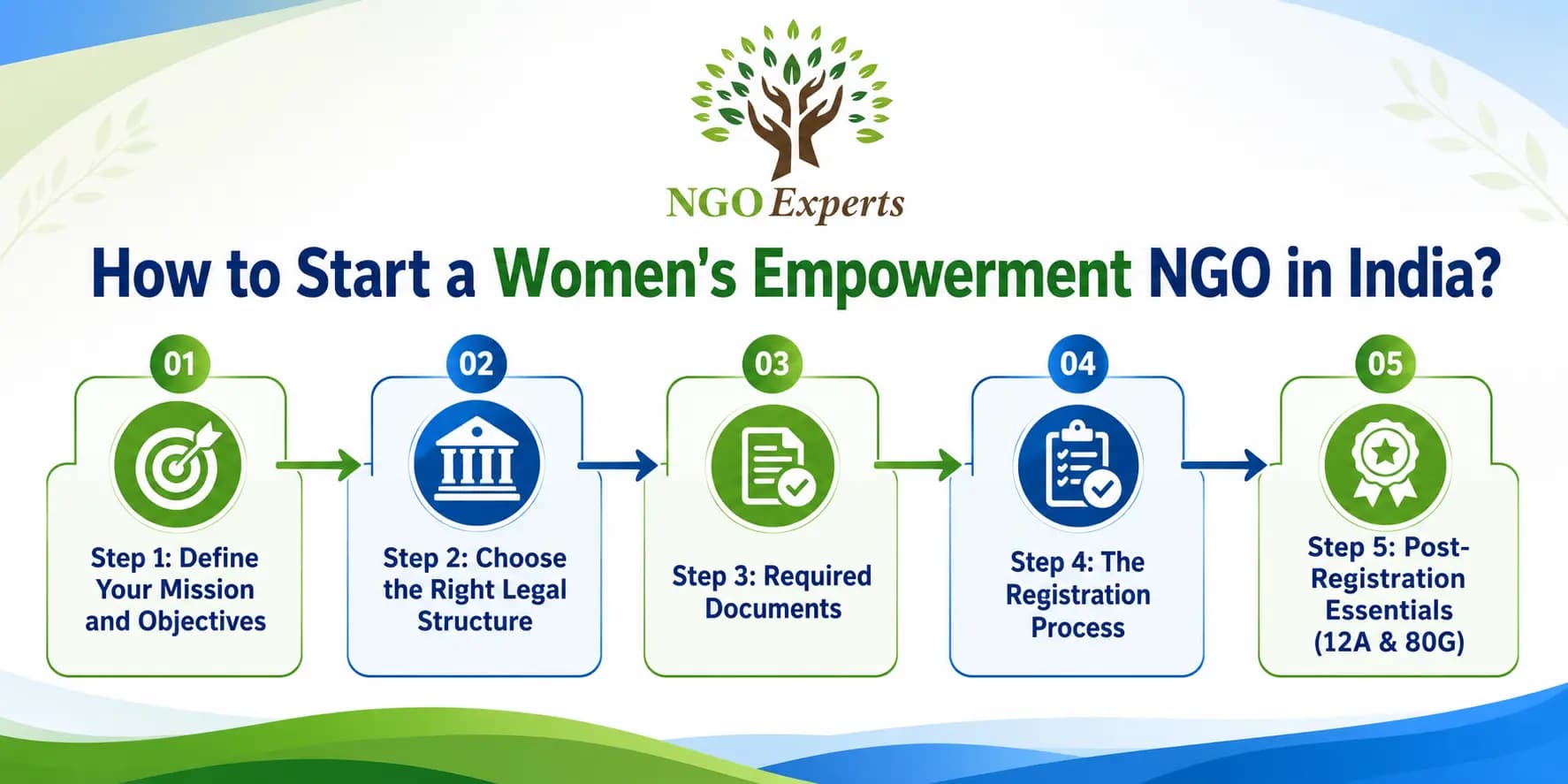
We will simplify the legal framework in India. The following step-by-step guide to NGO registration covers everything from registration to the post-registration process and is divided into 5 simple, actionable steps.
Step 1: Define Your Mission and Objectives
Before you file your paperwork, you must define your objective and explain how you will empower women. In India, NITI Aayog and the IncomeTax Department permit only specific charitable objects.
Common objectives for women's empowerment NGOs include
- Promoting vocational training and skill development.
- Providing legal aid for women’s rights.
- Supporting girl child education and healthcare.
- Establishing self-help groups (SHGs) for financial independence.
Step 2: Choose the Right Legal Structure
In India, you can register a Women’s Welfare Organisation in three ways. Let's compare with the help of the following Table
| Feature | Trust | Society | Section 8 Company |
| Law | Indian Trusts Act, 1882 | Societies Registration Act | Companies Act, 2013 |
| Best For | Small groups | Member-based groups | Professional/Large scale |
| Trustees/Members | Minimum 2 | Minimum 7 | Minimum 2 |
| Credibility | Moderate | Moderate | Highest (Global) |
Step 3. Required Documents
We want you to experience a smooth registration, so you are supposed to keep these documents ready:
- Identity Proof - Aadhaar Card, PAN Card, and Voter ID of all members.
- Address Proof - Utility bill (Electricity/Water) for the registered office.
- Rent Agreement - If your office is rented, along with an NOC (No Objection Certificate) from the landlord.
- Objects: Detailed objects for the Section 08 company.
- Contact Details of Members: Email ID and Mobile number of all the members is required.
- Address Proof of Members: A current bank statement or utility bill is required as proof of address for each member.
Step 4: The Registration Process
The Registration process is now divided into 4 simple, easy-to-implement steps.
- Name Approval - Choose a unique name that reflects your mission
- File on MCA Portal - File SPICe+ form on the MCA(Ministry of Corporate Affairs)
- Filing with the Registrar: Submit your application to the Sub-Registrar (for Trusts) or the ROC (Registrar of Companies)for Section 8 Companies.
The registration process is complete, and you can proceed with the steps required for your NGO to run successfully.
Step 5: Post-Registration Essentials (12A & 80G)
Registration is just the beginning; the key factor is donor acquisition. For that, you need Tax Exemptions. Let's explain the types of deductions
- 12A Registration: Makes your NGO’s income tax-free.
- 80G Registration: Allows your donors to claim a 50% tax deduction on their donations, the most crucial tool for successful fundraising.
- CSR (Corporate Social Responsibility) Registration: It is necessary if you want to receive funds from large corporations.
- NITI Aayog registration: A simple way to build credibility for a women-empowerment entity in India. Just sign up online using your NGO's registration certificate, PAN, and key member details to get a unique ID, and you'll start receiving government grants, CSR funds, and schemes for women's upliftment.
Legal structure for a women's empowerment NGO
A Section 8 company under the Companies Act 2013 requires only 2 directors, offers easier CSR funding and benefits from strong administrative support. It's well-suited to women's empowerment initiatives, such as education or skills training, as it builds credibility for grant applications and foreign funding. Section 8 companies are a top choice for women's empowerment NGOs in India due to their credibility and access to funding.
Let's take some successful examples under this structure.
Prominent Examples
These NGOs focus on women's education, skills, health, and rights and are established as Section 8 companies.
- SEWA (Self-Employed Women's Association)- Empowers millions of low-income women workers through skills training and microfinance, is a Section 8 company.
- CARE India - Runs women-led programs in health, education, and livelihoods across rural areas. Section 8 setup helps with large-scale funding and transparency.
- Breakthrough- Fights gender violence and promotes equality via campaigns and community work. Section 8 structure supports the donor trust.
Based on the examples and explanations above, Section 8 is the best choice for a women's empowerment NGO. If you don't want to register as a Section 8 company, NGOExperts can guide you on choosing alternative structures in the following cases.
When to Choose Other Structures?
- Form a society under the Societies Act 1860 for local women's welfare with 7+ members.
- Form a Trust under the Trusts Act 1882 for small teams focused on relief work.
Conclusion
NGO registration for women's empowerment in India creates a strong foundation that builds trust and credibility. By choosing the right structure, obtaining 12A/80G status, and obtaining a clear registration, you can secure sustainable funding and long-term growth with professional guidance. With NGOExperts, the NGO registration process for women's welfare becomes simple and compliant.
Frequently Asked Questions
Can a single person start a women's empowerment NGO in India?
Technically, no. All three legal structures require multiple people. A Trust or a Section 8 Company needs at least two people, while a Society requires a minimum of seven members. However, you can be the primary founder or promoter.
What are the tax benefits for a newly registered NGO?
You must apply for Section 12A registration and a Section 80G registration to save your NGO's income from being taxed.
Can my NGO receive funds from foreign donors immediately?
No. To be eligible for foreign funding, an NGO must have been active for at least 3 years.
What work does the women's empowerment NGO do?
Skills training, self-help groups, legal aid, sanitary pads, domestic violence help and girl child education programs.
Which government schemes are for women's empowerment NGOs in India?
Beti Bachao Beti Padhao, Mahila Shakti and Mahila Samriddhi Yojana are some key schemes for women's empowerment.
Author
Aabha Garg
A Content Strategist at NGOExperts, who focuses on NGO registration, 12A and 80G registration, FCRA compliance, income tax filing for non-profits, and CSR funding guidelines in India. I research and write our compliance guides in collaboration with our in-house Chartered Accountants and Company Secretaries, so every article reflects current tax and regulatory requirements for the NGO and non-profit sector.
Written by Aabha Garg. Last updated on August 25, 2026