
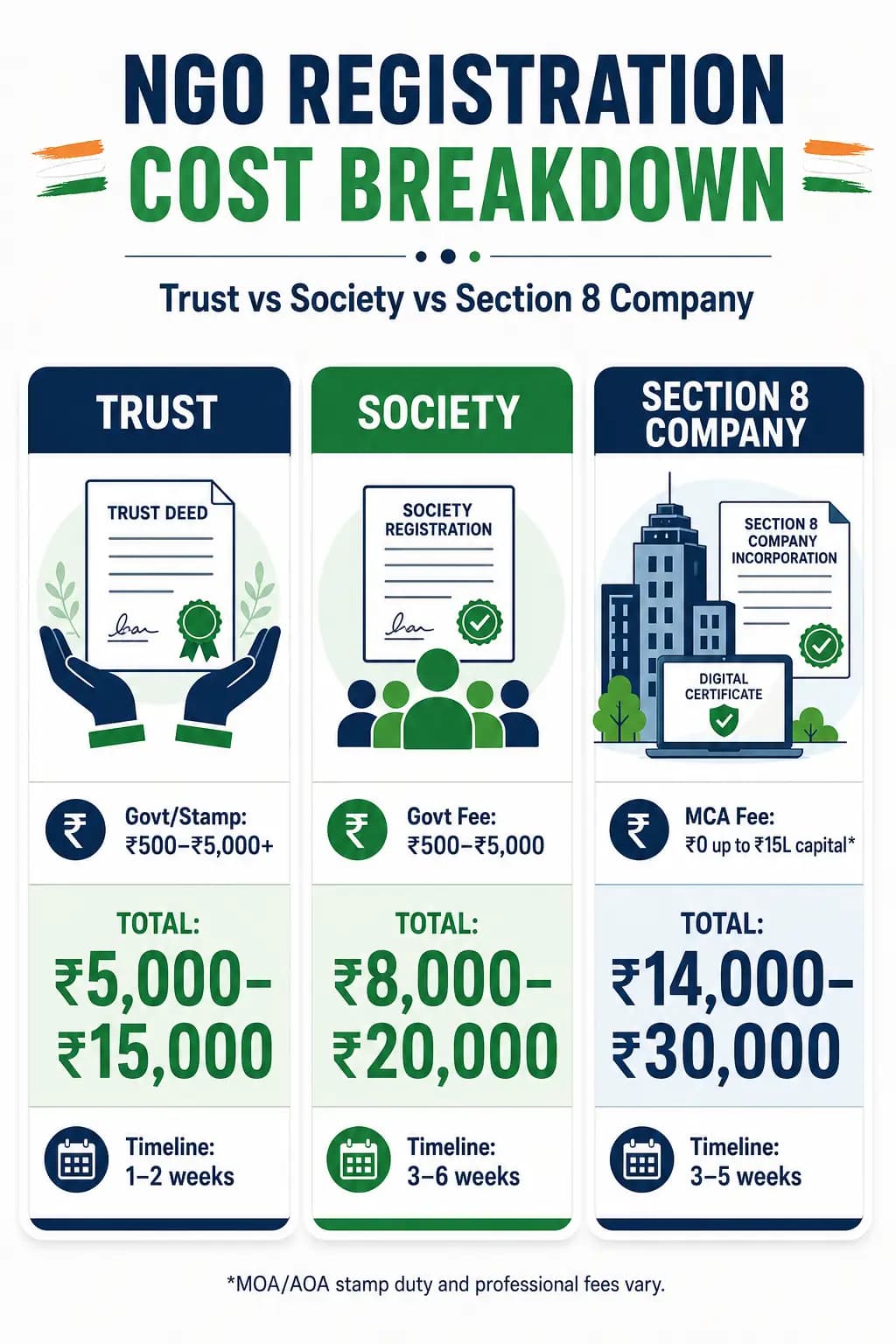
Registering an NGO in India typically costs ₹5,000 to ₹15,000 for a trust, ₹8,000 to ₹20,000 for a society, and ₹14,000 to ₹30,000 for a Section 8 company. The actual total depends heavily on your state's stamp duty and professional fees.
What Drivers Determine Your Total Cost?

Setting up an NGO involves two main expenses: government and stamp duty fees (fixed by law) and professional fees (for drafting, verification, and filing).
State Stamp Duty is the Primary Variable: Stamp duty varies significantly across states. Incorporating or registering the same structure can cost double in one state compared to another purely based on local stamp law.
Capital & Structure: Trusts are generally the most affordable to set up initially. Societies fall in the middle range. Section 8 Companies require higher upfront expenses due to digital compliance but offer easier access to corporate CSR funding and government grants down the line.
Registration Cost Breakdown by Structure
| Cost Head | Trust | Society | Section 8 Company |
| Govt / Stamp Duty | ₹500–₹5,000+ (State & property value dependent) | ₹500–₹5,000 (State-dependent) | ₹0 MCA fee (up to ₹15L capital); stamp duty on MOA/AOA charged separately |
| DSC & DIN | Not required | Not required | ₹1,000–₹2,000 per director (Class 3 DSC) |
| Name Reservation | Not applicable | Not applicable | ₹1,000 (SPICe+ Part A) |
| Professional Fees | ₹3,000–₹10,000 | ₹5,000–₹15,000 | ₹10,000–₹25,000 |
| Typical Total | ₹5,000–₹15,000 | ₹8,000–₹20,000 | ₹14,000–₹30,000 |
| Typical Timeline | 1–2 weeks | 3–6 weeks | 3–5 weeks |
Note: Figures represent standard ranges for registrations involving 2 to 7 founding members without complex documentation issues.
Detailed Cost Breakdowns
1. Trust Registration
- Stamp Duty: Payable on the Trust Deed under the respective State Stamp Act (either a flat rate or a percentage of the declared trust property value).
- Sub-Registrar Fee: Typically ₹1,000–₹3,000 depending on location.
- Professional Fee: ₹3,000–₹10,000 for deed drafting, legal review, and Sub-Registrar attendance.
- PAN Application: Nominal government fee, usually included in professional packages.
2. Society Registration
- State Registration Fee: ₹500–₹5,000 under the Societies Registration Act, 1860 (or state-specific variants).
- Professional Fee: ₹5,000–₹15,000 for drafting the Memorandum of Association (MOA) and Rules & Regulations.
- Member Requirement: Requires a minimum of 7 members, which increases document coordination rather than direct statutory cost.
3. Section 8 Company Registration
- MCA SPICe+ Fee: ₹0 incorporation fee for authorised capital up to ₹15 Lakh; standard slab fees apply above ₹15 Lakh.
- Name Reservation: ₹1,000 via SPICe+ Part A.
- Digital Signatures (DSC): ₹1,000–₹2,000 per director (Class 3 DSC mandatory).
- Stamp Duty on MOA/AOA: State-specific. Several states offer concessional or minimal rates for Section 8 entities.
- Professional Fee: ₹10,000–₹25,000 for drafting documents, obtaining certifications, and completing MCA filings.
Essential Post-Registration Costs
Registration gets your legal entity established. To become eligible for grants and tax-deductible donations, you will likely need to complete these post-registration filings:
| Filing / Exemption | Government Fee | Typical Professional Fee |
| NGO Darpan (NITI Aayog) | ₹0 | ₹0–₹2,000 (Can be self-filed) |
| PAN & Entity Bank Account | Nominal / ₹0 | ₹500–₹1,500 |
| Tax Exemption (12A & 80G / RNPO) | ₹0 (IT e-filing portal) | ₹5,000–₹15,000 (Form 104 / Form 105 filing) |
| CSR-1 Registration | ₹0 | ₹2,999–₹5,000 |
| FCRA Registration | ₹10,000 (₹5,000 for Prior Permission) | ₹10,000–₹25,000 |
Realistic First-Year Budgeting
Budgeting for your first year should account for both setup costs and initial compliance requirements.
Note: FCRA and CSR-1 costs are excluded here, as most NGOs apply for them after meeting operational track-record requirements.
Hidden & Recurring Expenses to Keep in Mind
- Name Rejection (Section 8): If the MCA rejects your proposed name, re-reserving it costs an extra ₹1,000 in government fees plus potential professional charges.
- DSC Renewals: Class 3 digital signatures are valid for 1–2 years and cost ₹1,000–₹2,000 per director to renew.
- Annual Audits & Filings: Recurring yearly costs for Chartered Accountant audits, ROC filings (for Section 8), or Registrar returns (for Societies/Trusts).
- Registered Office Documents: Rent agreements, utility bills, and notarized NOCs may incur minor local costs.
Frequently Asked Questions
Which NGO structure is the cheapest to register?
A Trust is generally the most economical, costing roughly ₹5,000 to ₹15,000 total. It does not require Digital Signatures, DINs, or MCA filings—just a stamped deed and Sub-Registrar registration.
Why does a Section 8 Company cost more to incorporate?
Section 8 Companies involve higher initial expenses due to mandatory Class 3 Digital Signatures (DSC) for directors, formal name approval fees, state-specific stamp duties on corporate documents, and expert secretarial drafting under the Companies Act.
Is NGO Darpan registration free?
Yes. Generating an NGO Darpan profile on the NITI Aayog portal carries no government fee. Most founders complete this step themselves without hiring external services.
How much does 12A and 80G tax-exemption registration cost?
The Income Tax Department charges no government fee on its portal for filing Form 104 or Form 105. Professional fees for drafting, verifying eligibility, and submitting the application generally range from ₹5,000 to ₹15,000.
What are the annual costs after NGO registration?
Annual compliance costs may range from ₹5,000 to ₹20,000, depending on the structure.
Author
Aabha Garg
A Content Strategist at NGOExperts, who focuses on NGO registration, 12A and 80G registration, FCRA compliance, income tax filing for non-profits, and CSR funding guidelines in India. I research and write our compliance guides in collaboration with our in-house Chartered Accountants and Company Secretaries, so every article reflects current tax and regulatory requirements for the NGO and non-profit sector.
Written by Aabha Garg. Last updated on August 25, 2026