

Quick Summary
With years of expertise in guiding companies through registration and compliance, we understand that NITI Aayog (National Institution for Transforming India) is the premier policy think tank of the Government of India, established in 2015 as a successor to the Planning Commission.
Its objectives shape policies that affect millions, making it essential to grasp what NITI Aayog aims to achieve for anyone interested in India’s governance, economic policies, or development projects. This blog presents an easy, simplified, and comprehensive overview of NITI Aayog’s key objectives, how it functions, its benefits, and overall processes in India.
What is NITI Aayog?
NITI Aayog, also known as the National Institution for Transforming India, is the government’s main policy think tank. Formed in 2015 to replace the Planning Commission, it works to ensure India’s growth is both cooperative and inclusive.
Chaired by the Prime Minister, it brings together State Chief Ministers and union territory lieutenant governors to design policies, track progress, and drive welfare and development programs that impact people across the country.
NITI Aayog works closely with:
- The Prime Minister of India acts as the Chairperson.
- The Chief Ministers of states and Union Territories with legislatures.
- Lt. Governors of Union Territories.
Objectives of NITI Aayog
NITI Aayog operates around several key objectives that reflect its role as India’s transformative policy think tank:
- Create a platform for Centre–State collaboration.
- Focus on underdeveloped areas and communities.
- Recommend innovative national and regional policies.
- Promote village-level development planning.
- Resolve inter-sectoral conflicts.
- Collaborate with global think tanks.
- Monitor, evaluate, and use tech for efficient policy execution.
Structure of NITI Aayog
The overall committee of NITI Aayog in India includes:
1. Chairperson: The Prime Minister of India.
2. Governing Council:
- Chief Ministers of all states.
- Lt. Governors of Union Territories.
3. Regional Councils:
- Formed to address specific regional issues.
- Chaired by the NITI Aayog Chairperson or a nominated member.
4. Domain Experts: Eminent specialists with expertise in relevant fields.
5. Full-Time Members: Key policymakers driving the Aayog’s objectives.
6. Vice-Chairperson: Appointed by the Prime Minister.
7. Ex Officio Members:
- Up to four ministers from the Union Cabinet are nominated by the Prime Minister.
8. CEO: Holds the rank of Secretary to the Government of India, appointed by the Prime Minister.
Key Functions of NITI Aayog
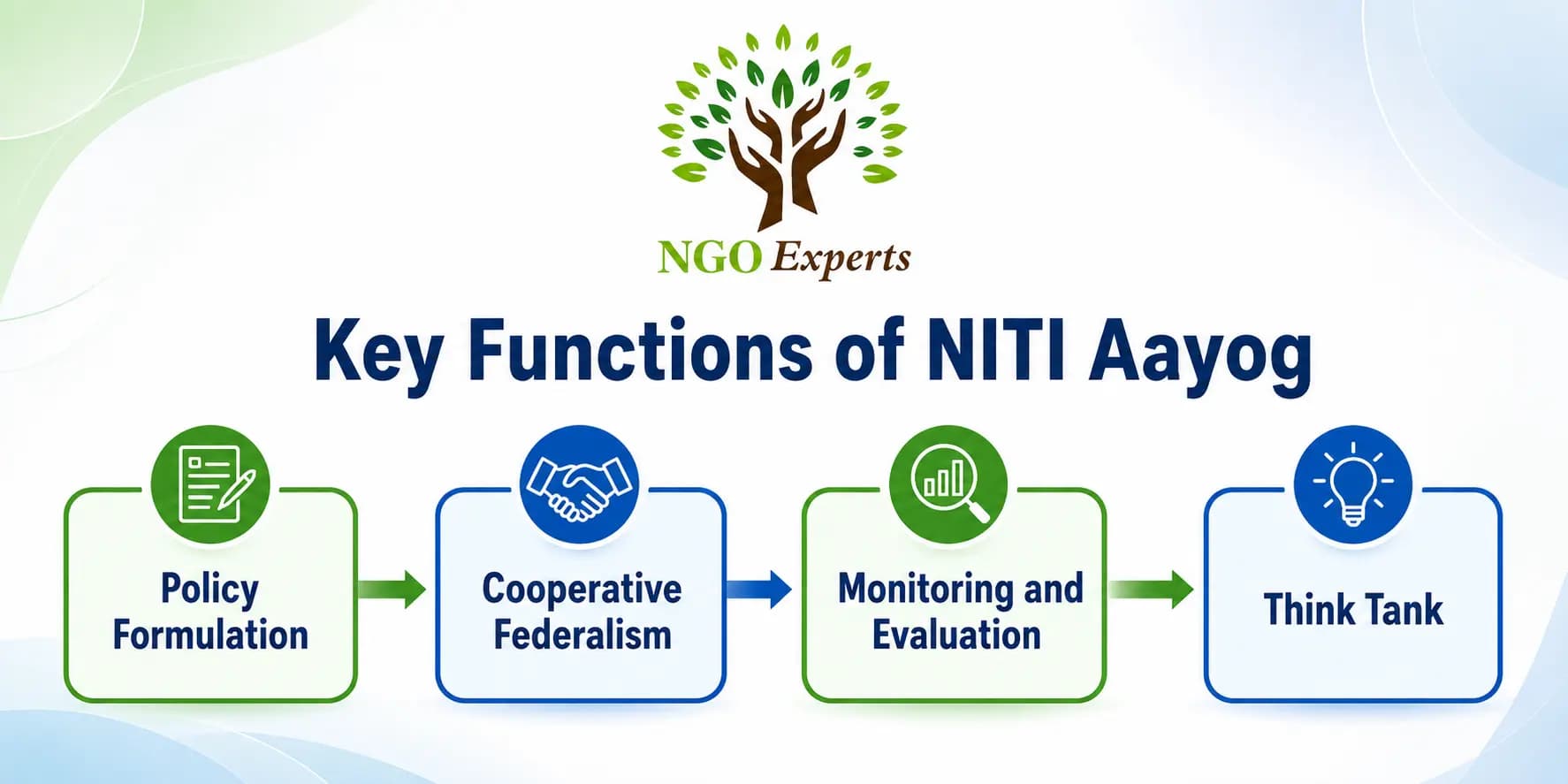
- Policy Formulation: Prepares long-term, strategic, and sectoral policies for India's economic development.
- Cooperative Federalism: Functions as a bridge between the central and state governments for coordinated policy implementation.
- Monitoring and Evaluation: Tracks the implementation of schemes and evaluates the outcomes.
- Think Tank: Provides knowledge, innovation, and thought leadership to address national challenges
Why is NITI Aayog important for Indian Businesses?
NITI Aayog plays a vital role in creating innovative policies and building global partnerships for India’s development.
- Policy Innovation: Develop cutting-edge strategies to address complex national challenges.
- Economic Growth: Ensures the benefits of economic progress reach all sections of society.
- Collaboration Platform: Facilitates cooperation between states and the central government.
- Global Partnerships: Collaborates with international organisations for development solutions.
- Transparent Governance: Promotes accountability and accessibility in policy implementation.
Key Benefits of NITI Aayog in India
By focusing on these objectives, NITI Aayog brings several benefits:
- Promotes coordination and cooperation across different government levels, improving policy coherence.
- Focuses on equity, ensuring disadvantaged social groups receive due attention.
- Boosts policy innovation by fostering public-private partnerships and research integration.
- Streamlines progress via evidence-based monitoring, making government programs more effective.
- Enhances technology-driven governance, improving transparency and service delivery.
Step-by-Step Process: How NITI Aayog Implements Its Objectives
Understanding how NITI Aayog functions to meet its objectives can be helpful:
- State-Centric Vision Formation: Engage states and Union Territories in formulating a shared vision aligned with national priorities.
- Collaborative Strategy Design: Build cooperative mechanisms to support federalism, allowing states to customize interventions.
- Village-Level Planning: Encourage grassroots development plans to flow upwards for integration into higher-level frameworks.
- Program Monitoring: Identify resources needed and evaluate program progress through bodies like DMEO (Development Monitoring and Evaluation Organisation).
- Innovation Promotion: Launch flagship initiatives like Atal Innovation Mission to foster entrepreneurship.
- Feedback process: Utilize monitoring data to implement mid-course corrections for policy effectiveness.
- Knowledge Hub Maintenance: Serve as a repository of governance research and share best practices.
Checklist for NITI Aayog's Objectives and Functions
| Objective | Description | Key Focus Area | Outcome |
| Cooperative Federalism | Promote collaboration between the Centre and States | Multi-level government coordination | Policy alignment & unity |
| Inclusive Growth | Focus on marginalized/vulnerable groups | Social equity | Balanced development |
| Village-Level Planning | Bottom-up planning processes | Local needs & resources | Realistic, targeted programs |
| Long-Term Strategic Policy | Formulate & monitor national-level policy frameworks | Sustainability & growth | Policy continuity & impact |
| Innovation & Technology | Foster innovation, tech adoption | Technology ecosystem | Modern, efficient governance |
| Knowledge & Resource Center | Establish a research & advisory think tank | Evidence & expertise sharing | Better-informed policy making |
| Monitoring & Evaluation | Track program implementation | Results-oriented governance | Efficiency & accountability |
| Stakeholder Partnerships | Collaborate with think tanks and research institutions | National & international ties | Enriched policy input |
Frequently Asked Questions
What is the main purpose of NITI Aayog?
NITI Aayog aims to foster cooperative federalism, promote inclusive growth, and steer strategic policy for India’s sustainable development.
How does NITI Aayog improve planning?
It encourages credible, bottom-up planning starting at village levels, integrating local needs into broader national strategies.
Who leads NITI Aayog?
The Prime Minister of India serves as the Chairperson of NITI Aayog, ensuring leadership and vision for national development planning.
What flagship initiatives does NITI Aayog support?
Initiatives like Atal Innovation Mission and Aspirational Districts Programme promote innovation and socio-economic development.
Author
Sakshi Kashyap
I am a dedicated and detail-oriented Website Content Writer with over two years of experience in creating compelling, reader-friendly, and SEO-optimized content. My expertise lies in developing well-structured web pages, landing pages, blogs, and service descriptions that enhance user engagement and drive organic traffic.
Written by Sakshi Kashyap. Last updated on October 6, 2026