
If your NGO gets any money from outside India, 2026 is a year you can't afford to ignore. New rules are already live, a bigger law is still being debated, and both sides have strong opinions on what it all means.
FCRA controls how Indian NGOs receive and use foreign donations. In 2026, proposed and reported changes have sparked debate over stricter monitoring, foreign-funded assets, religious funding, and registration renewals. Critics say the rules may put extra pressure on NGOs, while the government says they improve transparency and accountability. Importantly, any proposed amendment is not automatically law. NGOs should follow the FCRA rules currently in force and meet all applicable compliance deadlines.
What Is FCRA? Understanding the FCRA Amendment Bill 2026
The Foreign Contribution (Regulation) Act (FCRA) is India's law for making sure foreign money flowing into Indian non-profits is clean, legal, and used for what it's supposed to be used for — not something that could threaten national security or public order. It's run by the Ministry of Home Affairs (MHA), and you can check registrations and file returns directly through the FCRA Online Services Portal.
Here's the thing a lot of people miss: FCRA registration is completely separate from your organization's regular registration as a Society, Trust, or Section 8 Company. Even if you're a fully legit registered NGO, you cannot legally accept a single rupee of foreign funding without either:
- A permanent FCRA Registration Certificate (valid for 5 years), or
- Prior Permission for one specific project and donor
No FCRA registration or permission = no foreign funds, full stop.
What's New in the FCRA Amendment Bill 2026?
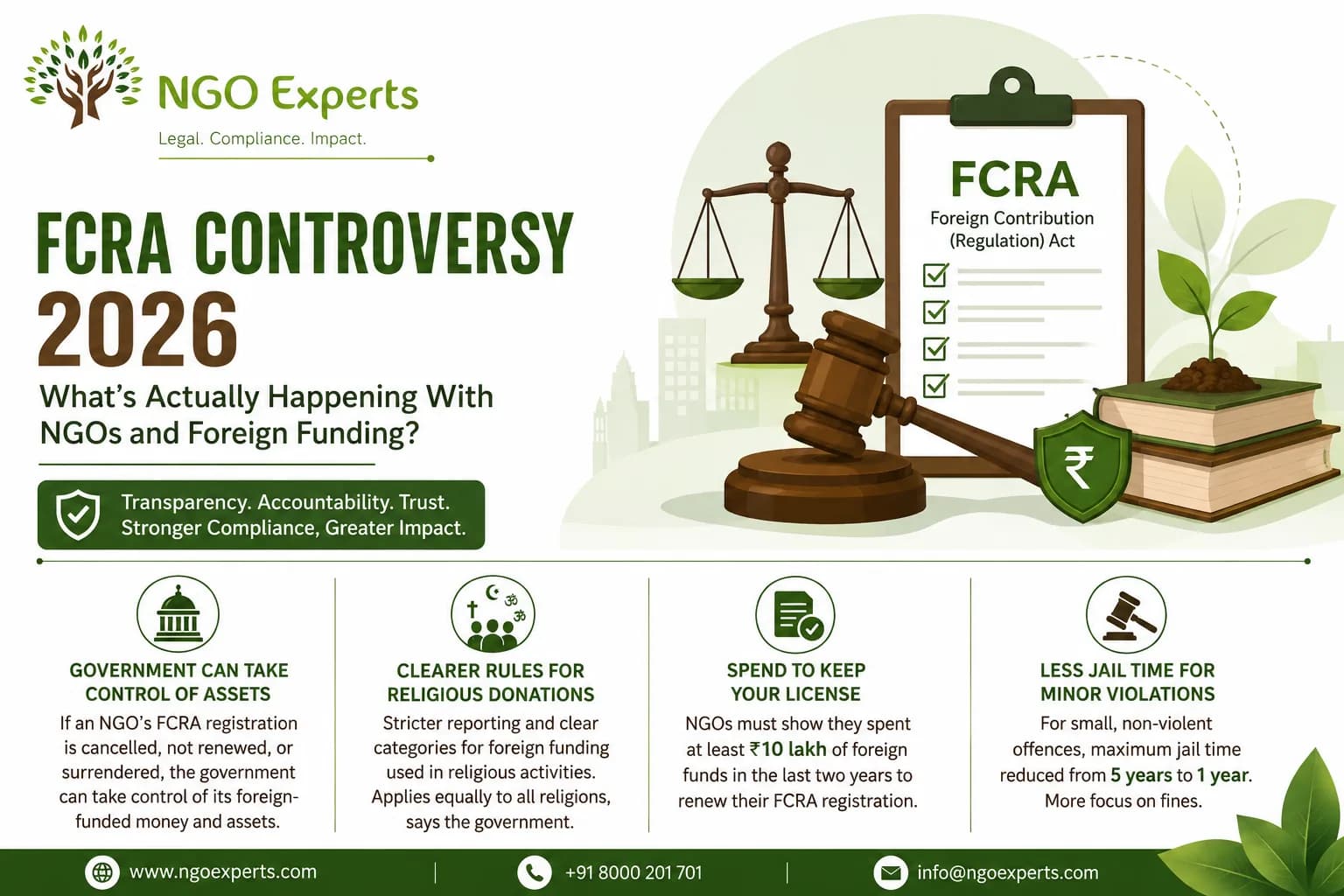
This is where 2026 has shaken things up. Here's a quick side-by-side of what used to be the rule versus what's changing:
| Feature / Topic | Old Requirement | 2026 Update |
| Foreign-funded assets | NGO keeps its assets even if registration is cancelled, unless stated otherwise | A designated government authority can take control of assets if registration is cancelled, surrendered, or expires |
| Religious activities | General declaration of activities | Clearer categorisation and mandatory reporting across all faiths |
| Renewal threshold | Active functioning + timely return filings | Must show at least ₹10 lakh in foreign funds actually utilized over the past 2 years |
| Penalties | Up to 5 years imprisonment for select offenses | Proposed cut to 1 year for minor, non-violent, procedural violations |
Let's break each one down in simple terms for better understanding.
1. The government can take control of foreign-funded assets
If an NGO's FCRA registration is cancelled, surrendered, or not renewed on time, a government-appointed authority may take control of its foreign-funded money and assets. This could include a building, vehicle, equipment, or other property bought with foreign funds. If the NGO later gets its FCRA registration back, these assets are expected to be returned. Until then, the government may remain in control.
2. Clearer rules for religious donations
The rules around foreign funding for religious activities are becoming more specific. NGOs may have to provide clearer details about how foreign money is being used for religious purposes. The government says these requirements apply equally to organisations working with different religions and are intended to improve transparency.
3. NGOs may actually need to use their foreign funds
Under the proposed changes described here, simply having FCRA registration and filing paperwork may not be enough for renewal. An NGO may need to show that it actually used a minimum amount of foreign funds during the required period. The idea is to identify organisations that are registered but are not carrying out meaningful activities.
4. Minor violations could mean less jail time
Not every proposed change makes the rules tougher. For certain minor, non-violent violations, the maximum jail term could be reduced from 5 years to 1 year. The approach would place more emphasis on fines and financial penalties instead of imprisonment for less serious offenses.
FCRA Amendment Bill 2026 vs. FCRA Rules: Know the Difference
This confuses a lot of people, so let's make it clear:
- The FCRA Rules, 2026 were officially notified and are already active law right now.
- The FCRA Amendment Bill, 2026 was introduced in the Lok Sabha in March 2026, but it is still just a proposal. It has no legal force until it clears both houses of Parliament, gets the President's signature, and is published in the official e-Gazette.
If someone tells you "the new FCRA law says NGOs can lose everything," you should ask: are they talking about the notified Rules (already active) or the pending Bill (still just a proposal)? It matters a lot.
Why Is the FCRA Amendment Bill 2026 Causing So Much Debate?
It's a debate between stricter government control and NGO freedom. The government says stricter rules can prevent misuse of foreign funds and improve transparency. Critics say excessive restrictions could make it harder for genuine NGOs.
Team Government says:
- We just want more transparency
- We want to stop foreign money from being misused
- We're protecting the country's interests
Team Critics (opposition + civil society groups) say:
- This gives the government too much power over independent NGOs
- NGOs could lose everything just for missing a deadline
- Small, grassroots NGOs will struggle to keep up with all the new paperwork
The government says the rules apply to everyone equally, and the real goal is to shut down fake "paper NGOs" and stop money laundering.
Why Is the US Involved in the FCRA Amendment Bill 2026?
The FCRA debate is no longer limited to India. Some US lawmakers and international religious-freedom groups have raised concerns about the impact of stricter foreign-funding rules on faith-based charities and places of worship. Other rights organisations have also questioned whether tougher rules could make it harder for genuine NGOs to receive and use donations.
India's position is clear: regulating foreign money is a sovereign right. The government argues that every country has the authority to decide how foreign funds enter the country and to prevent overseas money from influencing its domestic affairs.
FCRA by the Numbers: The Key Facts Behind the Debate
According to the FCRA Online Portal, India currently has:
- ~14,449 active FCRA registrations
- ~22,498 cancelled registrations (due to non-compliance or violations)
- ~15,212 expired registrations (missed renewal deadlines)
That's a lot of organizations that have fallen out of compliance over the years — which is exactly why both sides of this debate feel so strongly about how the system should work.
FCRA Amendment Bill 2026: NGO Action Checklist
Forget the politics for a second; if you run an FCRA-registered organization, here's your real-world action checklist:
- Renew early. File Form FC-3C at least 4–6 months before your certificate expires.
- Track your spending. Make sure you're hitting that ₹10 lakh utilization benchmark over 2 years to stay eligible for renewal.
- Use your designated bank account. All foreign contributions must come through your primary FCRA account at the SBI Main Branch, New Delhi, before moving to other accounts.
- File Form FC-4 every year. Submit audited statements and utilization accounts on the FCRA Online Portal by December 31st.
- Report changes fast. Any change in board members, address, or bank details must be reported via Form FC-6 within 45 days.
- Keep NGO Darpan updated too. Your profile on the NITI Aayog NGO Darpan Portal needs to stay current for FCRA processing.
The Bottom Line
Whatever your opinion on the politics, one thing's non-negotiable: compliance can't wait for Parliament to make up its mind. The Amendment Bill might get passed, watered down, or reworked entirely — but the notified 2026 Rules are already live, and the renewal deadlines, spending thresholds, and reporting requirements are real today.
Frequently Asked Questions
Is the FCRA amendment Bill, 2026 passed?
The FCRA Amendment Bill 2026 has not been passed into law. It remains a proposed bill, so NGOs should follow the FCRA rules currently in force.
Who introduced the FCRA amendment bill?
The FCRA Amendment Bill 2026 was introduced by the Central Government in the Lok Sabha to propose changes to the Foreign Contribution (Regulation) Act.
What changes does the FCRA Amendment Bill 2026 propose?
The Bill proposes changes relating to foreign-funded assets, fund utilisation, religious activities, renewals, and penalties for certain violations.
Does the FCRA Amendment Bill 2026 affect NGO renewals?
The proposed changes may introduce additional requirements for FCRA renewal, including requirements related to the utilisation of foreign contributions.
Does the FCRA Amendment Bill 2026 change FCRA penalties?
Yes. The proposed Bill includes changes to penalties and may reduce imprisonment for certain minor, non-violent violations.
Will foreign-funded NGO assets be affected?
Under the proposed changes, certain foreign-funded assets may come under government-appointed control if an organisation's FCRA registration is cancelled, surrendered, or expires.
Does the Bill change rules for religious organisations?
The proposed changes include clearer reporting and categorisation requirements relating to foreign contributions used for religious activities.
Will NGOs need to meet a minimum fund-utilisation requirement?
The proposed changes include a ₹10 lakh foreign-fund utilisation threshold over two years for certain renewal-related requirements.
Author
Aabha Garg
A Content Strategist at NGOExperts, who focuses on NGO registration, 12A and 80G registration, FCRA compliance, income tax filing for non-profits, and CSR funding guidelines in India. I research and write our compliance guides in collaboration with our in-house Chartered Accountants and Company Secretaries, so every article reflects current tax and regulatory requirements for the NGO and non-profit sector.
Written by Aabha Garg. Last updated on October 8, 2026