

NGO Registration in Tamil Nadu
NGO Registration in Tamil Nadu means legally forming a non-profit organization in the state for charitable, educational, healthcare, environmental, social welfare, or community development work. An NGO can be registered as a Trust, a Society, or a Section 8 Company
By Aabha GargLast updated:
Gives your NGO legal recognition and credibility.
Enables you to apply for government grants and welfare schemes.
Makes your NGO eligible for CSR funding from companies.
Allows you to apply for 12A and 80G tax exemption registrations.
Register Your NGO in Tamil Nadu
Avoid delays and documentation errors. Our experts ensure a smooth and hassle-free registration process for your NGO.
- A Trust is registered through the Sub-Registrar under the Registration Department.
- A Society is registered under the Tamil Nadu Societies Registration Act, 1975 — a state-specific law, unlike most states that still use the central Societies Registration Act, 1860.
- A Section 8 Company is registered under the Companies Act, 2013, via the MCA portal.
From 1 April 2026, the Income-tax Act, 2025, replaced the old 12A/80G system with the Registered Non-Profit Organization (RNPO) framework. Registration or approval now falls under Sections 332 and 354 and is filed via Form 105 on the Income Tax e-Filing portal.
Difference between the Registrar of Societies and the Registrar of Cooperative Societies in Tamil Nadu
Who Is This Guide For?
- Founders starting an NGO in Tamil Nadu
- Anyone unsure whether to choose a Trust, Society, or Section 8 Company
- NGOs in Chennai, Coimbatore, Madurai, Tiruchirappalli, or other districts
- Groups pursuing CSR funding, RNPO/12A/80G, NGO Darpan, or CSR-1
- Existing informal groups seeking legal status
Tamil Nadu Laws Applicable to NGO Registration
1. Trust Registration Law
| Law | Relevance |
| Registration Act, 1908 | Registration of the Trust Deed |
| Indian Stamp Act, 1899 (as amended by TN) | Stamp duty on the deed — commonly a fixed ₹180 for trust deeds, plus registration fee. TN revised several stamp duty rates in 2023–24, so confirm the current rate on TNREGINET before filing |
| Indian Trusts Act, 1882 | Guiding principle for trust concepts |
| Income-tax Act, 2025 | RNPO / tax exemption approval |
2. Society Registration Law
- Minimum members: 7 founders generally.
- Compulsory registration (Section 4): Any society with 20+ members, or an annual income/expenditure of ₹10,000 or more, must register. This isn't optional — it's a legal requirement.
Applications go through the Tamil Nadu Registration Department Internet Network (TNREGINET) to the District Registrar, with Form No. I (application), Form No. V (registered office notice), Form No. VI (member register), the memorandum, and the bye-laws.
3. Where Is an NGO Registered in Tamil Nadu? Authority & Portal
| Purpose | Authority | Portal / Office |
| Trust Registration | Sub-Registrar, Tamil Nadu Registration Department | TNREGINET / Local Sub-Registrar Office |
| Society Registration | District Registrar (IGR), Tamil Nadu | TNREGINET (IGR) |
| Section 8 Company Registration | RoC Tamil Nadu under the Ministry of Corporate Affairs | MCA Portal |
| PAN, TAN, RNPO (12A & 80G) Registration | Income Tax Department | Income Tax e-Filing Portal |
| NGO Darpan Registration | NITI Aayog | NGO Darpan Portal |
| CSR-1 Registration | Ministry of Corporate Affairs | MCA Portal |
| FCRA Registration | Ministry of Home Affairs | FCRA Online Portal |
Tamil Nadu NGO Sector: Latest Stats (2026)
- Tamil Nadu regularly ranks among the top 3–4 states for CSR inflows, alongside Maharashtra and Gujarat, per PrimeInfobase's FY 2024–25 analysis of NSE-listed firms.
- Chennai remains the state's leading CSR hub, attracting a significant share of CSR investments due to its concentration of manufacturing, automobile, IT, healthcare, and industrial companies.
- Tamil Nadu's strong corporate presence creates substantial funding opportunities for NGOs that have completed Section 8 registration, CSR-1 filing, 12A registration, and 80G registration.
| Point | Trust | Society | Section 8 Company |
| Best For | Local charity | Member-based work | CSR and grants |
| Minimum People | ~2 trustees | 7 members (mandatory above 20 or ₹10,000 income) | 2 directors + 2 members |
| Authority | Sub-Registrar | District Registrar | MCA/ROC |
| Law | Registration Act + Stamp Act | TN Societies Registration Act, 1975 | Companies Act, 2013 |
| Compliance | Low–medium | Medium | Higher |
| Credibility | Moderate | Moderate | High |
| CSR Readiness | Possible | Possible | Strong |
Benefits Of NGO Registration In Tamil Nadu
- Legal recognition Under Tamil Nadu's applicable law for your chosen structure.
- Statewide operation Across Chennai, Coimbatore, Madurai, Tiruchirappalli, and other districts.
- Strong CSR access: Tamil Nadu attracts substantial CSR investment from IT, automotive, and manufacturing companies.
- Easier banking: Registration certificate, PAN, and governing documents are usually enough to open a current account.
- Tax benefits and donor credibility via RNPO registration and Section 354 donor approval
Eligibility for NGO Registration in Tamil Nadu
Section 8 Company specifics:
- 2 directors, 2 members minimum – directors can double as initial members.
- Charitable objects only – education, healthcare, welfare, environment, art, science, or sports.
- No profit distribution – income must go back into the objects, never to members.
- Registered TN office – valid address proof mandatory.
- Eligible promoters – Indian citizens, NRIs, foreign nationals (subject to FDI/RBI rules).
- DSC & DIN for each director – needed to file incorporation forms online
How Do I Register an NGO in Tamil Nadu? Step-by-Step Process
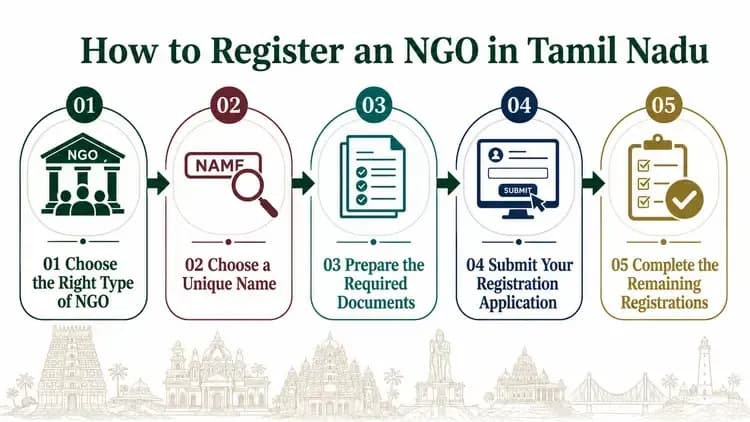
Step 1: Choose the Right Type of NGO
Step 2: Choose a Unique Name
Step 3: Prepare the Required Documents
Step 4: Submit Your Registration Application
Step 5: Complete the Remaining Registrations
Documents Required for NGO Registration in Tamil Nadu
Section 8 Company specifics:
- PAN, Aadhaar, photo, address proof – identity/address verification for each director/member.
- DSC & DIN – to digitally sign and file incorporation forms.
- Utility bill, rent agreement, owner's NOC – confirm the registered office.
- Proposed name(s), MOA & AOA – for name approval and governance rules.
- INC-14 & INC-15 – Section 8-specific licensing declarations.
Fees & Timelines NGO Registration in Tamil Nadu
| Structure | Estimated Cost | Timeline |
| Trust | ₹10,000–₹20,000 approx. | 7–15 working days |
| Society | ₹20,000–₹50,000 approx. | 1–3 months |
| Section 8 Company | ₹8,000–₹15,000 approx. | 10–25 working days |
2026 Update: RNPO, 12A, and 80G
Post-Registration Compliance
| Compliance | Why It Matters |
| PAN / TAN | Bank account, tax filing, TDS |
| Bank Account | Donations and expenses |
| Accounting | Clean, auditable records |
| RNPO / 12A | Tax exemption |
| 80G / Section 354 | Donor deductions |
| NGO Darpan | Grant eligibility |
| CSR-1 | CSR fund eligibility |
| Annual Filing | TN societies risk strike-off under Section 44 of the 1975 Act after 3 consecutive years of non-filing |
| Audit | Donor trust |
| FCRA | Legal foreign contribution |
NGO Registration in Major Cities of Tamil Nadu
- Chennai: Tamil Nadu's largest corporate and CSR hub, making it an ideal location for NGOs seeking partnerships with companies, foundations, and institutional donors.
- Coimbatore: A leading manufacturing and textile city with growing opportunities for NGOs working in skill development, education, healthcare, environmental sustainability, and rural livelihoods.
- Madurai: A major center for healthcare, education, women's empowerment, and rural development initiatives across southern Tamil Nadu, offering strong opportunities for community-based NGOs.
- Tiruchirappalli (Trichy): Known for its educational institutions and public welfare initiatives, Trichy offers opportunities for NGOs focused on education, disability support, youth development, and community welfare.
Common Mistakes in NGO Registration in Tamil Nadu
- Choosing Trust only because it is cheaper, without checking if it fits your long-term goals.
- Ignoring Tamil Nadu's specific requirements under the 1975 Societies Registration Act.
- Confusing the Registrar of Societies with the Registrar of Cooperative Societies (RCS).
- Copying generic objects instead of drafting objects specific to your NGO's work.
- Not planning for RNPO/12A/80G early in the registration process.
- Submitting a weak or incomplete owner NOC or office documents.
- Missing the compulsory registration deadline once membership or income crosses the Section 4 threshold.
- Skipping the CSR-1 filing before approaching companies for CSR funding.
- Not maintaining proper books of accounts — under Section 44 of the 1975 Act, a society can be struck off for failing to file required documents for 3 consecutive financial years.
- Assuming NGO registration alone grants tax exemption.
Why Choose NGOExperts for NGO Registration in Tamil Nadu?
Why NGOs in Chennai Choose NGOExperts
- Tamil Nadu registration expertise for Trusts, Societies, and Section 8 Companies under the applicable central and state laws.
- Guidance on TNREGINET procedures, including Trust registration appointments, document preparation, and Tamil Nadu stamp duty requirements.
- Experience with Society registrations through the District Registrar (IGR), helping founders prepare compliant Memorandums and Bye-laws.
- End-to-end Section 8 Company registration through the MCA Portal with RoC Tamil Nadu, including DSC, DIN, SPICe+, MOA, and AOA filings.
- Professionally drafted object clauses tailored to your NGO's activities, reducing the risk of registration queries or objections.
- Complete post-registration support, including PAN, 12A (RNPO), 80G, NGO Darpan, CSR-1, and annual compliance guidance.
Expert Guidance from Start to Finish
Avoid common registration mistakes and save valuable time. Our experts provide end-to-end support, ensuring your application is complete and compliant.
About the Author

A Content Strategist at NGOExperts, who focuses on NGO registration, 12A and 80G registration, FCRA compliance, income tax filing for non-profits, and CSR funding guidelines in India. I research and write our compliance guides in collaboration with our in-house Chartered Accountants and Company Secretaries, so every article reflects current tax and regulatory requirements for the NGO and non-profit sector.
Written by Aabha Garg. Last updated on Oct 6, 2026, 10:35 AM