
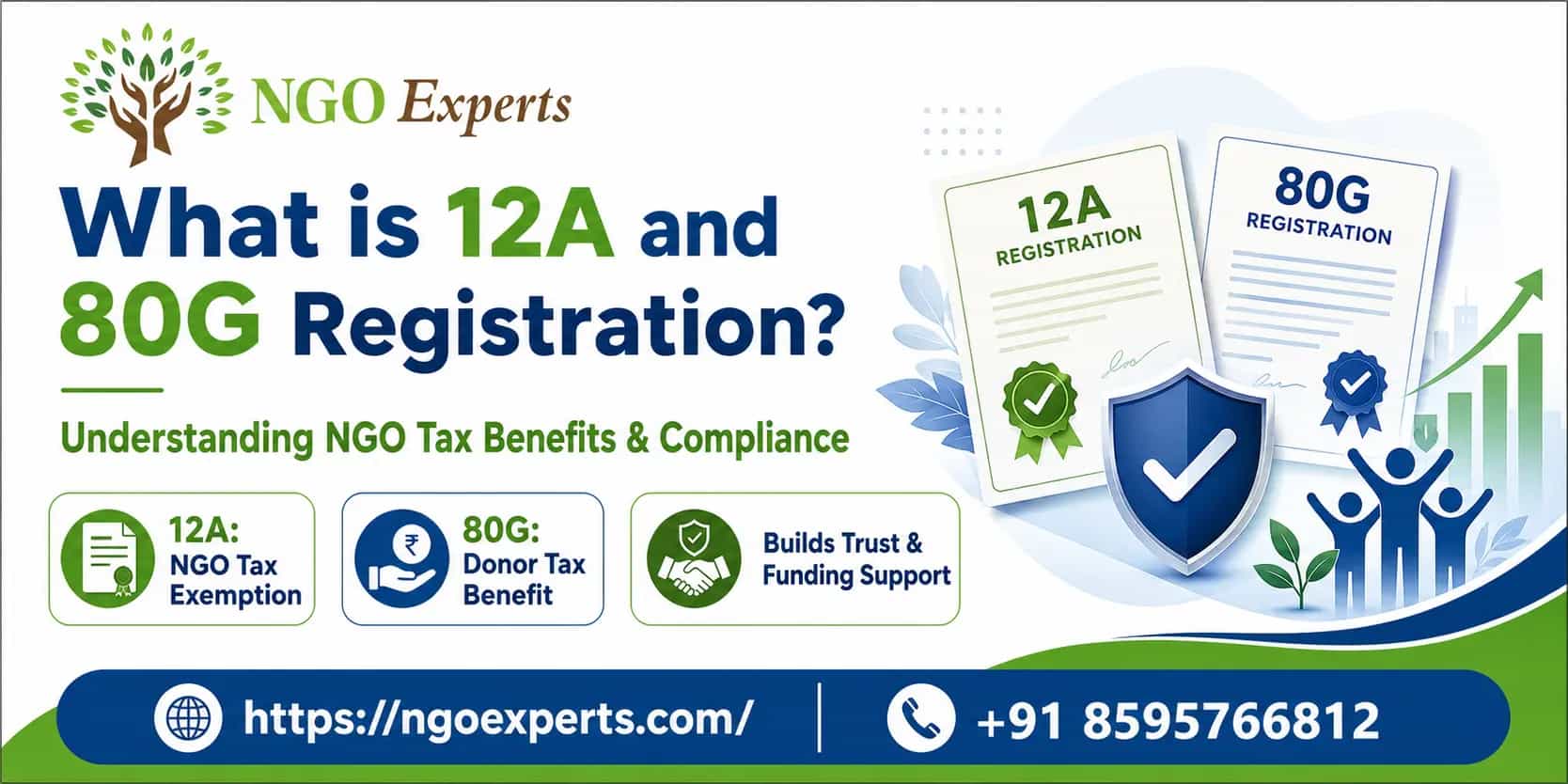
12A and 80G are two different tax benefits for NGOs: one relates to the tax treatment of the NGO's eligible income, while the other provides eligible donors with a deduction for qualifying donations. A 12A registration, under the current 2026 framework, is covered by the registration provisions of Section 332 of the Income-tax Act, 2025. An 80G approval, corresponding to the donor-deduction framework, is covered by Section 354. Both provisions can apply to eligible public charitable trusts, registered societies, Section 8 companies, and other specified non-profit organisations that meet the statutory conditions.
Get Expert Guidance for 12A and 80G
Need help with eligibility, documents, or the application process? Talk to an NGO registration expert.
From 1 April 2026, the Income-tax Act, 2025 and Income-tax Rules, 2026 provide the current framework for these registrations and approvals. For regular registration or approval in applicable cases, Form 105 is filed electronically on the Income Tax e-Filing portal.
What Is 12A Registration for an NGO?
12A registration refers to the tax-exemption registration available to eligible charitable or religious entities. Under the Income-tax Act, 2025, the corresponding registration framework is provided under Section 332.
Registration does not mean that every receipt or income of an NGO is automatically exempt from tax. The organisation must satisfy the applicable statutory conditions, including requirements relating to its objects, application of income, accounts, compliance, and other conditions prescribed under the law.
For a registered non-profit organisation, the registration can provide the basis for claiming the applicable income-tax benefits available under the charitable or religious institution provisions.
What Is 80G Approval for an NGO?
80G approval is a donor-focused tax benefit. Under the Income-tax Act, 2025, the corresponding approval framework is covered by Section 354.
An eligible donor may claim a deduction for a qualifying donation to an approved institution, subject to applicable conditions, limits, documentation requirements, and tax rules.
The deduction is therefore a benefit available to the donor, not a direct exemption of the NGO's own income. The Income Tax Department continues to describe donations to eligible charitable institutions and funds as qualifying for deduction under the applicable 80G framework, subject to conditions such as the prescribed limits and payment requirements.
Why Are 12A and 80G Registration Important for NGOs?
These two registrations/approvals can be important for an NGO's tax compliance, fundraising, and donor relationships:
- Tax treatment for the NGO: eligible income may receive the applicable tax benefits when the organisation satisfies the statutory conditions.
- Donor tax benefits: eligible donors may claim deductions for qualifying donations subject to applicable rules.
- Fundraising support: donor tax benefits can make eligible donations more attractive to individuals and other eligible taxpayers.
- Institutional credibility: valid registrations and approvals can help demonstrate that an organisation has completed relevant statutory compliance.
- Financial planning: understanding the applicable tax-exemption conditions helps an NGO plan its income, expenditure, accounts, and compliance obligations.
- CSR and institutional funding: 12A/80G status may be relevant to funding relationships, but these registrations do not by themselves establish CSR implementing-agency eligibility. Separate CSR-related requirements, including applicable CSR-1 requirements, must be considered.
12A vs 80G: What Is the Difference?
12A registration and 80G approval serve different purposes. 12A/Section 332 registration primarily concerns the NGO's eligibility for applicable income-tax benefits, while 80G/Section 354 approval relates to deductions available to eligible donors for qualifying donations.
| Point | 12A / Section 332 | 80G / Section 354 |
| Who benefits? | The eligible NGO/non-profit organisation | Eligible donors |
| Main purpose | Provides the registration framework for applicable tax benefits to the organisation | Provides the approval framework for donor deductions on qualifying donations |
| Tax impact | Concerns the NGO's eligible income and applicable exemption conditions | Concerns the donor's deduction for qualifying donations |
| Application route in 2026 | Form 104 for specified provisional cases; Form 105 for regular registration | Form 104 for specified provisional cases; Form 105 for regular approval |
| Main authority | Income Tax Department | Income Tax Department |
Form 105 is expressly prescribed for applications for registration of a non-profit organisation under Section 332 or approval under Section 354.
Check Your NGO’s 12A and 80G Eligibility
Find out whether your NGO qualifies and what documents you need to apply.
Who Can Apply for 12A and 80G Registration?
Eligible non-profit organisations can apply for the relevant registration or approval after satisfying the requirements under the Income-tax Act, 2025.
The Section 332 framework specifically includes categories such as:
- Public charitable trusts
- Registered societies
- Section 8 companies
- Certain universities and educational institutions
- Certain institutions financed by the Government or a local authority
- Other persons or organisations covered by the specified statutory provisions
For example, the official Form 105 instructions identify public trusts, societies, and Section 8 companies among the categories covered under Section 332.
The organisation must also satisfy the applicable conditions relating to its registration/incorporation, charitable or religious objects, activities, documents, and compliance.
What Documents Are Required for 12A and 80G Registration?
The exact documentation depends on the organisation's status, activities, previous registration, and type of application. Documents commonly required may include:
- Registration certificate, such as Trust Deed, Society registration certificate, or Certificate of Incorporation
- PAN of the organisation
- MOA/AOA, Trust Deed, or Society Rules containing the organisation's objects
- Details of trustees, members, directors, or other responsible persons
- Details of the organisation's activities
- Financial statements and accounts, where applicable
- Bank account and financial information, where applicable
- Activity reports and supporting evidence of charitable activities, where applicable
- Details of existing registration or approval, where the application relates to renewal, conversion, or subsequent registration
- Other documents and information required by the applicable Form 104 or Form 105 process
For organisations that have already commenced activities, the applicable regular-registration process can require information and supporting material relating to the organisation's activities and compliance. Form 104 is specifically not applicable where activities have already commenced; the Income Tax Department directs such applicants to Form 105 for the relevant registration or approval.
How to Apply for 12A and 80G Registration in 2026?

The 12A and 80G application process depends on whether the organisation is applying for provisional or regular registration/approval.
Step 1: Complete the NGO's Legal Registration
The organisation should first have an applicable legal structure, such as a public charitable trust, registered society, or Section 8 company.
Step 2: Obtain PAN in the NGO's Name
Obtain a PAN in the organisation's own name. The PAN and applicant details should match the organisation applying for registration or approval.
Step 3: Review the NGO's Objects
Check that the Trust Deed, MOA/AOA, or other governing documents clearly state the organisation's charitable or religious objects and that its proposed activities are consistent with those objects.
Step 4: Select the Correct Application Form
Determine whether the organisation requires provisional or regular registration/approval. Eligible organisations whose activities have not commenced may use Form 104 for specified provisional applications. Other applicable cases, including regular registration or approval, are handled through Form 105.
Step 5: Prepare the Required Documents
Prepare the governing documents, PAN details, activity information, financial information, and other documents or details required under the applicable form.
Step 6: File the Application Online
Submit the applicable application electronically through the Income Tax e-Filing Portal with the required information and supporting documents.
Step 7: Respond to Departmental Queries
If the Income Tax Department requests clarification or additional information, provide the required response and documents within the prescribed time.
Step 8: Receive the Registration or Approval
OrderAfter the application is processed, the applicable registration or approval order can be accessed or downloaded through the Income Tax e-Filing Portal.
For regular registration under Section 332(3) or regular approval under Section 354(2), the Income Tax Department specifically states that Form 105 is the prescribed electronic application.
Form 104 vs Form 105 for 12A and 80G in 2026
Understanding the correct form is important because the application route depends on the organisation's circumstances.
| Form | Main use |
| Form 104 | Provisional registration under Section 332(3) and/or provisional approval under Section 354(2) in specified cases, including eligible organisations whose activities have not commenced |
| Form 105 | Regular registration under Section 332 or regular approval under Section 354 in the applicable cases |
The Income Tax Department states that Form 104 is for specified provisional applications and that organisations whose activities have already commenced should use Form 105 for the relevant registration or approval.
What Tax Benefits Do 12A and 80G Provide?
The benefits are different for the NGO and the donor.
For the NGO
An eligible organisation with registration under the applicable charitable/religious institution provisions can claim the tax benefits available under the law, subject to fulfilling the relevant conditions.
For the donor
An eligible donor can claim a deduction for qualifying donations made to an eligible institution, subject to the applicable rules and limits. The Income Tax Department states that 80G deductions can fall into different categories, including 100% or 50% deductions and, depending on the category, qualifying limits.
The deduction should not be described as an automatic deduction of the entire donation amount because the actual benefit depends on the category of eligible donation and the applicable statutory conditions.
Can 12A and 80G Help an NGO Get CSR Funding?
12A and 80G can be relevant when an NGO approaches donors, foundations, companies, and other funding sources, but they should not be confused with CSR implementing-agency registration.
For CSR implementation, companies and NGOs must consider the separate requirements under the Companies Act and applicable CSR Rules, including CSR-1 registration where required.
Therefore:
12A/Section 332 → primarily concerns the NGO's applicable income-tax registration and benefits
80G/Section 354 → concerns eligible donor deductions for qualifying donations
CSR-1 → relates to eligibility/registration requirements for implementing CSR activities
This distinction is important when presenting an NGO's compliance status to corporate funders.
Real-Life Example: How 12A and 80G Can Support NGO Funding
The Akshaya Patra Foundation is a large-scale non-profit organisation working in areas including school meals and child welfare. An NGO operating at this scale needs to maintain appropriate statutory registrations, approvals, financial records, and compliance.
Where an NGO has valid donor-related approval, eligible donors may be able to claim the applicable tax deduction for qualifying donations, subject to the relevant statutory conditions. Similarly, registration under the applicable charitable-organisation tax framework can allow the organisation to claim the tax benefits available under the law, subject to compliance with the applicable requirements.
The example demonstrates why NGOs should treat tax registration, donor documentation, accounting, and ongoing compliance as interconnected parts of their financial management rather than viewing 12A and 80G as standalone certificates.
How Long Are 12A and 80G Registration and Approval Valid?
Validity depends on the type of registration or approval and the applicable provisions and rules. It should not be presented as a single universal period for every NGO.
In particular, the 2026 framework distinguishes between provisional registration/approval and regular registration/approval. The organisation should check the validity period stated in its registration or approval order and the applicable provisions before calculating its renewal deadline.
For organisations moving from provisional to regular registration/approval, the prescribed application must be filed within the applicable statutory timeline.
Because the Income-tax Act, 2025 and Income-tax Rules, 2026 introduced the current framework from 1 April 2026, NGOs should use the applicable 2026 provisions and the registration/approval order rather than relying on older 12A/12AB/80G validity tables.
Final Takeaway: 12A and 80G Compliance for NGOs
For NGOs in India, 12A and 80G remain important tax and fundraising-related registrations/approvals. However, organisations should understand the 2026 Income-tax Act framework rather than relying solely on terminology from the earlier Income-tax Act, 1961.
In simple terms:
- Section 332 registration → relates to registration of eligible non-profit organisations and applicable income-tax benefits.
- Section 354 approval → relates to approval connected with donor deductions for qualifying donations.
- Form 104 → specified provisional registration/approval applications.
- Form 105 → regular registration/approval applications in applicable cases.
- CSR-1 → separate CSR compliance requirement where applicable.
Keeping these requirements separate helps NGOs maintain accurate tax records, provide proper donor documentation, and avoid confusing income-tax registration with CSR eligibility.
Start Your 12A and 80G Registration
Get assistance with documentation, application preparation, filing, and registration support.
Frequently Asked Questions
What is the difference between 12A and 80G?
12A/Section 332 registration concerns the NGO's applicable income-tax benefits, while 80G/Section 354 approval concerns tax deductions available to eligible donors for qualifying donations.
Can a Section 8 company apply for 12A and 80G?
Yes, a Section 8 company can fall within the eligible categories under Section 332, subject to meeting the applicable statutory conditions. The Section 332 framework specifically includes companies registered under Section 8 of the Companies Act, 2013.
Which form is used for 12A and 80G in 2026?
Form 104 is used for specified provisional registration/approval applications. Form 105 is used for regular registration under Section 332 or regular approval under Section 354 in the applicable cases.
Can a new NGO apply for 12A and 80G?
An eligible new NGO may apply for provisional registration/approval where it satisfies the conditions prescribed under the 2026 framework. Form 104 covers specified provisional applications, including eligible organisations whose activities have not commenced.
Does 80G mean that donors always get a 100% tax deduction?
No. The deduction depends on the category of donation, the eligible institution, applicable limits, and other statutory conditions. The Income Tax Department identifies different 80G deduction categories, including 100% and 50% deductions.
Does 12A registration automatically make an NGO eligible for CSR funding?
No. 12A/Section 332 registration and 80G/Section 354 approval should not be treated as a substitute for the separate CSR implementing-agency requirements.
Author
Aabha Garg
A Content Strategist at NGOExperts, who focuses on NGO registration, 12A and 80G registration, FCRA compliance, income tax filing for non-profits, and CSR funding guidelines in India. I research and write our compliance guides in collaboration with our in-house Chartered Accountants and Company Secretaries, so every article reflects current tax and regulatory requirements for the NGO and non-profit sector.
Written by Aabha Garg. Last updated on September 23, 2026