
Quick Answer
Need Help Drafting Your Section 8 Company MOA & AOA?
Get professionally prepared MOA and AOA documents aligned with your Section 8 company's objectives and incorporation requirements.
What are the MOA and AOA of a Section 8 Company?
Four facts shape the drafting:
- The MOA must follow Form INC-13 under Rule 19(2), Companies (Incorporation) Rules 2014, not the ordinary Tables A–E.
- The AOA has no compulsory table; adapt Table F (share capital) or Tables G/H (guarantee), filed as e-AOA Form INC-31.
- Acts beyond the objects clause are ultra vires and void.
- The Registrar of Companies (ROC) vets both before granting the license; vague drafting causes most resubmissions.
Why MOA & AOA Drafting Matters for a Section 8 Company in 2026?
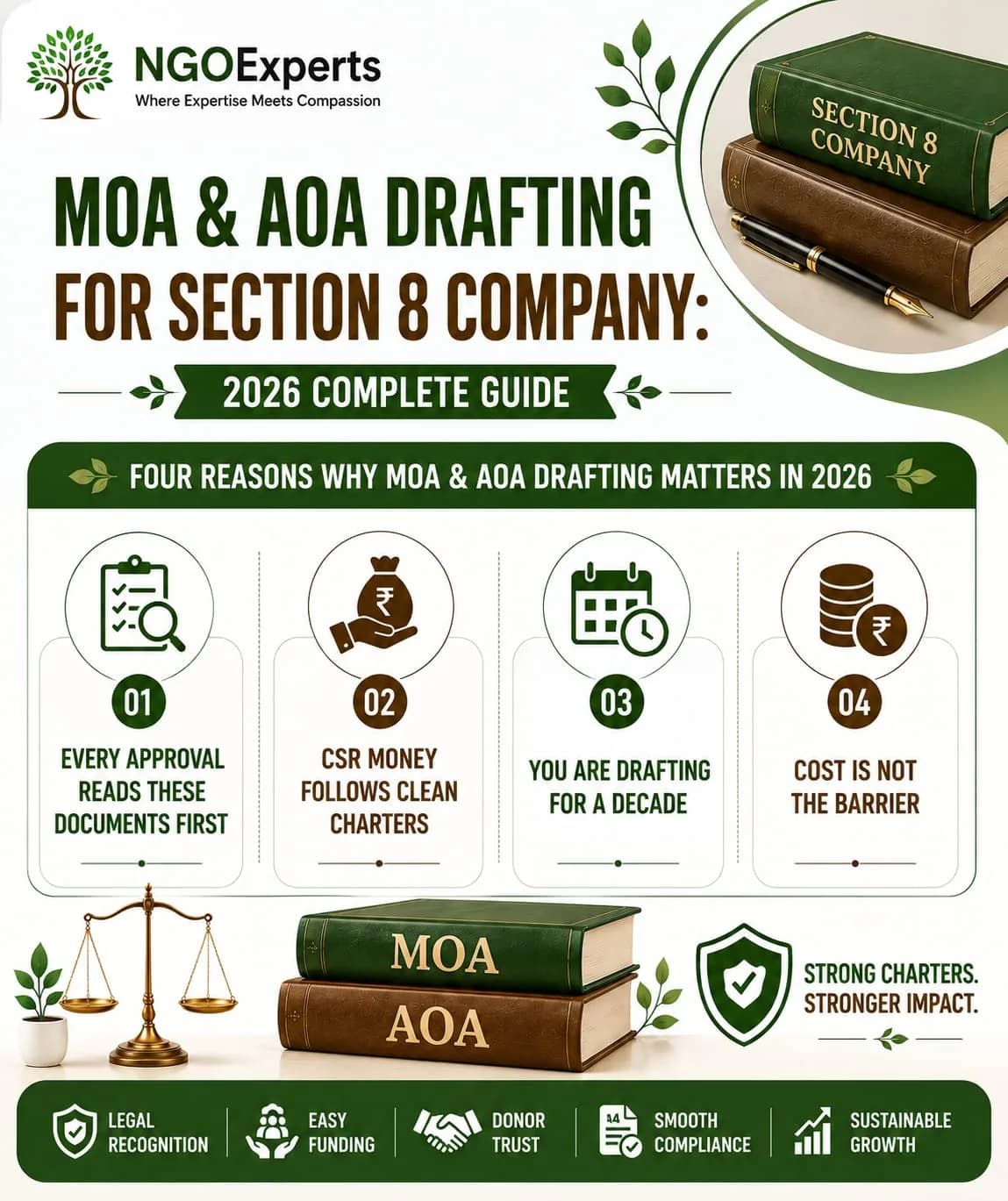
- Every future approval starts with these two documents. Section 332 registration and Section 354 donor-deduction approval under the Income-tax Act, 2025 (the new 12A and 80G from 1 April 2026), CSR-1, FCRA, NGO Darpan, and banks all vet the objects.
- CSR money follows clean charters. Indian corporates spent a record ₹40,794 crore on CSR in FY 2024-25, ₹13,877 crore on education, and due diligence starts with the MOA.
- You are drafting for a decade. Alteration needs prior Central Government approval under Section 8(4)(i), via the ROC.
- Cost is not the barrier. MCA charges zero incorporation fee up to ₹15 lakh authorised capital; several states charge nil or concessional stamp duty on the MOA and AOA.
Key Clauses to Include in the MOA and AOA of a Section 8 Company
Important MOA Clauses in Form INC-13
- Name clause: a word like Foundation, Forum, Association, Federation, Chambers, Confederation, Council, or Electoral Trust, with no "Private Limited/Limited" suffix.
- Situation clause: the registered-office state.
- Objects clause: main and ancillary objects from the Section 8(1)(a) fields — education, research, social welfare, charity, environment — matching the SPICe+ Part A description.
- Income-application clause: profits applied solely to promoting the objects.
- No-dividend clause: nothing paid to members as dividend, bonus, or profit.
- Member-benefit restriction: no member benefit beyond reasonable permitted payments like rent, interest, services, out-of-pocket expenses.
- Alteration and winding-up clauses: changes need prior Central Government approval; winding-up surplus goes to another Section 8 company with similar objects, never to members.
- Liability, capital, and subscription: limited by shares or guarantee (guarantee amounts stated), plus the subscriber sheet with names, addresses, occupations, signatures, and photographs.
Avoid Mistakes in Your Section 8 MOA & AOA
Ensure your company's objectives, rules, and non-profit structure are properly covered in your MOA and AOA with expert assistance.
Important Clauses to Include in AOA
- Membership: Classes, admission, subscription/guarantee amount, cessation, expulsion.
- General meetings: Notice, quorum, voting, proxies.
- Board: Strength, appointment, rotation, powers, meetings, committees.
- Borrowing, investment, accounts, and audit: Powers exercisable only for the objects, with statutory registers and inspection rights.
- Conformity and dissolution: Articles stand subject to the license conditions; dissolution mirrors the winding-up clause, with optional Section 5(3) entrenchment.
Filing on the MCA V3 Portal: Step-by-Step Process
Real-Life Example: NPCI
Common Mistakes to Avoid when writing MOA & AOA
- Copying a Trust deed or a private limited MOA instead of using Form INC-13
- Vague objects like "welfare of society" that fail the ROC and the tax officer
- Mismatch between the SPICe+ Part A description and the INC-13 objects
- Omitting the income-application, no-dividend, or winding-up clauses
- Using the standard eMOA/eAOA of regular companies instead of INC-13/INC-31
- Objects so narrow that routine expansion later triggers the approval cycle
How Do the MOA and AOA Affect the Long-Term Success of a Section 8 Company?
- Improve governance with clear rules for directors, members, and meetings.
- Build donor and CSR partner confidence through transparent objectives and governance.
- Support faster approvals for registrations such as 12A, 80G, CSR-1, and FCRA, as regulators review these documents carefully.
- Reduce legal disputes by clearly defining roles, powers, and decision-making procedures.
- Provide a strong legal framework for long-term growth, funding, and regulatory compliance.
Why Choose NGOExperts?
- Expert drafting of MOA and AOA for Section 8 Companies
- Legally compliant documents aligned with MCA requirements
- End-to-end support from drafting to MCA V3 filing
- Assistance with Section 8 Registration, 12A, 80G, CSR-1, NGO Darpan, and FCRA
- Transparent process with timely execution and expert guidance
Ready to Register Your Section 8 Company?
Get assistance with MOA and AOA drafting and move forward with your Section 8 company incorporation process smoothly.
Frequently Asked Questions
Which form is prescribed for the MOA?
Is Form INC-12 still required for the license?
Who certifies the draft MOA and AOA?
Can the MOA or AOA be changed later?
Do 12A and 80G still apply in 2026?
Is there a minimum capital, and what does it cost?
Author
A Content Strategist at NGOExperts, who focuses on NGO registration, 12A and 80G registration, FCRA compliance, income tax filing for non-profits, and CSR funding guidelines in India. I research and write our compliance guides in collaboration with our in-house Chartered Accountants and Company Secretaries, so every article reflects current tax and regulatory requirements for the NGO and non-profit sector.
Written by Aabha Garg. Last updated on October 24, 2026