

Ready to Raise Funds Through the SSE?
Get end-to-end support for SSE registration, ZCZP issue preparation, social audit, listing, and post-listing compliance.
What Is the Social Stock Exchange (SSE)?
What Is the Importance of SSE Listing for NPOs?
What Are the Benefits of SSE Listing?
- Reach more donors: Connect with donors and supporters looking for credible social projects.
- Raise funds without repayment: Funds raised through eligible ZCZP issues are donations, not loans.
- Attract larger contributions: Greater transparency can give donors more confidence to contribute.
- Build trust: Proper disclosures and reporting can strengthen your NGO's credibility.
- Access CSR opportunities: SSE-related fundraising can help eligible NGOs connect with corporate CSR funding
- Make future fundraising easier: A structured fundraising process can support future campaigns.
- Improve transparency: Regular reporting encourages better financial and impact tracking.
Who Is Eligible to List on the SSE?
- Entity type: NPOs must be a registered Trust, Society, or Section 8 Company, with valid 12A and 80G registration already in place
- Social intent threshold: at least two-thirds (67%) of your revenue, spending, or beneficiaries must be tied to genuinely social activity, as defined under SEBI's eligible activity list
- Track record: most NPOs are expected to show at least three years of operational history and audited financials
- Governance: a functioning governing board, proper financial records, and no history of regulatory violations
- Social auditor sign-off: an undertaking from a qualified Social Auditor or your statutory auditor confirming compliance with SEBI's disclosure norms
Is Your NPO Ready for the Social Stock Exchange?
Get an expert assessment of your eligibility, documentation, financials, and compliance requirements before applying for SSE registration.
Documents Required for SSE Registration
- Formal application: submitted on the NPO's official letterhead to each exchange separately
- Constitutional documents: Trust Deed / Society MOA & bye-laws / Section 8 MOA-AOA
- 12A/80G registration certificates
- NGO Darpan certificate
- Audited financial statements: for the last 3 financial years, including the auditor's report
- Eligibility undertaking: a signed declaration on NPO letterhead confirming social enterprise status and details of promoters
- Social/statutory auditor undertaking: confirming compliance with SEBI ICDR disclosure requirements and reporting on annual spending and past-year funding
- Board resolution: authorising the SSE registration and, later, the ZCZP issuance
How NGOExperts Supports Your SSE Listing: Step-by-Step Process
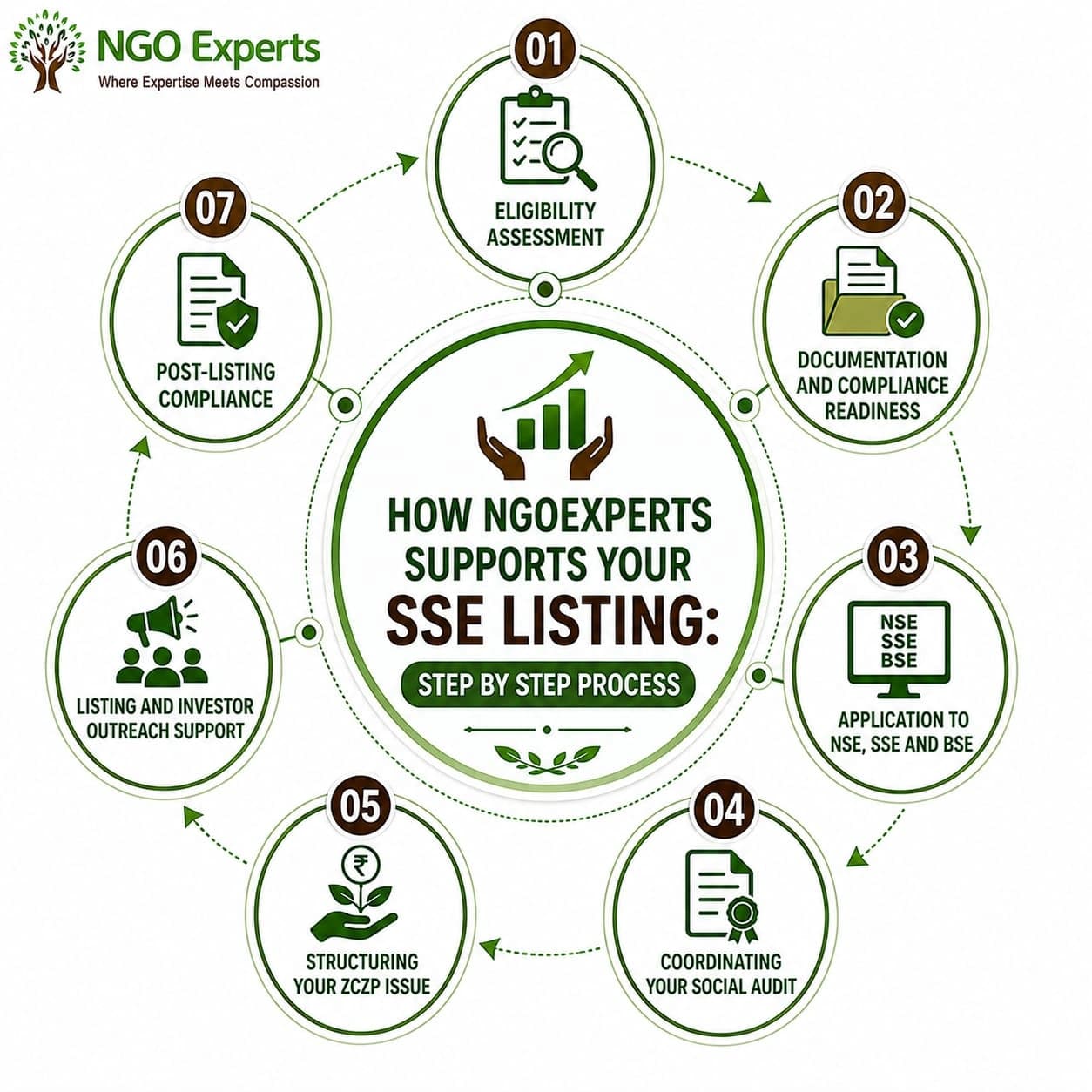
- Eligibility assessment. NGOExperts reviews your NPO's structure, financials, and activity mix against SEBI's 67% social-intent threshold and track-record requirements before recommending you proceed.
- Documentation and compliance readiness. This covers getting your 12A/80G, audited financials, and governance records into the exact shape that SEBI and the exchanges expect, closing gaps which can cause rejection.
- Application to NSE SSE and BSE SSE. NGOExperts prepares and submits the required applications and documents for each exchange, as registration with one exchange does not cover the other.
- Coordinating your social audit. A qualified Social Auditor's sign-off is a mandatory part of the process; NGOExperts helps coordinate it and ensures the reporting matches the exchanges' requirements.
- Structuring your ZCZP issue. Once registered, NGOExperts helps structure the actual fundraising instrument, the project it will fund, the target amount, and the investor-facing disclosures, ahead of listing.
- Listing and investor outreach support. NGOExperts supports the listing process and helps position your ZCZP issue to the HNI and retail investor base that is actively looking for verified social projects.
- Post-listing compliance. Listed NPOs must file Annual Impact Reports and meet ongoing disclosure obligations; NGOExperts supports this so your listing stays in good standing rather than becoming a one-time event.
SSE Registration and Fundraising at a Glance
| Requirement | Earlier Rule | 2026 Rule |
| NPO registration validity without raising funds | 1 year | Up to 3 years |
| Minimum ZCZP investment ticket | ₹10,000 | ₹1,000 (since March 2025) |
| Minimum ZCZP subscription threshold | Higher threshold | Eased to widen retail participation |
| CSR eligibility via ZCZP | Not linked | Linked under Companies (CSR Policy) Amendment Rules, 2026 |
Latest 2026 Updates for SSE Listing
- SEBI's circular dated 15 April 2026 extended the window for NPOs to remain registered on the SSE without raising funds from 1 year to 3 years, giving NPOs more time to prepare a listing without losing their registration.
- The minimum ZCZP subscription requirement has been eased, making it easier for issues to reach their funding target.
- Under the Companies (Corporate Social Responsibility Policy) Amendment Rules, 2026, eligible companies can now route certain CSR spending through ZCZP instruments issued by SSE-registered NPOs, creating a direct link between CSR budgets and SSE fundraising.
- As of May 2026, 92 NPOs are registered on BSE's SSE segment and 84 on NSE's, but only around 11 have actually listed a ZCZP instrument, showing the gap between registering and successfully raising funds that advisory support is specifically meant to close.
Funding Advantages of Listing on the SSE
- Access to HNI and retail capital: a funding pool most NGOs never reach through conventional donor or CSR channels.
- CSR alignment: the 2026 CSR Policy Amendment Rules make ZCZP-based fundraising directly relevant to corporate CSR planning.
- Credibility signal: SSE registration itself, even before listing, demonstrates governance and financial discipline to larger donors and partners.
- Structured, repeatable fundraising: unlike a one-off campaign, a well-run ZCZP issue can be a template for future fundraising rounds.
Is Your NPO Eligible for SSE Listing?
Check your organisation's eligibility, documents, social impact criteria, and compliance requirements before starting the SSE process.
Frequently Asked Questions
Is SSE registration the same as listing?
Do we have to register with both NSE and BSE?
What is a ZCZP instrument, in simple terms?
Do we need 12A/80G registration before applying for SSE registration?
How does CSR funding connect to SSE listing now? Under
Why do so few registered NPOs actually list on the SSE?
Author
A Content Strategist at NGOExperts, who focuses on NGO registration, 12A and 80G registration, FCRA compliance, income tax filing for non-profits, and CSR funding guidelines in India. I research and write our compliance guides in collaboration with our in-house Chartered Accountants and Company Secretaries, so every article reflects current tax and regulatory requirements for the NGO and non-profit sector.
Written by Aabha Garg. Last updated on October 12, 2026