

Planning to Start a Section 8 Company in Karnataka?
Get expert assistance with registration, documentation, and the complete application process.
What Is a Section 8 Company?
What Is Section 8 Company Registration in Karnataka?
Who Needs Section 8 Company Registration in Karnataka?
Why Section 8 Company Is a Preferred Structure: Section 8 Company vs Trust vs Society in Karnataka
- A Trust is created by a trust deed, signed on stamp paper and registered at your local Sub-Registrar's office (Karnataka Department of Stamps and Registration).
- A Society is registered under the Karnataka Societies Registration Act, 1960, and has been handled by the state's Department of Cooperative Societies since June 1, 2016.
- A Section 8 Company is registered centrally with the Ministry of Corporate Affairs, while your papers are handled locally by the RoC Karnataka in Bengaluru.
Section 8 Company Step-by-Step Registration Process in Karnataka
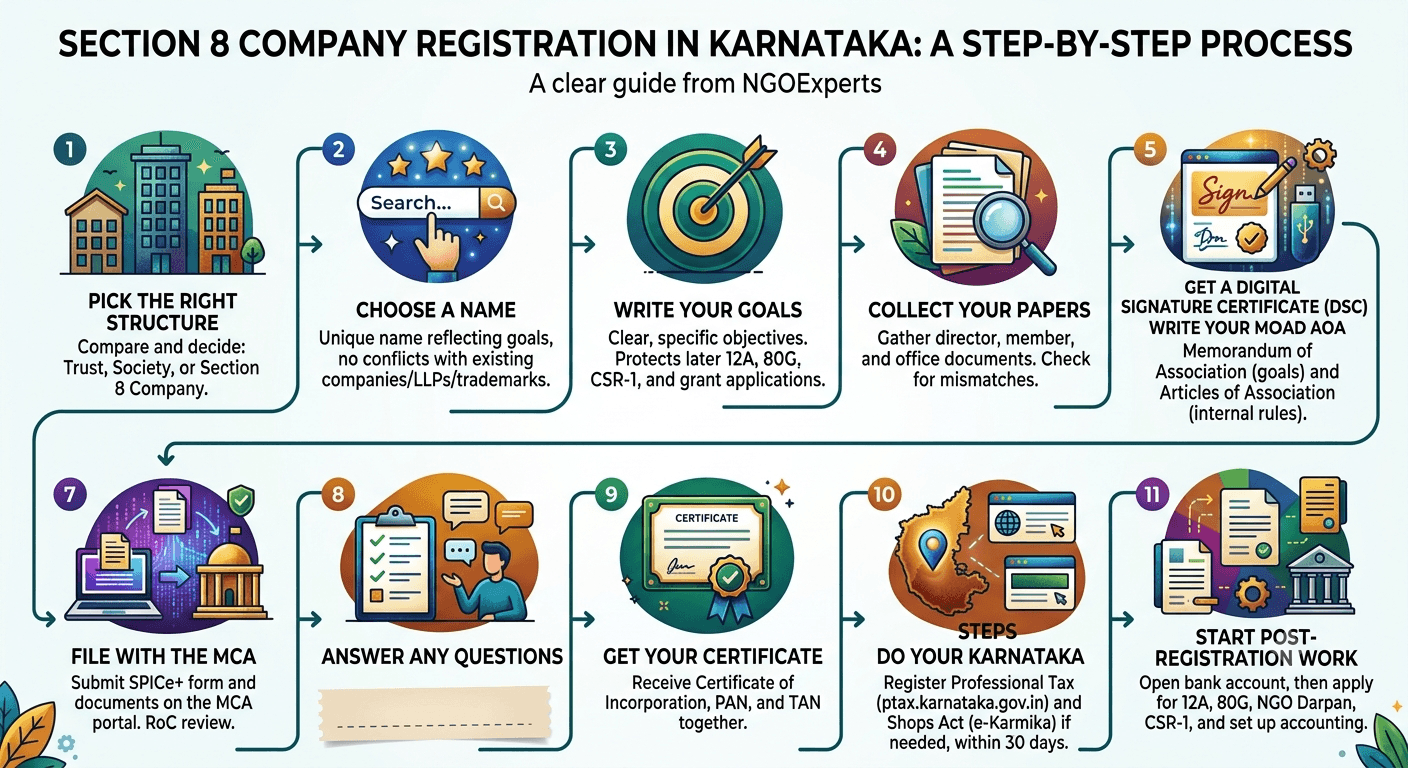
- Pick the right structure: Compare Trust, Society, and Section 8 Company one more time before you decide.
- Choose a name: Pick one that reflects your goals and doesn't clash with any existing company, LLP, or trademark.
- Write your goals: Keep them clear and specific, as this protects your later 12A, 80G, CSR-1, and grant applications.
- Collect your papers: Gather director, member, and office documents, and check them for mismatches before you file.
- Get a Digital Signature Certificate (DSC): Every director needs one to file online with the MCA.
- Write your MOA and AOA: These lay out your goals and your internal rules.
- File with the MCA: Submit the SPICe+ form and all your documents on the MCA portal. The RoC then checks it.
- Answer any questions: Reply quickly if RoC asks for changes or more proof; this is usually what causes delays.
- Get your certificate: Once approved, you receive your Certificate of Incorporation, PAN, and TAN, all together.
- Do your Karnataka steps: Register for Professional Tax on ptax.karnataka.gov.in, and, if you have staff or an office, for the Shops Act on e-Karmika, usually within 30 days of starting work.
- Start post-registration work: Open a bank account, then apply for 12A, 80G, NGO Darpan, and CSR-1, and set up your accounting.
Complete Comparison Table
| Trust | Society | Section 8 Company | |
| Karnataka law | Indian Trusts Act, 1882 (deed on stamp paper) | Karnataka Societies Registration Act, 1960 | Companies Act, 2013 — Section 8 |
| People needed | At least 2 trustees | At least 7 members, all above 18 | At least 2 directors + 2 members (private); at least 3 directors + 7 members (public) |
| Who registers it | Local Sub-Registrar office | Registrar of Societies (Dept. of Cooperative Societies) | RoC Karnataka, via the central MCA portal |
| Rough cost to set up | About ₹500 stamp cost if only money is given, and one person stays the sole trustee | About ₹1,000 (inside Bengaluru metro limits) or ₹500 (outside) | No stamp duty at all; only MCA government and service fees |
| Typical time to register | 5–10 working days | 2–4 weeks | 10–20 working days |
| Yearly paperwork burden | Lightest, simplest accounts, no yearly filing with a central regulator | Moderate, annual general body meeting and yearly return to the Registrar of Societies | Heaviest, yearly filing with the MCA, plus a statutory audit |
| How much do CSR teams and big donors trust it? | Lower, no public financial disclosure | Medium, depends on the Society's own record-keeping | Highest, financial filings are public on the MCA website |
| Best suited for | Simple, fast-moving charitable or religious work | Member-driven groups that want a voting body | Groups planning to work with companies, CSR funding, or government programs long-term |
Need Help With Section 8 Company Registration in Karnataka?
Avoid documentation errors and delays with professional guidance from NGOExperts.
Quick Decision Guide
- Pick a Trust if you want the fastest, simplest setup, and you're not chasing CSR funding or government grants right away.
- Pick a Society if you have at least 7 committed people and want a democratic, member-voted structure.
- Pick a Section 8 Company if you plan to work with companies, apply for CSR-1, or want the strongest, most trusted legal structure for the long run, as Arjun did.
Key Benefits of Section 8 Company Registration in Karnataka
- Tax relief: You can apply for tax exemption under Section 12A, and your donors can get a tax deduction under Section 80G.
- No stamp duty: You pay zero stamp duty on your incorporation papers — unlike a Trust deed, which still needs stamp paper.
- Safe from personal risk: Directors and members are not personally responsible for the company's debts.
- No minimum funds required: You can start with zero capital.
- Trusted by CSR teams: Because the MCA shares your records in public, it's easier to pass company checks.
- Keeps running forever: The company keeps going even if members or directors leave or change.
What Work Can a Section 8 Company Do in Karnataka?
- Education
- Helping people experiencing poverty and need
- Charity
- Health and medical help
- Religion
- Research and science
- Art and culture
- Sports
- Protecting nature
- Skill training
- Helping women grow
- Child welfare
- Village development
- Any other good, non-profit work
Section 8 Company Registration Rules and Laws in Karnataka
Rules that apply across India (including Karnataka):
- Companies Act, 2013 — Section 8: The main law. It says a company can be formed for good causes, and its funds must remain within the company.
- Companies (Incorporation) Rules, 2014: These specify what the RoC must check before granting you a Section 8 license.
- SPICe+ form: The MCA's online form covering name approval, company setup, PAN, and TAN—all at once.
- CSR-1 update (from July 14, 2025): Under the new MCA rules, Form CSR-1 is now completed entirely online — no more downloadable PDF.
- 12A/12AB and 80G: Apply separately after your company is set up through the official Income Tax e-filing portal.
Rules that apply only in Karnataka:
- Karnataka Professional Tax Act, 1976: If your company has paid staff in Karnataka, you must register for Professional Tax on the government's e-Prerana portal at ptax.karnataka.gov.in. Since April 1, 2025, staff earning below ₹25,000 a month pay nothing. Staff earning ₹25,000 or more pay ₹200 a month (₹300 in February) — ₹2,500 a year in total. You (the employer) register once to deduct staff tax (called PTRC), and your company also registers on its own (called PTEC) and pays ₹2,500 a year.
- Karnataka Shops and Commercial Establishments Act, 1961: If you run an office with staff in Karnataka, you must register on the official e-Karmika portal (Karnataka Department of Labor) within 30 days of starting operations. This certificate lasts 5 years. Your office sign must show Kannada along with any other language.
- GST registration: Karnataka follows standard rules — you must register for GST through the official GST portal once your annual earnings exceed ₹20 lakh for services or ₹40 lakh for goods.
Rules and websites can change, so always check the latest version before you file.
Who Is Eligible to Apply for Section 8 Company Registration in Karnataka?
- Purpose: Your goal must be charity or a public good. Any money earned must go back into that work.
- Members: At least 2 people for a private company; at least 7 for a public one. Private companies can have up to 200 members; public companies have no limit.
- Who can join: Individuals or groups — including firms, companies, and other NGOs. Directors should usually be residents of India, though foreign nationals can join with additional steps.
- Directors: At least 2 for a private company, at least 3 for a public one. Each director needs a Director Identification Number (DIN).
- Office address: Must be a real address in Karnataka, with proof (bill, rent papers, or ownership document).
- RoC approval: Karnataka RoC must issue you a license confirming your good cause purpose.
- No profit sharing: Money can never be paid out to members as profit.
Documents Needed for Section 8 Company Registration in Karnataka
For directors and members
- PAN card and Aadhaar card
- Passport, voter ID, or driving license (if asked)
- Recent address proof and a passport-size photo
- Mobile number and email ID
- Digital Signature Certificate (DSC) details
- Written consent to be a director, plus a few MCA forms
For your Karnataka office
- Electricity or utility bill
- Rent agreement (if rented); agreements under 11 months don't usually need to be registered, but get them notarized.
- No-objection letter (NOC) from the owner
- Property tax bill or ownership paper (if asked)
About your organization
- The company name you want
- Your main goals and planned work
- Rough income and spending plan (if asked)
- Details of your founders, directors, and members
Section 8 Company Registration Forms Used in Karnataka
| Form | What It's For |
| SPICe+ | Main form to set up your company |
| MOA | List your company's main goals |
| AOA | Sets your internal rules |
| INC-13 | MOA format made for Section 8 companies |
| INC-14 | A professional's written declaration, if needed |
| INC-15 | Declaration by the founding members, if needed |
| INC-9 | Declaration by founders and directors |
| AGILE-PRO-S | Linked form for GST, EPFO, ESIC, and bank account |
| DIR-2 | Consent to be a director |
| INC-22 | Office address form, if needed |
Section 8 Company Registration Fees and Time in Karnataka
| Item | Cost | Time |
| Talk and planning | Free with us | 1 day |
| Digital Signatures for 2 directors | ₹3,000 | 1–2 working days |
| Name check/apply with MCA | ₹1,000 | 1–3 working days |
| Service fee (writing goals, MOA, AOA) | ₹2,999 | 2–4 working days |
| Government fee and stamp cost | ₹1,000–₹2,000 | Set by MCA/state |
| PAN and TAN | Free with us | Comes with your certificate |
| Help getting your certificate | Free with us | Depends on RoC approval |
| Help after registration | Free with us | After you're set up |
| Karnataka Step | Rough Cost | How Often |
| Professional Tax, company sign-up (PTEC) | ₹2,500 | Every year |
| Professional Tax, per staff member earning ₹25,000+ a month (PTRC) | ₹200/month (₹300 in Feb) = ₹2,500/year, per staff member | Every year |
| Shops Act registration | Depends on staff count | Once, then renewed every 5 years |
What to Do After Section 8 Company Registration in Karnataka
| Step | Why It Matters |
| PAN and TAN | Needed for tax and money matters |
| Bank account | Needed to receive donations and grants |
| Professional Tax sign-up | A must in Karnataka if you have paid staff, via ptax.karnataka.gov.in |
| Shops Act registration | A must if you run an office with staff in Karnataka, via e-Karmika |
| Set up accounting | Keeps your records clear from day one |
| 12A/12AB sign-up | Let your NGO skip income tax, apply on the Income Tax portal |
| 80G sign-up | Let your donors get a tax deduction, apply on the Income Tax portal |
| NGO Darpan sign-up | Helps you get spotted for government schemes |
| CSR-1 sign-up | Needed to receive CSR money from companies, filed on the MCA portal |
| GST sign-up | Only once you cross ₹20 lakh (services) or ₹40 lakh (goods) in earnings, via the GST portal |
| Yearly ROC filing | A must every year with the MCA |
| Income tax return | Needed under the Income Tax Act |
| Yearly audit | Builds trust with your donors |
Common Mistakes in Section 8 Company Registration in Karnataka
- Picking a name that doesn't match your stated goals
- Copying generic NGO goals instead of writing your own
- Not planning early for 12A, 80G, and CSR-1
- Forgetting the NOC from your property owner
- Forgetting Karnataka's Professional Tax and Shops Act steps once you hire staff or rent an office.
- Wrong director or member details
- Thinking that your certificate alone will bring in donations or CSR money
Why Choose NGOExperts for Section 8 Company Registration in Karnataka
- Honest advice on Trust vs Society vs Section 8 Company
- Help picking your name and writing your goals
- Careful checks on your director, member, and office papers
- Full MCA filing support, working directly with RoC Karnataka
- Help with Karnataka-only steps: Professional Tax (e-Prerana) and Shops Act (e-Karmika)
- Help with 12A, 80G, NGO Darpan, and CSR-1 after you're set up
- Clear timelines, no hidden delays
Ready to Establish Your Non-Profit in Karnataka?
From choosing the right structure to completing registration, NGOExperts provides end-to-end support for Section 8 Company registration.
Frequently Asked Questions
Where does my Section 8 Company get registered if my office is in Karnataka?
Do I need Professional Tax registration for my Section 8 Company in Karnataka?
Do I need Shops Act registration for my NGO office in Karnataka?
How many people do I need to start a Section 8 Company?
Is a Section 8 Company better than a Karnataka Society?
Can my Section 8 Company in Karnataka get CSR money?
Does my Section 8 Company need GST in Karnataka?
Author
A Content Strategist at NGOExperts, who focuses on NGO registration, 12A and 80G registration, FCRA compliance, income tax filing for non-profits, and CSR funding guidelines in India. I research and write our compliance guides in collaboration with our in-house Chartered Accountants and Company Secretaries, so every article reflects current tax and regulatory requirements for the NGO and non-profit sector.
Written by Aabha Garg. Last updated on September 11, 2026