
Want to Start an NGO for Child Education?
Learn about the legal structures, registration process, documents, and essential steps required to establish an NGO focused on child education in India.
What Is a Child Education NGO?
Common activities run by a child education NGO include:
- Free tuition and after-school learning classes
- Digital literacy and STEAM education programs
- Scholarship and financial-aid support for students
- School kit, book, and uniform distribution
- Library and reading-room setup in low-income areas
- Career counseling and mentorship for older students
- Girl-child education and retention programs
- Dropout identification and re-enrolment support
Why India Needs Child Education NGOs in 2026?
- 46 million children out of school: UDISE+ 2024-25 data shows roughly 46 million children aged 6–17 are currently out of school in India, about 17% of that age group.
- Steep age-based drop-off: the out-of-school rate climbs to 22.7% at the secondary stage (14–15 years) and 22.8% at higher secondary (16–17 years).
- Weak Class 12 retention: only 47.2% of students who enter the school system go on to complete Class 12, even though 86.6% successfully transition from middle to secondary school.
- State-level disparities persist: 12 states and Union Territories report secondary dropout at or above 15%, led by West Bengal, Arunachal Pradesh, Karnataka, and Assam.
- Dropout rates are improving, but slowly: between 2023-24 and 2024-25, dropout fell from 3.7% to 2.3% at the preparatory stage, 5.2% to 3.5% at the middle stage, and 10.9% to 8.2% at the secondary stage.
- Funding is rising fast: CSR spending by Indian corporates hit a record ₹40,794 crore in FY 2024-25, up 17% year-on-year, and education alone received ₹13,877 crore — 34% of total CSR expenditure and a 14% increase over the previous year.
Eligibility and Documents to Register an NGO for Child Education in India
Eligibility Criteria
- Minimum founders/trustees: at least 2 for a Trust, 7 for a Society, and 2 directors/members for a Section 8 Company
- Age and citizenship: founders must be Indian citizens above 18 years (NRIs/foreign nationals can join with additional compliance)
- Registered office address: a valid, verifiable address in India (owned or rented with owner consent)
- Non-profit objective: the organisation's objects must be genuinely charitable, with no profit distribution to members
- No conflicting registrations: the proposed name must not duplicate an existing NGO, trademark, or government body
Documents Required
- Identity proof: PAN and Aadhaar of all founders, trustees, or directors
- Address proof: recent utility bill, bank statement, or Aadhaar of members
- Photographs: passport-size photos of all founding members
- Registered office proof: electricity bill, property tax receipt, or rent agreement
- NOC from property owner: mandatory if the office space is rented or owned by a third party
- Governing document: Trust Deed (for Trusts), Memorandum & Rules (for Societies), or MOA/AOA (for Section 8 Companies)
- Digital Signature Certificate (DSC): required only for Section 8 Company incorporation on the MCA portal
Confused About Which NGO Structure Is Right for You?
Whether you want to register a Trust, Society, or Section 8 Company for child education, our experts can help you choose the right structure and understand the registration requirements.
Step-by-Step Process to Register an NGO for Child Education in India
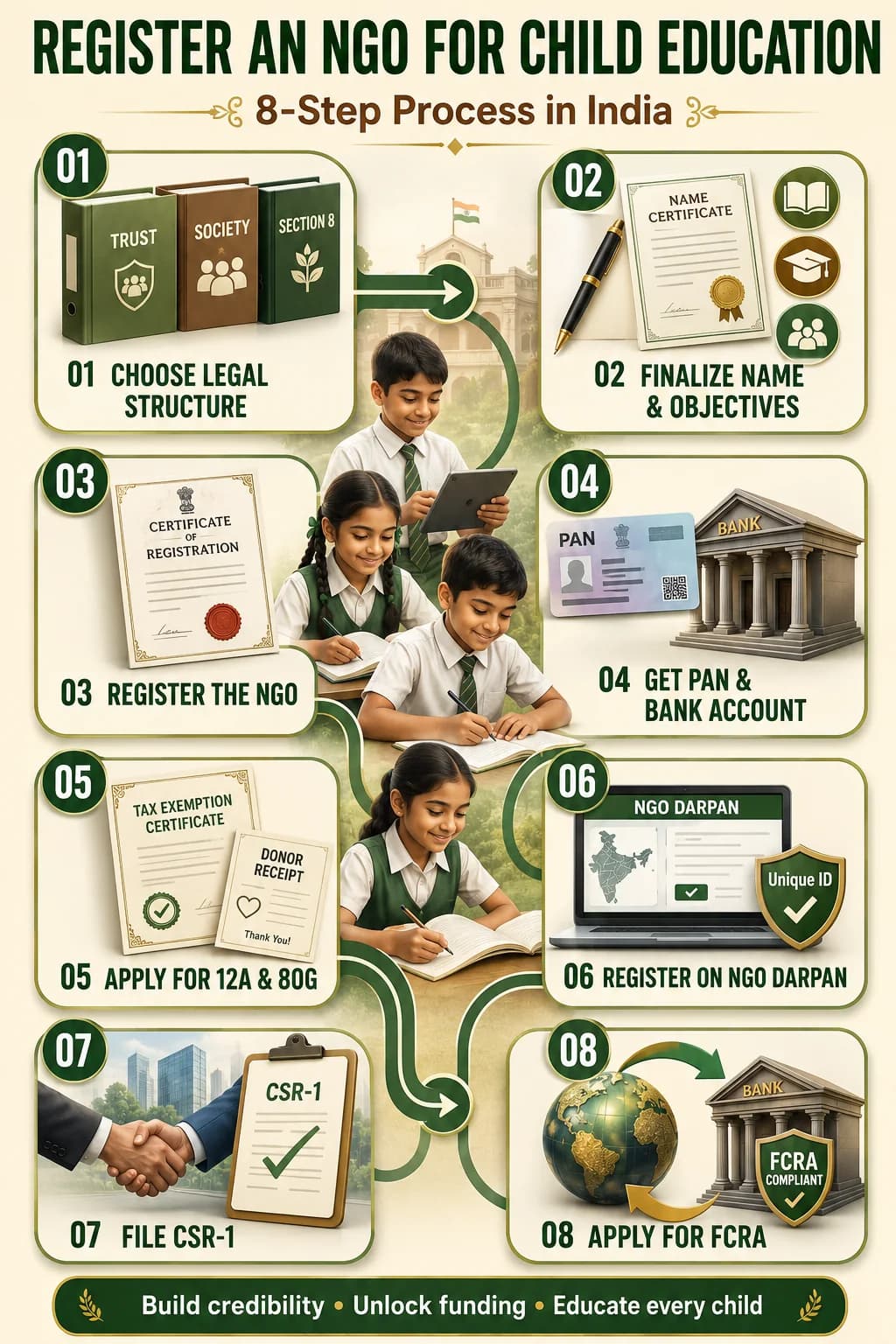
Step 1: Choose the Right Legal Structure
Step 2: Finalize the Name and Objectives
Step 3: Register the NGO
| Structure | Govt Fee | Professional Fee | Timeline |
| Trust | ₹500–₹2,000 | ₹5,000–₹10,000 | 7–15 days |
| Society | ₹500–₹5,000 | ₹8,000–₹15,000 | 30–60 days |
| Section 8 Company | ₹2,000–₹7,000 | ₹8,000–₹12,000 | 20–45 days |
Step 4: Apply for PAN and Open a Bank Account
Step 5: Apply for 12A and 80G Registration
Step 6: Register on NGO Darpan
Step 7: CSR-1 Registration for CSR Funding
- Minimum 3 years of NGO registration
- Active 12A and 80G registration
- Active NGO Darpan Unique ID
- Audited financial statements for the last 3 years
- Dedicated bank account
- File Form CSR-1 on the MCA portal
- Receive the CSR Registration Number (CRN), which companies use in their CSR disclosures
Step 8: FCRA Registration for Foreign Donations
- Minimum 3 years of existence
- At least ₹15 lakh spent on charitable activities during the last 3 financial years
- Active 12A registration
- Dedicated FCRA bank account at SBI, New Delhi Main Branch
- Apply through the Ministry of Home Affairs' FCRA online portal
Real-Life Example: How Bhumi Built a Funding-Ready Education NGO
Common Mistakes to Avoid
- Choosing a structure without a 3–5 year funding plan
- Copying generic objectives instead of education-specific ones
- Weak or missing registered-office proof
- Mixing personal and NGO bank transactions
- Seeking CSR funding before 12A, 80G, and NGO Darpan are in place
- Skipping activity documentation and annual audits
Ready to Start Your Child Education NGO?
Get professional assistance with NGO registration, documentation, and compliance so you can focus on creating better educational opportunities for children.
Frequently Asked Questions
Which structure is best for a child education NGO?
Is 12A compulsory for an education NGO?
Why does 80G matter?
Can a new NGO apply for CSR funding immediately?
How many children in India are currently out of school?
How long does it take to fully register a child education NGO in India?
Author
A Content Strategist at NGOExperts, who focuses on NGO registration, 12A and 80G registration, FCRA compliance, income tax filing for non-profits, and CSR funding guidelines in India. I research and write our compliance guides in collaboration with our in-house Chartered Accountants and Company Secretaries, so every article reflects current tax and regulatory requirements for the NGO and non-profit sector.
Written by Aabha Garg. Last updated on October 6, 2026