
Quick Answer
Naming your Section 8 company feels exciting until you sit down and realise there are actual government rules attached to it. You can't just call it "XYZ Foundation Pvt Ltd" and move on; the MCA has specific dos and don'ts, and getting them wrong means losing your ₹1,000 filing fee and starting over. This guide clarifies the naming rules, the exact steps to reserve your name, real examples of names that got approved (and ones that didn't), and what changed in 2026 so you don't file based on outdated information.
Got the Perfect Name for Your Section 8 Company?
Take the next step with professional guidance on Section 8 Company registration, documentation, and MCA compliance.
What Is a Section 8 Company Name, Exactly?
What Are the Section 8 Company Naming Rules in 2026?
Here's a simple breakdown:
| What the rule says | What it looks like in practice |
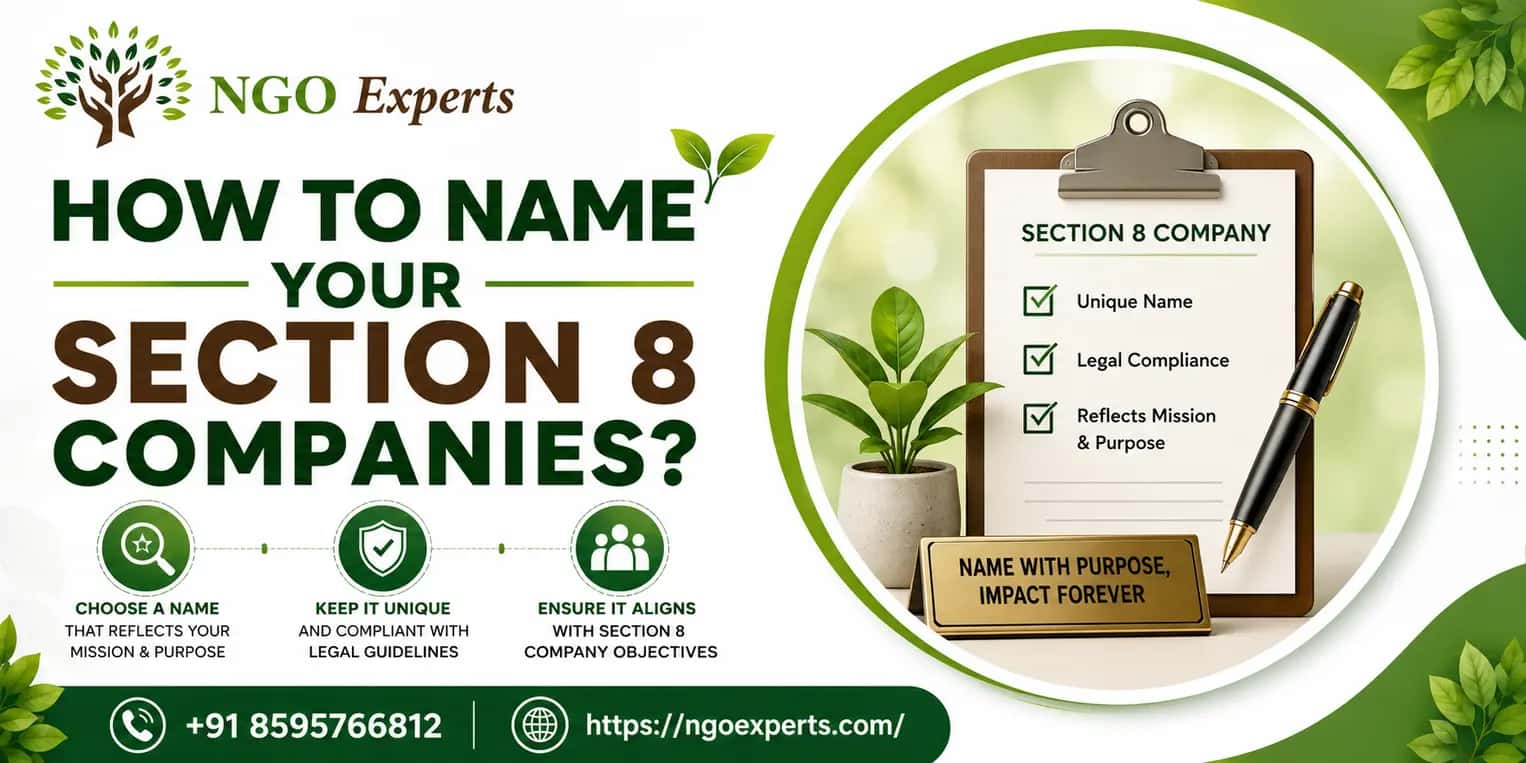
| Skip the commercial suffix | Don't write "Hope Pvt Ltd" |
| Show your purpose | Write "Hope Foundation" instead |
| Keep it unique | Search MCA and trademark records before you choose a name |
| Avoid words that suggest government backing | "National Hope Council" needs prior approval |
| Keep it clean | No offensive or obscene words, instant rejection |
Not Sure If Your Section 8 Company Name Will Be Approved?
Get expert assistance in choosing a compliant name, checking availability, and navigating the MCA name reservation process.
Which Words Can You Use in a Section 8 Company Name?
A few naming patterns that work well in practice:
- Cause or founder name + Foundation — Infosys Foundation, Reliance Foundation, and Tata Foundation are well-known real-world examples of this format.
- Sector + Association or Council — for example, "Indian Handicrafts Artisans Council."
- Region or community + Federation — for example, "Delhi Street Vendors Federation."
Which Words Need Approval or Are Restricted in a Section 8 Company Name?
Words That Need Prior Government Approval
- "India," "Bharat," "National," "Federal," "Republic," "President," "Prime Minister" usually need approval from the Central Government or a Regional Director because they hint at official backing.
- Anything implying a tie to an embassy, consulate, or foreign government needs clearance first.
- "Electoral Trust" is only allowed if you're registering under the CBDT's Electoral Trusts Scheme, 2013, and you submit an affidavit confirming that's your purpose.
- Names of national heroes or people holding high public office are restricted, since they imply endorsement or patronage.
Words That Are Not Permitted
- "British India" is not permitted in a company name under current MCA rules.
How to Reserve a Section 8 Company Name: Step-by-Step Process 2026
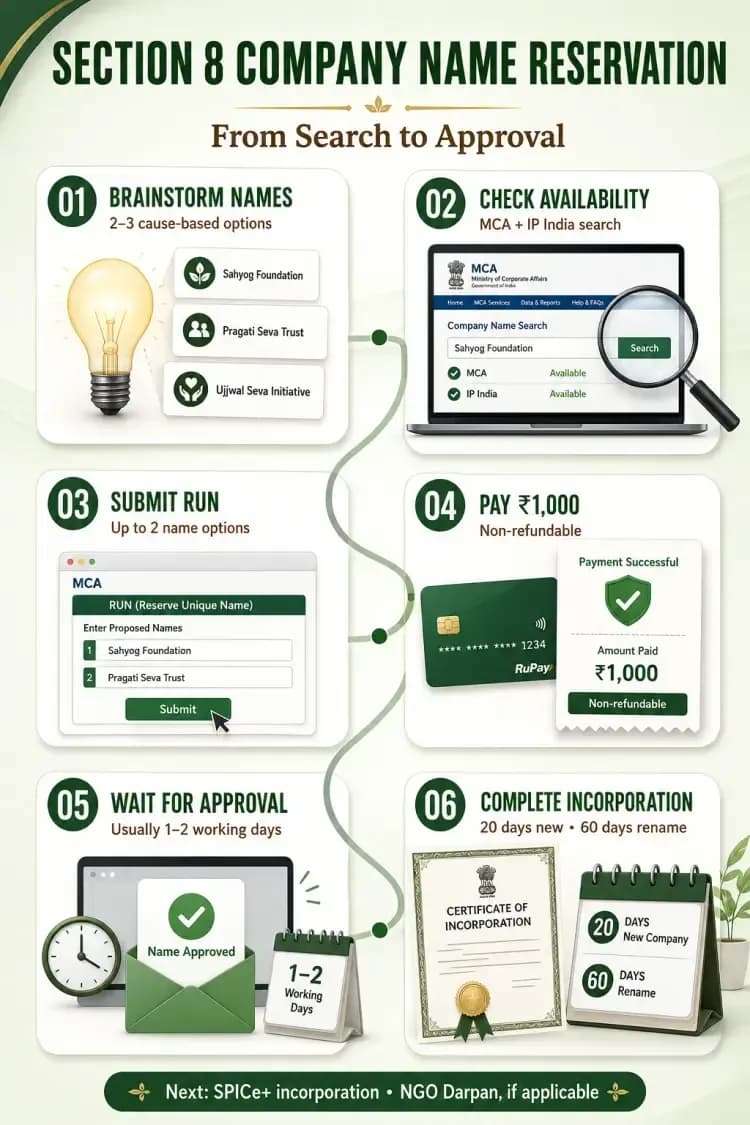
Brainstorm two or three name options that clearly reflect your cause and end in an approved word like Foundation or Association.
Run a free check on the MCA's "Check Company/LLP Name" tool and the IP India trademark search to rule out obvious clashes before you pay anything.
Application Log in to the MCA portal as a registered user and open the RUN (Reserve Unique Name) service. You can submit up to two name options in a single application.
Pay the RUN fee of Rs. 1,000 per submission. This isn't refundable, even if your name gets rejected, so choose carefully.
Wait for the CRC to review it. Approval usually comes through in about 1-2 working days if everything's in order.
Complete incorporation within the validity window: it takes 20 days for a brand-new company, or 60 days if you're renaming an existing one, through SPICe+. Miss the window and the name lapses, meaning you're back to square one and paying again.
Once your Section 8 company is incorporated, you may also need to complete other registrations and compliance requirements, such as NGO Darpan Registration, depending on your organization's objectives and funding requirements.
RUN Fees & Validity
| Detail | Value |
| Application fee | ₹1,000 per submission (non-refundable) |
| Names per application | Up to 2 |
| Validity for new company | 20 days from approval |
| Validity for existing company renaming | 60 days from approval |
| Typical approval time | 1–2 working days |
What Changed in the Section 8 Company Naming Rules in 2026?
- On 8 April 2026, the MCA rewrote Rule 8, the section that decides whether your proposed name is "too similar" to an existing one.
- A new Rule 8A was added, laying out a clearer, more detailed list of names considered undesirable.
- The updated Rule 8 lists twelve specific factors that the CRC now ignores when comparing names — so small tweaks like adding a space, a hyphen, or an extra letter no longer help you get around a similarity rejection.
Real-Life Naming Examples: What Works vs. What Doesn't
| Name that gets rejected | Why it fails | Name that gets approved |
| National Welfare Ltd | Has "Ltd" and "National" without approval | Sunrise Welfare Foundation |
| India Health Pvt Ltd | Commercial suffix plus a restricted word | Sehat Health Association |
| Royal Trust Council | Sounds like it has royal backing | Riverside Community Council |
| ABC Charity | Too vague, hard to remember or trust | Green Roots Environmental Foundation |
Real-life Example
Common Naming Mistakes to Avoid
- Assuming any charity-sounding word is fine: only the specific words listed under Rule 8(7) are automatically safe.
- Skipping the trademark check: The CRC compares your name against Section 4(2) of the Companies Act, 2013, so an unchecked name can still get flagged for trademark conflict.
- Choosing a name too close to a well-known NGO or foundation: even if unintentional, it can trigger a similarity rejection.
- Extra Budget allocation: Not setting aside extra budget for a second RUN application if your first choice doesn't clear.
Name Approved? Let's Complete Your Section 8 Registration
From name reservation to incorporation, get professional support to complete your Section 8 company registration smoothly.
Frequently Asked Questions
Can I apply for multiple names in one RUN application?
What happens if CRC asks for clarification on the proposed name?
Can I use just "Foundation" without any other qualifying word?
How long does name approval usually take?
Is the RUN fee refundable if my name gets rejected?
Can I rename my Section 8 company later?
Can a Section 8 change its name?
Author
A Content Strategist at NGOExperts, who focuses on NGO registration, 12A and 80G registration, FCRA compliance, income tax filing for non-profits, and CSR funding guidelines in India. I research and write our compliance guides in collaboration with our in-house Chartered Accountants and Company Secretaries, so every article reflects current tax and regulatory requirements for the NGO and non-profit sector.
Written by Aabha Garg. Last updated on October 13, 2026