
Quick Summary
A charitable trust is the most common way to establish an NGO in India due to its straightforward setup and low cost. All you need is a minimum of two trustees, a Trust Deed, and registration with the local Sub-Registrar's office. It provides tax benefits like 12A and 80G to attract more donors. If you are a social worker, a group of friends, or a family seeking to register this entity as an NGO, NGOExperts can guide you through the process of creating a charitable trust.
What is a Charitable Trust?
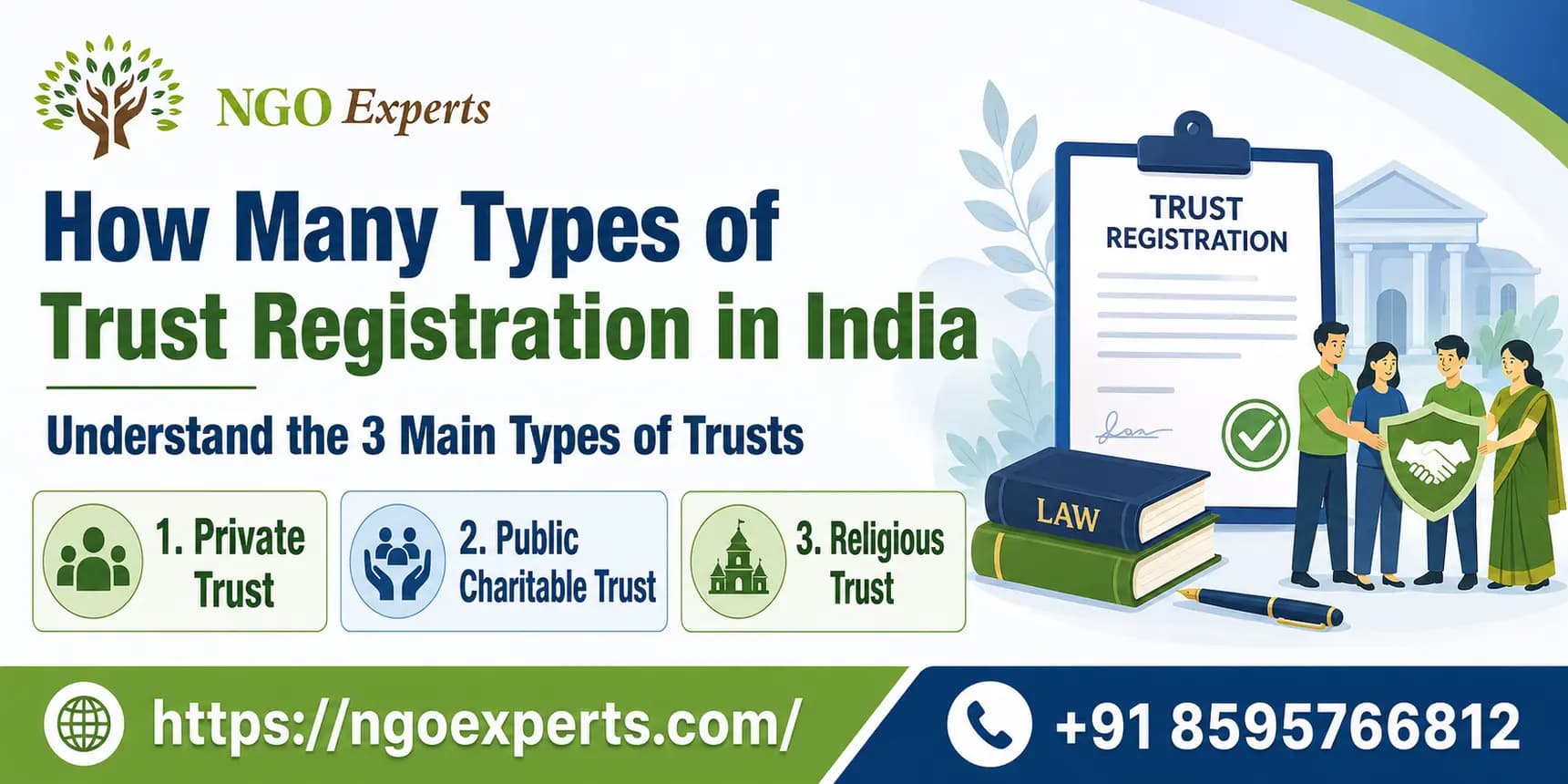
A charitable trust is a type of public trust established to carry out philanthropic, religious, educational, or social activities. Unlike private trusts, these operate for the benefit of society at large and not for any specific individual or family.
Trust must be registered under applicable laws, such as the Indian Trusts Act, 1882, or state-specific legislation, to be legally recognised and to enjoy tax benefits.
Difference Between Trust and Charitable Trust
It’s a common point of confusion. Let's first understand the crucial and valid complexity. There is a significant legal difference between a trust and a charitable trust.
At NGOExperts, we help you to understand it so your organisation is set up for the right purpose.
The Fundamental Difference
- A Private Trust is created for the benefit of specific, identifiable individuals (like your children or family members).
- A Charitable Trust (Public Trust) is established for the benefit of the general public or a specific segment of society.
Other Comparisons
| Feature | Private Trust | Charitable Trust (Public) |
| Purpose | To manage family wealth or specific heirs. | To promote education, relief of poverty, or healthcare. |
| Beneficiaries | Specific individuals | The public at large or a class of people. |
| Applicable Law | Indian Trusts Act, 1882. | Public Trust Acts (State-wise) |
| Tax Status | Generally taxed at the individual | Eligible for tax exemptions (12A, 80G, etc.). |
| Supervision | Governed by the Trust Deed internally. | Often supervised by the Charity Commissioner. |
| Duration | Can be dissolved upon meeting the goal. | Usually permanent in nature. |
NGOExperts helps you to clarify the following crucial points
1. The Exclusion Rule
In a Charitable Trust, you cannot restrict the benefits to your own family. If the Trust Deed states, This trust will provide scholarships only to the children of the founder, it is not a charitable trust. It will be treated as a private trust.
You will lose NGO-related tax benefits and the ability to accept donations.
2. The Tax Rule
People often establish a trust to reduce personal taxes. However, a Charitable Trust must spend at least 85% of its income on charitable activities annually. If you don't, you face heavy taxation.
3. Irrevocability
Once you donate money or property to a Charitable Trust, it becomes public property. You cannot easily take it back or terminate the trust and retain the assets. In a Private Trust, there is often more flexibility to revoke the trust or distribute the assets back to the family under specific conditions.
4. The 80G Advantage
Only a Charitable Trust can apply for 80G registration, allowing donors to deduct 50% of their donation from their taxable income. A private trust can never offer this to its contributors.
Legal Structure Options for Charitable Trust
When setting up a charitable organisation, you can choose from a few legal structures:
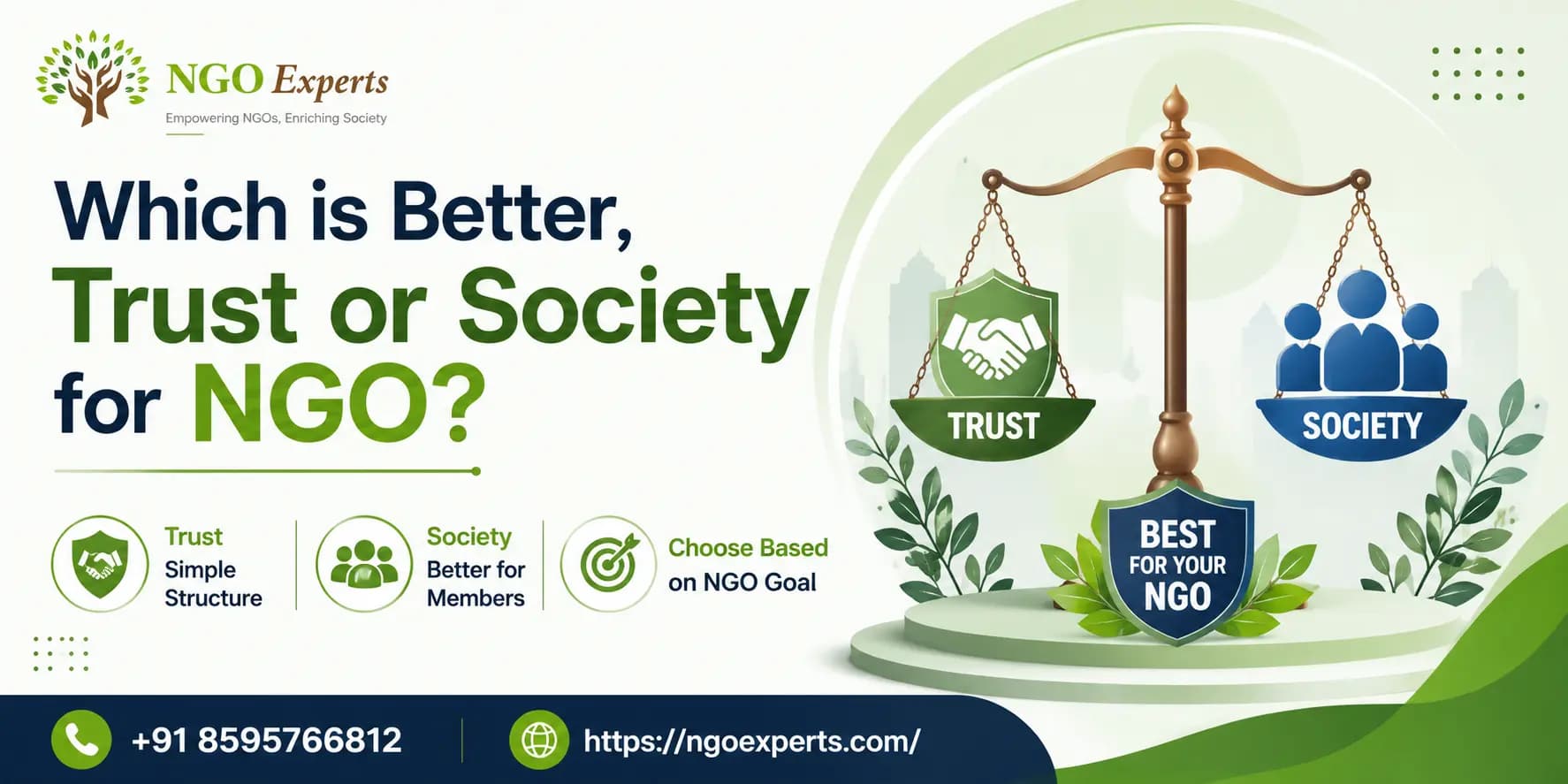
- Public Charitable Trusts– Governed by the Indian Trusts Act or state laws. Ideal for small to mid-sized social initiatives.
- Societies– Registered under the Societies Registration Act, 1860. Suitable for large-scale, membership-based organisations.
- Section 8 Companies– Formed under the Companies Act, 2013, for nonprofit purposes. Best for organisations looking for high compliance standards and credibility.
Comparison: Trust vs. Society vs. Section 8
| Feature | Charitable Trust | Society | Section 8 Company |
| Min. Members | 2 | 7 | 2 |
| Law | Indian Trusts Act | Societies Act | Companies Act |
| Ease of Setup | Very Easy | Moderate | Comp lex |
| Trust Factor | Medium | Medium | Very High |
Depending on your goals, each structure has different compliance requirements, operational flexibility, and advantages.
Benefits of Setting up a Charitable Trust
Registering a charitable trust offers many benefits in India. Let's explore these benefits.
1. Tax Exemptions (The 12A & 80G Advantage)
Tax exemption is the primary reason for formalising it as a Charitable Trust.
- 12A Registration: Once registered under Section 12A of the Income Tax Act, the entire income of the Trust (including donations and interest) is exempt from income tax.
- 80G Benefits: It allows your donors to deduct 50% of their donation amount from their taxable income.
2. Access to CSR (Corporate Social Responsibility) Funding
Under Indian Law, large companies are required to allocate 2% of the government's average subsidy to social causes. You must be a registered Charitable Trust to gain the CSR.
3. Government Grants and NITI Aayog Perks
If you plan to work on government-sponsored projects, you should be a registered Charitable Trust. It can avail you of many government schemes, subsidies, and grants.
4. Limited Liability and Legal Protection
Running a social cause puts your personal assets at risk. A registered charitable trust has the following features that can protect you
- Legal Entity: A Charitable Trust is a separate legal entity; it can purchase property, secure financing, or enter into contracts in its own name.
- Personal Protection allows the Trust to overcome a legal dispute or financial debt without harming the personal assets of the Trustees. The liability is limited to the Trust's assets.
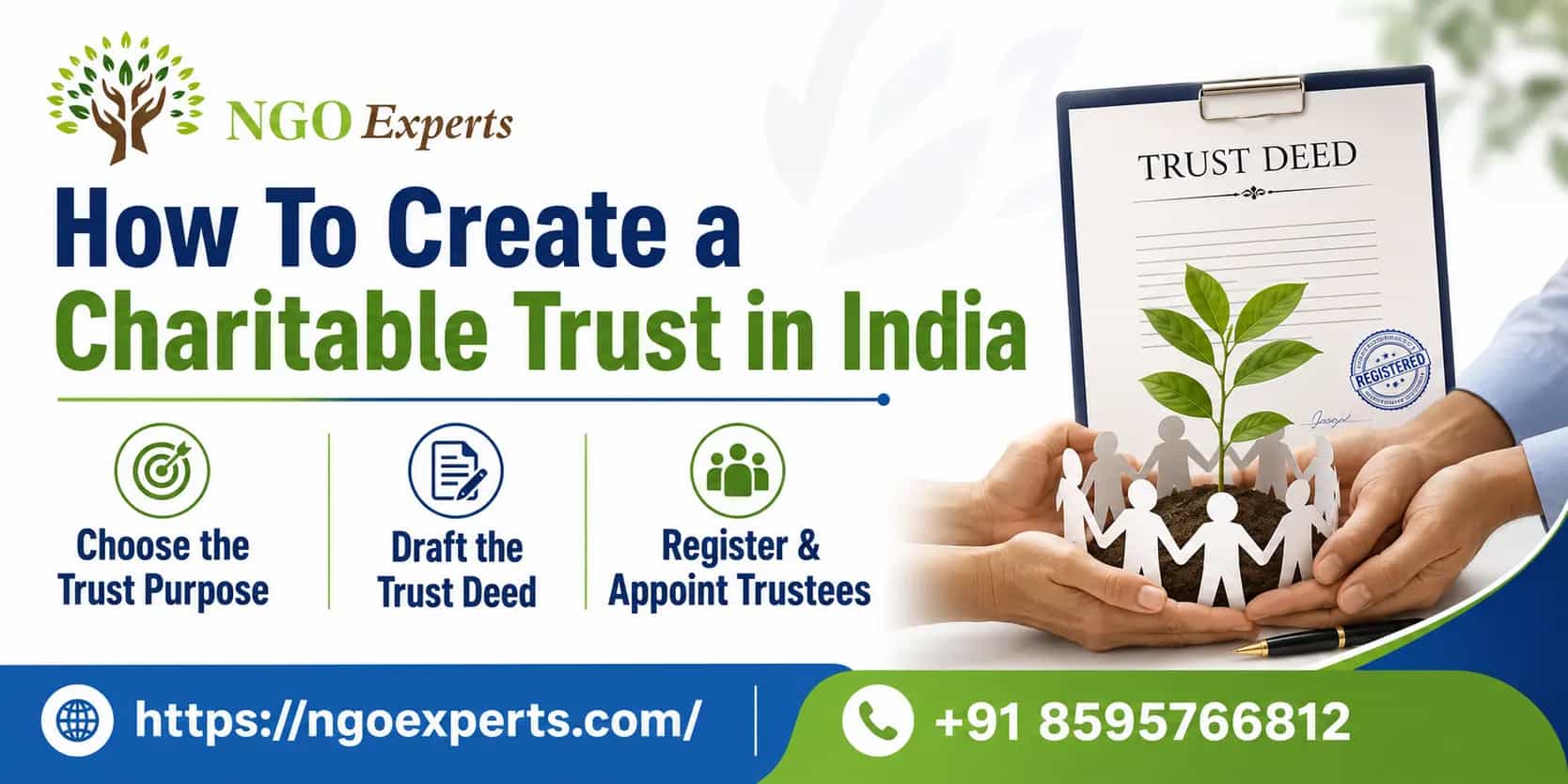
Step-by-Step Charitable Trust Registration Process
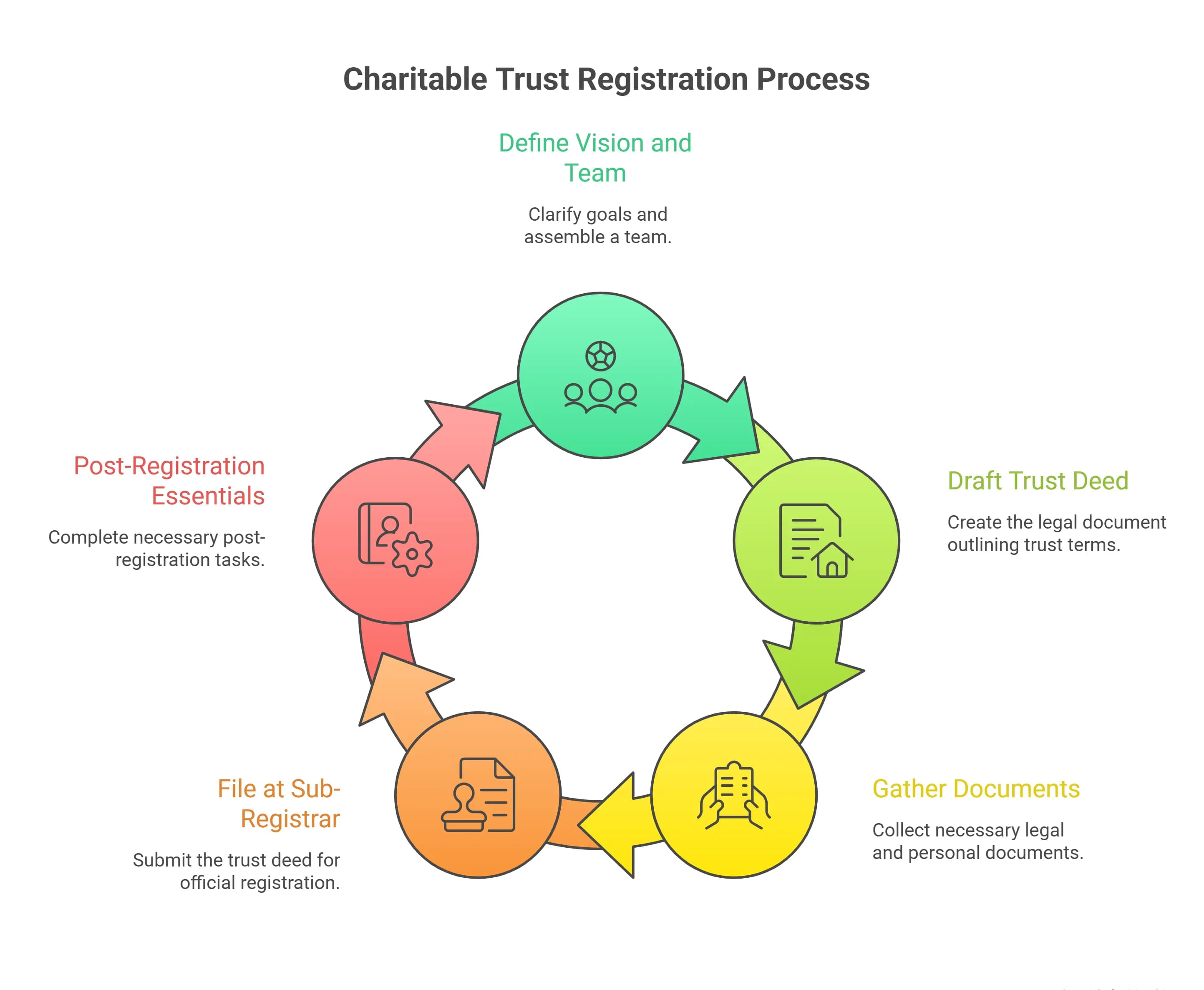
Follow this step-by-step guide to set up a charitable trust in India for a hassle-free process.
Step 1: Define Your Vision and Team
Pick a unique name and charitable objectives. Appoint 2-3 trustees and a settlor. Ensure a registered office address.
Step 2: Draft the Trust Deed
This is your trust's constitution, which includes the trust's name, goals, trustees' powers, property details, and rules. Use non-judicial stamp paper. Get it notarised.
Step 3: Gather Essential Documents
- Trust deed (2 copies).
- IDs (Aadhaar, PAN, Voter ID) for settlor/trustees/witnesses.
- Photos, proof of address, and landlord NOC (if rented).
- Court fee stamp.
Step 4: File at Sub-Registrar
Visit your local Sub-Registrar office. Submit the documents, pay the fees, and appear with witnesses. Verification takes 7-15 days. Get your registration certificate
Step 5: Post-Registration Essentials
After obtaining the registration certificate, apply for the following documents for a fully operational trust.
- Apply for a PAN and TAN in the Trust's name.
- Open a dedicated Bank Account.
- Apply for 12A and 80G Registration to provide tax exemptions to your donors.
- Register on the NITI Aayog Darpan portal to be eligible for government grants.
Conclusion
Establishing a charitable trust is a great first step toward changing society. Your careful planning and legal clarity determine your eligibility for government support and CSR funding. NGOExperts make the legal language understandable so you can accomplish your goals.
Frequently Asked Questions
What is the minimum number of members for a Trust registration?
In India, you only need a minimum of two trustees to register a charitable trust. Unlike a society (which needs 7), a trust is ideal for small groups or families.
Can I start an NGO in India with zero property?
Legally, a trust requires some property to be settled. However, this can be a nominal cash amount (Rs 500 or Rs 1,000) specified in the deed as the initial corpus.
Is 80G registration mandatory for all NGOs?
No, but it is highly recommended. Without 80G registration, your donors cannot claim tax deductions for their donations, making fundraising significantly harder.
How long does the registration process take?
Usually, once the deed is drafted, the physical registration at the Sub-Registrar's office takes 1 day, and the final certificate is issued within 7 to 15 days.
Do I need a professional NGO consultancy to register?
Many beginners encounter rejection due to drafting errors in the Trust Deed. Professional guidance ensures your trust is compliant with Income Tax and FCRA laws from day one.
Author
Srijita Chatterjee
I am a Content Specialist holding a Master’s degree and with over 5 years of experience in the creative arena. I specialize in breaking down complex concepts into clear, understandable insights that help my viewers deeply engage and retain. Known for my approachable and engaging style, I am committed to providing accurate, trustworthy information that empowers individuals and organizations to make informed decisions and achieve their goals.
Written by Srijita Chatterjee. Last updated on October 5, 2026