Trust
How to Register an NGO for Social Work in India
March 3, 20266 mins2 views

Quick Summary
Starting a journey in social work is a noble ambition. Before you begin, you need to register your NGO. NGOs are essential to social work because they fill critical service gaps left by governments, reaching marginalised communities with essential support. Operating without bureaucratic constraints, they provide specialised support in areas such as education, healthcare, and human rights, and empower communities.
What is an NGO?
An NGO (Non-Governmental Organisation) in India is a not‑for‑profit, voluntary organisation formed by individuals or groups to work for social, charitable, religious, educational, environmental, or similar public causes, independent of direct government control.Legally, NGOs typically take the form of a Trust, Society, or Section 8 Company, and any surplus must be reinvested in their objectives rather than distributed as profit to members. Having a registered NGO creates a separate legal identity for the organisation, which makes it easier to work with donors, government departments, and CSR partners.
Types of NGOs in India (Legal Structures)
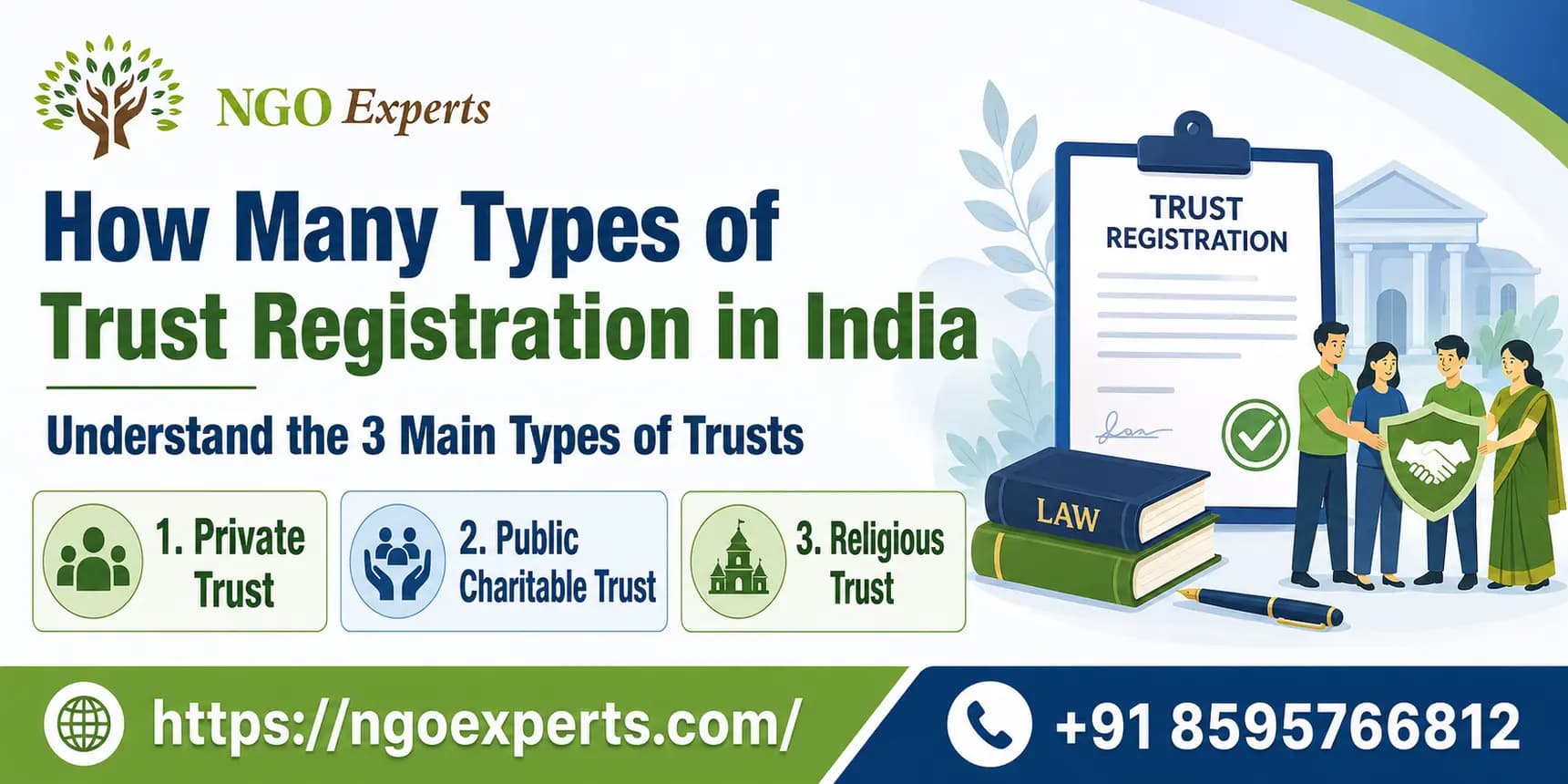
In India, the term NGO typically refers to the three main legal forms used to register NGOs.
| Legal form | Law & authority | Members needed | Best suited for |
| Public Charitable Trust | Indian Trusts Act / relevant state laws, Sub‑Registrar | Usually 2–3+ trustees (varies by state) | Family‑initiated or founder‑driven charities (education, health, temples, welfare) |
| Society | Societies Registration Act 1860 / state act, Registrar of Societies | Minimum of 7 founding members in most states | Democratic, membership‑based NGOs, networks, associations |
| Section 8 Company | Section 8 of the Companies Act 2013, Ministry of Corporate Affairs | At least 2 directors (private) or 3 (public) | Larger NGOs, CSR arms, organisations needing strong governance & national/international credibility |
Choosing the right legal structure can significantly strengthen your NGO's foundation, making your social work more credible and trustworthy. We at NGOExperts help you understand the benefits so you can select the most suitable entity for your NGO's mission.
Benefits of Registering Your NGO
Registering your NGO offers practical and legal benefits that can streamline your journey and provide peace of mind as you pursue your social goals.
- Legal identity: The NGO becomes a separate legal person that can own property, sign contracts, and sue or be sued in its own name.
- Bank account & financial operations: You can open a current account in the NGO’s name and receive donations, grants, and project funds in an organised manner.
- Donor and CSR trust: Registration and proper documentation enhance transparency, which is key to building trust with donors, government agencies, and partners, making your NGO more credible and reliable.
- Eligibility for government schemes and NGO‑Darpan: Registered NGOs can register on NGO‑Darpan and apply for government grants and schemes.
- Tax benefits: After registration, you can apply for 12AB registration (for income tax exemption on NGO income) and 80G approval (for tax deduction for donors).
- Continuity and governance: Rules for succession, meetings, and decision‑making are documented, so the NGO can continue even if founders change. Additionally, registered NGOs must comply with ongoing reporting, renewal, and audit requirements to maintain their legal status. NGOExperts can guide you on these compliance obligations, helping you sustain your NGO's operations and credibility over time.
Eligibility Criteria to Register an NGO in India
Eligibility depends on the chosen legal form, but the common basics remain the same, such as
Objective
- The purpose must be charitable or non‑profitand for public benefit.
Founders’ age and capacity
- Founders or promoters should be of legal age to contract (typically 18+ in most states; some states prefer 21+) and of sound mind.
Minimum members
- Trust: Typically, at least 2–3 trustees.
- Society: Generally, at least 7 founding members.
- Section 8 company: At least 2 directors (private) or 3 (public), and 2–3 shareholders and members.
Non‑profit intention
- Any surplus generated by the NGO must be used only for the NGO’s objects, not distributed as dividends or profits to members.
Registered office
- You must have a physical address in India with proof, and, for rented premises, an NOC (No Objection Certificate) from the landlord is required.
Documents Required to Register an NGO
Understanding the required documents for NGO registration helps you feel prepared and confident, ensuring a smoother process and peace of mind.
Common documents for all forms
- Identity proof of founders and key members (PAN, Aadhaar, passport, voter ID, etc.).
- Address proof of founders (Aadhaar, voter ID, utility bill, driving licence, etc.).
- Passport‑size photographs of founders and office staff.
- Registered office address proof: electricity/telephone bill, property tax receipt, rent agreement, NOC(No Objection Certificate) from the owner if rented.
- You must need a clear statement of objectives, proposed activities, and the area of operation.
Documents for a Trust
- Draft Trust Deed stating the name of the trust, objects, details of settlor, trustees, powers, mode of management, and rules.
- Photocopies of ID/address proofs of settlor and trustees, and two witnesses
Extra documents for a Society
- Memorandum of Association (MOA) describing name, registered office, aims and objectives, and details of the governing body.
- Rules and Regulations/Bylaws covering membership, meetings, elections, powers, audits, dissolution, and related matters.
- List of governing body members with their addresses, occupations, and signatures.
for a Section 8 Company
- Digital Signature Certificates (DSC) for proposed directors.
- Director Identification Numbers (DIN) for proposed directors.
- MOA and AOA drafted as per Section 8 requirements (non‑profit objects, application of profits clause, no dividend clause).
- Declarations and affidavits from directors about not‑for‑profit intent and compliance with Section 8.
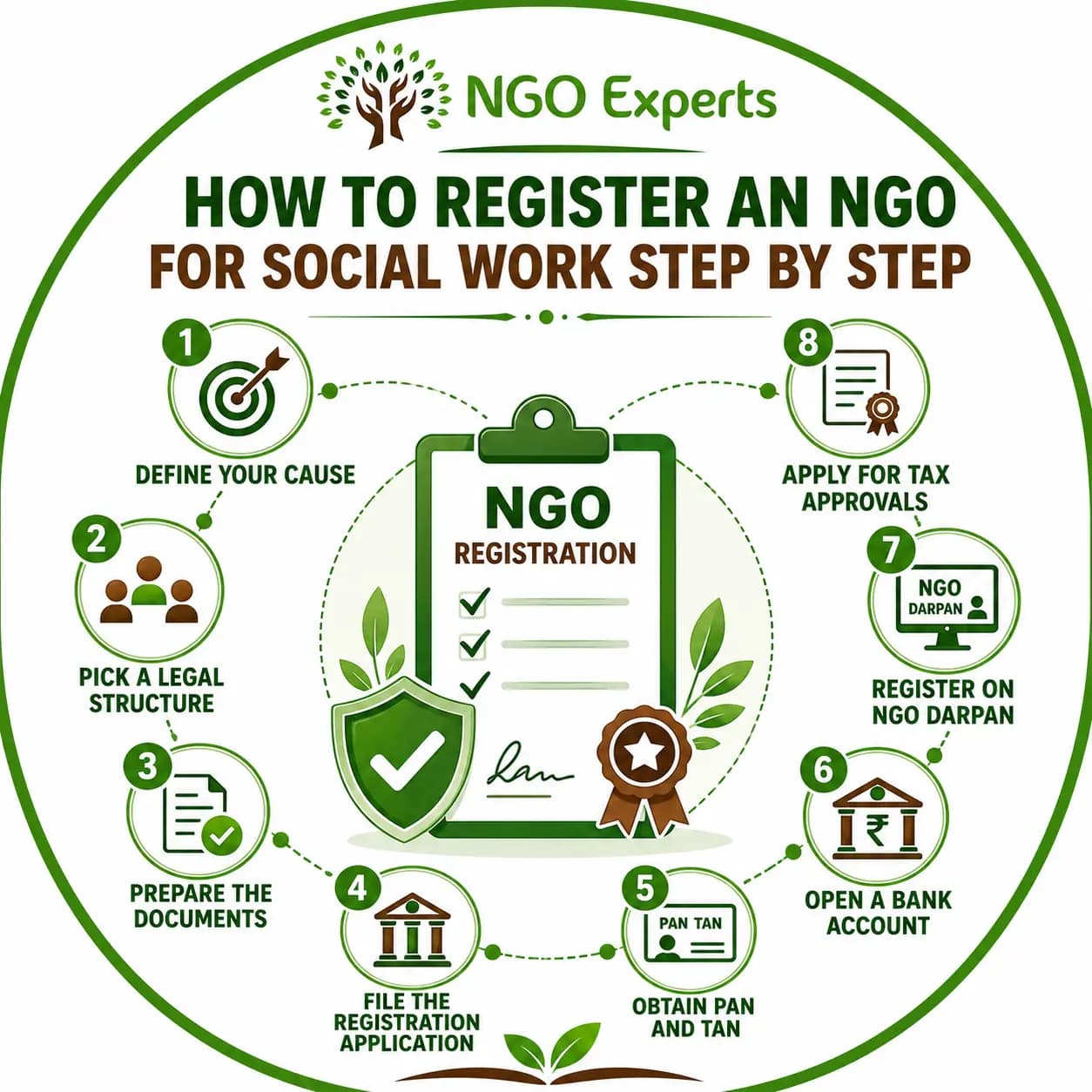
How to Register an NGO for social work in India?

Step 1: Finalise your mission, name, and structure
- Decide on your cause and activities, and clarify
- Who you want to help and how you want to help
- Choose a unique NGO name
- Prefer simple, meaningful names, avoiding restricted or offensive words and not copying existing registered names in your state or MCA(Ministry of Corporate Affairs) database.
- Select the legal form.
- Trust (simpler, founder‑driven; good for family‑initiated charities).
- Society (membership‑based; good for state or national networks).
- Section 8 company (more compliance but higher credibility for large or corporate‑facing NGOs).
Step 2: Assemble your founding team and documents
- Bring the required founders or members
- 2–3 trustees for the Trust, 7 members for the Society, 2–3 directors for the Section 8 company.
- Collect KYC and office documents
- PAN, Aadhaar, photos, address proof of members, office proof and NOC.
- Draft your constitutional document
- Trust: Trust Deed.
- Society: MOA and Rules & Regulations.
- Section 8: MOA and AOA as per the Companies Act.
Step 3: Register with the appropriate authority
The registration process varies by NGO structure. We will simplify the structure registration process for your convenience.
Public Charitable Trust
- Pay stamp duty (as per state) on the Trust Deed, present the deed with KYC documents to the local Sub‑Registrar or Registrar of Trusts, appear with witnesses, sign and register.
- The Sub‑Registrar issues a registered Trust Deed and/or certificate as proof of registration.
Society
- File signed MOA(Memorandum of Association), Rules & Regulations, list of governing body members, affidavit and KYC documents with your state’s Registrar of Societies.
- After scrutiny and approval, you receive a Society Registration Certificate.
Section 8 Company
- Apply online through the MCA portal using SPICe+ forms, including name reservation, DSC/DIN, MOA/AOA(Articles of association) and declarations of non‑profit intent.
- On approval, you get the Certificate of Incorporation and Section 8 licence.
Step 4: Post‑registration basic setup
- Apply for PAN and TAN in the NGO’s name if they are not automatically issued at incorporation.
- Open a dedicated current account with a bank using the registration documents, PAN, and KYC of the authorised signatories.
- Set up basic accounting and record‑keeping: cash book, vouchers, receipts, minutes of meetings, member and beneficiary records.
Step 5: Apply for tax registrations
Income tax exemption (12AB and 80G)
- File an online application on the income‑tax portal with registration documents
- 12AB provides an exemption for income applied to charitable purposes; 80G allows donors to claim deductions.
What to Do After Registration?
Once your NGO is registered, focus on Administration, compliance, and impact.
Build a basic administrative framework
- Conduct regular board and committee meetings, maintain minutes, and follow decision‑making rules in your Trust Deed/MOA/AOA.
Financial discipline and audits
- Maintain proper books of account, maintain vouchers for expenses, and have accounts audited annually.
- File required annual returns with the Income Tax Department and with the Registrar of Societies or MCA (for Section 8 companies).
Fundraising and partnerships
- Use your registration and 12AB/80G status to approach individual donors, CSR departments, and grant‑making agencies by sharing your registration details and reports.
Compliance monitoring
- Track renewal due dates (12AB/80G, FCRA (Foreign Contribution Regulation Act ), keep your government portal details up to date, and respond promptly to notices.
Conclusion
Starting an NGO for social work in India is achievable by following a structured roadmap: choose the right legal form (Trust, Society, or Section 8) and complete the registration process. With the right planning and support, your registered NGO can create long‑term social impact across India.
FAQs
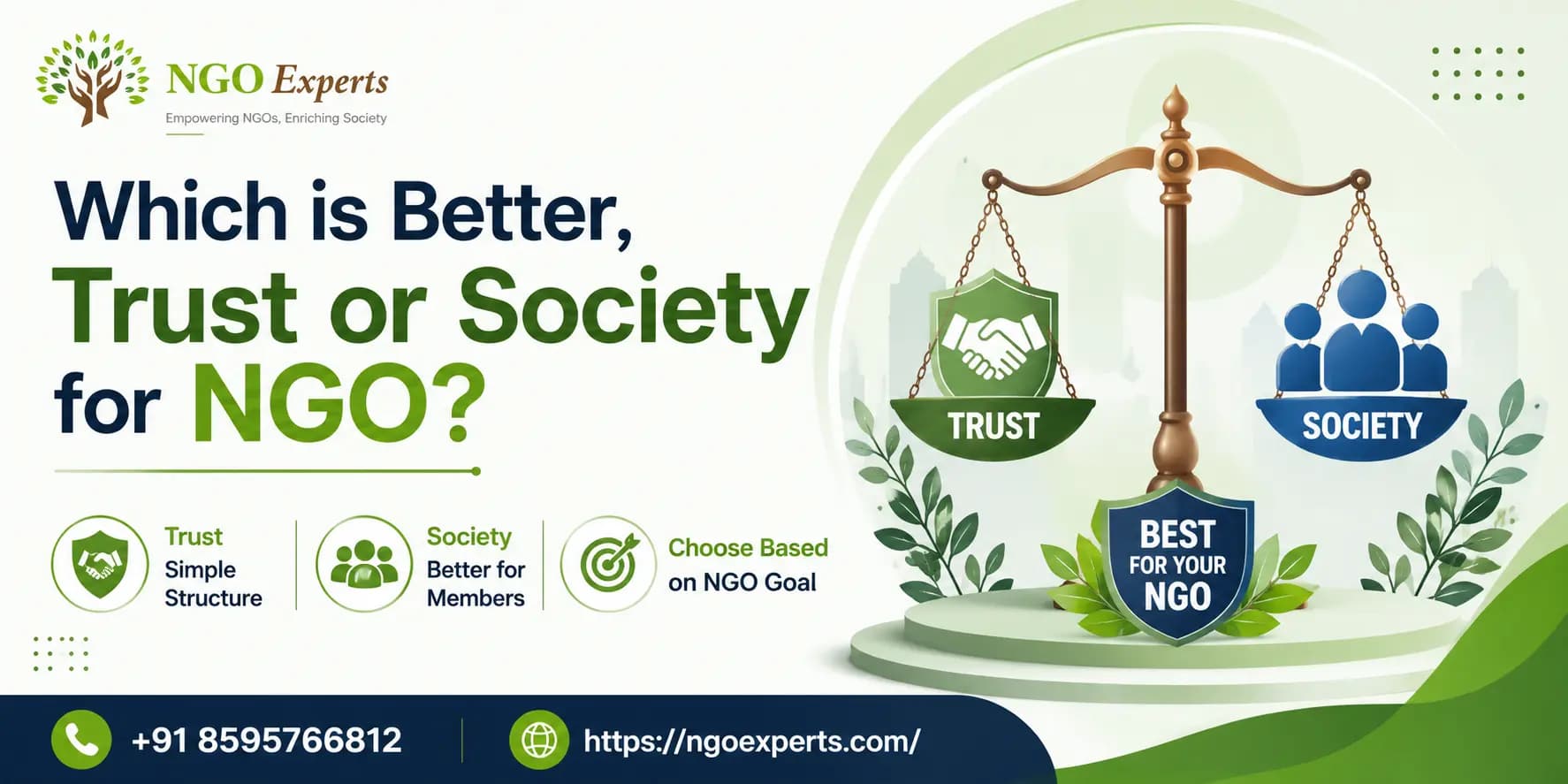
Q1. Which is the best type of NGO: Trust, Society, or Section 8?
Ans. There is no single best type; Trusts are simpler to set up, Societies suit membership‑based organisations, and Section 8 companies offer stronger governance and credibility for larger NGOs.
Q2. How much time does NGO registration usually take?
Ans Timelines vary by state and form, but Trusts and Societies may take a few weeks, while Section 8 companies may take longer due to documentation processing.
Q3. Is it mandatory to register an NGO to do social work?
Ans You can do small‑scale social work informally, but registration is mandatory if you want to receive donations in the organisation’s name or apply for grants.
Q4. Can one person start an NGO alone in India?
Ans: You cannot register an NGO as a sole proprietorship; you typically need at least two or three founders.
Q5. Do I need 80G and 12AB for my NGO immediately?
Ans. They are not required to complete basic registration, but are required soon afterwards so that your NGO’s income is tax‑free and your donors can claim tax benefits.