


Avoid Mistakes in Section 8 Company Registration
Planning to register a Section 8 Company? Avoid common errors in documentation, eligibility, name approval, and MCA filings. Get expert assistance from NGOExperts for a smooth and compliant registration process.
Important 2026 Update: New Sections, Forms, and Limited Reapplication Relief
- Registration under Sections 12A and 12AB is now dealt with under Section 332
- Approval under Section 80G is now dealt with under Section 354
- Form 104 replaces Form 10A for provisional registration or approval
- Form 105 replaces Form 10AB for regular registration, approval, and renewal
- Form 107 is used for regular grant, rejection, or cancellation orders
Why Do 12A and 80G Applications Get Rejected?
- Vague objects clause: Language like "general welfare of society" fails the specific-charitable-purpose test — named activities and locations are expected instead.
- Incomplete or mismatched documents: Missing trust deed pages, an unsigned MOA, or a PAN that doesn't match the organisation's name are extremely common causes.
- Wrong form or category selected: NGOs still thinking in "Form 10AB" terms often pick the wrong category on Form 105 — fresh, renewal, or provisional-to-regular.
- Filing renewal too close to expiry: Applications filed near or after expiry face far more scrutiny than those filed with buffer time.
- PAN in the wrong name: A PAN registered to an individual trustee instead of the organisation is a top-three rejection reason.
- Missing or outdated financial proof: Old or unaudited financials, mismatched with claimed numbers, routinely stall applications.
- Activities outside the stated objects: Work not included in the objects clause may be treated as non-compliance.
- Repeating a filing without fixing the root cause: A fresh application over an unresolved rejection usually adds delay rather than solving anything.
Common Mistakes and How to Fix Them
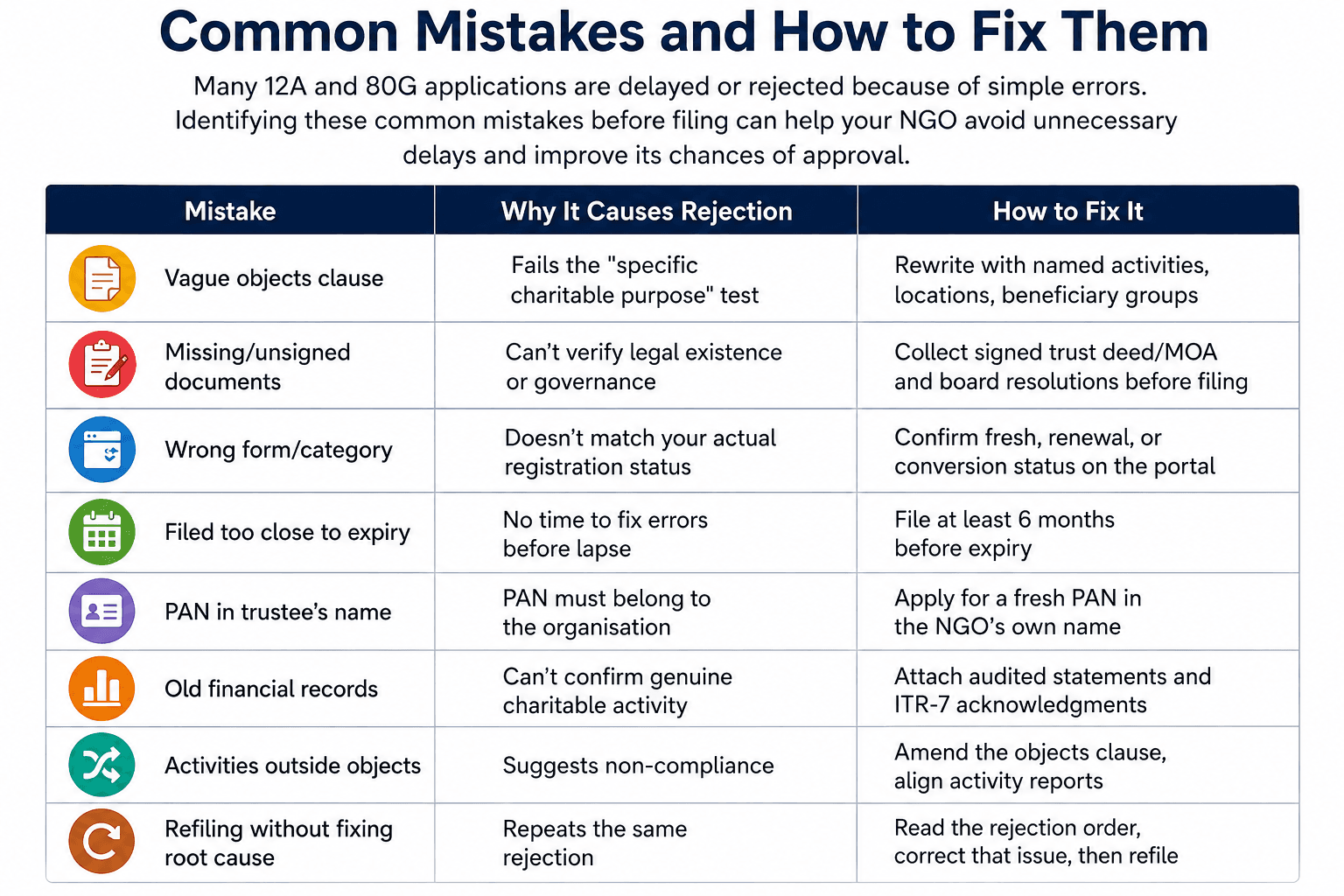
| Mistake | Why It Causes Rejection | How to Fix It |
| Vague objects clause | Fails the "specific charitable purpose" test | Rewrite with named activities, locations, beneficiary groups |
| Missing/unsigned documents | Can't verify legal existence or governance | Collect signed trust deed/MOA and board resolutions before filing |
| Wrong form/category | Doesn't match your actual registration status | Confirm fresh, renewal, or conversion status on the portal |
| Filed too close to expiry | No time to fix errors before lapse | File at least 6 months before expiry |
| PAN in trustee's name | PAN must belong to the organisation | Apply for a fresh PAN in the NGO's own name |
| Old financial records | Can't confirm genuine charitable activity | Attach audited statements and ITR-7 acknowledgments |
| Activities outside objects | Suggests non-compliance | Amend the objects clause, align activity reports |
| Refiling without fixing root cause | Repeats the same rejection | Read the rejection order, correct that issue, then refile |
How to Fix a Weak Application Before You File?
- Read your trust deed/MOA line by line: rewrite vague language into specific, named activities.
- Match your PAN to your organisation's name: apply for a correction or fresh PAN if it's in a trustee's name.
- Collect and date-check every document: registration certificate, PAN, financials, ITR-7, bank statements, activity report.
- Confirm the correct form category: fresh, renewal, or provisional-to-regular.
- Prepare a strong activity report: real project details, locations, and beneficiary numbers.
- File with buffer time: at least 6 months before expiry.
- Get a second pair of eyes: a quick review often catches the one error that would cause rejection.
Register Your Section 8 Company Without Errors
A small mistake during Section 8 Company Registration can lead to delays or rejection. Let NGOExperts handle the documentation and registration process with professional guidance.
Was Your 12A or 80G Application Rejected? Here's What to Do Next
- Read the rejection order: Identify the exact reason for rejection.
- Check the reapplication window: Where applicable, use the one-month window under Rule 181(12).
- Check for delay condonation: If you missed a deadline for a genuine reason, see whether condonation is available.
- Fix the underlying issue: Correct document, financial, or compliance gaps before submitting a new application.
- Get professional guidance: Complex cases may need expert review before refiling.
Time Needed to Fix and Refile
| Task | Time Needed |
| Reviewing the rejection order | 1 day |
| Rewriting the objects clause | 2–4 days |
| Correcting PAN details | 3–10 days |
| Refiling Form 105 | 1 day |
| Reapply window (Form 107 order) | Within 1 month |
Frequently Asked Questions
Why do most 12A or 80G applications get rejected in 2026?
Can I reapply immediately after a 12A or 80G rejection?
What is the most common documentation mistake?
Does a rejected 12A application also affect my 80G approval?
Will the Income-tax Act, 2025 cancel my existing valid registration?
How is rejection different from a lapsed registration?
What happens if I miss my renewal deadline without condonation?
Can I withdraw Form 105 after filing?
Author
A Content Strategist at NGOExperts, who focuses on NGO registration, 12A and 80G registration, FCRA compliance, income tax filing for non-profits, and CSR funding guidelines in India. I research and write our compliance guides in collaboration with our in-house Chartered Accountants and Company Secretaries, so every article reflects current tax and regulatory requirements for the NGO and non-profit sector.
Written by Aabha Garg. Last updated on August 25, 2026