

Quick Summary
If you want to create a potential impact in the promotion of art, culture, science, charity, etc, in society without any profitable intention, forming a Section 8 company is a smart and reputable way to establish your social welfare goals. With over 70,000 Section 8 companies registered across india, this unique corporate structure offers a compelling framework for charitable, educational, and social welfare activities. However, registered under Section 8, the Companies Act 2013 has its own advantages and disadvantages in the context of its non-profit mode of operations. In fact, Section 8 company registration in India comes with several benefits while gaining legal status without any hassle.
Overview
A company is termed a Section 8 company when registered as a Non-Profit Organization (NPO) underpinned by the Ministry of Corporate Affairs. After this registration, one has to follow several legal rules and regulations, which can sometimes become challenging. Members cannot receive any share of profits, and these companies may be less stable than other types. On the positive side, Section 8 companies do enjoy some attractive tax benefits under the Income Tax Act, 1961 , also they can apply for 12A and 80G registration while offering donors tax deductions ranging from 50% to 100% of the donated amount.
On the other hand, a Section 8 company must utilize the earned profits for the mentioned charitable objectives. The income of such entities cannot be utilized for any dividend-based liabilities. One of the major advantages of Section 8 companies is their eligibility to receive foreign grants and donations, provided they are registered under the Foreign Contribution Regulation Act, 2010. However, like any business structure, it comes with its own set of benefits and limitations that potential founders must carefully consider. Let's explore in detail through this comprehensive guide.
What is a Section 8 Company?
Governed by the Companies Act, 2013, a Section 8 is a non-profit organization that operates with the primary objective of promoting commerce, art, science, sports, education, research, social welfare, religion, charity, or environmental protection. According to the Ministry of Corporate Affairs (MCA), these companies are privileged, which exempts them from certain regulatory requirements applicable to traditional companies, making them an attractive option for social welfare goals.
The key distinguishing feature is that Section 8 companies apply their profits solely toward promoting their objectives and are prohibited from paying dividends to members. This fundamental characteristic sets them apart from profit-oriented entities while providing the structural benefits of a registered company.
The features of a Section 8 Company
- Established for social welfare: These companies are established solely for social welfare. It is designed to assess the needs of a community's people.
- No minimal capital: They don’t require minimal capital as others do. Its shareholders can decide it. There are no limitations on capital.
- Authorised by the government: They have the government's sanction for all their processes and transactions.
- Donations: Their primary source of income is donations received from the public and different organisations.
- Profit is used for the cause: Unlike in other companies, the funds acquired are not distributed among the organisation's members but are used solely for its cause.
Have Questions?
Advantages of Section 8 Company Registration
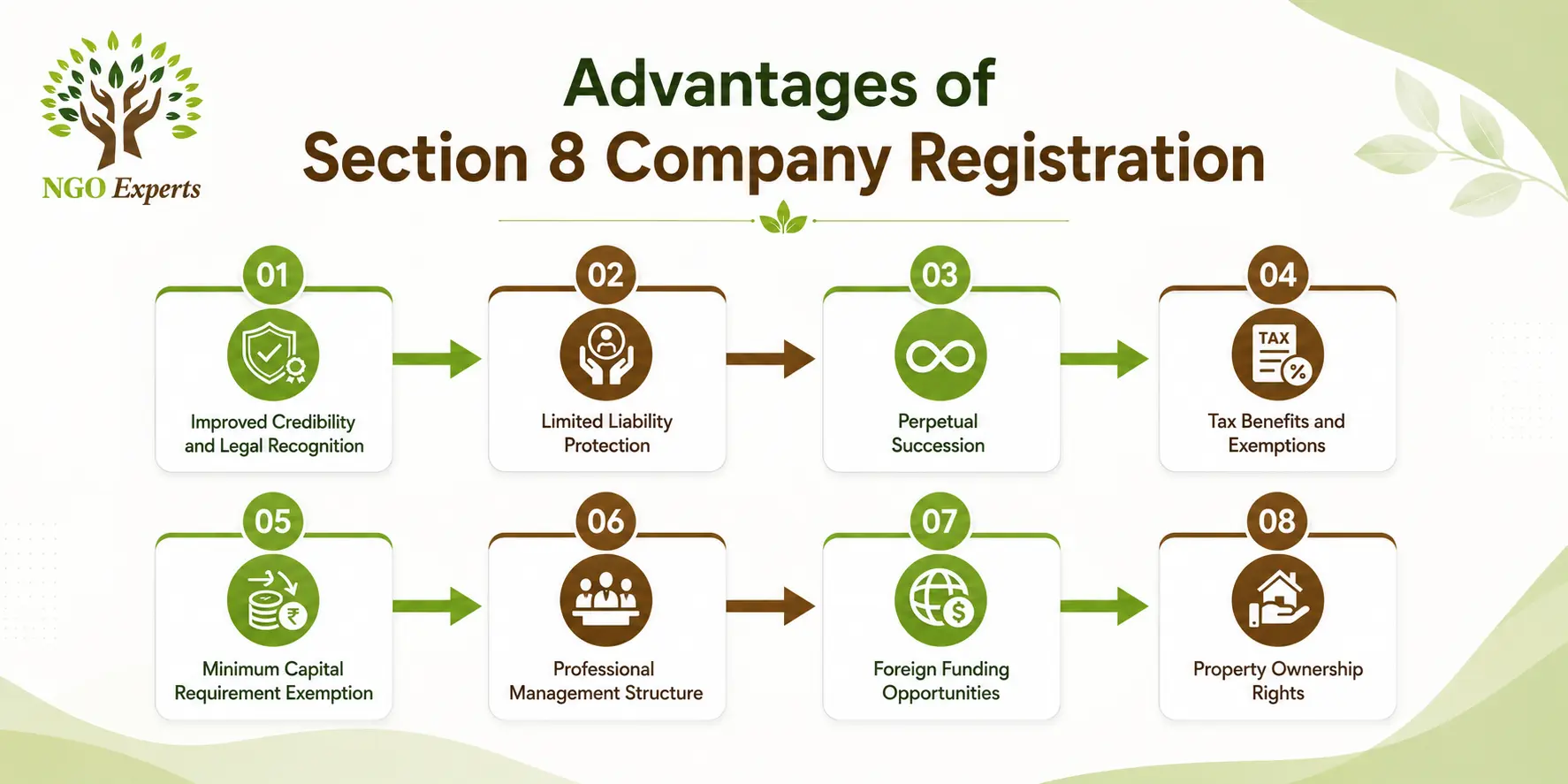
1. Improved Credibility and Legal Recognition
The Ministry of Corporate Affairs provides these entities with a certificate of incorporation, lending them official government recognition. This formal structure makes them enjoy greater credibility compared to trusts or societies.
2. Limited Liability Protection
This crucial advantage of limited liability protection shields individuals from financial risks associated with the organization's operations, encouraging more people to participate in social causes without fear of personal loss or bankruptcy.
3. Perpetual Succession
Unlike trusts that may face succession challenges, Section 8 companies enjoy perpetual succession. The organization continues to exist regardless of changes in membership or management, ensuring long-term sustainability and continuity of social initiatives.
4. Tax Benefits and Exemptions
Section 8 companies are eligible for fundraising capability and attractive tax benefits under the Income Tax Act, 1961. According to the Central Board of Direct Taxes (CBDT), they can apply for 12A and 80G registrations while offering donors tax deductions ranging from 50% to 100% of the donated amount.
5. Minimum Capital Requirement Exemption
The MCA has waived minimum capital requirements for Section 8 companies, making it easier to establish these entities without substantial initial investment. This provision democratizes access to formal non-profit structures for grassroots organizations.
6. Professional Management Structure
Section 8 companies operate with a formal board of directors, which enables a more structured governance and decision-making than trusts or societies.
7. Foreign Funding Opportunities
With proper FCRA (Foreign Contribution Regulation Act) registration, Section 8 companies can receive foreign donations, expanding their fundraising capabilities beyond domestic sources.
8. Property Ownership Rights
These companies can own property and assets in their own name, facilitating easier management of resources and long-term investments in infrastructure.
Disadvantages of Section 8 Company Registration
1. Stringent Regulatory Compliance
Section 8 companies must comply with various provisions of the Companies Act, 2013, including annual filing requirements, board meetings, and maintenance of statutory registers..
2. No profit-based outcomes
Members cannot receive any profits or dividends, which may discourage certain investors or stakeholders looking for financial returns. All incomes must be reinvested in the organization's objectives.
3. Longer Registration Process
Compared to trusts or societies, Section 8 company registration typically takes 15-30 days, involving multiple stages of approval from the Registrar of Companies (ROC). This extended timeline may delay the commencement of operations.
4. Alteration of Objects not permitted
Any change to the memorandum of association requires prior approval from the Central Government, making it challenging to pivot or expand organizational objectives quickly.
5. Mandatory Director Appointments
A minimum of two directors (for private companies) or three directors (for public companies) is mandatory, along with adherence to residency requirements as per Section 149 of the Companies Act.
6. Higher Formation Costs
Initial registration costs for Section 8 companies range from ₹15,000 to ₹25,000, higher than trusts or societies, particularly when professional services are engaged.
Advantages and Disadvantages of Section 8 Registration
| Advantages | Disadvantages |
| Limited liability protection | Stringent regulatory compliance |
| Enhanced credibility and trust | No profit distribution to members |
| Perpetual succession | Longer registration process |
| Significant tax benefits | Restricted alteration of objectives |
| No minimum capital requirement | Complex dissolution procedure |
| Professional management structure | Mandatory director requirements |
| Foreign funding eligibility | Higher formation costs |
| Property ownership rights | Continuous government monitoring |
Documents Required for Section 8 Registration in India
- Digital Signature Certificates (DSC) for all directors
- Director Identification Numbers (DIN)
- Draft Memorandum of Association (MOA)
- Draft Articles of Association (AOA)
- Address proof of registered office
- NOC from the property owner
- Directors' identity and address proofs
Post-Registration
- Apply for PAN and TAN immediately
- Register for 12A and 80G tax exemptions
- Open a dedicated bank account
- Obtain FCRA registration if planning foreign funding
- Set up compliance calendars for timely filings
Have Questions?
Quick Tips before a Section 8 Registration
- It is vital to clearly define your organization's charitable objectives
- Ensure that your objectives align with Section 8 eligibility criteria
- Prepare a unique name that reflects your mission
- Appoint a committed team of directors with relevant expertise
Conclusion
Section 8 company registration offers an attractive framework for individuals and organizations committed to social causes. The advantages of limited liability, tax benefits, enhanced credibility, and perpetual succession make it an attractive option for serious non-profit ventures. Consulting a trustworthy non-profit company registration firm as NGOExperts not only provides you with specialized knowledge and practical insights but also ensures your organization maintains seamless compliance with government standards.
Frequently Asked Questions
What is the minimum number of members required to register a Section 8 company?
According to the Companies Act, 2013, there is no maximum limit on membership. However, a minimum of two members is required to register a Section 8 company as a private limited company, while three members are needed for a public limited Section 8 company.
Can a Section 8 company generate profit or income?
Yes, a Section 8 company can generate profit and income through its activities, donations, grants, and fee-based services.
How long does it take to register a Section 8 company in India?
Section 8 company registration typically takes 15 to 30 days from the date of application submission to the Registrar of Companies (ROC).
Can a Section 8 company accept foreign donations?
Yes, a Section 8 company can accept foreign donations after obtaining FCRA (Foreign Contribution Regulation Act) registration from the Ministry of Home Affairs.
What is the registration cost for a Section 8 company?
The registration cost for a Section 8 company ranges from ₹15,000 to ₹25,000, depending on authorized capital and professional fees. Government fees are minimal as Section 8 companies enjoy exemptions on stamp duty and registration charges.