
Ready to Start Your NGO in India?
Check your eligibility and get expert assistance with choosing the right legal structure and completing your NGO registration
Quick Eligibility Checklist

- Are you at least 18 years old and legally competent to contract?
- Do you have a genuinely charitable objective — education, poverty relief, healthcare, environment, or public welfare?
- Can you gather the minimum number of founders/members your chosen structure needs?
- Do you have valid identity and address proof for every founder?
- Do you have access to a registered office address (residential is fine)?
Who Can Legally Register an NGO in India?
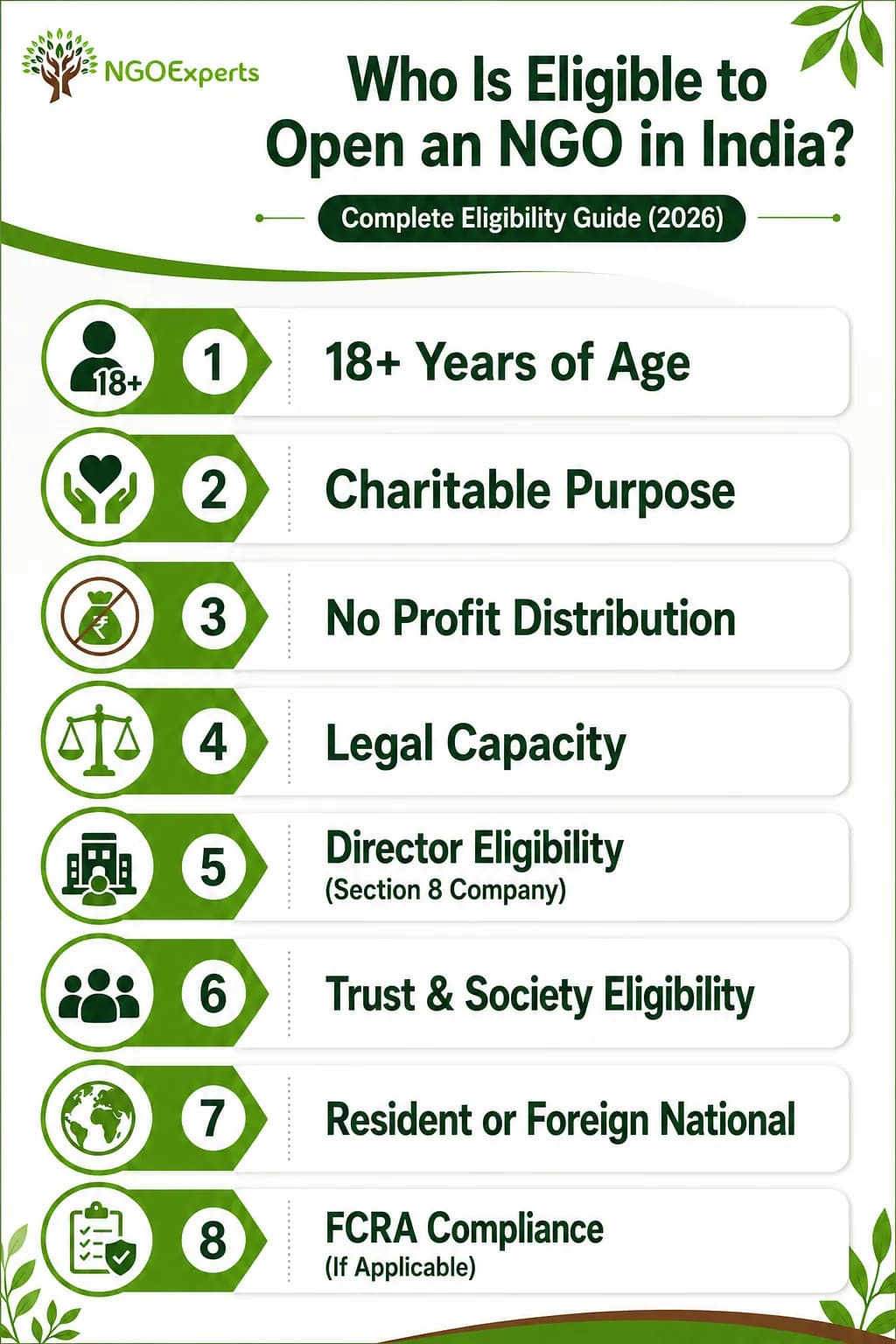
Age
Purpose
No Profit Distribution
Character Standing
Residency
Which NGO Structure Should You Register: Trust, Society, or Section 8 Company?
| Requirement | Trust | Society | Section 8 Company |
| Minimum founders | 2 trustees | 7 members | 2 directors + MoA subscribers |
| Registered office | Required | Required | Required |
| PAN | After registration | After registration | Often via SPICe+ |
| Governing law | Indian Trusts Act, 1882 | Societies Registration Act, 1860 | Companies Act, 2013, Sec. 8 |
| Best for | Local charity | Community organisations | CSR & corporate funding |
Not Sure Which NGO Structure Is Right for You?
Get personalised guidance on registering your NGO as a Trust, Society, or Section 8 Company based on your goals.
Can Students, Homemakers, NRIs, or Foreign Nationals Start an NGO?
What's Changed for NGO Tax Registration Under the New Income Tax Act, 2025?
- Section 332 governs registration of the entity itself (replacing Sections 12A, 12AA, 12AB, and 10(23C)). A validly registered entity is now a Registered Non-Profit Organization (RNPO).
- Section 354 governs donor tax-deduction approval (replacing Section 80G), a distinct application on a separate timeline.
- Renewal cycles: Provisional Section 332 registration runs 3 years (Form 10A); regular registration runs 5 years, or 10 for smaller RNPOs. Section 354 approval must always be renewed every 5 years, with no extended cycle.
- Existing valid 12A/12AB registrations convert automatically into RNPO status; no need to reapply until due for renewal.
- New entities can file Section 332 and Section 354 simultaneously, cutting processing delays.
What Are the Most Common Mistakes That Delay NGO Registration?
- Choosing the wrong structure without factoring in future funding plans — e.g., a Trust when the real goal is CSR funding.
- Vague or commercial-sounding objectives in the Trust Deed, Memorandum, or By-laws.
- Mismatched documents or incomplete address proof: differing names/spellings, or a missing NOC, rent agreement, or utility bill.
- Ignoring post-registration compliance: PAN, Section 332/354 registration, NGO Darpan, and CSR-1 are separate steps many founders forget.
- Treating tax registration as one-time. It isn't — renewal deadlines are strict, and missing one can cause RNPO status to lapse.
What Should You Do Immediately After Registering Your NGO?
- Apply for PAN and open a dedicated NGO bank account: It is mandatory for any financial transaction in the NGO's name.
- Register on NGO Darpan (NITI Aayog): required for most government schemes and CSR access, and cross-checked by FCRA and Income Tax departments to confirm active status.
- Apply for Section 332 registration and Section 354 approval on the Income Tax e-filing portal to secure tax exemption and donor deductions.
- Apply for CSR-1 registration on the MCA portal if you want to receive CSR funds. (See our CSR-1 registration guide for the full document checklist.)
- Maintain proper books of account and file annual compliance on time to protect your RNPO status.
Ready to Register Your NGO?
Planning to Start an NGO? Let's Get Started.
Speak with our NGO registration experts for guidance on eligibility, documents, registration, and compliance requirements.
Frequently Asked Questions
Who is eligible to open an NGO in India?
Can one person register an NGO alone?
Can students or homemakers start an NGO?
Can NRIs or foreign nationals start an NGO?
Do I still need 12A/80G, or has this changed?
Can I register an NGO using my home address?
Which structure is best for CSR funding?
Author
A Content Strategist at NGOExperts, who focuses on NGO registration, 12A and 80G registration, FCRA compliance, income tax filing for non-profits, and CSR funding guidelines in India. I research and write our compliance guides in collaboration with our in-house Chartered Accountants and Company Secretaries, so every article reflects current tax and regulatory requirements for the NGO and non-profit sector.
Written by Aabha Garg. Last updated on September 11, 2026