
Quick Summary
Securing government funding can transform an NGO's ability to create meaningful social impact. However, the application process for government schemes in India can be complex, requiring extensive documentation, regulatory compliance, and strategic preparation.
This is where most NGOs lose momentum. NGOexperts was built to fill this exact gap. Think of us as your true partner in this ongoing journey; we handle the accuracy and speed of your filings, so your mission never has to wait on a "pending" status.
1. Understanding the Government Funding Landscape
Before diving into the preparation process, it's crucial to understand the diversified government schemes available to NGOs in India. The government offers funding through multiple channels, each with distinct objectives, eligibility criteria, and application processes.
Major Government Funding Sources:
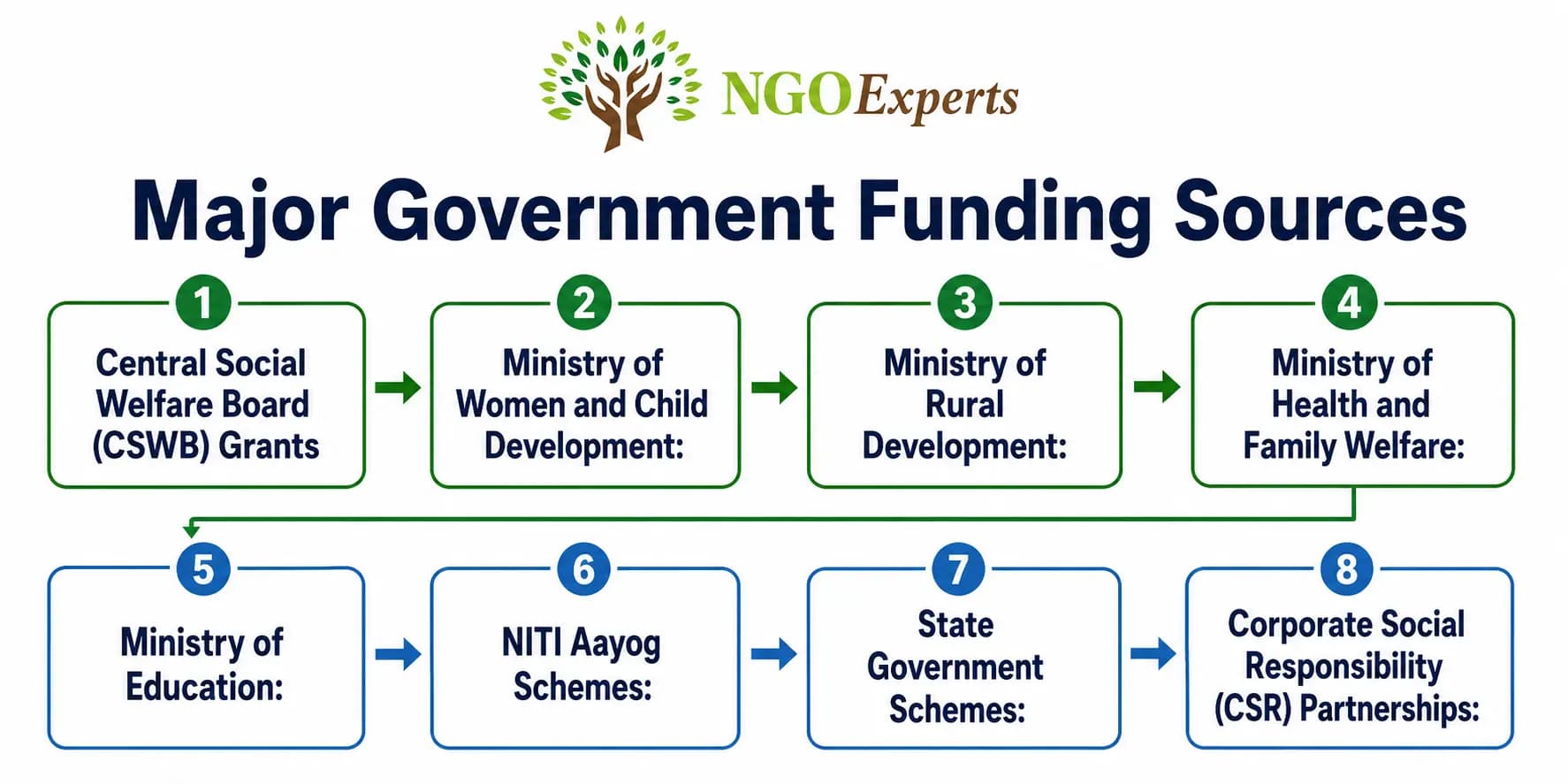
- Central Social Welfare Board (CSWB) Grants: Supporting welfare programs for women, children, and marginalized communities through financial assistance for infrastructure, training, and program implementation.
- Ministry of Women and Child Development: Funding initiatives focused on women's empowerment, child protection, nutrition programs, and gender equality through schemes like Swadhar Greh, Ujjwala, and Mission Shakti.
- Ministry of Rural Development: Supporting rural upliftment through programs like National Rural Livelihood Mission (NRLM), Deen Dayal Upadhyaya Grameen Kaushalya Yojana (DDU-GKY), and rural infrastructure schemes.
- Ministry of Health and Family Welfare: Grants for healthcare delivery, disease prevention, maternal and child health, and public health awareness campaigns in underserved areas.
- Ministry of Education: Funding for literacy programs, skill development, vocational training, digital education initiatives, and educational infrastructure in rural and tribal areas.
- NITI Aayog Schemes: Various programs supporting innovation, sustainable development, women entrepreneurship, and evidence-based policy interventions across sectors.
- State Government Schemes: Diverse funding opportunities through State Social Welfare Departments, State Rural Development Agencies, and specialized state-level programs aligned with local priorities.
- Corporate Social Responsibility (CSR) Partnerships: Government-facilitated CSR collaborations where NGOs can partner with public sector enterprises for implementing social development programs.
2. Building Your Legal Foundation (0–3 Years)
Before you look at a specific scheme, your NGO must exist as a "Grant-Ready" legal entity.
- Section 8 Companies: In 2026, this is the preferred structure for central grants and large-scale CSR. It offers higher credibility and follows corporate-style governance.
- Trusts & Societies: Perfectly valid, but they require meticulous updates to their deeds and bye-laws.
- The 3-Year Track Record: Most major schemes require at least 3 years of audited financials. The government wants to see stability before they trust you with public funds.
3. Tax Registrations and Compliance
Tax exemptions and registrations are critical for NGOs seeking government funding. These certifications not only provide tax benefits but also demonstrate your organization's credibility and commitment to transparent operations.
| ☐ | 80G Certificate enabling donors to claim tax deductions on donations (enhances fundraising capability) |
| ☐ | FCRA Registration for receiving foreign contributions (if applicable, requires 3 years of domestic operations) |
| ☐ | GST Registration number if the annual turnover exceeds the prescribed threshold limit |
| ☐ | Tax Exemption Certificate from the Income Tax Department with current validity status |
| ☐ | Income Tax Returns (ITR) filed for the last 3-5 years with acknowledgment receipts |
| ☐ | Form 10B and 10BB filed annually for 12A compliance and continuation of exemptions |
| ☐ | CSR-1 Registration on the MCA portal for receiving CSR funds from corporates |
| ☐ | Darpan Portal Registration with a unique NITI Aayog ID for government scheme access |
4. Banking and Financial Infrastructure
Proper banking infrastructure ensures smooth fund management, transparent accounting, and compliance with government audit requirements. Your banking setup must facilitate clear fund segregation and detailed transaction tracking.
Banking Infrastructure Checklist
| ☐ | Dedicated organizational bank account in a nationalized or scheduled commercial bank |
| ☐ | Separate bank account for government grants/project funds (recommended for clear fund tracking) |
| ☐ | Bank account linked to organizational PAN and registered address for verification |
| ☐ | Multiple authorized signatories appointed as per organizational bylaws and board resolution |
| ☐ | Cancelled cheque or bank certificate for verification of account details |
| ☐ | Bank statements for the last 2-3 years showing regular operational transactions |
5. Essential Documentation: Building Your Application Portfolio
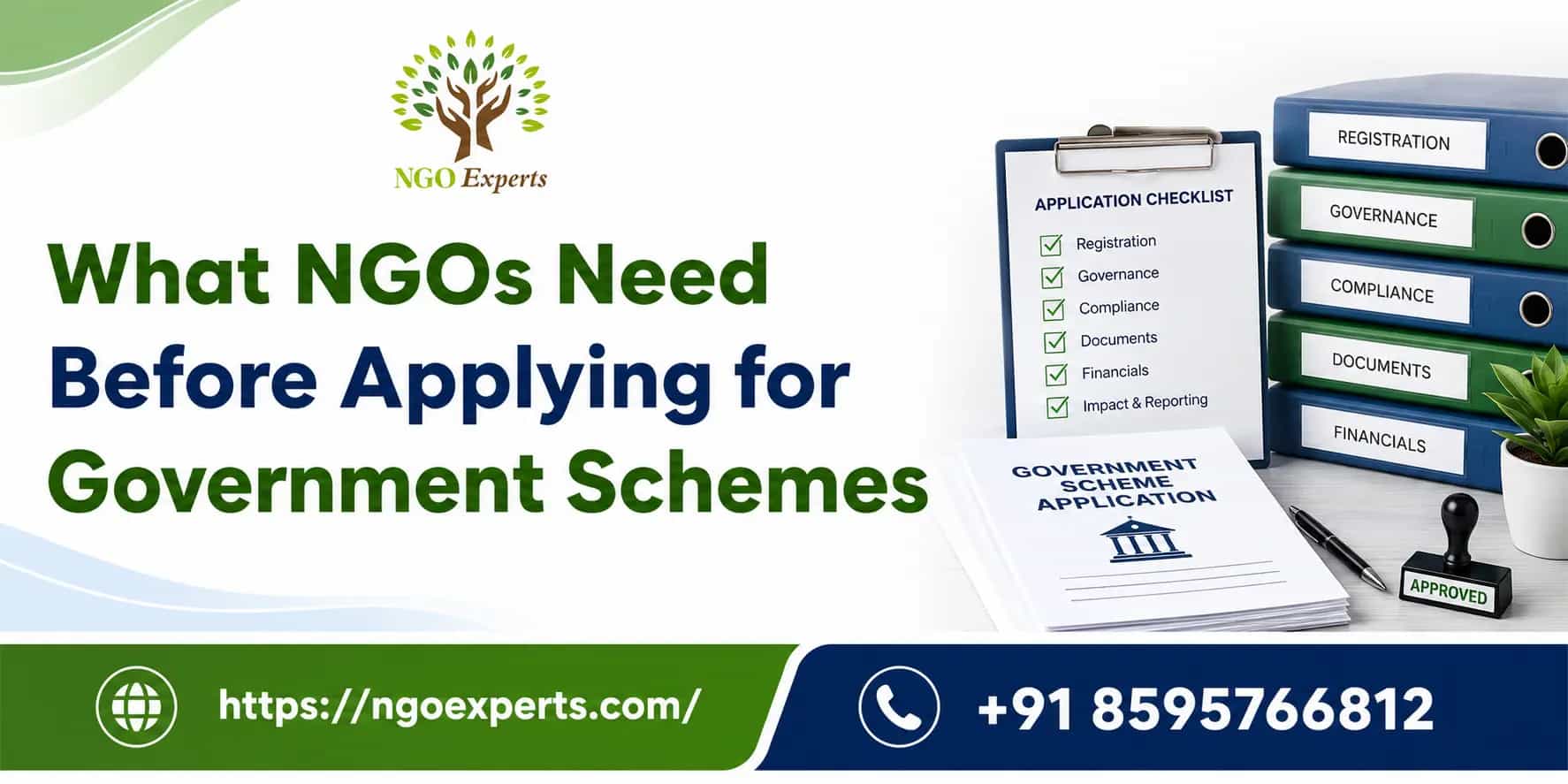
Government schemes require comprehensive documentation demonstrating your NGO's credibility, track record, and ability to execute proposed projects. Maintaining organized, updated documentation is crucial for quick application turnaround and successful evaluation.
Organizational Profile Documentation Checklist
| ☐ | Detailed organizational profile including history, mission, vision, values, and organizational culture (2-3 pages) |
| ☐ | Comprehensive information about founders, board members, and key management personnel with qualifications and experience |
| ☐ | Organizational chart showing governance structure, reporting relationships, and functional departments |
| ☐ | Geographic coverage and operational areas with maps and community demographics |
| ☐ | Target beneficiary groups with detailed demographic profiles and needs assessment data |
| ☐ | List of current and completed projects with timelines, budgets, beneficiaries reached, and outcomes achieved |
| ☐ | Annual reports for the last 3-5 years documenting activities, achievements, and financial performance |
| ☐ | Case studies and success stories demonstrating the impact and effectiveness of interventions |
| ☐ | Photographs, videos, and multimedia documentation of project activities and beneficiary testimonials |
| ☐ | Media coverage, awards, recognition, and certifications received by the organization |
| ☐ | Partnership agreements with other NGOs, community organizations, government departments, and stakeholders |
6. Track Record and Experience: Proving Your Impact
Government agencies prioritize NGOs with demonstrated experience and proven impact in their proposed intervention areas. Building and documenting a strong track record is essential for competitive applications, especially for larger grant opportunities.
Track Record Documentation Checklist
| ☐ | Problem statement clearly defined with data, statistics, and evidence of need in the target geography |
| ☐ | Needs assessment report or situational analysis documenting community consultation and gap identification |
| ☐ | Project objectives articulated using the SMART framework (Specific, Measurable, Achievable, Relevant, Time-bound) |
| ☐ | Project activities are described in detail with timelines, responsible personnel, and resource requirements |
| ☐ | Innovation or value addition highlighted how the project differs from existing interventions |
| ☐ | Partnership strategy explaining collaboration with government, other NGOs, and community institutions |
A Complete Action Plan: Your NGOs Need Before Applying for Government Schemes
Proper time management is crucial for preparing a high-quality application. Most NGOs underestimate the time required for documentation, consultation, and proposal development. Here's a recommended timeline for comprehensive preparation.
| Timeframe | Key Activities |
| 6-12 Months Before | Ensure legal registrations are current and valid; Obtain or renew 12A and 80G certificates; Complete FCRA registration if planning international partnerships; Establish robust accounting systems and audit processes. Register on NGO Darpan and other relevant portals; |
| 4-6 Months Before | Build project documentation and case studies; Conduct needs assessments in target areas; Develop organizational profile and capability statement |
| 3-4 Months Before | Identify suitable government schemes aligned with organizational expertise; Download and study scheme guidelines thoroughly; Assess organizational readiness against eligibility criteria; Begin preliminary project design and budget estimation. |
| 2-3 Months Before | Develop a detailed project proposal with community consultation; prepare a comprehensive budget with justifications; design a monitoring and evaluation framework; and collect and organize all required documents |
| 1-2 Months Before | Complete proposal writing and internal review; Obtain quotations for major expenses; Finalize budget and activity timeline; Secure board resolution approving the application |
| 2-4 Weeks Before | Conduct thorough document verification and quality check; Digitize all documents in required formats; Complete online portal registration if not done earlier; Prepare for potential site visits by organizing documentation |
| 1 Week Before | Final proofreading and consistency checks; Upload documents and fill online application forms; Obtain digital signatures on required documents; Create backup copies of all submitted materials |
| Submission Deadline | Submit application before deadline with buffer time; Save acknowledgment receipt and application reference number; Note submission date and expected decision timeline; Begin tracking application status on portal |
Conclusion
Accessing government schemes requires systematic preparation, meticulous documentation, and sustained organizational capacity building. While the process may seem daunting initially, breaking it down into manageable steps and using these comprehensive checklists will significantly improve your readiness and success rate.
At NGOexperts , we step in to handle every piece of documentation and compliance, ensuring you get the best funding with the greatest benefits, accurately and fast.
Remember, every well-prepared application, whether successful or not, is a learning opportunity that brings you closer to your funding goals and organizational development objectives.
Frequently Asked Questions
Can we apply for a scheme if we only have 1 year of experience?
Usually, no. However, look for "Skill India" or "Startup India" micro-grants that sometimes support younger organizations. For the big stuff, you need 3 years.
Is a separate bank account really necessary?
Yes, it is recommended, as most government grants must be kept in a "Project-Specific" account.
What if our board members don't have PAN/Aadhaar?
Then they cannot be on the board of a 2026-compliant NGO. The government requires full KYC of all office bearers to prevent money laundering.
How long does the approval process take?
Expect anywhere from 3 to 9 months. This is why you should apply for schemes before your funds run out, not when you are in a crisis.
Do we need an FCRA for Indian government schemes?
No, FCRA is only for Foreign funding. For Indian government schemes, your 12A/80G and Darpan ID are the main requirements.
Author
Srijita Chatterjee
I am a Content Specialist holding a Master’s degree and with over 5 years of experience in the creative arena. I specialize in breaking down complex concepts into clear, understandable insights that help my viewers deeply engage and retain. Known for my approachable and engaging style, I am committed to providing accurate, trustworthy information that empowers individuals and organizations to make informed decisions and achieve their goals.
Written by Srijita Chatterjee. Last updated on October 8, 2026