

Quick Summary
Corporate Social Responsibility has evolved from an optional nice gesture by companies to help society into a powerful force for social change in India. Since the Companies Act of 2013 made CSR mandatory, billions of rupees have flowed into projects that are reshaping communities across the nation. If you're an NGO, social enterprise, or simply curious about how Indian companies are giving back, this guide will walk you through everything you need to know about CSR project partners in India.
What Makes India's CSR Landscape Unique?
India stands out globally as the first nation to make CSR a legal requirement. Under Section 135 of the Companies Act, 2013, companies meeting specific financial criteria must spend at least 2% of their average net profits from the past three years on CSR activities.
This has created a huge impact. For FY 2023-24, total CSR spending reached about ₹34,909 crore, funding key areas like education, health, rural infrastructure, women's empowerment, and eco-friendly initiatives. This direct investment helps NGOs and communities drive sustainable change.
Understanding CSR Funding Companies in India
Who Qualifies as a CSR Funding Company?
Not every company in India is required to undertake CSR activities. The mandate applies to companies that meet any of these criteria in the preceding financial year:
- Net worth of ₹500 crore or more
- Turnover of ₹1,000 crore or more
- Net profit of ₹5 crore or more
As of 2025, over 32,000 companies in India have collectively invested more than ₹1.5 lakh crore in CSR projects since the law came into effect.
How CSR Funding Works
CSR funding companies in India channel their resources through various mechanisms:
- Direct implementation through their own CSR teams
- Partnership with NGOs and implementing agencies
- Contributions to government funds like PM CARES or the Clean Ganga Fund
- Collaboration with specialised CSR foundations
The beauty of this system is that it creates opportunities for organisations of all sizes to access funding and make a real impact.
Top 10 CSR Companies in India
Based on the latest data on CSR spending and impact, here are the leading companies driving social change in India:
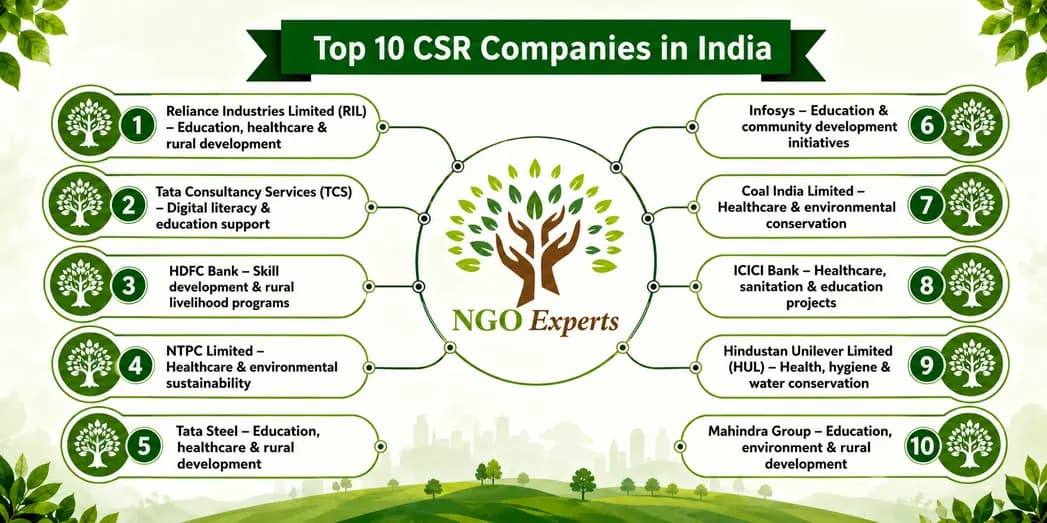
1. Reliance Industries Limited (RIL)
CSR Spend: ₹922 crores (FY 2020-21). Focus Areas: Education (49%), healthcare, rural development, sports promotion, and COVID relief
2. Tata Consultancy Services (TCS)
CSR Spend: ₹756 crores (FY 2022-23). Focus Areas: Digital literacy, education, healthcare, livelihood, equipping schools with technology infrastructure, and training teachers.
3. HDFC Bank
CSR Spend: ₹444 crores (FY 2022-23). Focus Areas: Education, skill development, rural livelihood enhancement, including school infrastructure, teacher training, and scholarships for underprivileged students.
4. NTPC Limited
CSR Spend: ₹418.87 crores. Focus Areas: Healthcare (66% of budget), rural development, environmental sustainability, education
5. Tata Steel
Focus Areas: Education, healthcare, environmental sustainability, and rural development. Legacy: The first company in India to incorporate social responsibility in its Articles of Association (1979).
6. Infosys
Focus Areas: Education, rural development, and healthcare through Infosys Foundation Impact: Reaching millions through educational programs and community development initiatives.
7. Coal India Limited
CSR Spend: Among India's largest coal producers. Focus Areas: Healthcare, education, rural development, and environmental conservation.
8. ICICI Bank
CSR Contribution: 200+ projects. Focus Areas: Healthcare (including 50 Mobile Medical Units), education, and sanitation.
9. Hindustan Unilever Limited (HUL)
Focus Areas: Sustainable living, health and hygiene, water conservation. Impact: Community-based programs addressing sanitation and health challenges.
10. Mahindra Group
Focus Areas: Education, healthcare, environment, and rural development. Impact: Integrated approach to community development across India.
CSR Activities of Indian Companies
Understanding where CSR funds are allocated helps organizations align their proposals with corporate priorities. Here's the sector-wise breakdown based on recent data:
Education: The Leading Sector
Allocation: Over ₹13,000 crores (40%+ of total CSR funding in FY 2022-23)
Indian companies recognize education as transformative. CSR activities include:
- Building and renovating school infrastructure
- Providing scholarships to underprivileged students
- Digital literacy programs
- Teacher training initiatives
- Setting up science labs and libraries
Real Example: Coca-Cola India's "Support My School" campaign provides sanitation facilities and basic amenities to rural educational institutions lacking fundamental resources.
Example: Tata Sponge Iron's mass afforestation program transformed barren land through tree plantation with community participation.
Other Growing Areas
- Sports Development: ₹526 crores for building infrastructure and talent development
- Heritage & Culture: ₹441 crores for restoration and preservation
- Sanitation & Clean Water: Critical investments in Swachh Bharat initiatives
How to Online Apply for CSR Funding
Securing CSR funding isn't as complicated as it might seem. Here's your practical roadmap to apply online for CSR funding in 2026:
Step 1: Before you start the application process, ensure you have:
- Registration as a Trust, Society, or Section 8 Company
- PAN and TAN numbers
- GST registration (if applicable)
- CSR-1 Registration (mandatory since April 2021)
- 12A Registration: Income tax exemption
- 80G Certificate: Allows donors to claim tax deductions
- FCRA Registration: If receiving foreign funds
- NGO Darpan Registration: Government's official NGO portal
- Proof of at least 3 years of experience in social development
- Impact stories and case studies
- Previous project reports
- Testimonials and references
Step 2: Register on the National CSR eXchange Portal
The government's National CSR eXchange Portal (https://csrxchange.gov.in/) is your primary gateway to CSR opportunities.
Step 3: Complete CSR-1 Form Registration
Since July 2025, the Ministry of Corporate Affairs introduced a new web-based CSR-1 registration process.
Step 4: Research and Identify Potential Corporate Partners
- Review the company's CSR policies (available on their websites)
- Study their focus sectors
- Understand their geographic preferences
- Note their funding ranges
- Get CSR Grant portal (https://getcsrgrant.in/)
Step 5: Craft a Winning Proposal
Clearly define the social issue you're addressing with measurable goals aligned with CSR priorities
Step 6: Submit Your Application
Submit through the national platform like GetCSRGrant.in consolidate opportunities
Step 7: Build Relationships, Not Just Applications
- Attend CSR conferences and workshops
- Engage on LinkedIn with CSR professionals
- Participate in NGO-corporate meets
- Join CSR forums and communities
- Schedule meetings with CSR heads (be prepared with a crisp pitch)
Common Challenges and How to Overcome Them
Challenge 1: Lack of Track Record
Solution: Partner with established NGOs for your first projects, or start small with community-level initiatives to build credibility.
Challenge 2: Documentation Gaps
Solution: Hire an NGO consultant (platforms like NGOExperts.com) to help with registrations and compliance.
Challenge 3: Proposal Rejections
Solution: Seek feedback, refine your approach, and remember that persistence pays off. Even established NGOs face rejection.
Challenge 4: Competition
Solution: Differentiate through innovation, measurable impact, and strong storytelling. Show what makes your approach unique.
Your CSR Success Checklist:
- Organisation registered as a Trust/Society/Section 8 Company
- CSR-1 registration complete
- 12A and 80G certifications obtained
- NGO Darpan registration done
- Minimum 3 years of operational track record
- Audited financial statements for the past 3 years
- Professional website with impact stories
- Active social media presence
- Clear project proposal with measurable outcomes
- Realistic budget with detailed breakdown
- Impact measurement framework in place
Conclusion
CSR funding companies in India aren't just looking for projects to fund, but they're seeking partners who can help them fulfil their social responsibility mandate effectively. Position yourself as that trustworthy, capable partner, and you'll find doors opening.
However, the entire CSR funding process demands expertise and experience. This is where professional guidance makes all the difference. With deep knowledge of how top CSR companies in India operate, what they look for in partners, and how to craft winning proposals, NGOExperts has helped hundreds of organisations successfully secure CSR funding and build lasting corporate partnerships.
Partner with NGOExperts to transform your social vision into a funded reality.
Frequently Asked Questions
Can new NGOs without 3 years of experience get CSR funding?
While the 3-year track record is preferred, new NGOs can collaborate with experienced organizations or target smaller grants to build credibility.
How long does the CSR funding approval process take?
Timelines vary from 1-6 months depending on the company, project complexity, and due diligence requirements.
Can administrative costs be covered under CSR funding?
Yes, but only up to 5% of the total grant can be used for administrative or overhead costs.
What happens to unspent CSR funds?
Under 2025 rules, unspent CSR funds must be returned or transferred to a government-specified CSR fund within the financial year.
Do we need to visit the company offices to submit proposals?
Most companies accept online applications through their portals or email. Physical visits are typically not required for initial submissions.
Author
Srijita Chatterjee
I am a Content Specialist holding a Master’s degree and with over 5 years of experience in the creative arena. I specialize in breaking down complex concepts into clear, understandable insights that help my viewers deeply engage and retain. Known for my approachable and engaging style, I am committed to providing accurate, trustworthy information that empowers individuals and organizations to make informed decisions and achieve their goals.
Written by Srijita Chatterjee. Last updated on May 25, 2026