
Quick Summary
A Section 8 Company is a specific legal structure for a non‑profit. At the same time, the term NGO broadly covers any non‑profit organisation, whether it is registered as a trust, society, or Section 8 Company. An NGO in the form of a trust or society is usually simpler and more affordable to set up, with lighter compliance requirements, making it ideal for small, local, or community‑based initiatives. On the other hand, a Section 8 Company offers a more formal, transparent, and professionally recognised structure, which often appeals to donors, corporates, and government agencies seeking nationwide credibility.
The difference between an NGO and a Section 8 Company
Understanding the difference between NGO and Section 8 Company ensures that your organization is built for both compliance and scale.
Many founders start with a simple trust, only to realize later that corporate donors prefer a more rigorous structure. This guide breaks down the core differences in governance, compliance, and fundraising potential to help you choose the right path for your mission.
What is an NGO?
An NGO (Non‑Governmental Organisation) is a non‑profit, voluntary organisation that works for social welfare, education, healthcare, environment or any other charitable cause.In India, NGOs are usually registered under one of three legal structures:
- Trust (under the Indian Trusts Act, 1882)
- Society (under the Societies Registration Act, 1860)
- Section 8 Company (under the Companies Act, 2013)
Essentially, every Section 8 Company is an NGO, but not every NGO is a Section 8 Company.
What is a Section 8 Company?
A Section 8 Company is a non‑profit company registered under Section 8 of the Companies Act, 2013, to promote:
- Charitable activities
- Social welfare
- Education
- Science, religion, commerce, or any other useful object for public benefit
Key features of a Section 8 Company:
- No minimum paid‑up capital requirement
- Profits are reinvested into the mission, not distributed as dividends
- Limited liability for members
- Separate legal identity from its members
Because it is a company governed by the Companies Act, it has a more formal corporate‑style structure than a typical trust or society‑NGO.
Key Differences Between NGO and Section 8 Companies
While both structures enjoy tax exemptions under Section 12A and 80G, the operational "Difference between NGO and Section 8 Company" lies in how they are managed and perceived by investors
Governance and Management
NGO (Trust or Society)
- Managed by Trustees (for a trust) or a Managing Committee (for a society).
- Governance is more informal and flexible, with fewer mandatory meetings and less formal documentation.
- Decisions are usually taken by consensus or by a small governing body.
Section 8 Company
- Managed by a Board of Directors, which must follow corporate‑governance rules (board meetings, resolutions, registers, etc.).
- Registered centrally with the Ministry of Corporate Affairs (MCA). It requires a license from the Central Government, a Memorandum of Association (MoA), and Articles of Association (AoA).
If your NGO expects high‑value CSR funds, institutional grants, or corporate collaborations, a Section 8 Company is often preferred for its formal structure and nationwide credibility.
Registration and Legal Formalities
NGO (Trust/Society)
- Trusts: Registered with the local registrar under the Indian Trusts Act or relevant state act..
- Societies: Registered with the Registrar of Societies at the state level..
Both are relatively easier and cheaper to set up compared to a Section 8 Company.
Section 8 Company
- Registered with the Registrar of Companies (RoC) under the Companies Act, 2013.
- Name approval (with exemption for Limited)
- Memorandum and Articles of Association (MoA & AoA) with clear non‑profit objectives
- Two or more directors (for private) and at least seven members (for public)
- Application for a Section 8 license from the Ministry of Corporate Affairs
Because of additional paperwork and higher compliance requirements, Section 8 registration is more complex and slightly more costly than a simple trust or society‑NGO.
Compliance and Transparency
The most significant difference between NGO and Section 8 Company is the level of scrutiny.
Trust/Society: Lower compliance burden. Annual filings are less rigorous, which saves on administrative costs.
Section 8 Company: High compliance. You must file annual returns (AOC-4, MGT-7) with the Registrar of Companies (RoC). While this is more work, it builds immense trust with international donors.
Tax Benefits and Fundraising
Both NGOs (trust/society) and Section 8 Companies can:
- Apply for 12A/12AA registration to get an income‑tax exemption on charitable income.
- Apply for 80G registration so donors can claim tax deductions for their contributions.
However, many CSR bodies, corporates, and government schemes prefer Section 8 Companies because:
- They are MCA‑registered entities with public records
- Have clear directorship and financial disclosures
- They appear more professional and credible compared to a local trust or society
Analysis between NGO and Section 8 Companies
| Feature | NGO (Trust/Society) | Section 8 Company |
| Legal Statute | State Acts / Indian Trusts Act | Companies Act, 2013 |
| Liability | Unlimited/Personal (usually) | Limited to the company |
| Governance | Trustees/Committee Members | Board of Directors |
| Reporting | To State Registrar | To Central Government (MCA) |
| CSR Eligibility | Eligible (Variable trust levels) | Highly Preferred by Corporates |
| Scalability | Best for local/regional | Best for National/Global |
Section 8 Company vs NGO: The Entrepreneur’s Perspective
When to Choose an NGO (Trust/Society)?
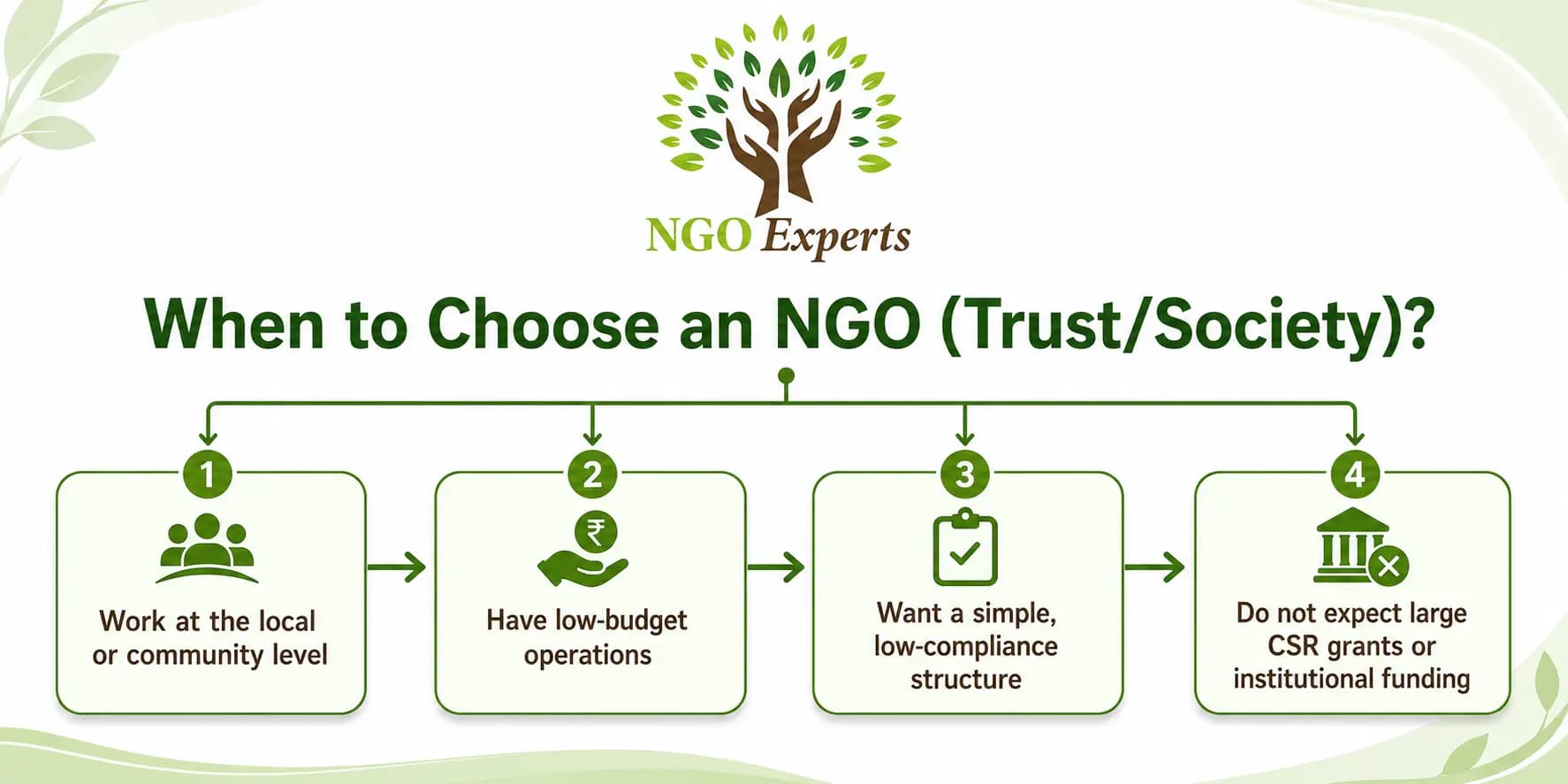
Choose a trust or society‑NGO if you:
- Work at the local or community level
- Have low‑budget operations
- Want a simple, low‑compliance structure
- Do not expect large CSR grants or institutional funding
This form is ideal for small educational trusts, women‑empowerment groups, religious or local relief societies, and family‑led charitable initiatives.
When to Choose a Section 8 Company?
Choose a Section 8 Company if you:
- Aim for pan‑India recognition and branding
- Plan to raise large donations, CSR funds, or institutional grants
- Want limited liability protection for members
- Prefer high transparency and corporate‑style governance
Section 8 Companies work well for national‑level NGOs, education foundations, research bodies, and social‑impact startups looking to scale
Conclusion
The difference between NGO and Section 8 Company ultimately comes down to your vision. If you want a simple, grassroots setup, a Trust or Society works best. Still, if you’re building a scalable, professional, nationwide non‑profit that wants CSR funds, partnerships, and strong legal credibility, a Section 8 Company is often the better long‑term choice.
Frequently Asked Questions
What is the difference between an NGO and a Section 8 company?
An NGO is an umbrella term for any nonprofit organisation, such as a trust or society, that has basic legal status. A Section 8 company is a specific form of NGO registered under the Companies Act; it offers higher compliance, credibility, and eligibility for CSR/foreign funding.
What is Section 8 NGO?
It refers to a non-profit entity registered under Section 8 of the Companies Act, 2013, focused on social welfare, education, or charity, with stricter governance and legal benefits.
Which type of organisation is preferred by corporate donors?
CSR programs and institutional funders usually prefer Section 8 companies due to their regulatory transparency and central government approval.
What are the compliance differences between an NGO and a Section 8 company?
Section 8 companies are required to undergo regular annual audits and ROC filings, while trusts and societies also require annual audits.
Can a Section 8 company receive foreign funding?
Yes, Section 8 companies are highly rated for FCRA approval and foreign donations because of their rigorous compliance and governance systems.
Author
Sakshi Kashyap
I am a dedicated and detail-oriented Website Content Writer with over two years of experience in creating compelling, reader-friendly, and SEO-optimized content. My expertise lies in developing well-structured web pages, landing pages, blogs, and service descriptions that enhance user engagement and drive organic traffic.
Written by Sakshi Kashyap. Last updated on September 30, 2026