

To register a Section 8 Company, you need at least two directors, Digital Signature Certificates, name approval, drafted MOA/AOA, and an online SPICe+ filing with the MCA. The process to register a Section 8 Company typically costs ₹8,000–₹15,599 and takes 10–20 working days. Once you register a Section 8 Company, you must follow up with 12A and 80G, and CSR-1 applications to unlock tax benefits and CSR funding.
Section 8 Company Registration is one of the most trusted legal structures for starting a non-profit organization in India. It is suitable for founders who want to work in areas such as education, charity, social welfare, healthcare, the environment, research, sports, religion, skill development, or community development. At NGOExperts, we help founders, trustees, directors, and social entrepreneurs register Section 8 Companies simply and properly. Our team supports you with structure selection, name planning, object drafting, documents, MCA filing, and post-registration guidance.
New to NGO registration?
Download our free NGO Structure Comparison Guide (Trust vs Society vs Section 8 Company) to see which one fits your mission before you commit
What Is a Section 8 Company?
A Section 8 Company is a non-profit entity registered under the Companies Act, 2013, meant for charitable, educational, religious, or social welfare purposes. When you register a Section 8 Company, it can legally earn income and accept donations. Still, that money must be reinvested into its stated objectives rather than distributed as profit to members.
As a Section 8 Company is registered with the Ministry of Corporate Affairs (MCA), it comes with a Memorandum of Association (MOA), Articles of Association (AOA), a formal board of directors, and annual ROC filings. This structure is one reason CSR teams and institutional donors trust this entity more than an informally registered trust or society.
Real-Life Example
The Akshaya Patra Foundation is a well-known example of an entity that chose to register a Section 8 Company. Founded in 2000 and headquartered in Bengaluru, it runs one of the world's largest school mid-day meal programs, feeding over two million children daily in partnership with government schools. It operates under strict MCA compliance while benefiting from tax exemptions such as 12A and 80G, showing how the structure works in practice for a large-scale, donor-funded NGO.
Why Register a Section 8 Company?
People choose to register a Section 8 Company for the credibility and tax advantages it offers:
- Eligibility for tax exemptions under 12AB and 80G
- No stamp duty on incorporation documents in several states
- Limited liability protection for directors
- No minimum capital requirement
- Higher trust with corporate donors, banks, and government bodies
- Perpetual succession, so the entity continues even as members change
How to Register a Section 8 Company: Step-by-Step Process
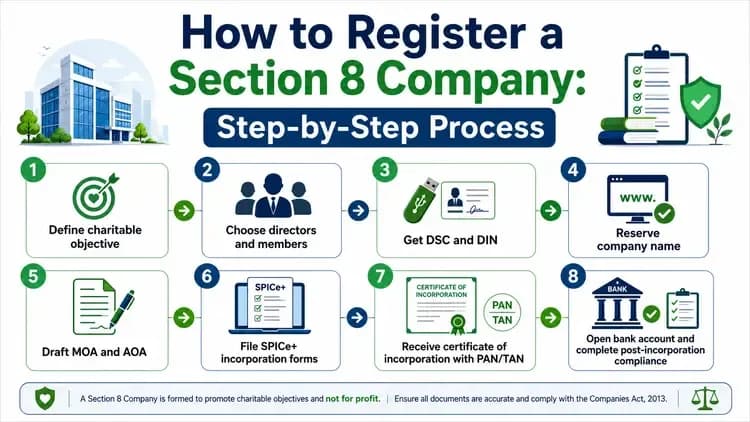
Once your documents are ready, the process of registering a Section 8 Company with the MCA follows a fixed sequence. Here is how it works, step by step:
- Obtain Digital Signature Certificates (DSCs): Every proposed director needs a DSC to sign forms electronically, since all filings to register a Section 8 Company are online.
- Apply for a Director Identification Number (DIN): DINs for directors are applied for directly in the SPICe+ form as part of the incorporation filing.
- Reserve the company name: Use the SPICe+ Part A service on the MCA portal to propose and reserve a name that reflects the company's charitable objects.
- Draft the MOA and AOA: Prepare the Memorandum of Association and Articles of Association clearly stating the non-profit objectives, since this is central to how you register a Section 8 Company.
- Apply for a Section 8 license: File Form INC-12 with supporting documents so the Registrar of Companies can issue the license confirming the entity's non-profit status.
- File SPICe+ Part B: Submit the integrated incorporation form covering company details, registered office proof, director details, PAN, and TAN application in one filing.
- Upload supporting documents: Attach identity proofs, address proofs, the NOC, MOA, AOA, and declarations as required by the MCA portal.
- Pay the government fee and stamp duty: Complete the applicable RoC fee and state-specific stamp duty as part of the submission.
- Receive the Certificate of Incorporation: Once the RoC verifies the filing, it issues the Certificate of Incorporation along with PAN and TAN, thereby officially completing the process of registering a Section 8 Company.
Completing these steps in order is what finally lets you register a Section 8 Company and legally operate as a non-profit entity in India.
Who Is Eligible to Register a Section 8 Company?
Before you start Section 8 company registration, your organization needs to meet these basic MCA conditions:
- Members: At least 2 for a private company, or 3 for a public one, up to a cap of 200.
- Directors: At least 2 (private) or 3 (public), each with a valid Director Identification Number (DIN).
- Residency: At least one director must be a resident of India; foreign nationals can also be appointed with proper compliance.
- Purpose: Genuine charitable or public-benefit objects, with income reinvested rather than distributed.
- License: A Section 8 license from the Registrar of Companies confirming non-profit purpose.
What Documents Do You Need to Register a Section 8 Company?
Gathering the right paperwork early makes it much easier to register a Section 8 Company without delays:
- PAN, Aadhaar, and photographs of all directors and members
- Address proof and a Digital Signature Certificate (DSC) for each director
- Signed consent to act as director, along with MCA declarations
- Utility bill and rent agreement for the registered office, if the premises are rented
- No Objection Certificate (NOC) from the property owner
- Proposed company name along with its main objects and activities
A common hold-up when people try to register a Section 8 Company is a mismatch between the name on Aadhaar and PAN — check this before filing to avoid resubmission.
Not sure you qualify?
Talk to an NGO registration advisor for a free 15-minute eligibility check before you gather documents.
Latest 2026 update: Section 8 Company registration is done through SPICe+
If you registered a company before this year, the Section 8 company registration process has changed in a few important ways:
- The Section 8 license is now issued together with the Certificate of Incorporation through SPICe+ Part B, with no separate INC-12 filing for a fresh company.
- MCA waives the core incorporation government fee for authorized capital up to ₹15 lakh.
- Name reservation (SPICe+ Part A) is checked against Rule 8 naming guidelines and is valid for 20 days before Part B must be filed.
- DIN allotment for up to three directors is bundled free into SPICe+ Part B.
Section 8 Company Registration: Cost & Timeline
(Figures in ₹ INR, India, indicative as of August 2026; verify current rates on the MCA portal before filing.)
| Particulars | Cost | Timeline | What Is Included |
| Consultation & Structure Planning | Included | 1 day | Discussion on NGO objective, city, founders, activities, and future 12A/80G/CSR-1 planning |
| DSC for 2 Directors | ₹3,000 | 1–2 working days | Digital Signature Certificate for online MCA filing |
| Name Application & MCA Name Check | ₹1,000 | 1–3 working days | Name search, name planning, and MCA name application support |
| Professional Fee | ₹2,999 | 2–4 working days | Drafting of charitable objects, MOA, and AOA for the Section 8 Company |
| Government Fee & Stamp Duty | ₹1,000–₹2,000 | As per MCA/State | MCA fee, stamp duty, and state-based charges, as applicable |
| PAN & TAN | Included | Along with incorporation | PAN and TAN through the MCA-linked incorporation process |
| Certificate of Incorporation Support | Included | Subject to RoC approval | Follow-up and approval coordination |
| Post-Registration Guidance | Included | After incorporation | Bank account, 12A, 80G, NGO Darpan, and CSR-1 guidance |
Final Section 8 Registration Package
| Service | Professional Fee/DSC | Government Fee / Stamp Duty | GST | Estimated Total Cost | Typical Timeline |
| Section 8 Company Registration | ₹4,000–₹8,000 | ₹2,000–₹5,000 as actual | 18% on the professional fee | ₹8,000–₹15,599 approx. | 10–20 working days |
What this package includes:
- Section 8 Company structure consultation
- Name planning and MCA name application support
- DSC support for 2 directors
- MOA and AOA drafting
- Charitable object drafting
- MCA/RoC filing support
- SPICe+ incorporation support
- Director and member document review
- PAN and TAN support through incorporation
- Certificate of Incorporation coordination
- Basic post-registration guidance for bank account, 12A, 80G, NGO Darpan, and CSR-1
Costs include 18% GST on the professional fee; government charges and stamp duty vary by state and are subject to periodic changes.
What Compliance Comes After You Register a Section 8 Company?
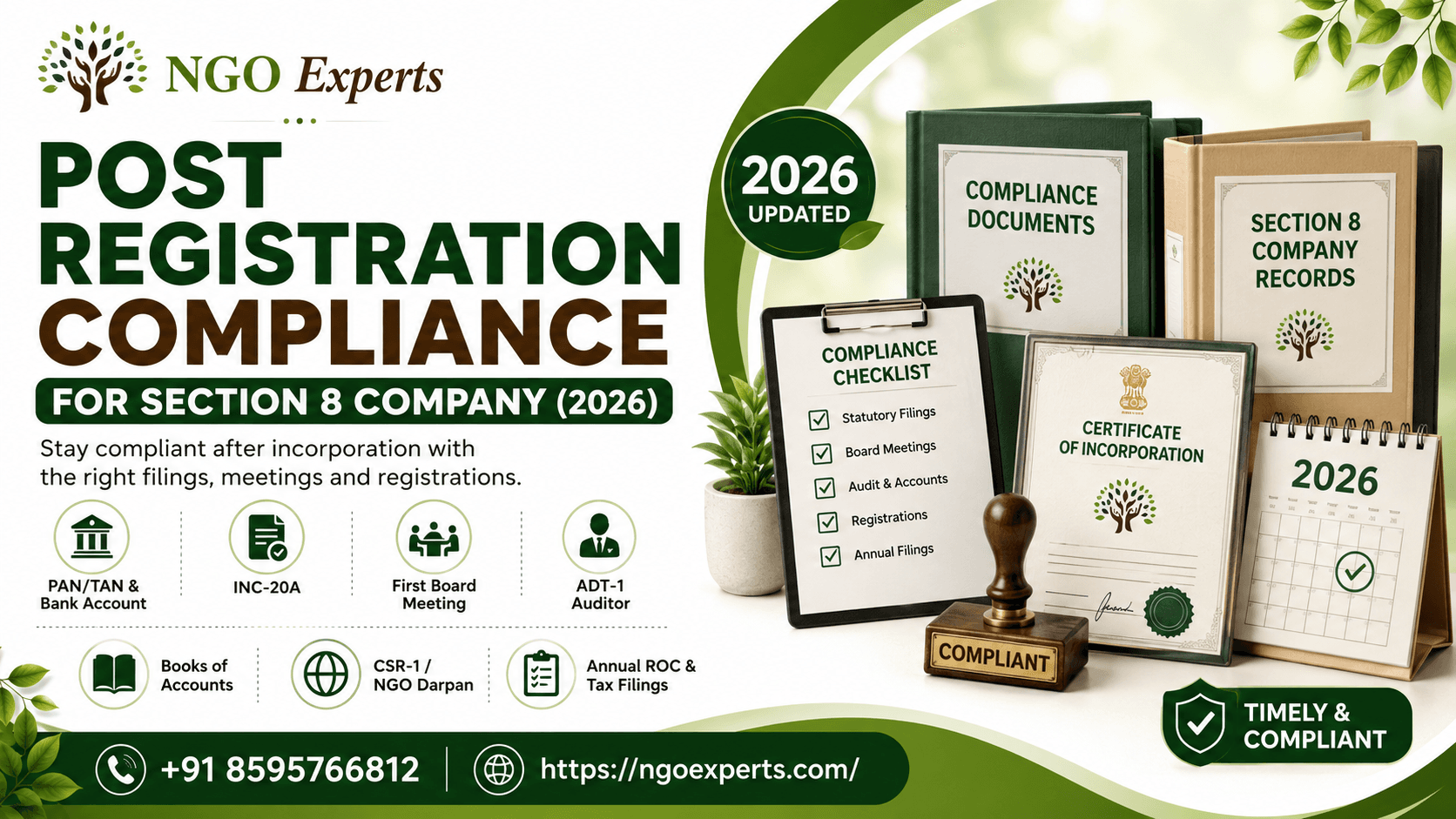
Incorporation is only the first milestone. After you register a Section 8 Company, ongoing compliance keeps it legally sound and fundable:
- Open a dedicated bank account for donations and grants
- Set up proper accounting and bookkeeping from day one
- Apply for 12A (tax exemption) and 80G (donor tax deduction)
- Register on NGO Darpan for government scheme recognition
- Complete CSR-1 registration to become eligible for CSR funds
- File annual ROC returns and income tax returns
- Get yearly audits done to maintain donor transparency
Frequently Asked Questions
How long does it take to register a Section 8 Company?
It typically takes 10–20 working days to register a Section 8 Company, depending on the readiness of the documents and the RoC processing time.
What is the minimum number of people needed to register a Section 8 Company?
You need at least 2 directors and 2 members for a private company, or 3 directors and 7 members for a public company.
Can a Section 8 Company earn income after registration?
Yes. A Section 8 Company can earn income and accept donations, but the funds must be reinvested into its charitable objects and never distributed as dividends
What documents are mandatory to register a Section 8 Company?
You need PAN, Aadhaar, photographs, address proof, and DSCs for directors, plus a rent agreement or proof of ownership, and an NOC for the registered office.
What form is used to get the Section 8 license?
Form INC-12 is filed with the Registrar of Companies to obtain the license confirming the entity's charitable, non-profit status.
Do I need 12A and 80G separately after I register a Section 8 Company?
Yes. 12A and 80G are separate approvals under the Income Tax Act and must be applied for after incorporation to obtain tax-exemption and donor-deduction benefits.
Can a Section 8 Company receive CSR funding?
Yes, once it completes CSR-1 registration on the MCA portal and meets the eligibility conditions for corporate donors.
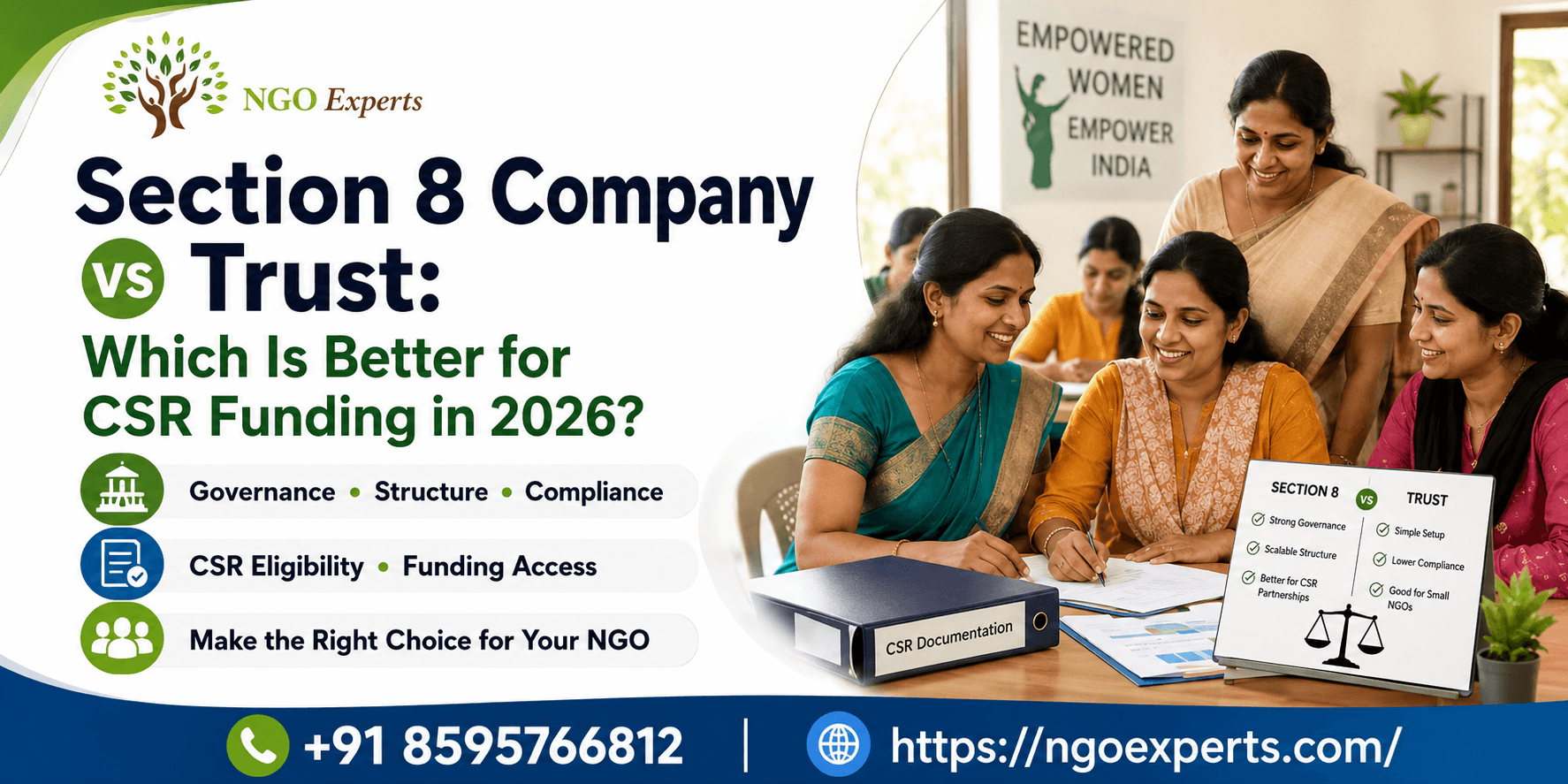
Is it better to register a Section 8 Company or set up a Trust?
It depends on your goals, a Section 8 Company suits CSR-facing, institutionally funded NGOs, while a Trust suits simpler, smaller-scale charitable work.
Author
Aabha Garg
A Content Strategist at NGOExperts, who focuses on NGO registration, 12A and 80G registration, FCRA compliance, income tax filing for non-profits, and CSR funding guidelines in India. I research and write our compliance guides in collaboration with our in-house Chartered Accountants and Company Secretaries, so every article reflects current tax and regulatory requirements for the NGO and non-profit sector.
Written by Aabha Garg. Last updated on September 18, 2026