

Quick Summary
In India, Corporate Social Responsibility (CSR) funding is a powerful way for NGOs to partner with companies that are legally required under Section 135 of the Companies Act, 2013. It contributes a portion of its profits to social development projects. To qualify, an NGO must be registered as a Trust, Society, or Section 8 Company and possess key approvals like CSR-1, 12A, and 80G.
Eligible sectors include education, healthcare, environment, skill development, sanitation, rural development, and more (Schedule VII).
To receive CSR funds, NGOs must:
Be a Trust, Society, or Sec-8 Company Have valid CSR-1, 12A, and 80G registrations Show at least 3 years of a credible track record
Overview
As per Section 135 of the Companies Act, 2013, India became the first country in the world to make CSR spending compulsory for companies that meet certain financial thresholds (net worth of ₹500 crore or more, turnover of ₹1,000 crore or more, or net profit of ₹5 crore or more). Such companies must allocate at least 2% of their average net profits from the past three years to approved developmental areas under Schedule VII.
These include education, healthcare, skill development, environmental sustainability, sanitation, women's empowerment, rural development, and other community welfare activities. For NGOs, this creates a significant opportunity to partner with companies in delivering professional, transparent, and impactful projects that benefit society at large.
This blog will help you understand the CSR landscape in India, the eligibility criteria, and how NGOs can effectively position themselves to secure funding and create lasting impact.
Why is CSR Funding Important?
CSR funding plays a vital role in creating real social change while giving companies a chance to contribute meaningfully beyond profits. In India, filing Form CSR-1 with the Ministry of Corporate Affairs (MCA) is mandatory for NGOs to be listed on the National CSR Portal and become eligible for corporate partnerships. These funds are transforming sectors like healthcare, education, climate action, women's empowerment, rural infrastructure, and skill development, directly improving lives across the country.
However, only NGOs that are legally compliant, transparent, and aligned with Schedule VII of the Companies Act can access these opportunities. Being proposal-ready and demonstrating impact are key to winning trust and funding from corporates. This blog will guide you step by step on how to apply for CSR funds in India, so your organization can unlock these resources and maximize its social impact.
Registration of an NGO on the MCA Portal for CSR Funding
To receive Corporate Social Responsibility (CSR) funding in India, NGOs must be registered on the Ministry of Corporate Affairs (MCA) portal. This requirement was introduced under Rule 4(2) of the Companies (CSR Policy) Amendment Rules, 2021, making registration a mandatory step for all organizations seeking CSR support.
The process is straightforward:
- An NGO must file Form CSR-1 electronically with the Registrar of Companies through the MCA portal.
- The form must be digitally certified by a practicing Chartered Accountant (CA), Company Secretary (CS), or Cost Accountant.
- Once the form is successfully submitted and verified, the system automatically generates a unique CSR Registration Number for the NGO.
CSR-1 registration helps ensure transparency, accountability, and better monitoring of CSR activities. Without a valid CSR-1 registration, NGOs are not eligible to receive CSR contributions from companies. Therefore, completing this step is essential for any Trust, Society, or Section 8 Company that wishes to access corporate CSR funds in India.
Documents Required for CSR-1 Registration
For an NGO to successfully register on the MCA portal and become eligible for CSR funding, certain documents and details must be prepared in advance. These requirements enable the government to verify the legal status and credibility of the organization before issuing the CSR Registration Number.
The list of documents required for CSR-1 registration includes:
- NGO Registration Certificate – Incorporation/registration document of the entity (Trust Deed for a Trust, Society Registration Certificate, or Certificate of Incorporation for a Section 8 Company).
- PAN Card of the NGO – Permanent Account Number issued by the Income Tax Department.
- PAN Card of Authorized Signatory – The person (trustee, director, or authorized representative) who will sign and verify the form.
- Details of Members/Directors – Names, Designation, DIN/DSC (for company/section 8), or details of trustees/society members as applicable.
- Email ID and Mobile Number of Authorized Person – For OTP verification during filing.
- Digital Signature Certificate (DSC) of the Authorized Signatory – Required to sign and submit Form CSR-1 electronically.
- Valid Registrations under Income Tax Act – Copies of 12A and 80G certificates (compulsory for NGOs seeking CSR funding).
- Financial Statements/Track Record – Proof of at least 3 years of activity and credibility, which companies may later request while considering partnerships.
Where to Find CSR Donor Companies?
Finding the right donor companies is one of the most important steps for NGOs seeking CSR funding in India. Every year, thousands of companies are mandated under the Companies Act, 2013 to spend on CSR, and most publish their CSR policies and funded projects publicly. NGOs can explore potential donor companies through:
- MCA’s National CSR Portal – A government platform that lists companies, their CSR obligations, and past funded projects.
- Annual Reports and CSR Policies of Companies – Corporations disclose CSR spending, priority areas, and partner NGOs in their reports.
- Dedicated CSR Foundations – Many large companies (like Tata Trusts, Reliance Foundation, Infosys Foundation, etc.) run independent CSR arms.
- Industry Events, Networks, and CSR Forums – CSR conferences, NGO expos, and chambers of commerce where companies and NGOs connect.
- Professional Platforms and Databases – CSR consulting firms, donor databases, and online NGO portals that track funding opportunities.
Quick tips for corporate: By researching a company’s CSR focus areas and aligning their project proposals with those objectives, NGOs can position themselves as ideal partners for corporate CSR initiatives.
Eligibility for CSR Funding
Not all NGOs are eligible to receive CSR funds. To access CSR contributions from companies, organizations must meet specific compliance and regulatory requirements under the Companies (CSR Policy) Amendment Rules, 2021. The key eligibility conditions include:
| Eligibility Criteria | Description |
| Legal Registration | The NGO must be registered as a Trust, Society, or Section 8 Company in India. |
| CSR-1 Registration | The NGO must file and obtain a valid CSR-1 Registration Number through the MCA portal. |
| Income Tax Exemptions | The NGO must hold valid 12A and 80G registrations under the Income Tax Act for credibility. |
| Track Record | The organization should have a minimum 3-year proven track record in carrying out social activities. |
| Alignment with Schedule VII | The NGO’s activities must align with CSR focus areas listed in Schedule VII, such as education, healthcare, gender equality, skill development, environment, rural development, and social welfare. |
These requirements ensure that CSR funds go only to credible, transparent, and capable NGOs that can execute projects responsibly and deliver measurable social impact.
Step-by-Step: How to File CSR-1
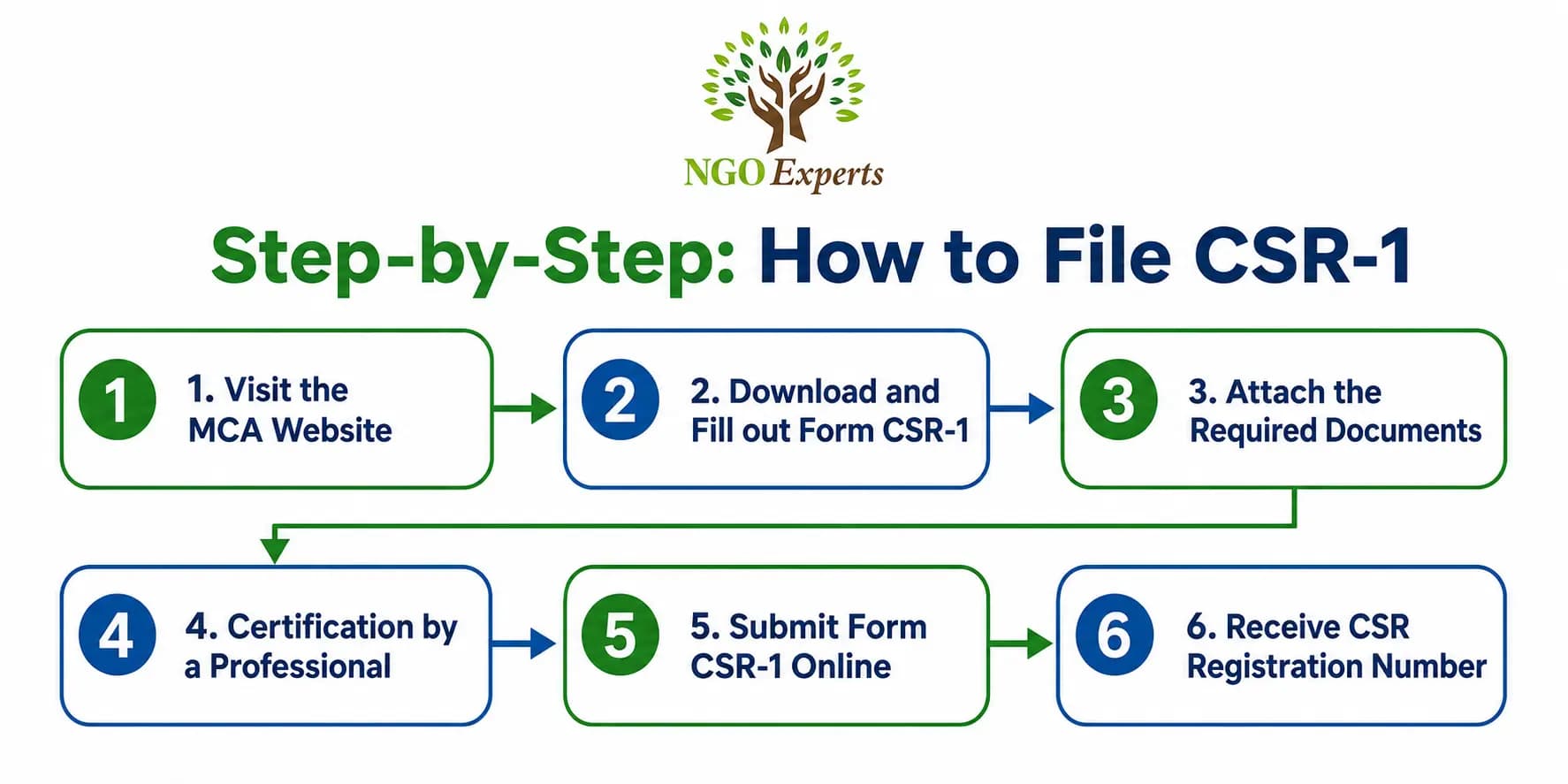
Filing Form CSR-1 is mandatory for any NGO in India that wishes to receive CSR funding. The process is conducted entirely online through the Ministry of Corp
orate Affairs (MCA) portal and ensures that only registered, compliant organizations can partner with companies for CSR activities. Below is a simple step-by-step guide:
1. Visit the MCA Website
Go to the official MCA portal at www.mca.gov.in .
2. Download and Fill out Form CSR-1
Access Form CSR-1 from the portal and fill in the required details of your NGO.
3. Attach the Required Documents
Prepare and attach the following documents for submission:
- PAN card of the NGO
- Registration Certificate (Trust Deed, Society Registration Certificate, or Certificate of Incorporation for a Section 8 Company)
- Valid 12A and 80G certificates
- PAN card of the authorized signatory
- Digital Signature Certificate (DSC) of the authorized signatory
4. Certification by a Professional
Ensure the form is digitally verified by a Chartered Accountant, Company Secretary, or Cost Accountant in practice.
5. Submit Form CSR-1 Online
Upload the completed form with documents on the MCA portal.
6. Receive CSR Registration Number
Once approved, the system will automatically generate a unique CSR Registration Number, confirming your NGO’s eligibility for CSR funding.
Note: Only NGOs with valid CSR-1 registration are listed on the National CSR Portal.
Other Registrations necessary for CSR funding
| Registration Types | Purpose | How to Apply (Short) |
| 12A Registration | Income tax exemption on NGO income | Apply via Income Tax portal → Form 10A → Upload docs |
| 80G Certificate | Allows donors to claim a tax deduction on donations | Same as above – 80G application filed along with 12A in Form 10A |
| PAN Card (NGO) | Unique ID for filings and bank accounts | Apply via NSDL or UTIITSL with the Trust/Society/Company PAN form |
| Audit Reports (3 years) | Builds credibility and is often required by CSR donors | Get audited by a CA; upload balance sheets and IT returns annually |
| FCRA (if foreign funds) | Required to accept any foreign CSR donations | Apply via fcraonline. nic. in |
Quick Tips to Approach CSR Teams of Companies
- Align with Company Priorities – Research the company’s CSR policy, focus areas, and preferred locations before presenting your project.
- Build Relationships Early – Initiate conversations through networking events, LinkedIn, webinars, or a warm introduction before making a direct funding request.
- Maintain a Professional Online Presence – Keep your website and social media updated with success stories, impact numbers, CSR-1 registration details, and 12A/80G certifications.
- Share a concise proposal – Send a concise project brief or one-slide pitch deck that highlights key achievements, beneficiaries, and organizational credentials before submitting a full proposal.
- Highlight Brand Visibility – Offer co-branding opportunities such as featuring the company in media coverage, project signage, case studies, or annual CSR impact reports.
- Show Transparency and Compliance – Emphasize your registrations, audits, and monitoring systems to reassure companies of proper fund utilization.
Conclusion
Corporate Social Responsibility (CSR) has become a crucial aspect for India’s social sector, creating opportunities for NGOs to access steady funding from companies that are legally mandated to contribute toward nation-building. With proper registration through Form CSR-1, transparent compliance under 12A and 80G, and impactful program design aligned with Schedule VII, NGOs can position themselves as trusted partners for corporates.
By building credibility, maintaining strong proposals, and aligning with the company’s CSR focus areas, NGOs can not only secure funding but also create meaningful, long-term social change. This blog is designed to help NGOs understand CSR laws, meet eligibility requirements, and confidently approach donor companies for collaboration.
Frequently Asked Questions
What is CSR funding in India?
CSR funding refers to the mandatory contribution that qualifying companies make toward social and environmental projects under Section 135 of the Companies Act, 2013. Eligible areas include education, healthcare, rural development, women's empowerment, environmental sustainability, and more.
Which NGOs are eligible for CSR funding?
Only NGOs registered as a Trust, Society, or Section 8 Company with valid CSR-1, 12A, and 80G registrations and a proven 3-year track record are eligible to receive CSR funding.
Why is CSR-1 registration important for NGOs?
Filing Form CSR-1 on the MCA portal is compulsory. Without CSR-1 approval, an NGO cannot appear on the National CSR Portal or receive funds from companies.
How much CSR spending is mandatory for companies in India?
Companies with a net worth of ₹500 crore or more, turnover of ₹1,000 crore or more, or net profit of ₹5 crore or more must spend at least 2% of their average net profits of the last three financial years on CSR activities.
Where can NGOs find CSR donor companies?
NGOs can find CSR donor companies through the National CSR Portal (MCA), company annual reports, CSR foundations, industry forums, and networking events.
What documents are required for CSR-1 registration?
PAN of the NGO and authorized signatory, NGO registration certificate (Trust, Society, or Sec-8 Company), valid 12A & 80G certificates, financial details, and Digital Signature Certificate (DSC) are essential for filing CSR-1.
Can foreign NGOs get CSR funding in India?
No, only NGOs registered in India as Trusts, Societies, or Section 8 companies with valid CSR-1, 12A, and 80G registrations can receive CSR funding from Indian companies.
How can NGOs attract more CSR funding?
By aligning proposals with company CSR themes, demonstrating measurable impact, showcasing transparency, maintaining an updated website, and offering co-branding opportunities, NGOs can strengthen their chances of securing corporate partnerships.
Author
Srijita Chatterjee
I am a Content Specialist holding a Master’s degree and with over 5 years of experience in the creative arena. I specialize in breaking down complex concepts into clear, understandable insights that help my viewers deeply engage and retain. Known for my approachable and engaging style, I am committed to providing accurate, trustworthy information that empowers individuals and organizations to make informed decisions and achieve their goals.
Written by Srijita Chatterjee. Last updated on June 5, 2026