
Ready to Register a Section 8 Company?
Planning to start a non-profit instead of a profit-making business? Our experts help you register a Section 8 Company with complete support, including name approval, SPICe+ filing, MOA & AOA drafting, and 12A & 80G registration.
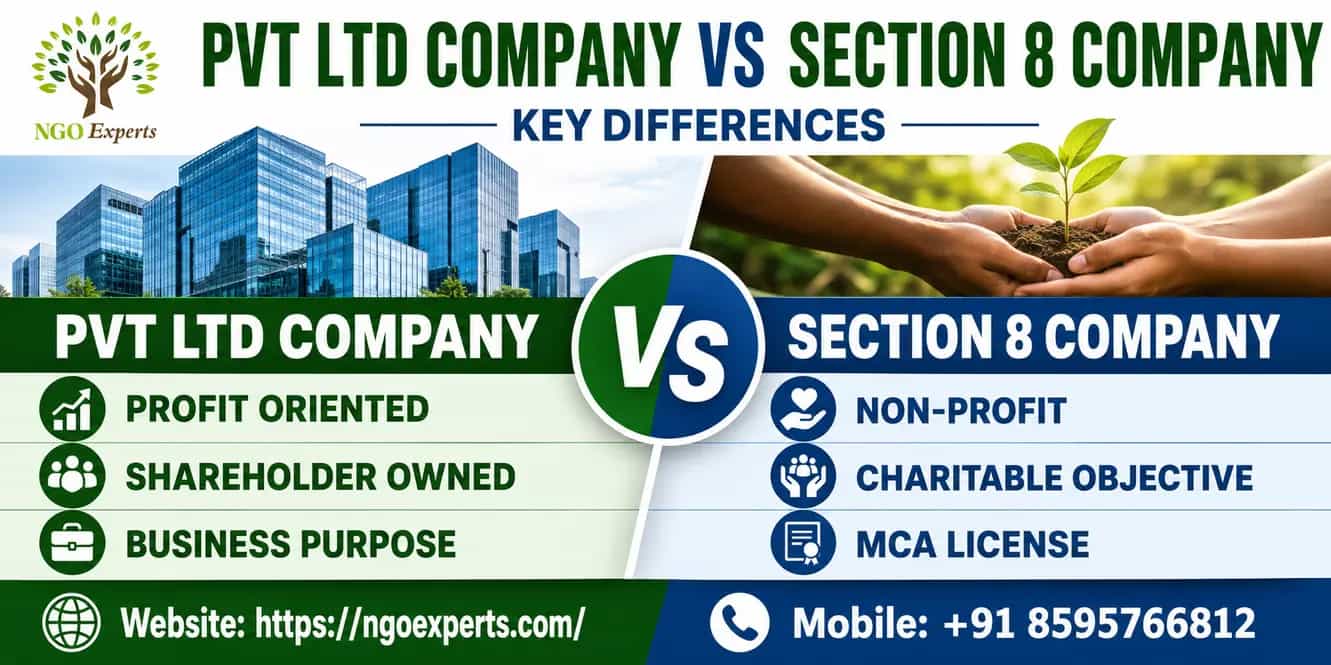
What Is a Pvt Ltd Company?
What Is a Section 8 Company?
Pvt Ltd Company vs Section 8 Company
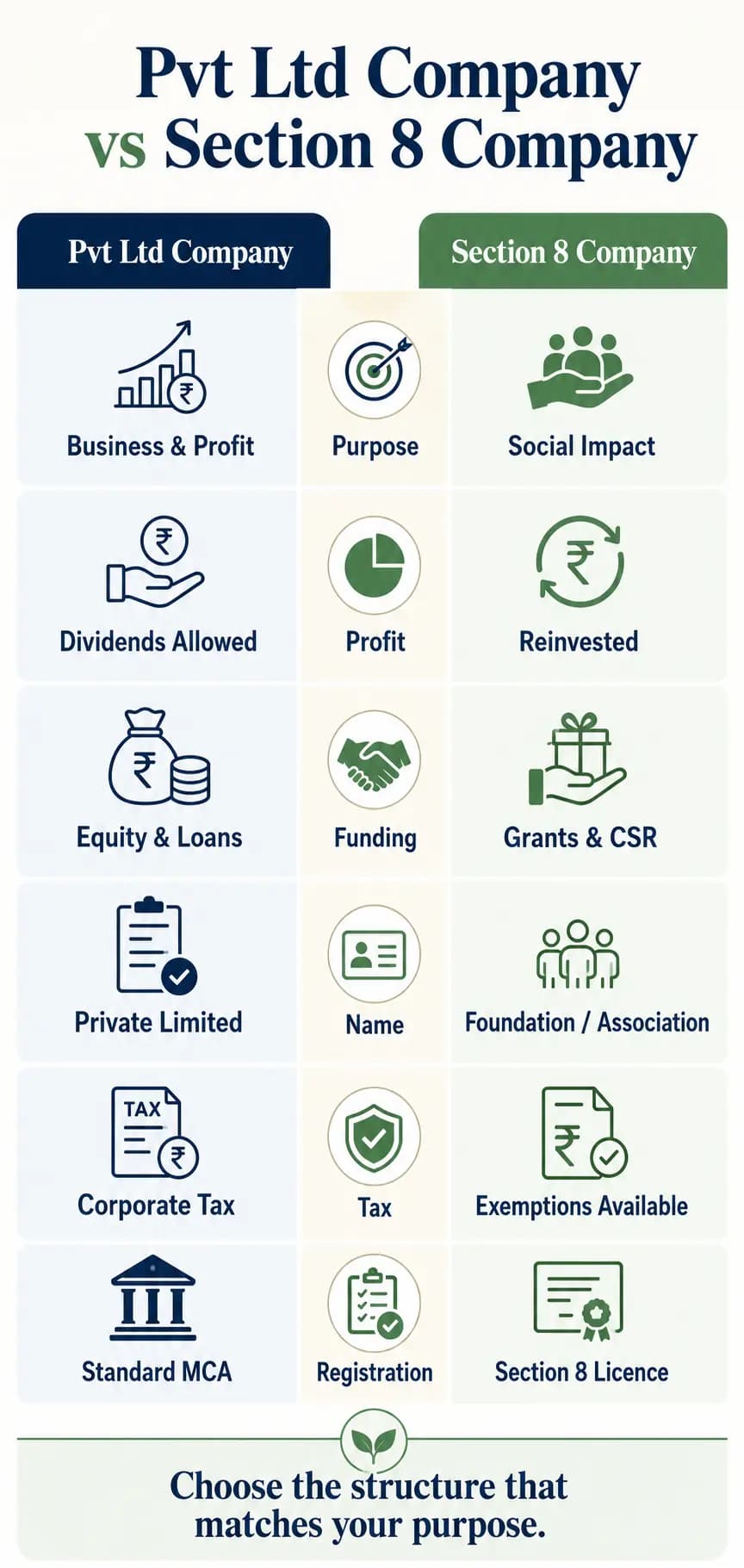
| Feature | Pvt Ltd Company | Section 8 Company |
| Main Purpose | Profit-making business | Charitable/non-profit work |
| Profit Distribution | Yes, as dividends to shareholders | No, must be reinvested in the cause |
| Minimum Members | 2 shareholders, 2 directors | 2 members, 2 directors (private) |
| Maximum Members | 200 | 200 (private); unlimited (public) |
| Name Suffix | Must end with "Private Limited" | Cannot use "Limited"; uses words like Foundation, Forum, Association |
| Stamp Duty on MOA/AOA | Applicable | Exempt |
| Government Approval | Standard MCA registration | Needs a special Section 8 license from the Central Government |
| Fundraising | Equity investment, loans, business revenue | Donations, grants, CSR funds (after CSR-1 filing) |
| Tax Benefits | Regular corporate tax rules apply | Can claim exemption under Section 12A and let donors claim deductions under 80G |
| Minimum Capital | No minimum capital requirement | No minimum capital requirement |
| Compliance Level | Standard Companies Act compliance | Standard compliance, plus 12A/80G/CSR-1 obligations |
Need Help Choosing the Right Company Structure?
Not sure whether a Private Limited Company or a Section 8 Company is right for you? Get personalised guidance from our legal experts and start your NGO with the correct legal structure from day one.
Key Differences Explained in Simple Terms
- Why they exist: A Pvt Ltd Company exists to grow a business and make its owners money. A Section 8 Company exists to do good — education, health, environment, or similar causes — and money is only a means to that end, never the goal itself.
- What happens to profit: This is the single biggest difference. A Pvt Ltd Company can pay dividends to shareholders whenever the board decides to. A Section 8 Company is legally barred from doing this; every surplus rupee must go straight back into its charitable objects.
- The name says it all: You can usually spot the difference just by reading the name. A Pvt Ltd Company's name always ends with "Private Limited." A Section 8 Company's name typically ends with words like "Foundation," "Association," "Council," or "Forum," and it's not allowed to use "Limited" at all.
- Government scrutiny: Setting up a Pvt Ltd Company follows a fairly standard MCA registration route. A Section 8 Company needs an additional license confirming its non-profit purpose, which the SPICe+ form now issues together with the Certificate of Incorporation.
- How they raise money: A Pvt Ltd Company raises funds through equity investment, business revenue, or loans. A Section 8 Company depends on donations, grants, and CSR contributions. Before applying for many government schemes and registrations, NGOs should also obtain an NGO Darpan Registration. Additionally, a Section 8 Company needs a CSR-1 filing before it can legally receive corporate CSR funds.
Which One Should You Choose between a Pvt Ltd Company and a Section 8 Company?
How to Register a Private Limited Company and Section 8 Company Through SPICe+?
- Get a Digital Signature Certificate (DSC): Every proposed director and subscriber needs a DSC to sign forms electronically. Mandatory for both structures.
- Reserve your name via SPICe+ Part A: You propose up to two names, checked against MCA's Rule 8 naming guidelines. A Pvt Ltd name must end in "Private Limited"; a Section 8 name uses words like Foundation or Association instead.
- Draft your MOA and AOA: The Memorandum of Association sets your objects, and the Articles of Association set your governance rules. A Section 8 Company's MOA must spell out its charitable objects — this section gets extra scrutiny.
- File SPICe+ Part B: This single filing covers incorporation, PAN, and TAN for both structures. For a Section 8 Company, it also bundles in the non-profit license application — no separate filing needed.
- Attach supporting forms: Both structures file INC-9 (declaration) and AGILE-PRO-S (for linked GST/EPFO/ESIC registrations, if needed).
- Receive your Certificate of Incorporation: Both get a CIN, PAN, and TAN together once the Registrar of Companies (RoC) approves the application.
How Many Private Limited and Section 8 Companies Are Registered Each Year?
| Financial Year | Total Companies Registered | Section 8 Companies |
| FY 2021–22 | 1,67,086 | 9,282 |
| FY 2022–23 | 1,59,302 | 8,271 |
| FY 2023–24 | 1,85,318 | 11,358 |
| FY 2024–25* | 1,00,320 | 6,090 |
What Does This Mean?
- Private Limited Companies and other for-profit companies make up the majority of new registrations in India.
- Section 8 Companies account for around 6% of all SPICe+ incorporations, showing they are a specialised structure for non-profit organisations.
- Section 8 registrations are increasing, rising from 8,271 in FY 2022–23 to 11,358 in FY 2023–24 — an increase of nearly 37%.
- MCA's Corporate Data Management (CDM) portal also shows that Private and Public Companies together account for nearly 90% of active companies. In contrast, Section 8 Companies, OPCs, Nidhi Companies, and Producer Companies make up the remaining share.
Common Mistakes to Avoid for a Pvt Ltd Company and a Section 8 Company?
- Choosing a Section 8 Company when a Trust or Society is more suitable for a small, local initiative.
- Registering a Private Limited Company for charitable activities, only to realise it cannot operate as a non-profit.
- Using "Private Limited" or "Limited" in the name of a Section 8 Company, which is not permitted.
- Assuming Section 8 registration alone is enough for CSR funding, without obtaining CSR-1 registration.
- Delaying 12A and 80G registration, which can postpone tax benefits and donor eligibility.
Frequently Asked Questions
Can a Section 8 Company make a profit?
Can a Pvt Ltd Company be converted into a Section 8 Company?
Which one is cheaper to register?
Which one is cheaper to register?
Does a Section 8 Company have shareholders?
Is a Section 8 Company more credible than a Trust or Society?
Author
A Content Strategist at NGOExperts, who focuses on NGO registration, 12A and 80G registration, FCRA compliance, income tax filing for non-profits, and CSR funding guidelines in India. I research and write our compliance guides in collaboration with our in-house Chartered Accountants and Company Secretaries, so every article reflects current tax and regulatory requirements for the NGO and non-profit sector.
Written by Aabha Garg. Last updated on August 5, 2026