
NGO Experts Logo
NGO

Can I Earn Money Through an NGO in India

May 26, 20266 min read610 views
Can I Earn Money Through an NGO in India
Start Your NGO With Free Consultation
4.8/5
130+ Reviews on

Quick Summary

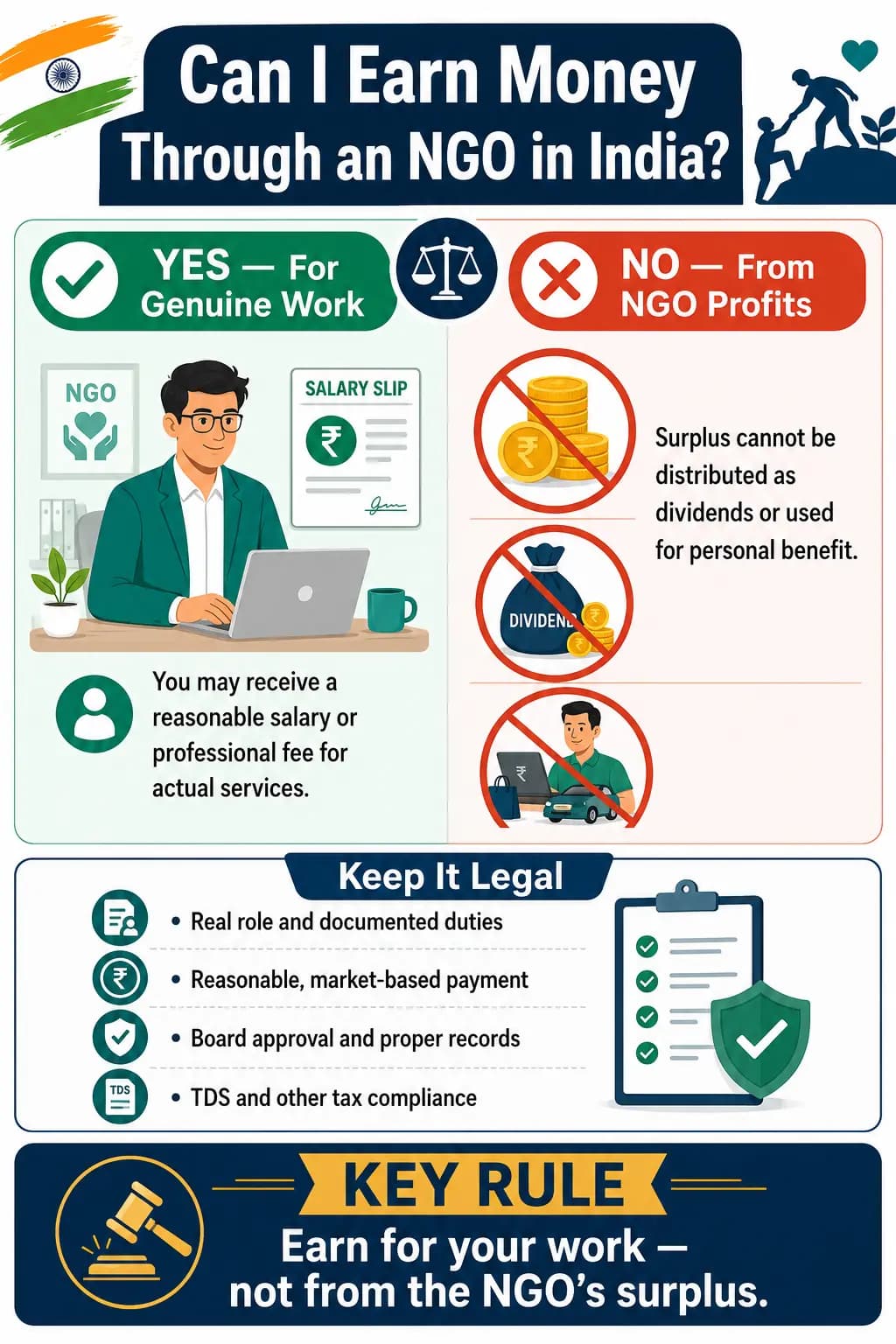
In India, while an NGO is a not-for-profit entity, it is perfectly legal for founders, directors, and employees to earn professional salaries. So, you can absolutely legally earn money through an NGO in India. NGO professionals and founders can receive salaries, consultancy fees, training income, and project-based payments while working for social causes. The key lies in reasonable compensation and ensuring that no dividends or profits are distributed to members. By establishing a strong legal structure, such as a Section 8 Company or a Trust, and maintaining strict compliance with 12A and 80G, you can build a fulfilling career while driving social impact.

Introduction

Many people believe working in an NGO means zero income or volunteer-only positions. This is a common misconception that stops talented professionals from joining the nonprofit sector. The truth is simple: NGOs in India generate substantial revenue, pay competitive salaries, and offer legitimate income opportunities to employees, consultants, trainers, and founders.
According to recent data, the nonprofit sector in India employs over 3.7 million people with annual salaries ranging from ₹15 lakhs to ₹50 lakhs depending on roles and experience. Entry-level NGO positions offer monthly salaries of ₹10,000 to ₹25,000; mid-career roles, ₹40,000 to ₹1,00,000; and senior leadership positions, ₹1,00,000 to ₹5,00,000.
The nonprofit sector is not just about charity; it's a growing economy with real jobs and real income opportunities for those willing to commit to social impact.

How Can You Earn Money Through an NGO?

Employment-Based Income: Salaries & Wages

The most straightforward way to earn through an NGO is through full-time or part-time employment. NGOs hire program managers, field coordinators, trainers, fundraisers, accountants, content creators, and administrative staff. These positions offer structured salaries tied to roles and responsibilities, making them a reliable source of income.
A program coordinator at a community development NGO might earn between ₹20,000 and ₹35,000 per month. A fundraising manager in a larger organisation could earn between ₹60,000 and ₹1,50,000 per month. The salary structure depends on the NGO's budget, donor funding, and organisational hierarchy. Importantly, these salaries are legal and fully tax-compliant when properly documented.

Project-Based Consultancy Fees

NGOs often hire external consultants for specific projects, evaluation, training design, research, impact assessment, or strategic planning. These consultancy arrangements allow professionals to earn substantial fees without becoming permanent employees. A consultant might charge between ₹10,000 and ₹50,000+ per project, depending on the scope and expertise.

Training & Workshop Revenue

Many NGOs run paid training programs, skill development workshops, and certification courses for the public. These generate direct revenue while building the NGO's expertise. 

CSR Funding & Grant-Based Income

Corporate Social Responsibility (CSR) funds from companies represent a significant source of income for NGOs. India's top companies allocate over ₹20,000 crores annually for CSR activities. NGOs that secure CSR contracts can pay staff salaries from project budgets. This creates legitimate, project-specific employment for dozens of professionals.

Founder's Salary & Administrative Percentage

NGO founders and executive directors can legally draw reasonable salaries for managing the organisation. This is not profit distribution, it's compensation for genuine work. Most donors and regulatory bodies accept an administrative cost of 15-25% of project budgets for staff salaries and operational expenses.

Have Questions? Talk to Our NGO Experts

Tax Registration & Compliance

For an NGO to legally earn money, it must be properly registered. The most common structures in India are:
  • Section 12A Registration: Provides an income tax exemption for the NGO itself
  • Section 80G Registration: Allows donors to claim tax deductions on contributions
  • FCRA Registration: Required if the NGO receives foreign donations
Under Section 12A of the Income Tax Act, registered NGOs can receive donations and grants without paying income tax on that money. However, unregistered NGOs cannot claim this benefit and are subject to full tax liability.

Salary Rules & Documentation

Salaries paid by NGOs must follow these legal rules:
  • Salaries should be reasonable and justified by the role
  • All salary payments must be documented in payroll records
  • Employees must be on the organisation's statutory payroll
  • PF, ESI, and other statutory deductions must be followed
  • TDS (Tax Deducted at Source) must be calculated and deposited correctly
Failure to follow these rules can result in income tax penalties and organisational deregistration.

Audit & Financial Transparency

NGOs receiving income beyond ₹1 crore annually must undergo audits by certified auditors. All income and expenses must be transparently documented. This is not a burden; it protects the NGO's credibility and ensures donor confidence.

Prohibited Income Sources

Not all income is legal for NGOs. Activities strictly prohibited include:
  • Personal profit distribution to founders or trustees
  • Political campaign funding
  • Unethical business ventures unrelated to the mission
  • Money laundering or shell company activities
  • Evading taxes through hidden accounts

Step-by-Step Roadmap for NGO Income Beginners

Step 1: Understand Your Interests & Skills

Identify whether you want full-time employment, freelance consulting, or starting your own NGO. Each path has different income potential and flexibility.

Step 2: Research NGO Sectors

Explore NGO work in education, health, environment, women's empowerment, or community development. High-demand sectors pay better.

Step 3: Build Your Foundation

If starting as an employee, apply to established NGOs with transparent financials and a good reputation. Check their 12A and 80G registration status; this indicates legal compliance and stability.

Step 4: Learn Fundraising & Compliance

Understanding how NGOs get funded (CSR, grants, donations) helps you position yourself as valuable. Even non-finance roles benefit from this knowledge.

Step 5: Start Documenting Everything

Maintain clear records of your salary, consultancy work, project involvement, and impact metrics. This creates a strong portfolio for career growth and consultancy opportunities.

Step 6: Diversify Your Income

Combine a full-time NGO salary with part-time consultancy, freelance training, or project-based work. Many NGO professionals earn ₹5,00,000-15,00,000+ annually through income diversification.

Red Flags: What NOT to Do?

Cash-Only Payments: Never work with an NGO that pays entirely in cash without official documentation. This is a sign of unregistered status and tax evasion. Your income won't be recognised legally, and you have no employment protections.
Unrealistic Promises: Be alert to NGOs promising monthly salaries of ₹ 1,00,000+ for entry-level roles or claiming "no compliance needed." Legitimate organisations follow strict compliance rules.
No Written Agreement: Always insist on written employment contracts, consultancy agreements, or work orders. Verbal agreements leave you unprotected and create disputes during tax filing.
Founder-Only Benefits If only the founder takes a high salary while staff earn minimal wages, it raises questions about the organisation's ethics and stability. Reputable NGOs maintain reasonable salary scales.

Unregistered Status

Verify the NGO's registration through:
  • Income Tax Department (12A status)
  • State charity registrar
  • NGO Darpan database
  • FCRA portal (if receiving foreign funds)
An unregistered NGO cannot legally pay salaries with tax benefits, and this poses a financial risk to employees.

Conclusion

Earning money through an NGO in India is not only possible, but it's also increasingly common and professionally rewarding. The nonprofit sector offers genuine career growth, competitive salaries, and the satisfaction of contributing to social change simultaneously.

Frequently Asked Questions

Yes, absolutely. NGO founders can legally draw a salary for the genuine work they perform as executive directors or project leads. The salary should be reasonable, documented, and approved by the board. Most donors accept administrative costs of 15-25% of project budgets, which covers founder salaries.
This depends on the NGO's registration status. The income of a registered 12A NGO is tax-exempt. However, employees receiving salaries from NGOs must pay personal income tax on those salaries (just as in any organisation). The NGO doesn't pay income tax; employees pay tax on their personal earnings.
No. First, you must register the NGO (Section 12A for income tax exemption). Then, you need initial funding through donations or grants. Only after receiving funds can you legally draw a salary.
Generally, yes, NGOs can earn surplus income from donations, CSR funds, training programs, and other sources. However, this surplus must be reinvested into the mission; it cannot be distributed as personal profit to trustees or founders.
Donors and regulatory bodies typically accept 15-25% of project budgets for administrative and operational costs. This includes staff salaries, office rent, utilities, and compliance expenses.

Recent Blogs

Stay informed with in-depth articles, guides, and updates on NGO registration, compliance, and key legal aspects for NGO.

📢Subscribe For Updates

Get the latest news delivered to your inbox

Live Update