
Choose the Right NGO Structure
Still comparing a Trust, Society, and Section 8 Company? If your goal is to build a professional NGO with better donor confidence and funding opportunities, Section 8 Company Registration is the ideal choice.
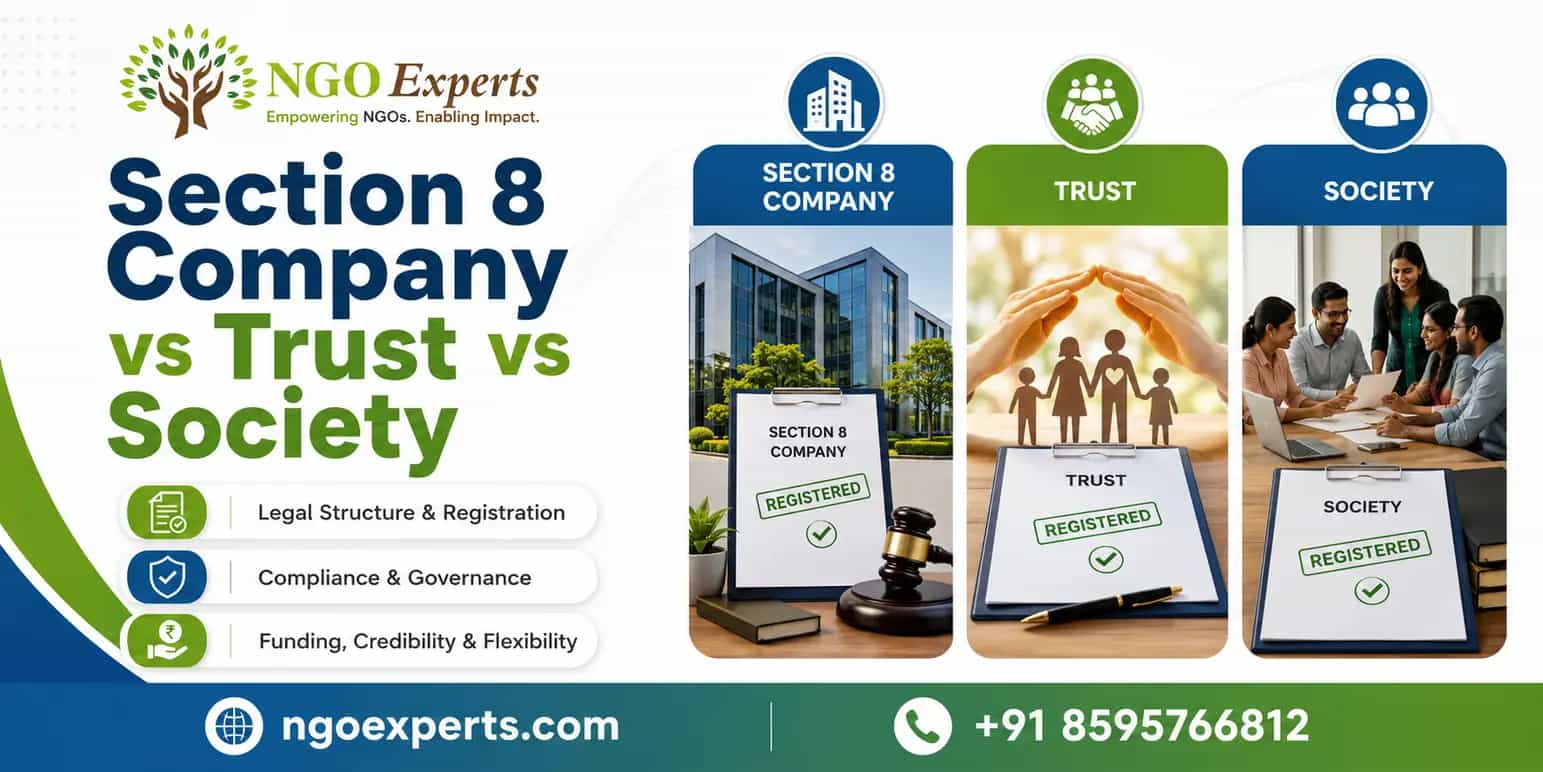
What Is a Trust, a Society, and a Section 8 Company?
- Trust: Formed via a Trust Deed under the Indian Trusts Act, 1882, or a state Public Trust Act; run by a Board of Trustees. Best for founder-driven or religious causes.
- Society: Formed via a Memorandum of Association under the Societies Registration Act, 1860; run by an elected managing committee with at least 7 members. Best for membership-driven groups — clubs, professional bodies, alumni associations.
- Section 8 Company: Formed under Section 8 of the Companies Act, 2013, licensed by the MCA; run by a Board of Directors with full corporate compliance. Best for scaling nationally and attracting CSR/institutional funding.
What Are the Key Differences Between a Trust, Society, and Section 8 Company?
| Parameter | Trust | Society | Section 8 Company |
| Governing Law | Indian Trusts Act, 1882 | Societies Registration Act, 1860 | Companies Act, 2013 |
| Registering Authority | Sub-Registrar / Charity Commissioner | Registrar of Societies | MCA, via SPICe+ |
| Governing Body | Board of Trustees | Elected Managing Committee | Board of Directors |
| Minimum Members | 2 trustees (typical) | 7 members (10 in UP, MP, Rajasthan) | 2 directors + 2 shareholders (private); 3 directors + 7 shareholders (public) |
| Annual Compliance | Lighter, state-dependent | Annual list of managing body filed | Mandatory audit, ROC filings |
| Public Transparency | Limited disclosure | Moderate, state-dependent | High — public MCA filings |
| Approx. Registration Cost | ₹5,000–₹10,000 | ₹500–₹5,000 (govt. fee) + professional fees | ₹8,000–₹15,000 |
| Typical Registration Time | Days to 2 weeks | 15–30 working days | 15–25 working days |
| Donor/CSR Perception | Considered less transparent | Moderate, membership-dependent | Generally preferred |
Register a Section 8 Company – The Preferred NGO Structure
Planning to start an NGO? Section 8 Company Registration is the preferred choice for organizations seeking higher credibility, CSR funding, government recognition, and long-term growth. Our experts manage the entire registration process online.
What's Changed in 2025–2026 for Trusts, Societies, and Section 8 Companies?
- 12AB validity extended: Under the Finance Act, 2025, all three structures with income under ₹5 crore now get 10-year 12AB registration, up from 5 years. 80G still renews every 5 years.
- New tax registration forms: From April 1, 2026, the Income-tax Act, 2025 replaced Form 10A/10AB with Form 104 (activities not commenced) and Form 105 (activities commenced) for all three structures.
- FCRA Amendment Rules, 2026: Foreign nationals (except Persons of Indian Origin (PIOs) and Overseas Citizens of India (OCIs), where permitted under the applicable FCRA rules) are generally not allowed to serve as key functionaries in FCRA-registered Trusts, Societies, or Section 8 Companies.
- Digitization for Societies: States like Maharashtra and Delhi now allow full online Society registration, while states like Uttar Pradesh have moved documentation and renewal processes to online portals.
- Section 8 licensing simplified: Since the 2019 amendment, new Section 8 incorporations get their license with the Certificate of Incorporation via SPICe+, with no separate Form INC-12 filing (that's now only needed for conversions).
Which NGO Structure Offers the Best Balance of Cost, Compliance, and Credibility?
- Cheapest and fastest: A Society usually has the lowest government fee (₹500–₹5,000), though a Trust is often quicker in practice since it skips the managing-committee election step.
- Lightest ongoing compliance: A Trust, generally; Societies must file an annual list of managing body members, and Section 8 Companies face full statutory audits.
- Most donor/CSR credibility: A Section 8 Company, due to stricter MCA oversight and public filings.
- Best for membership-driven causes: A Society, since its structure is built around elected governance and general body meetings — ideal for clubs, alumni groups, or professional associations.
- Tax exemption is identical across all three: 12AB and 80G eligibility depends on registration status, not legal form.
Real Organizations Examples
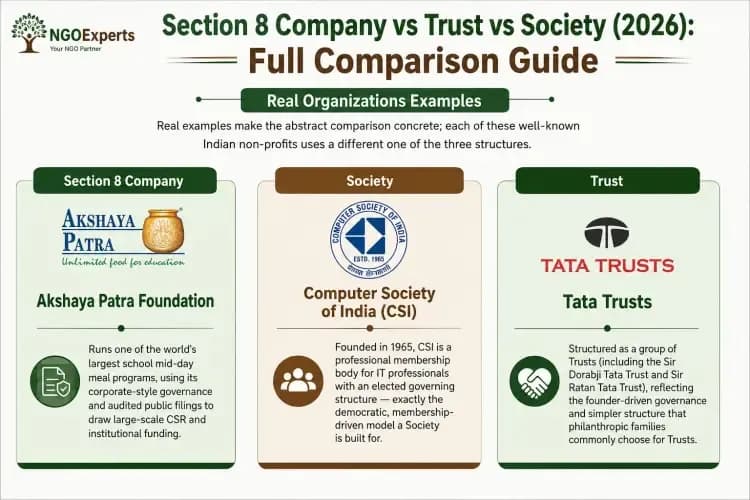
- Section 8 Company — Akshaya Patra Foundation: Runs one of the world's largest school mid-day meal programs, using its corporate-style governance and audited public filings to draw large-scale CSR and institutional funding.
- Society — Computer Society of India (CSI): Founded in 1965, CSI is a professional membership body for IT professionals with an elected governing structure — exactly the democratic, membership-driven model a Society is built for.
- Trust — Tata Trusts: Structured as a group of Trusts (including the Sir Dorabji Tata Trust and Sir Ratan Tata Trust), reflecting the founder-driven governance and simpler structure that philanthropic families commonly choose for Trusts.
Which One Should You Choose?
- Choose a Trust if: you're running a small, founder-led, or religious initiative and want the simplest, lowest-compliance route.
- Choose a Society if: your cause is inherently membership-driven — a club, professional body, or alumni association — and you want democratic governance.
- Choose a Section 8 Company if: you're targeting CSR funds, foreign grants, or planning to scale into a nationally recognized organization.
Build a Strong Foundation with Section 8 Company Registration
A Section 8 Company offers better governance, nationwide recognition, and greater opportunities for grants and CSR funding than most other NGO structures. Get expert assistance with complete online registration and post-registration compliances.
Frequently Asked Questions
Which is better, a trust or a Section 8 company for NGO registration in India?
What is the difference between trust, society, and a Section 8 company?
What are the advantages of a Section 8 company over a trust?
Who can form a trust or a society for an NGO?
How long does NGO registration take for a trust, society, and a Section 8 company?
Author
A Content Strategist at NGOExperts, who focuses on NGO registration, 12A and 80G registration, FCRA compliance, income tax filing for non-profits, and CSR funding guidelines in India. I research and write our compliance guides in collaboration with our in-house Chartered Accountants and Company Secretaries, so every article reflects current tax and regulatory requirements for the NGO and non-profit sector.
Written by Aabha Garg. Last updated on September 18, 2026