

Quick Answer
The Social Stock Exchange is a platform within a recognised stock exchange that helps eligible social enterprises raise funds for social goals under SEBI rules. Eligible nonprofits may be able to raise funds through permitted instruments after meeting registration and disclosure requirements. Eligibility, costs, and timelines depend on the organisation type, fundraising method, and applicable regulatory process.
Quick Summary
Starting an educational NGO in India involves choosing the right legal structure (Trust, Society, or Section 8 Company), registering the organization, applying for 12A and 80G tax exemptions, developing educational programs, and securing funding through CSR grants, donations, and government schemes. This is a Complete guide covering Trust, Society, Section 8 Company registration, funding sources, CSR grants, FCRA, 12A, 80G, compliance, and legal requirements in 2026.
What Is an Educational NGO?
An educational NGO in India is a non-profit organization dedicated to promoting learning, literacy, and educational development across diverse communities. These organizations work toward objectives such as providing education to underprivileged children, running adult literacy programs, offering vocational training, and improving educational infrastructure in rural areas.
How do Educational NGOs Work in India?
Educational NGOs operate through the following structures:
- Direct implementation: Running schools, tuition centers, or learning programs
- Partnerships: Collaborating with government schools under schemes like Samagra Shiksha
- Advocacy: Campaigning for policy changes and education rights
- Resource provision: Supplying books, technology, and teacher training
Role of Educational NGOs in Rural India
Educational NGOs play a critical role in bridging India's education gap. According to the India Philanthropy Report 2025, India's social sector funding has grown at ~13% annually over the past five years, reaching approximately ₹25 lakh crore in FY 2024, with education being a primary focus area. Organisations like Educate Girls operate in over 30,000 villages with more than 55,000 community volunteers, bringing back to school over 2 million girls.
Benefits of Starting an Educational NGO in India
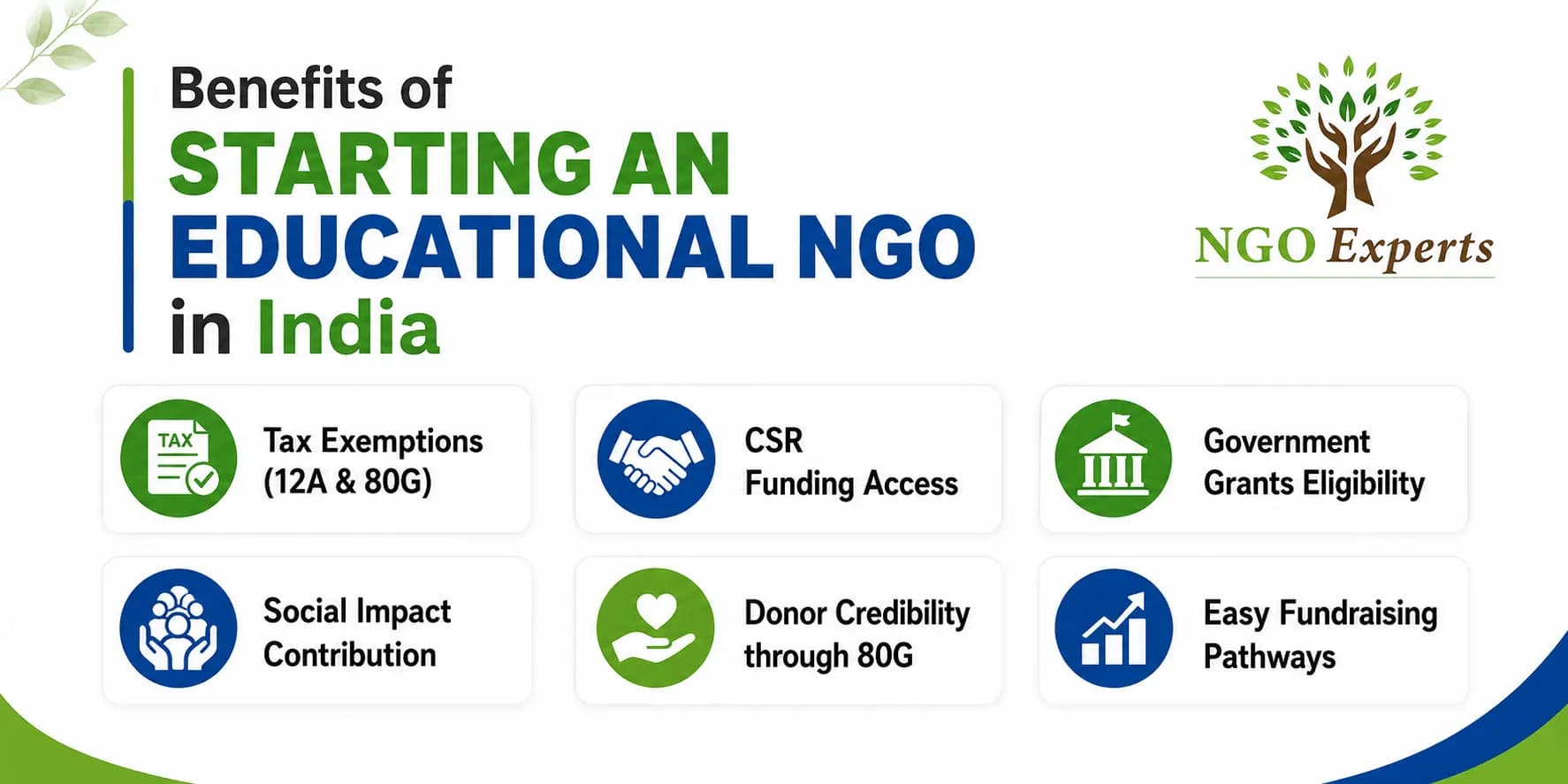
Educational NGOs in India enjoy significant advantages, as outlined below.
- Tax exemptions (12A & 80G): NGOs receive a lifetime income tax exemption on surplus income from educational activities, and donors can claim 50% tax deduction on contributions.
- CSR funding access: Education receives 35% of total CSR spending (₹6,482.7 crore in FY22), making it the top-funded social sector for corporate social responsibility.
- Government grants eligibility: Registered NGOs can access Ministry of Education schemes, Samagra Shiksha Abhiyan, PM CARES Fund, and state-level educational welfare programs.
- Social impact contribution: Directly advance SDG 4 (Quality Education) by bringing millions of out-of-school children, especially girls in rural areas, back to learning.
- Donor credibility through 80G: 80G certification increases donor trust and fundraising potential by providing tax benefits to individual and corporate contributors.
- Easy fundraising pathways: Registered NGOs in Education with 12A/80G can access funding from various sources.
Why Start an NGO for Education in India?
India faces significant educational challenges despite progress:
- Over 2 million girls are still out of school in rural areas
- Trained teachers: Rural areas lack quality educational infrastructure and trained teachers.
- Dropout rates: Especially among girls after primary school
- Quality gaps: Government schools often lack resources and trained teachers
- Digital divide: Limited access to technology and online learning
Educational NGOs work on the above issues and are widely spread in India.
Impact of NGOs on the Education Sector in India
Educational NGOs have demonstrated measurable impact:
- Smile Foundation's CSR-supported digital classroom initiative achieved 95% attendance in 2025
- Programs in rural Maharashtra increased school attendance from 65% to 90% and test scores by 20%
- Telecom partnerships distributed tablets to 50 village schools, rising classroom participation by 40%
Comparison among Trust, Society & Section 8 Company
| Aspect | Trust | Society | Section 8 Company |
| Governing Law | Indian Trusts Act, 1882 | Societies Registration Act, 1860 | Companies Act, 2013 |
| Minimum Members | 2 trustees | 7 members | 2 directors |
| Registration Cost | ₹5,000–₹15,000 | ₹8,000–₹20,000 | ₹15,000–₹40,000 |
| Total Initial Cost | ₹10,000–₹30,000 | ₹15,000–₹40,000 | ₹20,000–₹50,000 |
| Processing Time | 10–15 days | 30–45 days | 45–60 days |
| Best For | Small, family-led initiatives | Community-based organizations | Scaling, CSR funding, credibility |
| Governing Document | Trust Deed | MoA + Rules | MoA + AoA |
| DSC/DIN Required | No | No | Yes (for directors) |
| Stamp Duty | ₹1,000–₹5,000 | ₹1,000–₹5,000 | Often exempt (Delhi: ₹0) |
| Annual Compliance Cost | ₹2,000/year | ₹5,000–₹20,000/year | ₹5,000–₹20,000/year |
| CSR Credibility | Moderate | Good | Highest (preferred by donors) |
| Documents Required | Trust Deed, ID/address proofs, office proof | MoA, Rules, ID/address proofs, office proof | MoA, AoA, DSC, DIN, ID/address proofs, office proof |
| 12A Registration | Required for tax exemption | Required for tax exemption | Required for tax exemption |
| 80G Registration | Required for donor tax deduction | Required for donor tax deduction | Required for donor tax deduction |
Documents Required for Educational NGO Registration
To register any educational NGO structure, you need:
- Governing document (Trust Deed/MoA/AoA)
- ID proofs (Aadhaar, PAN) of all trustees/members/directors
- Address proofs of all trustees/members/directors
- Registered office address proof (electricity bill, rent agreement, NOC from owner)
- Passport-sized photographs
- Stamp duty payment receipt
Top Corporate Donors for Education in India (2025-26)
India's leading corporations allocated over ₹7,000 crore to education-focused CSR initiatives in FY25, with Reliance Industries, TCS, and HDFC Bank leading the sector.
- Reliance Industries (₹2,156 Cr, FY25): Largest CSR spender focusing on rural transformation and education through infrastructure development and community learning centers.
- TCS (₹960 Cr, FY25): Prioritizes digital education and skilling programs, distributing tablets to 50+ village schools and achieving 95% attendance in digital classrooms.
- HDFC Bank (₹945 Cr, FY24): Invests heavily in education and rural development, supporting school infrastructure, teacher training, and girl child education initiatives.
- ONGC (₹614 Cr, FY24): Focuses on healthcare and education in oil-rich regions, funding school buildings, mid-day meals, and scholarship programs for underprivileged children.
- NTPC (₹512 Cr, FY24): Supports environment and community education projects, including vocational training centers and digital literacy programs in Tamil Nadu and Odisha.
- Indian Oil (₹490 Cr, FY24): Funds healthcare and education initiatives across India, particularly in rural areas, with emphasis on school infrastructure and teacher development.
- ICICI Bank (₹430 Cr, FY24): Prioritizes skill development and education through vocational training centers, computer literacy programs, and scholarship schemes for girl students.
- Infosys (₹360 Cr, FY24): Invests in education and healthcare through STEM education programs, digital classrooms, and teacher training in Karnataka and rural India.
- ITC (₹325 Cr, FY24): Focuses on agriculture and education, supporting rural school development, digital literacy, and agricultural education for farmers' children.
- Tata Motors (₹300 Cr, FY24): Supports road safety and education through school safety programs, vehicle donation for school transport, and infrastructure upgrades in Maharashtra.
Eligibility Criteria for CSR Funding
To receive CSR funds, educational NGOs must have:
- Legal registration (Trust, Society, or Section 8 Company)
- 12A registration (tax exemption certificate)
- 80G certificate (donor tax benefit certification)
- CSR-1 registration on the MCA portal (mandatory, stricter in 2025)
- Minimum 3 years track record with similar activities and audited financials
- NGO Darpan registration on the NITI Aayog portal
Government Grants for Educational NGOs
- Ministry of Education: Vidyanjali CSR App for school-NGO-company partnerships
- Samagra Shiksha Abhiyan: Support for school infrastructure and teacher training
- PM CARES Fund: Emergency and educational relief grants
- State-level social welfare programs: Vary by state
- Government Support for Educational Charities: Public spending on the social sector reached ₹23 lakh crore in FY 2024 and is projected to grow to ₹43 lakh crore by FY 2029.
The following NGOs are some established names in the education sector.
- Smile Foundation: Digital classrooms in 50 village schools, 95% attendance achieved
- Educate Girls: 30,000+ villages, 2 million girls back to school, 2.4 million children in remedial learning.
- Spherule Foundation: Government school infrastructure upgrades for inclusive learning
Compliance Checklist for NGO for Education in India
Here is the Essential Compliance list for the NGO for education.
- Valid registration certificate
- PAN card
- 12A registration certificate
- 80G certificate
- NGO Darpan registration
- CSR-1 (if receiving CSR funds)
- FCRA (if receiving foreign funds)
- Current year audit report
- Filed income tax return
- Updated governing body records
- Registered office address proof
It is advisable to keep the above documents ready before you start your ngo for education.
Common Mistakes to Avoid When Starting an Educational NGO
Here are some Key reasons you should consider before you start your ngo
- Lack of sustainable funding model: Over-reliance on a single donor
- Poor impact measurement: Can't demonstrate results to donors
- Compliance failures: Registration/certificate lapses
- Weak governance: Internal conflicts, lack of transparency
- Unclear mission: Too broad or unfocused objectives
Why Choose NGOExperts?
- Expertise: Specialized in NGO registration, CSR consulting, and nonprofit compliance
- Speed: Fast processing (Trust: 10–15 days, Society: 30–45 days, Section 8: 45–60 days)
- Transparency: Clear pricing, no hidden fees
- End-to-end support: From registration to compliance to fundraising strategy
We are serving NGOs across India with registration and compliance services.
Frequently Asked Questions
Can one person start an educational NGO in India?
Yes, but with limitations. A single person can start a Trust (a minimum of 2 trustees is required, so you need at least one more person). For Society, a minimum of 7 members is required. For Section 8 Company, a minimum of 2 directors is needed.
Which is better for an educational NGO: Trust, Society, or Section 8 Company?
For educational NGOs seeking CSR funding and long-term growth, a Section 8 Company is the best choice due to its greater credibility with corporate donors and institutional funders.
How much money is required to start an educational NGO?
The total initial cost ranges from ₹10,000 to ₹50,000, depending on the structure. Many successful educational NGOs started with registration costs under ₹20,000.
Is FCRA mandatory for educational NGOs?
No, FCRA is only mandatory for educational NGOs if you want to receive foreign contributions exceeding ₹10,000. FCRA eligibility for educational NGOs requires 3+ years of registration and ₹10 lakhs+ spent on activities in the last 3 years.
How can educational NGOs raise funds online effectively?
Educational NGOs can raise funds online by creating a professional website with impact metrics and success stories, using crowdfunding platforms like Ketto/Milaap/ImpactGuru, leveraging social media, running email campaigns to existing donor base, hosting virtual events and webinars,
Author
Aabha Garg
A Content Strategist at NGOExperts, who focuses on NGO registration, 12A and 80G registration, FCRA compliance, income tax filing for non-profits, and CSR funding guidelines in India. I research and write our compliance guides in collaboration with our in-house Chartered Accountants and Company Secretaries, so every article reflects current tax and regulatory requirements for the NGO and non-profit sector.
Written by Aabha Garg. Last updated on October 13, 2026