
Quick Answer
Most NGOs in India shut down or stall, not because the founders lacked passion, but because the legal structure they chose couldn't withstand an audit, a CSR check, or a founder's departure. A Section 8 Company is the one structure built to handle all three, and it's simpler to set up than most people assume. If you're thinking about starting a non-profit in India, this guide walks you through the process for setting up a Section 8 Company.
Ready to Start Your Section 8 Company?
Launch your non-profit with expert legal assistance. We handle the complete registration process—from name approval to incorporation—so you can focus on your mission.
What Is Section 8 Company Registration?
Who Is This Guide For?
- First-time founders who are confused between Trust, Society, and Section 8 Company.
- Social workers and educators are already doing the work informally, and now want legal recognition.
- Anyone planning to apply for 12A and 80G, or CSR-1 after incorporation.
- Founders who want to work with companies, donors, or government bodies and need a structure that looks credible on paper.
- People building a long-term organization, not a one-off charity drive.
Is a Section 8 Company Better Than a Trust or Society?
What Are the Key Benefits of a Section 8 Company?
- Tax exemptions: Eligible for income tax exemption under Section 12A, and donors can claim a deduction under Section 80G.
- Zero stamp duty: No stamp duty on incorporation documents like the MOA and AOA.
- Limited liability: Directors and members aren't personally on the hook for the company's debts.
- No minimum capital: You don't need a minimum paid-up capital to incorporate.
- Credibility: MCA oversight makes it more trusted by corporates, government bodies, and foreign donors.
- Perpetual succession: The company continues to exist even if its members or directors change.
Section 8 Company vs Trust vs Society: Which Is Best for NGO Registration?
| Structure | Best Suited For | Common Requirement | Good to Know |
| Trust | Charitable, religious, or family-led social work | Usually, a minimum of 2 trustees | Simple structure, but rules vary by state |
| Society | Membership-based organizations and community groups | Usually, a minimum of 7 members | Good where a governing body and membership model matter |
| Section 8 Company | Professional NGOs, CSR-facing work, grant-focused organizations, long-term social impact | At least 2 directors and 2 members (private); at least 3 directors and 7 members (public) | Strong governance image, MCA-based compliance |
What Activities Are Allowed Under a Section 8 Company?
- Education
- Social welfare
- Charity
- Healthcare and medical relief
- Religion
- Research
- Science
- Art and culture
- Sports
- Environment protection
- Skill development
- Women empowerment
- Child welfare
- Rural development
- Any other charitable or social development object
What Are the Laws and Rules for Section 8 Company Registration?
- Companies Act, 2013 — Section 8: This is the core law. It says a company can be formed for charitable or social good, but its profits must remain within the organization, not accrue to its members.
- Companies (Incorporation) Rules, 2014 — Rules 19 & 20: These outline exactly what the Registrar of Companies (RoC) checks before issuing your Section 8 license.
- SPICe+ filing system: Registration happens online via the MCA's SPICe+ form — a single form that covers name approval, incorporation, PAN, and TAN.
- CSR-1 update (since July 2025): If you want to receive CSR funding, Form CSR-1 must now be filed only online — the older downloadable PDF version no longer works.
- 12A and 80G (Income Tax Act): Separate from your company registration. 12A provides your NGO with tax exemption; 80G allows your donors to claim a deduction. You apply for these only after incorporation.
Still Deciding if a Section 8 Company Is Right for You?
Understand the legal structure, compliance requirements, and registration process before making a decision.
Who Is Eligible to Register a Section 8 Company?
- Purpose: The company must promote charitable or social welfare activities, and any income must be reinvested into those objectives, not distributed to members.
- Number of members: At least 2 individuals for a private Section 8 Company; at least 3 for a public Section 8 Company.
- Legal status of members: Individuals or entities (including partnerships, companies, and NGOs) can become members. Directors must generally be Indian residents, though foreign nationals can be appointed with the right compliance.
- Directors: At least 2 for a private company, at least 3 for a public one. Each director needs a Director Identification Number (DIN).
- Approval from authorities: A license must be obtained from the RoC to prove the company is being formed for charitable purposes.
- No profit distribution: Income may never be paid out as dividends; it must be reinvested in the organization's work.
What Documents Are Required for Section 8 Company Registration?
Documents of directors and members
- PAN card and Aadhaar card
- Passport, voter ID, or driving license, if required
- Latest address proof and a passport-size photograph
- Mobile number and email ID
- Digital Signature Certificate (DSC) details
- Consent to act as director, plus other MCA declarations
Registered office documents
- Electricity or utility bill
- Rent agreement, if the premises are rented
- NOC from the property owner
- Property tax receipt or ownership proof, if required
Organisation details
- Proposed company name
- Main objects and planned activities
- Estimated income and expenditure, where required
- Details of promoters, directors, and members
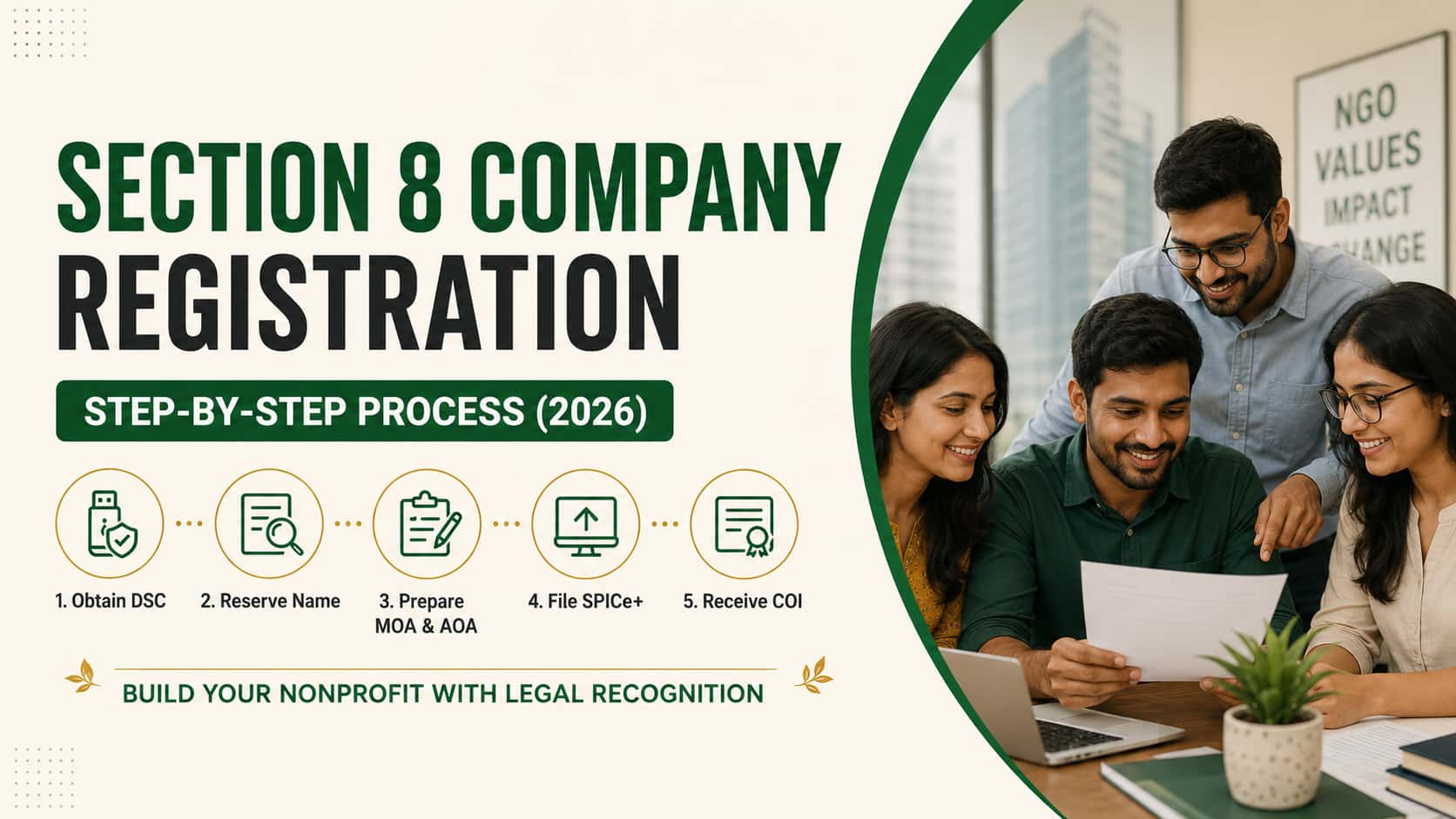
What Is the Section 8 Company Registration Process in India?
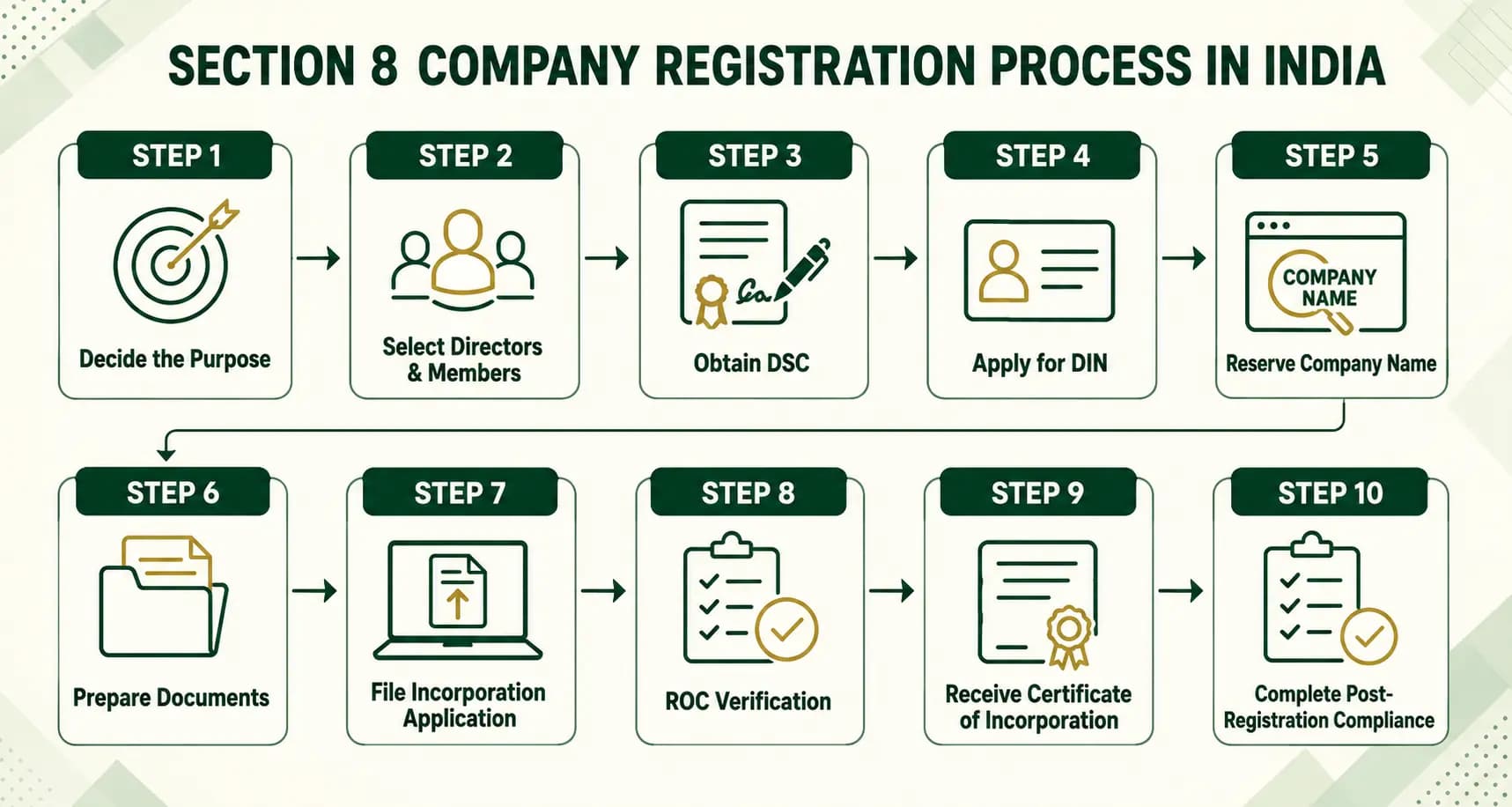
Step 1: Decide the Purpose of the Organization
Step 2: Select the Directors and Members
Step 3: Obtain Digital Signature Certificates (DSC)
Step 4: Apply for Director Identification Number (DIN)
Step 5: Reserve a Unique Company Name
Step 6: Prepare the Incorporation Documents
Step 7: File the Online Incorporation Application
Step 8: Verification by the Registrar of Companies (ROC)
Step 9: Receive the Certificate of Incorporation
Step 10: Complete Post-Registration Compliance
What Forms and Attachments Are Used in the MCA Filing?
| Form / Document | Purpose |
| SPICe+ | Main incorporation form |
| MOA | Defines the company's main objects |
| AOA | Defines internal rules and governance |
| INC-13 | MOA format specific to Section 8 companies |
| INC-14 | Professional declaration, where applicable |
| INC-15 | Declaration by subscribers, where applicable |
| INC-9 | Declaration by subscribers and directors |
| AGILE-PRO-S | Linked form for GST, EPFO, ESIC, and bank account setup |
| DIR-2 | Consent to act as director |
| INC-22 | Registered office form, where required |
What Is the Section 8 Company Registration Fee and Timeline?
| Particulars | Cost | Timeline |
| Consultation & structure planning | Included | 1 day |
| DSC for 2 directors | ₹3,000 | 1–2 working days |
| Name application & MCA name check | ₹1,000 | 1–3 working days |
| Professional fee (object, MOA, AOA drafting) | ₹2,999 | 2–4 working days |
| Government fee & stamp duty | ₹1,000–₹2,000 | As per MCA/state |
| PAN & TAN | Included | Along with incorporation |
| Certificate of Incorporation support | Included | Subject to RoC approval |
| Post-registration guidance | Included | After incorporation |
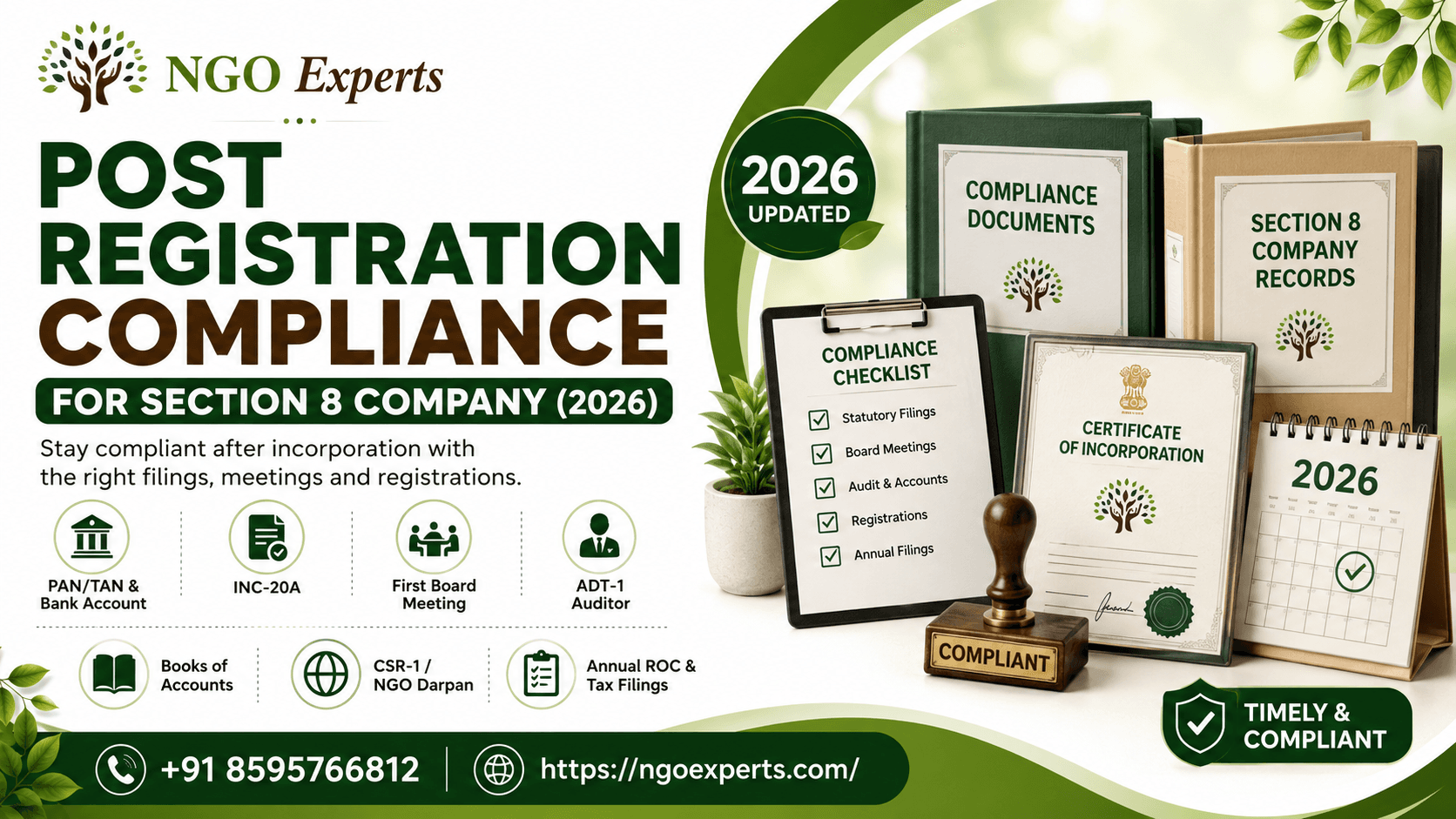
What Compliance Is Required After You Get Your Incorporation Certificate?
| Post-registration work | Why it matters |
| PAN and TAN | Needed for tax and financial compliance |
| Bank account | Needed to receive donations and grants |
| Accounting setup | Keeps records transparent from day one |
| 12A registration | Let the NGO claim income tax exemption |
| 80G registration | Let donors claim a tax deduction |
| NGO Darpan / NITI Aayog | Useful for government scheme recognition |
| CSR-1 registration | Needed to receive CSR funds |
| Annual ROC filing | Mandatory annual MCA compliance |
| Income tax return | Required under the Income Tax Act |
| Audit and financial statements | Builds transparency with donors |
What Are the Common Mistakes in Section 8 Company Registration?
- Choosing a name that doesn't match the stated objects.
- Copy-pasting generic NGO objects instead of writing your own.
- Not planning AHR 12A, 80G, and CSR-1.
- Missing the NOC from the property owner.
- Incorrect director or member details.
- Ignoring post-registration compliance.
- Assuming the registration certificate alone is enough to unlock donations or CSR funding.
Why Register Your Section 8 Company Through NGOExperts?
- Practical, honest advice on Trust vs Society vs Section 8 Company.
- Name planning and object drafting support.
- Document checks for directors, members, and the registered office.
- MCA filing assistance from start to Certificate of Incorporation.
- Guidance for 12A, 80G, NGO Darpan, and CSR-1 after registration.
- Transparent timelines, no surprise delays.
Talk to an Expert Now
Not sure whether Section 8 Company is right for your NGO? Share your objective, city, number of founding members, and future funding plan with us. Our team will guide you through the right registration process and next steps — no obligation, just clarity. Call +91 85957 66812 to start your Section 8 Company Registration.
Frequently Asked Questions
What is the first step in the Section 8 Company registration process?
Is Section 8 Company registration completely online?
Do I need a Digital Signature Certificate (DSC) to register a Section 8 Company?
Can I apply for a Director Identification Number (DIN) during registration?
How is the company name approved?
What documents are required for Section 8 Company registration?
How long does it take to register a Section 8 Company?
What happens after submitting the incorporation application?
What documents are issued after successful registration?
Can a Section 8 Company start operations immediately after incorporation?
What compliances should be completed after Section 8 Company registration?
Can I register a Section 8 Company without professional assistance?
Author
A Content Strategist at NGOExperts, who focuses on NGO registration, 12A and 80G registration, FCRA compliance, income tax filing for non-profits, and CSR funding guidelines in India. I research and write our compliance guides in collaboration with our in-house Chartered Accountants and Company Secretaries, so every article reflects current tax and regulatory requirements for the NGO and non-profit sector.
Written by Aabha Garg. Last updated on October 13, 2026